
When it comes to crypto regulation India, the set of rules and taxes imposed by the Indian government on cryptocurrency trading and ownership. Also known as Indian crypto policy, it’s not about banning crypto—it’s about controlling how you trade it, when you pay taxes, and what proof you need to show. Unlike countries that welcome crypto businesses, India treats digital assets like a high-risk commodity: taxable on every trade, with no room to offset losses.
This system hits hardest because of the no loss offset rule India, a policy that prevents traders from using losses in one crypto trade to reduce taxable gains in another. So if you lost ₹50,000 on one coin but made ₹30,000 on another, you still pay tax on the full ₹30,000. Add the 1% TDS India, a tax deducted at source on every crypto transaction, regardless of profit or loss, and you’re paying twice—once upfront, again at year-end. And there’s no carry-forward. No refunds. No deductions. Just pure tax on every single trade.
It’s not just about taxes. The lack of clear licensing for exchanges means many platforms operate in gray zones. Some users turn to VPNs, tools used to mask location and bypass geo-restrictions on crypto platforms to access global exchanges—but now, exchanges like Binance and OKX are using AI and browser fingerprinting to block them. Meanwhile, projects with no team, no utility, and zero liquidity—like xMOON, BURNS, or ETPOS—are still being traded, often by people who don’t realize they’re gambling, not investing.
What you’ll find here isn’t theory. It’s real stories from Indian traders who got hit by the tax system, deep dives into how TDS works on exchanges like Bitso, and breakdowns of the scams that thrive in this regulatory fog. You’ll see why Malta’s clear rules make it a magnet for crypto firms while India’s rules push activity underground. You’ll learn what happens when you can’t deduct losses, how a single trade can trigger multiple tax events, and why some tokens vanish overnight with no warning.
This isn’t about whether crypto is good or bad. It’s about how the rules shape what you can do—and what you can’t. If you trade in India, you’re already playing by these rules. The question is: do you understand them well enough to protect your money?
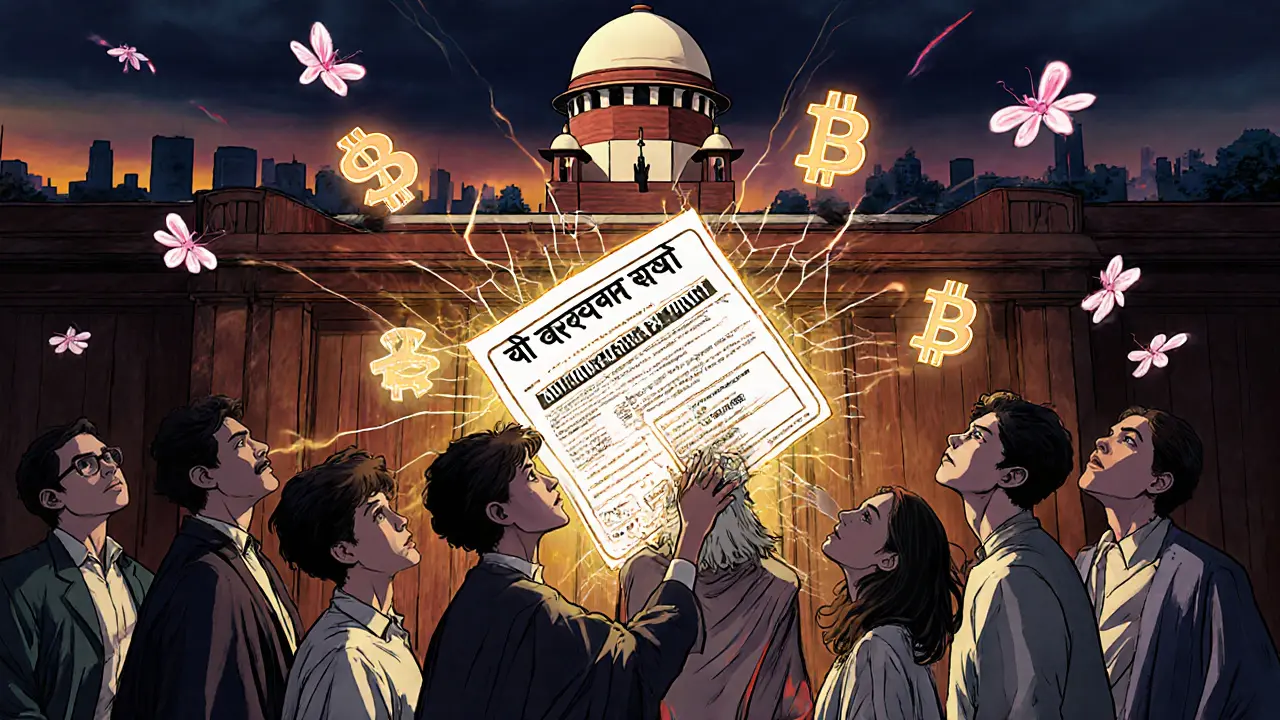
The Supreme Court of India overturned the RBI's crypto ban in 2020, making trading legal. But with a 30% tax, no clear laws, and government inaction, crypto in India remains risky and uncertain.
Learn More