
The WSPP airdrop wasn’t just another crypto giveaway. It was a promise - that blockchain could help the poorest people on Earth. Wolf Safe Poor People (WSPP) launched its token with a bold mission: to build a decentralized system where holding cryptocurrency directly supports poverty relief. The Polygon version of WSPP became the main focus after its initial release on Binance Smart Chain, aiming for lower fees and faster transactions. But what actually happened after the airdrop? And is there anything left to claim today?
How the WSPP Airdrop Actually Worked
The big WSPP airdrop didn’t happen on a decentralized platform. It happened on MEXC, a mid-tier crypto exchange. In December 2021, MEXC ran a Kickstarter-style campaign called "Vote to List." Users had to stake MX tokens - MEXC’s native token - to vote for new projects to get listed. WSPP was one of them. If the voting goal was hit, the project would be listed, and everyone who staked MX would get free WSPP tokens as a reward. The goal? 18.9 million MX tokens. That’s about $1.5 million at the time. The community hit it. On December 13, 2021, the campaign closed. Around 215 million WSPP tokens were distributed to roughly 1,200 participants. Each person got a share based on how much MX they staked. No sign-up forms. No KYC. Just staking and waiting. This wasn’t a random giveaway. It was a structured, exchange-led event with clear rules. If you didn’t stake MX during that window, you missed it. There’s no second chance. No ongoing airdrop. No claim portal. The window closed over three years ago.Why Polygon? Why Not Just Stay on BSC?
Wolf Safe Poor People started on Binance Smart Chain (BSC). That made sense - low fees, big user base. But BSC got crowded. Gas fees crept up. Transactions slowed. So the team moved part of the project to Polygon. The Polygon version of WSPP uses contract address0x46d502fac9aea7c5bc7b13c8ec9d02378c33d36f. It was audited by Solidity Finance, which gave it a clean bill of health. Polygon’s architecture allowed for cheaper transfers, better scalability, and smoother integration with wallets like MetaMask. For a project claiming to help poor people, low-cost transactions weren’t just nice - they were essential.
But here’s the catch: the Polygon version was never meant to replace the BSC version. Both still exist. The BSC version trades at $0.0000000000624. The Polygon version trades at $0.0000000194. That’s a 300x difference in price, but not in value - both are nearly worthless.
What’s the Token Worth Today?
As of January 2026, the WSPP token on Polygon has a market cap of around $54. The 24-hour trading volume? About $104. That’s less than what most people spend on coffee in a week. On CoinMarketCap, it ranks #3542. The BSC version is #2311. Neither is listed on Binance, Coinbase, or Kraken. You can only trade it on small exchanges like MEXC, Gate.io, or decentralized platforms like PancakeSwap (for BSC) or QuickSwap (for Polygon). The token’s price isn’t just low - it’s practically invisible. At $0.0000000194, you’d need over 5 billion WSPP tokens to make $1. That’s not a currency. It’s a digital collectible with no real utility.
Did WSPP Actually Help Poor People?
This is the core question. The project claims to be "the first currency that has a program to reduce world poverty." It says 1% of every transaction goes to poverty relief. It talks about NFTs on Wolfible (their platform) funding clean water projects. But where’s the proof? No public reports. No charity partnerships named. No bank statements showing transfers to NGOs. No receipts for food, medicine, or housing aid. The website still says it’s building a "decentralized marketing platform next generation cryptocurrency that automatically gives you an imbalance because it holds and helps reduce poverty in the world." That’s not a business plan. That’s poetry. The project’s Telegram group, @robowolfproject, has a few hundred members. Most posts are about token price charts or memes. No updates on poverty programs. No photos from the field. No interviews with beneficiaries. If you’re helping millions, you’d expect at least one story - one video, one testimonial. Without transparency, the mission feels like marketing. And marketing without results doesn’t build trust. It builds skepticism.Who Still Holds WSPP Tokens?
A handful of early airdrop recipients. A few speculators who bought cheap on MEXC. A few bots running automated trades. That’s about it. There are no major wallets holding large amounts. No institutional investors. No venture capital backing. The project’s roadmap mentions NFT DeFi and Wolfible expansion - but no timelines. No hires. No code commits on GitHub. The last update on their website was in 2022. If you bought WSPP after the airdrop, you’re likely holding a token with no liquidity, no use case, and no clear path forward. Selling it? You’d pay more in gas fees than you’d get back.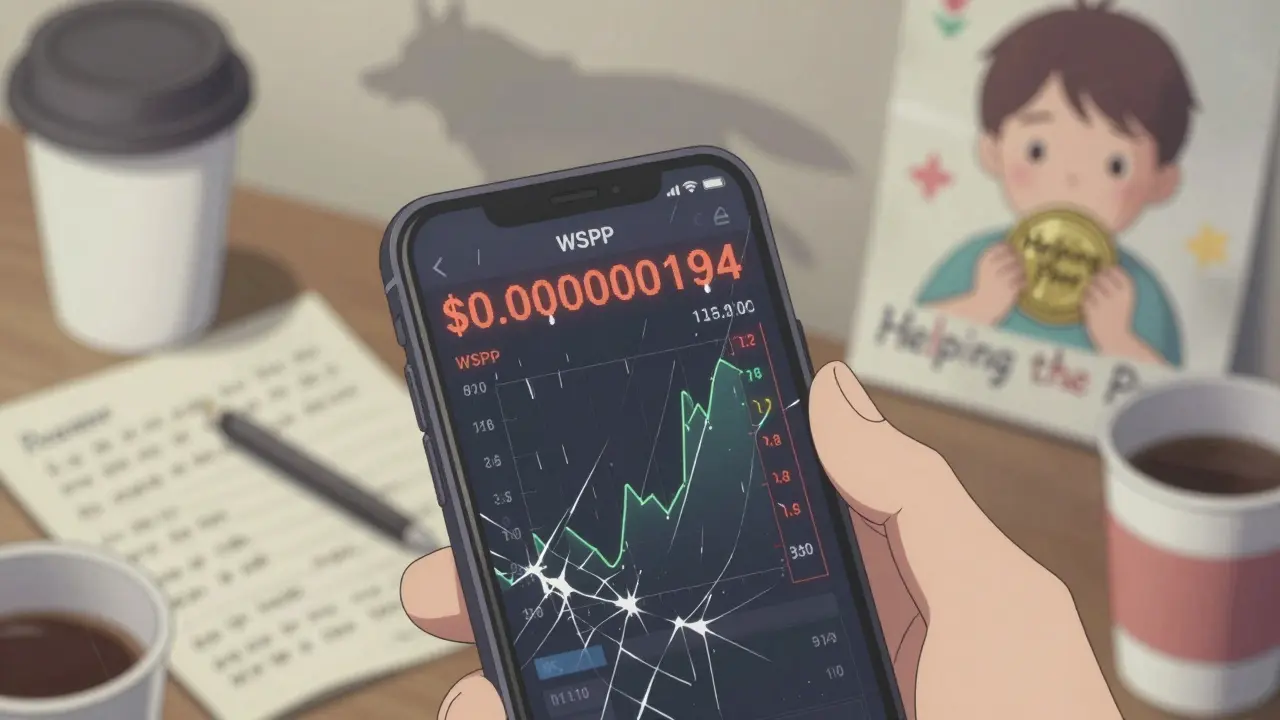
Is There Any Value Left in WSPP?
Technically, yes - the smart contract works. The audit is real. The token exists on-chain. But value isn’t just about code. It’s about adoption, utility, and trust. WSPP has none of those. It’s a ghost project. A relic of a 2021 trend where every crypto startup slapped on a "social good" label and hoped for a free ride. It didn’t fail because of bad tech. It failed because it didn’t deliver on its promise. If you still hold WSPP tokens, you’re holding digital paper. It won’t crash - it’s already crashed. It won’t rebound - there’s no demand. The only thing left is the memory of what it promised.What You Should Do Now
If you got WSPP in the 2021 airdrop:- Check your wallet. Do you still have it? If so, it’s worth less than a penny.
- Don’t add more. There’s no reason to invest now.
- If you want to sell, try MEXC or QuickSwap. But expect to lose most of what you have.
- Don’t wait for a "second airdrop." There won’t be one.
- Ask for proof. Not promises. Proof.
- Look for real partnerships with NGOs or charities.
- Check if they publish quarterly impact reports.
- See if their team has a track record in humanitarian work - not just crypto.
Was the WSPP airdrop real?
Yes, the WSPP airdrop was real. It happened on MEXC in December 2021 as part of their "Vote to List" Kickstarter campaign. Users who staked MX tokens received 215 million WSPP tokens in return after the voting goal was met. The distribution was recorded on-chain and verified by participants.
Can I still claim WSPP tokens from the airdrop?
No, you cannot claim WSPP tokens from the airdrop anymore. The MEXC Kickstarter campaign ended on December 13, 2021. There has been no official airdrop since. Any website or social media post claiming to offer a new WSPP airdrop is likely a scam.
Is WSPP listed on Binance or Coinbase?
No, WSPP is not listed on Binance, Coinbase, Kraken, or any other major exchange. It’s only available on smaller platforms like MEXC, Gate.io, and decentralized exchanges such as PancakeSwap (for BSC) and QuickSwap (for Polygon).
What happened to the poverty relief program?
There is no public evidence that WSPP ever funded or distributed aid to any poverty relief program. While the project claimed 1% of every transaction went to help the poor, no charity partnerships, financial reports, or beneficiary stories have ever been published. The project’s social mission remains unverified.
Is WSPP still being developed?
There is no evidence of active development. The project’s website hasn’t been updated since 2022. No new code commits appear on public repositories. The Telegram group is mostly inactive. The token’s trading volume is negligible. WSPP appears to be abandoned.
Should I buy WSPP tokens now?
No. WSPP has no liquidity, no utility, and no roadmap. Its price is near zero, and there’s no reason to believe it will recover. Buying it now is not an investment - it’s a donation to a project that has already failed to deliver on its promise.
19 Responses
WSPP was never about helping people. It was about getting free tokens and vanishing.
I staked MX for this and got nothing but a ghost token 😔 but hey, at least I learned not to trust crypto "social good" projects again. Live and learn!
I still have a few billion WSPP tokens in my wallet. I don’t sell them. Not because I think they’ll rise, but because I keep them as a reminder: good intentions don’t fix bad execution. This project meant well, but never showed up. And that’s worse than a scam.
Sometimes the most dangerous thing isn't a scam... it's a dream that just stopped breathing. 🌱 WSPP had a beautiful idea. But dreams need roots. Not just whitepapers. And it never grew.
If you still believe in this token, you’re not investing-you’re donating to a meme. And even memes have better ROI than this.
I was in the airdrop. Got my tokens. Checked the contract. Saw the audit. Thought, 'this could be real.' Then I waited. And waited. Nothing. No updates. No charity reports. Just silence. That’s the real failure-not the price drop.
USA built the internet. India built crypto scams. WSPP? Classic. Just another Indian dev team slapping 'help the poor' on a token and running. Sad.
i still have wspp in my meta mask... like a dusty trophy from 2021. every now and then i check the price... still 0.0000000194... i just laugh now. remember when we thought crypto could fix the world? lol.
i remember when this thing was trending on twitter. everyone was like 'oh my god this is the future!' now? crickets. and the website still says 'next generation cryptocurrency' like it's 2021 and we're all still drunk on hype.
The audit was clean. The contract works. The distribution was transparent. But transparency without accountability is just a fancy paperweight. WSPP had the mechanics right but the soul wrong.
This isn’t a project. It’s a graveyard. And you’re all just standing around it taking selfies with the tombstone. Wake up.
I respect the intent. But if you’re claiming to help the poor, you owe them more than a tweet. You owe them receipts. And you didn’t deliver.
Why do people still talk about this? It’s dead. The devs are gone. The community is asleep. The token is worth less than a coffee stirrer. Move on.
I feel bad for the people who believed this. Not because they lost money-but because they trusted something that didn’t even try. 💔
Look, I’ve been in crypto since 2017. I’ve seen ponzi schemes, rug pulls, and moon boys with zero code skills. But WSPP? It’s the saddest one. Not because it was fake-but because it *wanted* to be real. It had the heart of a hero and the spine of a jellyfish. It didn’t collapse. It just... faded. Like a candle in a hurricane. No drama. No explosion. Just silence. And that’s what makes it hurt more. We didn’t get robbed. We got ignored.
If you’re holding WSPP, don’t sell it out of hope. Sell it out of closure. And if you’re thinking of jumping into another 'help the poor' crypto project, ask for the last 3 quarterly impact reports. If they can’t show them, walk away. Real change doesn’t hide behind a tokenomics diagram.
this was a joke. and we were the punchline. i spent 3 months trying to get my friends to stake mx. now i just block anyone who mentions wspp. save your breath.
I was one of the 1200 who got tokens. I held for 2 years. Then I donated them to a local food bank in Delhi as a symbolic gesture. They didn’t know what it was. But they smiled. And I felt better than if I’d sold it for pennies. Sometimes the value isn’t in the price-it’s in what you choose to do with the mess.
I can't believe people still defend this. The project didn't fail because of market conditions-it failed because its founders were more interested in writing poetry than writing checks. '1% of every transaction' is the most hollow phrase in crypto history. You don't help the poor by writing a line in a whitepaper. You help them by sending money. And you didn't. So stop pretending you did.