
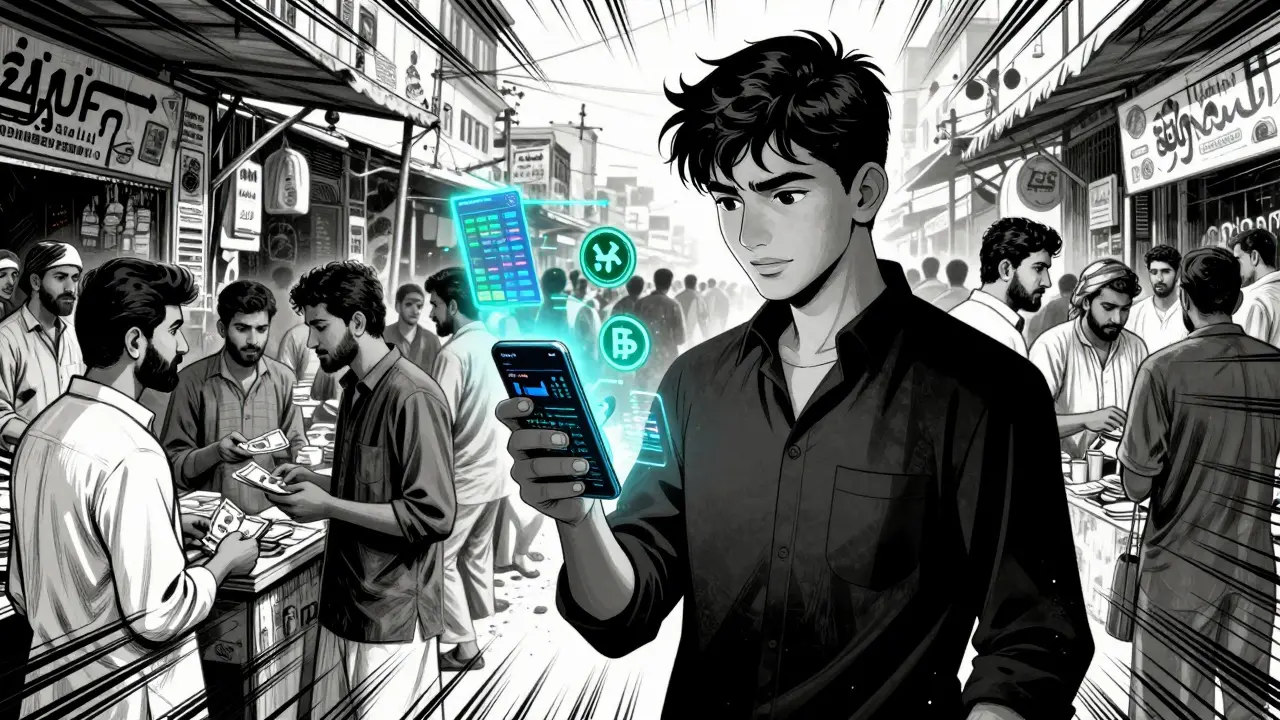
It sounds like a contradiction. How can a country that officially bans cryptocurrency transactions for years suddenly jump to the third spot in global adoption rankings? Yet, this is exactly what happened in Pakistan. In October 2025, Chainalysispublished its Global Crypto Adoption Index, placing Pakistan at number three globally, behind only India and the United States. This wasn't a slow climb; it was a six-position leap from the previous year. You might wonder if the data is wrong or if people are just ignoring the law. The truth is more complex: while the government tightened restrictions, the economic reality on the ground pushed millions toward digital assets for survival and stability.
The Numbers Behind the Ranking
To understand why Pakistan ranks so high, you have to look at how these rankings work. They don't just count how many people own Bitcoin. They measure transaction volume, adjusted for purchasing power parity (PPP). This means a $100 transaction in Pakistan carries much more weight in the index than a $100 transaction in Switzerland because it represents a larger portion of a local person's income.
As of late 2025, approximately 20 million citizens in Pakistan hold digital currencies. That’s roughly 8.7% of the population, significantly higher than the global average of 6.9%. These users collectively hold between $20 billion and $25 billion in crypto assets. When you break down the Chainalysis methodology, it looks at four key areas:
- Retail participants using centralized services (like exchanges).
- Retail participants using decentralized services (like peer-to-peer networks).
- Institutional investors using centralized platforms.
- Institutional activity on decentralized networks.
Pakistan scored highly across all these metrics, but the standout performance came from retail users engaging with decentralized finance (DeFi) and peer-to-peer (P2P) markets. This suggests that everyday people, not just wealthy investors, are driving this adoption.
Restrictions vs. Reality: The Regulatory Paradox
You cannot talk about crypto in Pakistan without addressing the elephant in the room: the ban. For years, the State Bank of Pakistan (SBP)the central bank of Pakistan, which has historically prohibited banks and financial institutions from facilitating cryptocurrency transactions. treated crypto as illegal tender. In 2018, they explicitly banned exchange companies from processing crypto trades. If you tried to buy Bitcoin through a traditional bank account, your funds would be frozen or returned.
So, how did adoption surge? Because restrictions often drive innovation underground. When formal channels are blocked, people find informal ones. Pakistani users turned to P2P trading platforms where they could swap Pakistani Rupees (PKR) for US Dollars (USD) or Tether (USDT) directly with other individuals. This bypassed the banking system entirely. Instead of buying crypto to speculate on price increases, most Pakistanis used it to solve immediate problems: inflation and currency devaluation.
The regulatory landscape began to shift dramatically in 2024 and 2025. The government realized that banning crypto didn't stop its use; it just stopped the tax revenue and oversight. By July 2025, the Pakistan Virtual Assets Regulatory Authority (VARA)a new regulatory body established to oversee virtual assets and provide legal clarity for crypto operations in Pakistan. was launched. This marked a complete reversal from the hostile stance of previous years. However, this change came after the adoption had already peaked, suggesting that the market moved first, and regulation followed later.
Stablecoins: The Real Driver of Adoption
If you ask an expert why Pakistan is adopting crypto, they won't tell you it's because everyone loves Bitcoin's technology. It's because of stablecoins. Kim Grauer, Chief Economist at Chainalysis, noted that adoption is accelerating in emerging markets where stablecoins transform how people manage money. In Pakistan, the primary use case isn't speculation; it's preservation.
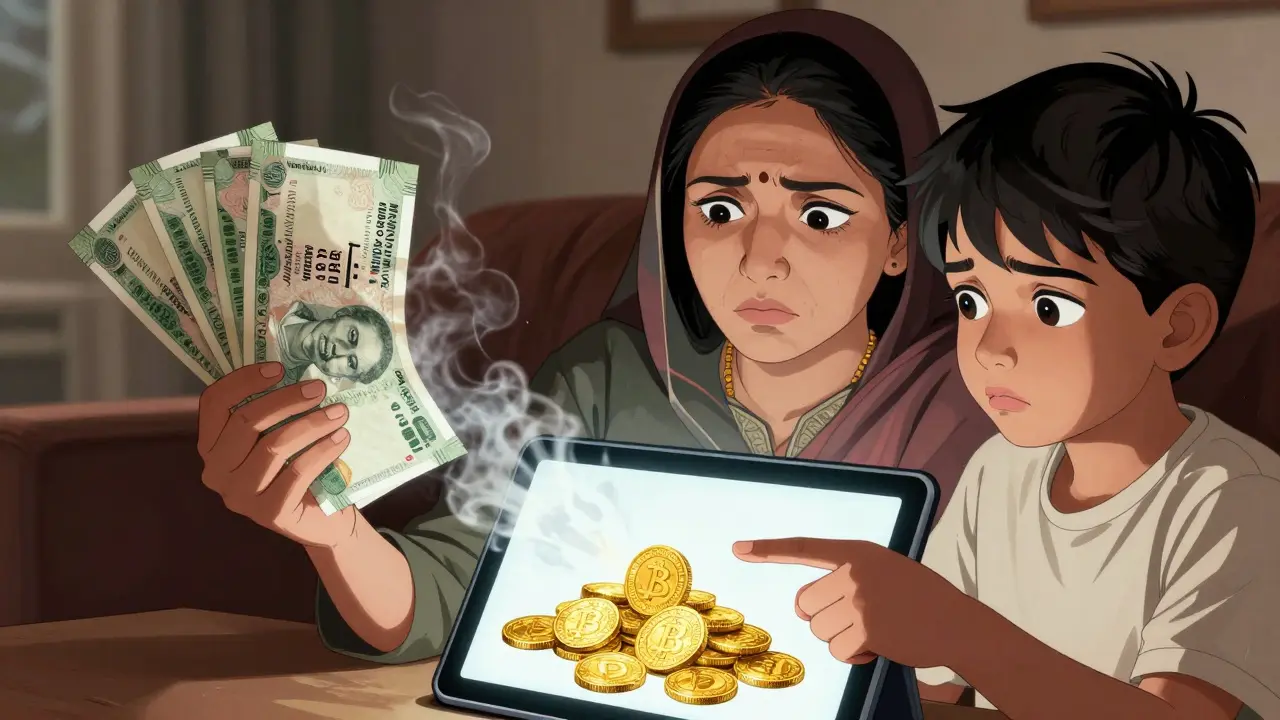
Consider the economic context. Pakistan has faced severe inflation rates, sometimes exceeding 30% annually. The Pakistani Rupee has lost significant value against the US Dollar over the past decade. For a family trying to save money for education or healthcare, keeping cash under the mattress or in a low-interest savings account means watching their wealth evaporate. Stablecoins like USDT (Tether) and USDC (USD Coin) offer a way to store value in a dollar-pegged asset without needing a US bank account.
This utility extends to remittances. Pakistan receives billions of dollars annually from overseas workers, particularly in the Middle East. Traditional remittance channels involve high fees and slow processing times. Crypto-based remittances allow families to receive funds instantly and with lower costs. A worker in Dubai can send USDT to a wallet in Lahore, and the recipient can convert it to PKR locally via P2P networks within minutes. This practical application explains why the adoption rate is so broad-based, touching millions of ordinary households rather than just tech-savvy traders.
Geopolitics and Private Sector Influence
While economics drove the bottom-up adoption, top-down strategy involved some surprising geopolitical moves. In 2025, Pakistan engaged heavily with international figures to legitimize and accelerate its crypto ecosystem. One notable event occurred in June 2025, when Finance Minister Muhammad Aurangzeb and Bin Saqib, CEO of the Pakistan Crypto Councilan industry coordination body facilitating dialogue between the government, private sector, and international partners regarding blockchain adoption., met with Michael Saylor, the prominent Bitcoin advocate and executive chairman of MicroStrategy.
MicroStrategy holds over $62 billion in Bitcoin reserves. Discussions focused on how Pakistan could utilize cryptocurrency for financial resilience. But perhaps more controversially, in August 2025, the Pakistan Crypto Council signed an agreement with World Liberty Financial, a venture associated with the Trump family. Zach Witkoff, co-founder of World Liberty Financial and son of Steve Witkoff (Trump's Special Envoy to the Middle East), secured direct access to Pakistani leadership, including Army Chief Asim Munir and Prime Minister Shehbaz Sharif.
This partnership aims to accelerate blockchain adoption but raises questions about conflicts of interest. Critics argue that tying national financial infrastructure to politically connected private entities introduces volatility. If the political winds in Washington shift, what happens to Pakistan's crypto initiatives? It highlights a risk: relying on external, profit-driven partners for core financial stability can be precarious.
Comparison: Pakistan vs. Other Top Adopters
To put Pakistan's position in perspective, let's compare it with other top-ranked countries. Different ranking systems yield slightly different results, but the leaders remain consistent.
| Rank (Chainalysis) | Country | Primary Driver | Regulatory Status |
|---|---|---|---|
| 1 | India | Massive retail user base, speculative trading | Strict taxes, no ban but heavy scrutiny |
| 2 | United States | Institutional investment, ETF approvals | Evolving regulations, SEC enforcement |
| 3 | Pakistan | Stablecoins for inflation hedge, remittances | Recently legalized via VARA (July 2025) |
| 4 | Nigeria | P2P trading, dollar shortage workaround | Bans lifted partially, CBN easing rules |
| 5 | Vietnam | Gaming, NFTs, young demographic | Prohibited for payments, allowed for investment |
Note that Nigeria dropped from 2nd to 6th in some recent updates due to stricter enforcement by the Central Bank of Nigeria, whereas Pakistan climbed despite earlier bans because the underlying economic need remained unmet until regulation caught up. India remains #1 largely due to its sheer population size and active trading communities, even with a 30% tax on crypto gains.

Risks and Future Outlook
Is this growth sustainable? Experts say yes, but with caveats. The shift from speculative trading to utility-driven usage (remittances, savings) creates a stronger foundation. However, several risks remain.
First, there is the issue of financial literacy. Many users enter the space through informal P2P channels without understanding the risks of scams, rug pulls, or losing private keys. Without robust consumer protection laws, the newly formed VARA must work hard to educate the public.
Second, geopolitical dependencies pose a threat. The reliance on partnerships with US-based political entities means Pakistan's crypto policy could become entangled in international politics. If relations sour, or if the US imposes sanctions on specific crypto protocols, Pakistan's ecosystem could face sudden disruption.
Finally, there is the technological infrastructure challenge. While smartphone penetration is high, reliable internet access and electricity remain issues in rural areas. Scaling crypto adoption requires not just software but hardware and connectivity improvements.
Looking ahead to 2026 and beyond, Pakistan is likely to maintain its top-10 position. The combination of a large, young population, acute economic needs that crypto solves, and now a supportive regulatory framework creates a perfect storm for continued growth. The question is no longer whether Pakistan will adopt crypto, but how quickly it can integrate it into the formal economy to boost transparency and tax collection.
Key Takeaways for Investors and Observers
- Utility Over Speculation: Pakistan's rise is driven by real-world use cases like hedging against inflation and receiving remittances, not just price speculation.
- Regulation Follows Adoption: The government waited until adoption was massive before creating VARA, showing that market forces often dictate policy in emerging economies.
- P2P is King: With banking restrictions in place for so long, peer-to-peer networks became the backbone of the crypto economy, a structure that persists even after legalization.
- Geopolitical Risks: Partnerships with politically connected foreign firms introduce uncertainty that investors should monitor closely.
Is cryptocurrency legal in Pakistan in 2026?
Yes, as of July 2025, cryptocurrency activities are regulated by the Pakistan Virtual Assets Regulatory Authority (VARA). While the State Bank of Pakistan previously prohibited banks from facilitating crypto transactions, the new regulatory framework provides legal clarity for exchanges and users. However, using crypto as legal tender for daily purchases is still restricted; it is primarily treated as a digital asset for investment and transfer.
Why did Pakistan rank 3rd in the Chainalysis index?
Pakistan ranked 3rd because of its high volume of crypto transactions adjusted for purchasing power parity (PPP). The Chainalysis index measures not just ownership but the intensity of usage relative to local income levels. With 20 million users and widespread use of stablecoins for remittances and inflation hedging, Pakistan's per-capita engagement with crypto is among the highest globally.
How do Pakistanis buy crypto if banks are restricted?
Historically, Pakistanis used Peer-to-Peer (P2P) trading platforms where they exchanged Pakistani Rupees (PKR) for cryptocurrencies like USDT or Bitcoin directly with other users. This bypassed the banking system. Now that VARA has been established, licensed exchanges are beginning to operate more openly, allowing for easier fiat-to-crypto onboarding through regulated channels.
What is the role of stablecoins in Pakistan's crypto adoption?
Stablecoins like USDT and USDC play a crucial role. Due to high inflation and currency devaluation of the Pakistani Rupee, citizens use stablecoins to preserve their savings. Additionally, they are widely used for remittances, allowing overseas workers to send money home quickly and cheaply compared to traditional banking wires.
Who is the Pakistan Crypto Council?
The Pakistan Crypto Council is an industry coordination body led by CEO Bin Saqib. It facilitates dialogue between the government, private sector companies, and international partners to promote blockchain adoption. The council has been instrumental in lobbying for regulatory changes and securing partnerships with global figures like Michael Saylor and entities like World Liberty Financial.