

You hit "send" on your wallet, expecting a quick transfer. Instead, you stare at a fee estimate that looks more like a mortgage payment than a transaction cost. It happens to the best of us. One day, sending Bitcoin costs pennies; the next, it costs dollars or even hundreds during peak chaos. Why does this happen? It isn’t random pricing by greedy exchanges. It’s a complex mix of network traffic, data size, and the specific rules of the blockchain you are using.
Understanding what drives these costs is no longer optional for anyone holding digital assets. With stablecoin volumes hitting over USD 4 trillion in the first half of 2025 alone, as reported by TRM Labs, the pressure on networks has never been higher. If you don't understand the mechanics behind the fee, you will always pay the premium. Let's break down exactly why your fees fluctuate and how you can take control.
The Core Driver: Network Congestion and Block Space
Imagine a highway with only one lane. When five cars want to pass, they all get through easily. Now imagine ten thousand cars trying to squeeze into that same lane at once. That is network congestion, which is the primary factor determining cryptocurrency transaction fees across most major blockchains.
Blockchains have limits. Bitcoin, for instance, produces a new block roughly every ten minutes. Each block has a maximum size limit (currently 4 million weight units, often simplified as 1MB). When more transactions are broadcast than can fit into the next block, they pile up in a waiting area called the mempool. Miners or validators then pick which transactions to include. How do they choose? They prioritize the ones paying the highest fee.
This creates an auction mechanism. If you need your transaction confirmed quickly, you must outbid everyone else in the mempool. During market rallies or high-volume events, such as the March 2025 rally mentioned in user reports, demand for block space spikes exponentially. KuCoin’s research team noted that this congestion is arguably the most significant driver of high fees. If you set a low fee during these times, your transaction might sit in the mempool for hours or days, effectively "stuck," until the network clears out.
Transaction Size and Complexity: It’s Not About Value
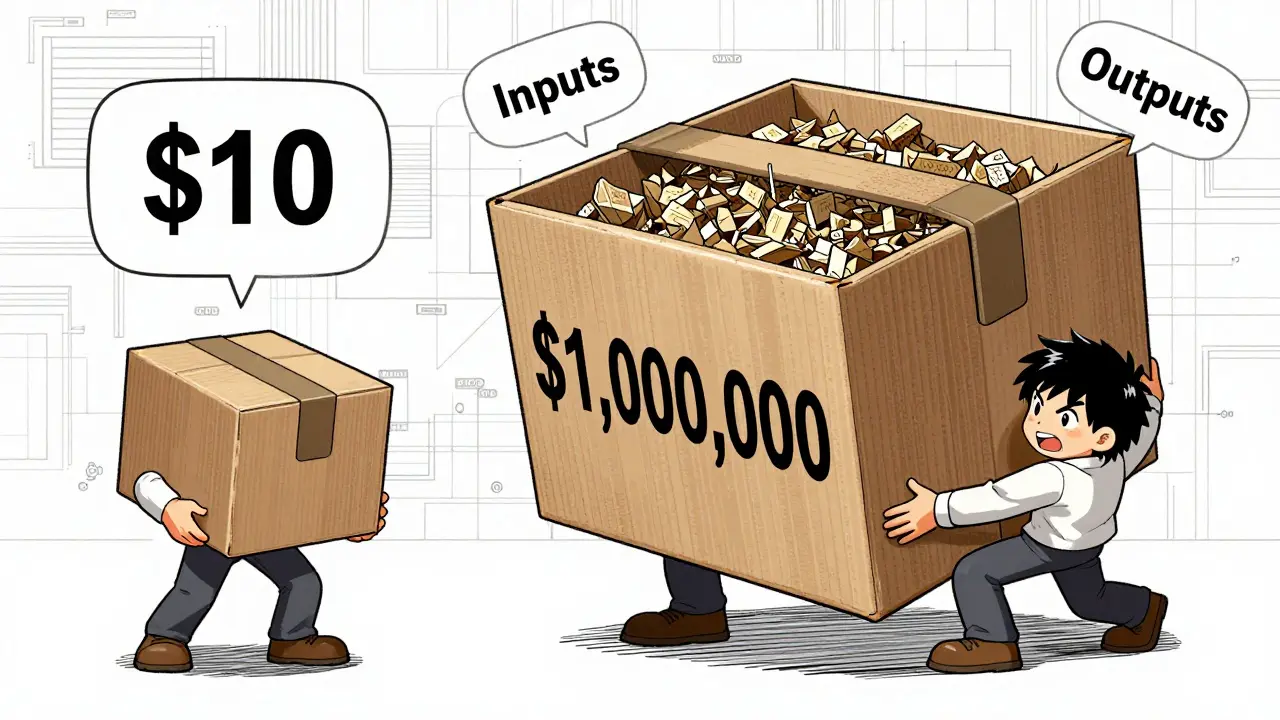
A common misconception is that sending $1 million in Bitcoin costs more than sending $10. In reality, the monetary value is irrelevant to the network fee. What matters is the transaction size, measured in virtual bytes (vBytes) or simply bytes, depending on the protocol.
Think of a blockchain transaction like a package being shipped. The shipping cost depends on the weight and dimensions of the box, not the value of the jewelry inside. On Bitcoin, the "size" of your transaction is determined by its complexity. Specifically, it depends on the number of inputs and outputs.
- Inputs: These are the Unspent Transaction Outputs (UTXOs) you are spending. If you have received Bitcoin from fifty different sources over time, your wallet might need to bundle all fifty of those small inputs to make a single payment. This makes your transaction data much larger.
- Outputs: These are the addresses receiving the funds. Sending to one address is smaller than splitting a payment among ten friends.
A simple transaction with one input and two outputs might be around 250-300 bytes. A complex transaction aggregating many small UTXOs could exceed 1,000 bytes. Since the fee formula is Total Fee = Transaction Size (Bytes) × Fee Rate (Sat/Byte), a larger transaction pays significantly more, even if the satoshi-per-byte rate is the same. This is why "consolidating" your UTXOs occasionally can save you money in the long run.
Different Chains, Different Rules: Gas vs. Satoshis
Not all blockchains charge fees the same way. The structure depends entirely on the consensus mechanism and design philosophy of the network.
| Network | Fee Unit | Primary Cost Driver | Typical Cost Range (2025/2026) |
|---|---|---|---|
| Bitcoin | Satoshis per Byte (Sat/vB) | Data size (bytes) & network congestion | $0.10 - $50+ (highly variable) |
| Ethereum | Gas Gwei | Computational complexity & EVM operations | $1 - $100+ (depends on DeFi activity) |
| Tron (TRX) | TRX (Energy/Bandwidth) | DPoS Validator rewards | <$0.01 (often free for USDT) |
| IOTA | None | Tangle architecture (no miners) | $0.00 (Fee-less) |
| Litecoin | Litoshi per KB | Similar to Bitcoin but faster blocks | Fraction of a cent |
Ethereum uses a system called gas, where fees are calculated based on the computational power required to execute the transaction. Simple transfers are cheap, but interacting with smart contracts (like swapping tokens on Uniswap or minting an NFT) requires complex calculations. The more code runs, the more gas you burn. This is why Ethereum fees spike during surges in Decentralized Finance (DeFi) activity.
In contrast, Tron utilizes a Delegated Proof of Stake (DPoS) model that enables extremely low transaction fees, often under $0.01. Because Tron has fewer validators sharing the reward and a different block production schedule, it can process thousands of transactions per second with minimal cost. This is why it became the dominant chain for USDT transfers in 2025, with 87% of users citing low fees as their primary reason for choosing it, according to NOWPayments.
Then there is IOTA, which offers completely fee-less transactions due to its unique Tangle architecture that eliminates miners and validators. This makes it ideal for microtransactions and Internet of Things (IoT) devices, where charging a fraction of a cent would still be prohibitive.
Timing Is Everything: When to Send
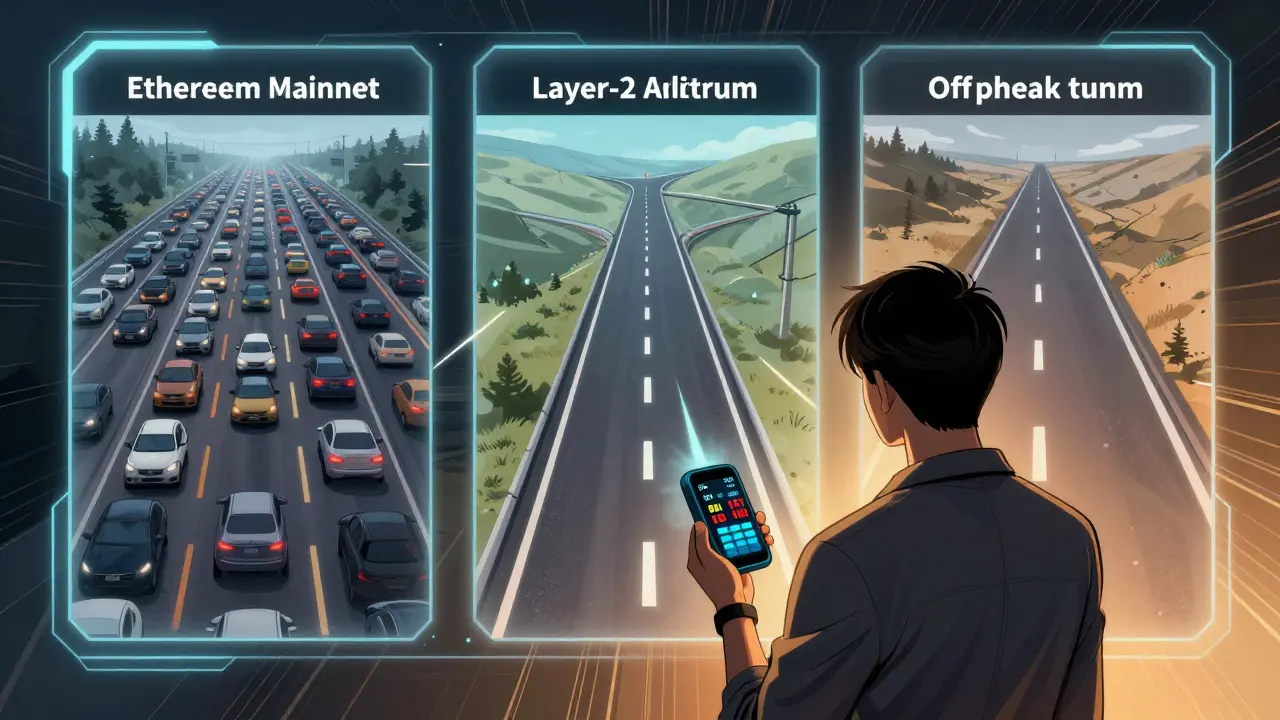
If you cannot change the blockchain's rules, you can change when you play. Network congestion follows patterns. Just like rush hour on a highway, crypto networks have peak and off-peak times.
Data from Reddit communities and blockchain explorers in mid-2025 showed a clear trend: fees are typically lowest during Tuesday through Thursday mornings in UTC time. Weekend activity, particularly Saturday afternoons UTC, often sees a surge in retail trading and meme coin launches, driving up demand for block space. One analysis noted a 62% average fee reduction for Bitcoin transactions sent during off-peak weekday mornings compared to peak weekend times.
Market volatility also plays a huge role. When Bitcoin price surges or crashes, transaction volume explodes as people rush to buy, sell, or move funds to safety. If you are not in a hurry, wait for the dust to settle. Use tools like mempool.space for Bitcoin or blockchain explorers that visualize current network congestion and predict confirmation times. These tools show you the real-time "price" of speed.
Exchange Withdrawal Fees vs. Network Fees
Here is where many users get burned. There is a difference between the network fee (paid to miners/validators) and the exchange withdrawal fee (charged by platforms like Coinbase, Binance, or Kraken).
Exchanges often apply fixed withdrawal fees. For example, an exchange might charge a flat 0.0005 BTC to withdraw Bitcoin, regardless of whether the network fee is currently 10 sats/vB or 100 sats/vB. Sometimes, this fixed fee covers the network cost plus a profit margin for the exchange. Other times, if network fees drop significantly, the exchange keeps the difference.
BitGo’s technical team warned in early 2025 that these fixed fees may not reflect real-time network costs, creating confusion. Always check the current network fee before withdrawing. If the network fee is low but the exchange charges a high fixed fee, consider using a non-custodial wallet (like MetaMask or Electrum) to send directly from your private keys, bypassing the exchange markup entirely.
How to Optimize Your Crypto Fees in 2026
You don't have to accept high fees as inevitable. Here are practical steps to reduce your costs:
- Choose the Right Chain: If you are moving stablecoins like USDT or USDC, avoid Ethereum mainnet unless necessary. Use Tron, Polygon, or Solana for near-instant, sub-cent transfers. BVNK’s 2025 guide highlighted that businesses using Tron for USDT achieved 99.7% lower fees compared to Ethereum.
- Use Layer-2 Solutions: For Ethereum users, Layer-2 networks like Arbitrum, Optimism, or Base handle transactions off-chain and settle them on Ethereum later. This reduces fees by 90-99%. You interact with the L2, not the expensive mainnet.
- Enable RBF and CPFP: If you send a Bitcoin transaction and realize you paid too little, don't panic. Most modern wallets support Replace-By-Fee (RBF) or Child-Pays-For-Parent (CPFP). These features allow you to bump the fee of a stuck transaction without starting over. 99Bitcoins notes that implementing these techniques takes only 15-20 minutes of learning but saves hours of anxiety.
- Consolidate Inputs: If your Bitcoin wallet has hundreds of tiny UTXOs, perform a consolidation transaction during a low-fee period. This merges them into one large UTXO, reducing the byte size of future transactions.
- Monitor Mempools: Make it a habit to check mempool.space or Etherscan Gas Tracker before sending large amounts. Waiting 2-4 hours for a dip in congestion can save you significant money.
The Future of Fees: Abstraction and Stability
The landscape is evolving. We are seeing the rise of fee abstraction, where dApps or wallets pay the gas fees on behalf of the user. To the end-user, the transaction feels "free," even though the cost is embedded in the service price or covered by the platform. BitGo documented this trend in early 2025, noting it improves user experience while maintaining network economics.
Additionally, as stablecoins capture a larger share of the cross-border payments market-projected to reach 20% by 2035 according to BVNK-the pressure to keep fees low will intensify. Networks that fail to scale or offer competitive fees will lose volume to cheaper alternatives. The competition between Bitcoin's security, Ethereum's ecosystem, and newer chains' efficiency ensures that users will always have options.
High fees are not a bug; they are a feature of a secure, decentralized network protecting itself against spam and overload. But by understanding the factors-congestion, size, chain choice, and timing-you stop being a victim of the auction and start making informed decisions. Next time you see a high fee, ask yourself: Do I really need this confirmed in 10 minutes, or can I wait for the rush hour to clear?
Why are Bitcoin transaction fees so high sometimes?
Bitcoin fees spike due to network congestion. When more transactions are broadcast than can fit into the 10-minute block interval, users enter an auction to pay miners for priority. High market volatility or popular events increase demand for block space, driving up the satoshi-per-byte rate.
Does sending more money cost more in crypto?
No. The transaction fee is based on the data size (bytes) of the transaction, not the monetary value. Sending $1 or $1,000,000 costs the same if the transaction complexity (number of inputs and outputs) is identical.
What is the cheapest cryptocurrency to send?
IOTA offers completely fee-less transactions. For traditional cryptocurrencies, Tron (TRX), Nano, and Litecoin are known for ultra-low fees, often costing less than $0.01 per transaction. Stablecoins like USDT on the Tron network are also extremely cheap to move.
How can I lower my Ethereum gas fees?
You can lower Ethereum fees by using Layer-2 solutions like Arbitrum, Optimism, or Base. Alternatively, transact during off-peak hours (typically Tuesday-Thursday mornings UTC) and avoid times of high DeFi activity or NFT mints.
What should I do if my transaction is stuck?
If your Bitcoin transaction is stuck, use Replace-By-Fee (RBF) or Child-Pays-For-Parent (CPFP) to increase the fee. For Ethereum, you can broadcast a new transaction with the same nonce but a higher gas price to replace the original one. Most modern wallets have a "speed up" button for this purpose.
Are exchange withdrawal fees the same as network fees?
No. Exchange withdrawal fees are fixed charges set by the platform, which may include a profit margin. Network fees are dynamic and paid to miners/validators. Exchanges often charge more than the actual network cost, especially during low-congestion periods.
14 Responses
Yo, this is gold! I’ve been burning so much gas on ETH lately just trying to swap tokens and it feels like robbery every time. The part about Tuesday mornings being cheaper is a total game changer for my workflow. I’m definitely setting a reminder now. Thanks for breaking it down so simply without all the tech jargon that usually confuses me. :D
Hah! Look at you folks dancing around the real issue. It’s not about 'network congestion' or 'block space.' It’s about centralization creeping back in under the guise of decentralization. You think Tron is free because it’s efficient? No. It’s cheap because they’ve optimized out the security guarantees that make Bitcoin actually valuable. You’re trading sovereignty for convenience, and you’ll pay for it when the validators decide to censor your transaction. Wake up.
The author completely misses the nuance here; frankly, it is embarrassing. Most retail users do not understand the difference between Layer 1 and Layer 2 settlement layers, which leads to catastrophic financial decisions. If you are moving significant capital, you should never rely on volatile mainnet fees without hedging via options or using institutional-grade cold storage with pre-negotiated fee structures. This article is too simplistic for serious investors.
They want you to believe it's just math but it's actually surveillance capitalism disguised as blockchain technology. Every time you pay a fee you're funding the very system that tracks your movements. The 'mempool' isn't neutral ground it's a panopticon where miners sell your data to the highest bidder before even confirming your tx. Don't fall for the narrative that timing saves you money. They know exactly when you send funds.
There is a profound irony in how we treat these digital tolls. We accept them as inevitable taxes on freedom, yet we rarely question the architecture that demands such payment. Is it truly efficiency we seek, or merely the illusion of speed? When I look at the mempool, I don't see transactions; I see human desperation quantified in satoshis. It is tragic, really, that our economic interactions must be auctioned off like slaves in an ancient market.
I guess I just don't get why everyone is so stressed about a few dollars. If the network is busy, maybe it's because people are using it? I mean, sure, it sucks when you're trying to move small amounts, but if you're holding long-term, does it really matter if you wait an extra hour? I just let my transactions sit there until they go through. No big deal. Life goes on.
Ah, the beautiful dance of the mempool, where dreams go to die in a sea of unconfirmed garbage. You think you're sending value, but you're really just feeding the beast of computational gluttony. The 'fee' is merely the blood price paid to the silicon gods who demand sacrifice for their block validation rituals. It's poetic, in a twisted, dystopian sort of way. Your UTXOs are nothing but scattered bones in a graveyard of inefficiency.
I have found that consolidating inputs is absolutely vital, especially if you receive many small payments over time! It is quite surprising how quickly the byte size grows, and consequently, the fees skyrocket during peak hours. One must be diligent about checking the current rate, otherwise, one might end up paying significantly more than necessary. It is a simple habit, but it yields substantial savings in the long run, wouldn't you agree?
i moved all my usdt to tron last year and never looked back. eth gas fees were killing me every time i wanted to swap or provide liquidity. now its basically pennies and instant. dont listen to the bitcoin maximalists telling you its safer if you cant afford to use it. practicality matters more than ideology when you are trying to live your life
You people are missing the forest for the trees. The real issue isn't the fee structure itself, it's the lack of interoperability that forces you to choose between chains based on cost rather than utility. We need a unified standard that abstracts away these differences entirely. Until then, we are just playing whack-a-mole with different networks. It is pathetic that we still have to manually check mempool.space in 2026.
Hey team! Just wanted to add that RBF is your best friend if you mess up the initial fee estimate. I've saved myself hundreds of dollars by just bumping the fee instead of waiting days for confirmation. Also, try using Base or Arbitrum for ETH swaps, the experience is so much smoother and cheaper. Keep learning and stay safe out there! 🚀💪
This is a comprehensive overview, but I wonder if the rise of account abstraction will eventually render manual fee management obsolete. If dApps can sponsor gas fees seamlessly, the user experience improves dramatically, though it shifts the cost burden elsewhere. It raises interesting questions about transparency and who ultimately pays for network security. I would be interested to hear thoughts on whether this centralizes control further.
Look, whether you like it or not, understanding these mechanics is key to not getting screwed. Exchanges love to hide the difference between their withdrawal fee and the actual network fee. Always check the explorer yourself before you hit confirm. It takes two seconds and could save you twenty bucks. Simple stuff.
STOP PAYING HIGH FEES RIGHT NOW! Seriously, if you are still sending transactions during peak weekend hours, you are leaving money on the table. Switch to L2s, use Tron for stablecoins, and stop letting greedy exchanges rip you off with fixed withdrawal rates. Take control of your finances today! Do not let another dollar slip through your fingers due to ignorance. Act now!