
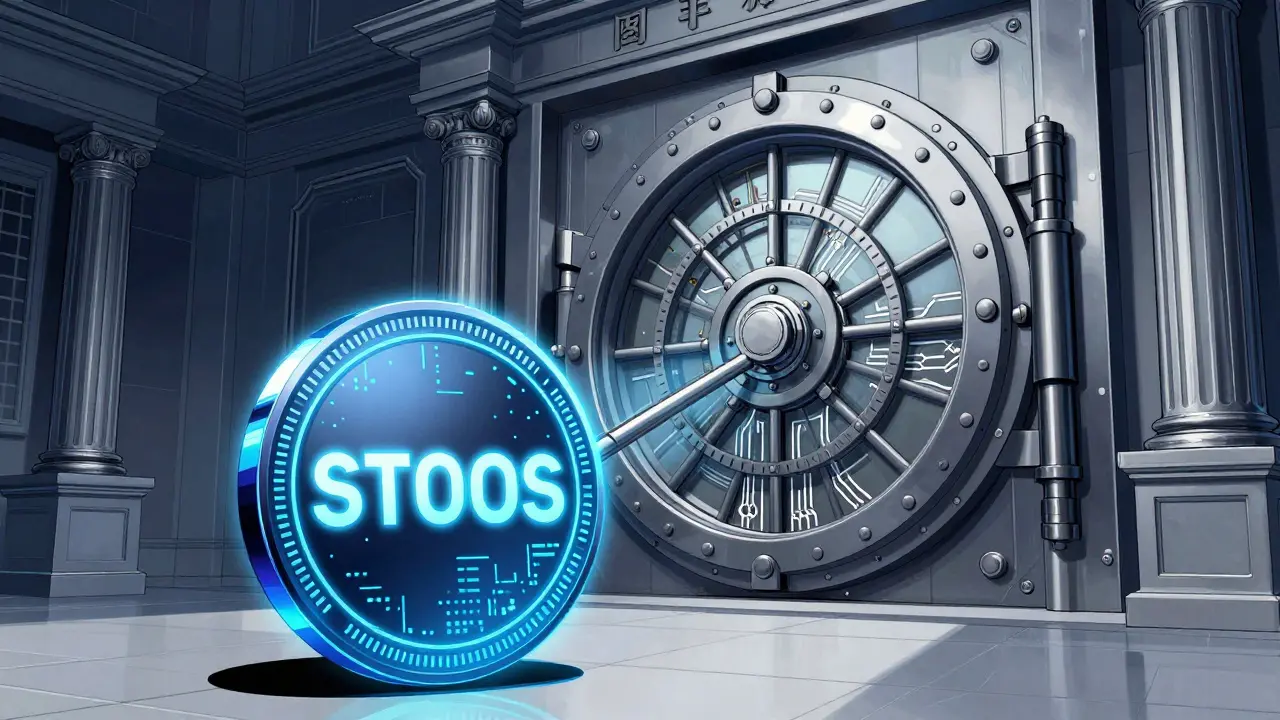
If you've been tracking the shift toward institutional finance on the blockchain, you've probably noticed a buzz around Real World Assets (RWA). At the center of this movement is the STO Operating System is a specialized cryptocurrency token, known as STOOS, that powers a permissioned blockchain designed specifically for regulated assets. Also referred to as the STOOS token, it isn't your typical speculative coin; it's a tool built for the complex world of security tokens and institutional compliance.
The Shift from Security Token Offering to STOOS
To understand what STO Operating System is today, you have to look at where it started. The project originally launched as the Security Token Offering project. However, as the vision grew, the team rebranded to STO Operating System and migrated to a new contract address (0x1551...def476) to better reflect its role as a foundational layer for the industry.
Unlike public blockchains where anyone can join and do anything, STOOS runs on the STO Chain is an institutional-grade permissioned blockchain optimized for regulated assets and RWA . Think of it as a "private club" for finance-it provides the security and privacy that big banks and asset managers require, which you won't find on a completely open network.
Breaking Down the Market Data
Looking at the numbers for STOOS can be a bit like reading a weather report during a storm-there's a lot of movement. As of April 2026, the token is trading around $1.59 to $1.60. If you look at the history, the volatility is staggering. In December 2024, the token hit an all-time low of $0.0012. By November 4, 2025, it rocketed to an all-time high of $4.197574. That is a climb of over 133,000%, which usually signals a massive shift in project utility or a surge in speculative interest.
Right now, the market capitalization sits at roughly $41.58 million. But here is the part where you need to pay attention: the Fully Diluted Valuation (FDV). The FDV is a massive $1.59 billion. This gap tells us that while the current market value is modest, there is a huge amount of supply yet to hit the market. With a total supply of 1 billion tokens, the price will be heavily influenced by the emission schedule-basically, how fast the remaining tokens are released into the wild.
| Metric | Value | Significance |
|---|---|---|
| Current Price | ~$1.60 USD | Stable trading across major exchanges |
| All-Time High | $4.1975 | Reached Nov 4, 2025 |
| Market Cap | $41.58 Million | Current valuation of circulating supply |
| FDV | $1.59 Billion | Theoretical value if all 1B tokens circulate |
| Total Supply | 1 Billion STOOS | Fixed cap for the ecosystem |
How RWA Tokenization Actually Works
You'll hear the term "RWA" or Real World Assets is the process of bringing tangible assets, like real estate, gold, or corporate bonds, onto a blockchain as digital tokens quite often. But why do this? Why not just keep a deed in a filing cabinet?
The magic is in the liquidity. Imagine trying to sell 10% of a commercial office building. In the traditional world, that's a nightmare of paperwork. With STOOS and the STO Chain, that building is tokenized. Investors can buy and sell small fractions of that asset instantly, 24/7, without needing a dozen intermediaries to sign off on every trade. STOOS acts as the fuel and the governance layer that makes this a reality within a regulated framework.

Where Can You Trade STOOS?
If you're looking to get your hands on some STOOS, it's listed on several major platforms. You'll find it on Binance is one of the world's largest cryptocurrency exchanges by trading volume , as well as Bybit, Coinbase, LBank, and CoinGecko for data tracking. The price is generally consistent across these venues, which is a good sign. It means there is enough liquidity that a single big buyer or seller can't easily manipulate the price on one specific exchange.
However, be wary of the reporting. Some exchanges, like Binance, occasionally show the circulating supply as zero. This is likely a data lag or a reporting error, rather than a sign that the tokens don't exist. Always cross-reference data across at least three sources-like CoinMarketCap, CoinGecko, and the actual blockchain explorer-before making a move.
The Risks and Trade-offs
Is STOOS a guaranteed win? Not necessarily. There are a few red flags or "caution zones" to keep in mind. First, the huge difference between the market cap and the FDV is a classic risk. If a massive amount of tokens are suddenly unlocked for early investors or the team, it could create significant downward pressure on the price.
Second, because it is a permissioned blockchain, it doesn't have the same "censorship resistance" as Bitcoin. It's designed to be compliant with the law, which is great for institutions but might feel restrictive to hardcore crypto enthusiasts. You are essentially betting on the growth of regulated digital finance rather than the overthrow of the traditional banking system.

Is STOOS Right for Your Portfolio?
Whether you should hold STOOS depends on your goal. If you're looking for a "moonshot" that might 100x overnight, the extreme volatility in its past shows it's possible, but the current price action is much more muted. If you believe that the future of finance is the tokenization of everything-houses, art, stocks-then STOOS is a direct bet on the infrastructure that enables that shift.
It's not competing with Ethereum or Solana for the most "apps." Instead, it's carving out a niche in the institutional space. It's a play on the bridge between Wall Street and the blockchain.
What is the main purpose of the STOOS token?
The primary purpose of STOOS is to power the STO Operating System and the STO Chain. It is used to facilitate the tokenization and management of Real World Assets (RWA) on a permissioned, institutional-grade blockchain, ensuring that all transactions remain compliant with financial regulations.
Why is there such a big difference between the market cap and FDV?
The market cap only counts tokens currently in circulation, while the Fully Diluted Valuation (FDV) calculates the value if all 1 billion tokens were released. This gap indicates that a large portion of the token supply is likely locked in reserves or vesting schedules, which could affect the price as those tokens enter the market.
Is STOOS a decentralized coin?
Not in the traditional sense. STOOS operates on a permissioned blockchain. This means that while it uses blockchain technology, the network is controlled to ensure that only verified, compliant entities can participate, making it more centralized than Bitcoin but more secure for regulated financial institutions.
Where can I track the real-time price of STOOS?
You can track STOOS in real-time on major exchanges like Binance and Bybit, or through data aggregators such as CoinMarketCap and CoinGecko, which use volume-weighted average formulas to give a fair market price.
What happened to the original Security Token Offering project?
The Security Token Offering project rebranded to become the STO Operating System (STOOS). This change included a migration to a new contract address and a refocusing of the project to provide a full operating system for regulated asset tokenization.
Next Steps for Investors
If you're planning to enter the STOOS ecosystem, don't just look at the price chart. Start by researching the current state of RWA tokenization. Look into how other projects are handling compliance and see if STOOS's permissioned approach gives it an edge. Also, keep a close eye on the token emission schedule; knowing when the next big batch of tokens unlocks is often more important than the daily price fluctuation.
16 Responses
The FDV is way too high for a project with this kind of circulating supply. Basic math tells you it is a ticking time bomb for the price.
Totally agree with the point about liquidity! Tokenizing real estate is such a game changer for smaller investors who can't afford a whole building. 🚀
Calling this a "bridge between Wall Street and blockchain" is just marketing speak for a centralized database. If it's permissioned, you've effectively just built a slower version of a traditional ledger without the actual benefits of decentralization. The irony of using a blockchain to recreate the very gatekeeping mechanisms the technology was meant to destroy is not lost on me.
Love seeing how RWA is evolving globally! 🌍 It's all about making finance more accessible for everyone everywhere. This looks like a solid step forward! ✨
The sheer audacity to market a permissioned chain as "innovative" is almost quaint. 🙄 One must wonder if the architects of this system truly believe in the ethos of the space or if they are simply chasing the institutional scent of blood. It's a pedestrian approach to a complex problem, lacking any real intellectual rigor. 💅
It is important to maintain a balanced perspective regarding the necessity of regulatory compliance in institutional finance. While decentralization is a core tenet of cryptocurrency, the integration of real-world assets necessitates a framework that adheres to existing legal statutes to ensure systemic stability and investor protection. A permissioned system provides the requisite oversight that traditional entities require before committing significant capital to a digital ecosystem.
Spot on analysis of the RWA sector.
imagine buying into a coin with a 1.5 billion FDV while the market cap is a joke lol. pure cope for those hoping for another 133k pump. the math just doesnt add up and the "institutional" label is just a shield for the team to dump their unlocks on retail. classic venture capital play where the early guys win and the latecomers hold the bag. honestly just lazy design at this point.
I really appreciate the warnings about the emission schedule! It's so helpful to be reminded to check the unlock dates before diving in. Stay safe everyone! 🌟
This is such a dazzling way to look at the future of property! 🏠✨ I can just imagine the freedom of trading fractions of a beach house while sipping a cocktail! Absolutely fabulous energy here! 🍸💖
why even bother with the fluff just tell me if it's gonna pump or dump. this aint rocket science just another corporate wrapper on a database. american markets will eat this for breakfast anyway because they love anything that sounds like a security token
I am truly moved by the vision of a more inclusive financial future where we all can collaborate!!
It is simply breath taking to think about how this technology might bridge the divide between the elite and the everyday investor!
Plese, let us all strive to help each other navigate these complex markets with grace and understanding!
The potential for synergy here is just... wow!!
It is most distressinng to see such volatility in the price history.
The horror of a 133,000% climb only to fall back down is truly a trageddy for the unware investor!
One must be so careful with these digital assets as the risks are simply overwhelming!!
It's interesting to consider the philosophical shift here. We're moving from the 'trustless' ideal of Bitcoin to a 'trusted' institutional model. In a way, we're not replacing the system, but digitizing it. It makes me wonder if the original dream of crypto was ever truly compatible with the scale of global real estate.
I've been looking into other RWA projects too, and the compliance part is always the hardest. It's cool to see a project lean into the permissioned side instead of fighting it. It seems like a more realistic path for big banks to actually use it without getting sued by the SEC.
money is just numbers anyway so why does it matter if it is on a chain or in a bank lol just buy and hope it goes up