

You’ve probably seen the ticker SEOR pop up on a price tracker or an exchange list. It looks like another small-cap cryptocurrency promising to change the game. But what actually sits behind that logo? Is it a solid piece of blockchain infrastructure, or just another project with big words and little substance?
That’s the question we need to answer before you think about buying or building with it. SEOR Network claims to be a bridge between off-chain data and on-chain smart contracts-a so-called "oracle" network. It also wants to make Web3 development easier for everyone. On paper, that sounds useful. In practice, the picture is a bit more complicated.
In this guide, we’ll break down exactly what SEOR Network is, how its token works, where you can trade it, and why you should keep one eye on the risks. We’re looking at the facts as they stand in mid-2026, cutting through the marketing fluff to see if this project delivers real value.
What Exactly Is SEOR Network?
To understand SEOR, you first have to understand what problem it tries to solve. Blockchains are isolated islands. They know everything happening inside their own walls but nothing about the outside world. If you want a DeFi app to react to the price of gold, or a game to check the weather, the blockchain needs help getting that data. That’s where oracle networks come in.
SEOR Network positions itself as a decentralized Web3.0 application development infrastructure and oracle network. Its main goal is to provide accurate off-chain data to different blockchain systems using something called a Lightweight Oracle Network (LON). Think of it as a messenger service that fetches real-world info and delivers it securely to smart contracts.
The project launched around 2022. Since then, it has tried to carve out a niche by combining two things: data delivery (the oracle part) and developer tools. The idea is that if you make it easy for developers to build apps and hard for bad actors to fake data, you create a healthy ecosystem.
Here’s where it gets interesting-and slightly confusing. Some sources describe SEOR as focused on SEO and digital marketing ecosystems. Others, including the project’s own technical documentation, emphasize its role as a general-purpose oracle and cross-chain tool for DeFi, gaming, and utility DApps. This inconsistency suggests the project may have pivoted, or that different platforms haven’t updated their descriptions. For now, the strongest signal points to it being a technical infrastructure play, not a marketing tool.
Tokenomics: How the SEOR Coin Works
Every crypto project needs a token to grease the wheels of its economy. SEOR uses the BEP-20 standard on the BNB Smart Chain (BSC). This means if you hold SEOR, it lives in your BSC-compatible wallet, like MetaMask or Trust Wallet, configured for BNB Chain.
Let’s look at the numbers, because they tell a story about scarcity and supply pressure:
- Total Supply: 1,000,000,000 SEOR tokens.
- Max Supply: 1,000,000,000 SEOR tokens (fixed, no inflation).
- Initial Circulation: Around 21.5 million tokens were released at launch.
A fixed max supply is generally good news for long-term holders because it prevents dilution. However, the circulating supply figure is where things get murky. Different exchanges and trackers report wildly different numbers. Some show nearly zero circulation, while others assume the full billion is in play. This discrepancy makes calculating the true market cap difficult. If only 24 million tokens are truly liquid, the market dynamics are very different than if half a billion are trading hands.
The token serves several specific utilities within the ecosystem:
- Transaction Fees: Every action on the SEOR network costs SEOR tokens.
- Oracle Services: Developers pay SEOR to access data feeds via the LON network.
- Staking: You must stake SEOR to become a node operator or register with the oracle network.
- Governance: Holders vote on protocol updates and parameter changes.
- Cross-Chain Bridges: Moving assets across chains incurs fees payable in SEOR.
This multi-utility design aims to create constant demand for the token. If people use the network, they burn or lock up SEOR. If they want to run nodes, they buy and stake it. It’s a classic deflationary pressure model, provided there is actual usage.

Technology: The Lightweight Oracle Network (LON)
The core tech behind SEOR is its Lightweight Oracle Network (LON). Traditional oracles can be heavy and expensive to run. SEOR claims to offer a lighter, more efficient alternative that still maintains security.
How does it work? The LON integrates with conventional oracle protocols to verify data before it hits the blockchain. When a smart contract requests external data-say, the current ETH/USD price-the LON nodes fetch that data, verify it against multiple sources, and package it into a unified format. This ensures that the smart contract receives accurate information without having to trust a single data provider.
One key feature is its cross-chain ambition. While the SEOR token lives on BNB Smart Chain, the network aims to serve other blockchains too. There are mentions of support from the Web3 Foundation grants program and connections to the Polkadot ecosystem. This suggests SEOR isn’t trying to build a walled garden but rather acts as a universal data layer that plugs into various chains.
For developers, this means less friction. Instead of integrating with five different oracle providers for five different chains, they could theoretically use SEOR’s unified protocol. Whether this vision is fully realized depends on the quality of their SDKs and documentation, which remains somewhat sparse compared to industry giants like Chainlink.
Where Can You Buy SEOR?
If you decide to take a chance on SEOR, you won’t find it on every major exchange. As of mid-2026, liquidity is fragmented across several mid-tier centralized exchanges.
| Exchange / Platform | Status | Notes |
|---|---|---|
| ByBit | Listed | Active trading pairs; significant portion of circulating supply. |
| Mudrex | Listed | Available for investment/trading. |
| Bitget | Listed | Trading available; low reported market cap due to data issues. |
| Binance | Price Only | Tracks price index; not necessarily tradable directly. |
| Coinbase | Not Tradable | Tracks price data but asset is not listed for trading. |
Notice the absence of Coinbase Prime or Binance Spot trading. This is typical for micro-cap projects. It means lower barriers to entry for listing but also higher risk. Liquidity is thin. Daily trading volumes hover in the tens of thousands of dollars. If you try to sell a large amount of SEOR at once, you could move the price significantly against yourself. Always check the order book depth before entering a position.
Pricing varies wildly depending on where you look. One aggregator might show $0.0007, while another shows $0.00008. This spread exists because of low volume and differing data feeds. Never rely on a single source for pricing. Check the actual exchange you intend to use.
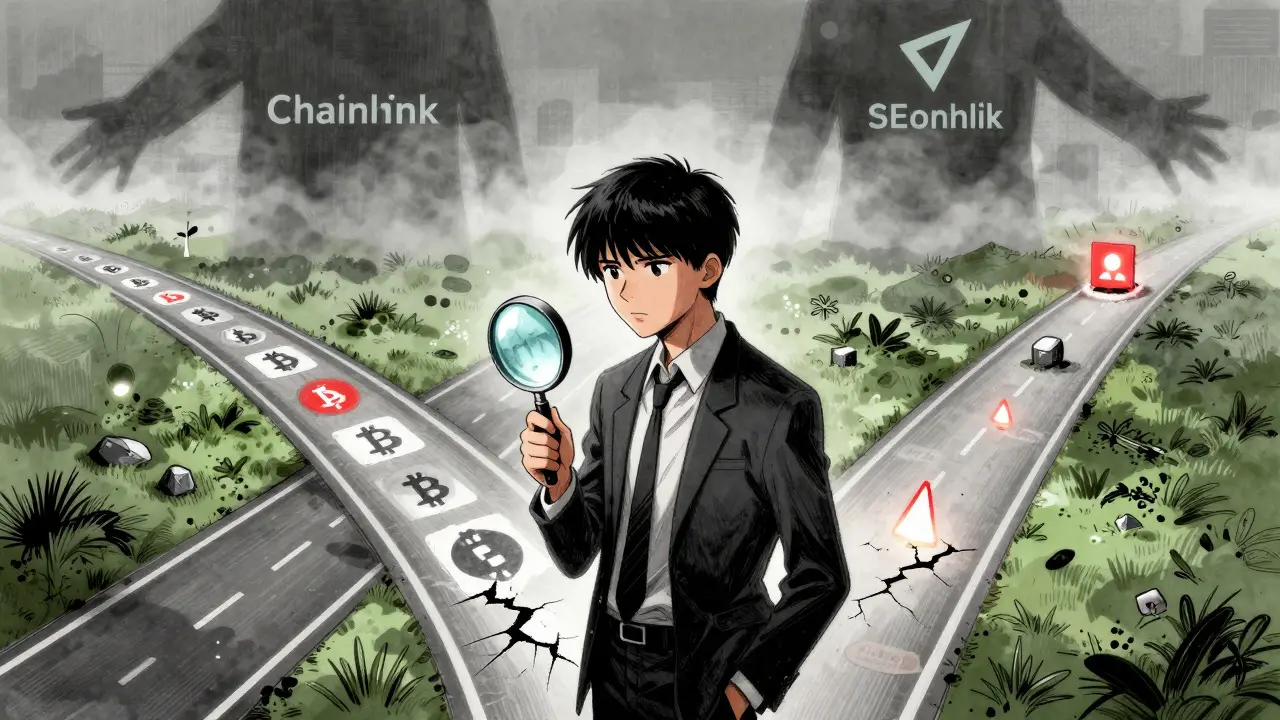
Risks and Red Flags
No crypto investment is safe, but SEOR comes with specific warnings you shouldn’t ignore.
1. Data Transparency Issues: The fact that major aggregators like Coinbase and Bitget report a market cap of "$0" or conflicting circulating supplies is a red flag. It indicates poor data hygiene or lack of verified on-chain metrics. Before investing, you should manually verify the token distribution on BscScan. Look at the top holders. Are they exchanges? Team wallets? Or unknown addresses? Concentration risk is high in micro-caps.
2. Lack of Independent Audits: Some reviews mention an audit by "Sertic Zor," but this name doesn’t immediately ring a bell among top-tier firms like CertiK, Hacken, or OpenZeppelin. Without a clear, publicly accessible audit report from a reputable firm, you’re trusting the code based on faith alone. Smart contract vulnerabilities are the number one cause of crypto losses.
3. Adoption Uncertainty: Being an oracle is a crowded space. Chainlink dominates. Band Protocol, API3, and Pyth Network fight for second place. SEOR is ranked outside the top 4,000 cryptocurrencies by market cap. For a new entrant to gain traction, it needs major DApps to integrate its services. Currently, there is little public evidence of widespread enterprise or DeFi adoption. Most activity seems speculative rather than functional.
4. Conflicting Narratives: Remember that SEO vs. Oracle confusion? It’s a sign of weak branding or unclear direction. Investors hate uncertainty. If the team can’t agree on what they do, why should you bet on them?
Is SEOR Worth Your Attention?
So, what’s the verdict? SEOR Network is a technically ambitious project trying to solve a real problem: getting reliable data onto blockchains cheaply and efficiently. The fixed supply and multi-utility token model are sound in theory. The connection to Web3 Foundation grants adds a layer of credibility regarding early-stage validation.
However, execution is lagging behind vision. The lack of clear documentation, inconsistent market data, and minimal visible adoption make it a high-risk, speculative play. It’s not a blue-chip asset. It’s not even a mid-tier contender yet. It’s a micro-cap experiment.
If you’re a developer curious about lightweight oracles, it might be worth exploring their testnet (if available) to see if the tech holds up. If you’re an investor, treat SEOR like venture capital. Allocate only what you can afford to lose completely. Diversify. Don’t put all your eggs in one tiny basket.
The crypto market rewards those who spot trends early, but it punishes those who fall for hype without substance. Do your own research. Check the contracts. Watch the volume. And stay skeptical.
What blockchain is SEOR Network built on?
The SEOR token is issued as a BEP-20 token on the BNB Smart Chain (BSC). However, the network's oracle functionality aims to be cross-chain, with reported connections to the Polkadot ecosystem and Web3 Foundation grants.
What is the total supply of SEOR tokens?
The total and maximum supply of SEOR is fixed at 1,000,000,000 (one billion) tokens. This means no new tokens can be created after this limit is reached, preventing inflation.
Can I buy SEOR on Coinbase?
No, SEOR is not currently tradable on Coinbase. While Coinbase tracks the price data for informational purposes, the asset has not met the criteria for direct listing and trading on the platform.
What is the Lightweight Oracle Network (LON)?
LON is SEOR Network's proprietary system for delivering off-chain data to smart contracts. It is designed to be more efficient and cost-effective than traditional oracle solutions, providing verified data for DeFi, gaming, and other DApps.
Why is the market cap of SEOR often listed as $0?
This usually happens due to missing or unreliable circulating supply data on aggregators. If a platform doesn't know exactly how many tokens are actively trading, it may default to showing a zero or near-zero market cap, even though the token has a real price.
Has SEOR Network been audited?
Some sources claim SEOR was audited by "Sertic Zor," but this is not a widely recognized top-tier audit firm. Detailed, public audit reports from reputable companies like CertiK are not readily available, which poses a security risk for investors.