

When you hear the word "stablecoin," you probably think of USDT or USDC - the big names that dominate headlines and trading volumes. But if you're operating in Europe, especially under new crypto rules, there's another player that matters more than you might think: Quantoz USDQ. It’s not the largest, and you won’t find it on every exchange. But for businesses and institutions inside the EU, it’s becoming the go-to for compliant, dollar-backed transactions. Here’s what you need to know - no fluff, just facts.
What Exactly Is Quantoz USDQ?
Quantoz USDQ (USDQ) is a digital token that’s worth exactly $1 - or very close to it. As of November 2025, its price hovered at $0.9989, with daily swings between $0.9907 and $1.0067. Unlike some stablecoins that claim to be backed by cash or reserves but lack transparency, USDQ is issued by Quantoz Payments BV, a company licensed as an Electronic Money Institution (EMI) by the Dutch Central Bank (DNB). That means it doesn’t just operate on blockchain - it’s legally supervised like a bank.
This isn’t a side project. USDQ was built from the ground up to meet the Markets in Crypto-Assets Regulation (MiCA), Europe’s first comprehensive crypto law. MiCA kicks in fully in 2026, and USDQ was one of the first stablecoins to submit its full regulatory whitepaper and get approved. That’s why regulators like the European Banking Authority (EBA) called it a "leading example" of how compliance and blockchain can work together.
How Is USDQ Backed? Real Reserves, Not Promises
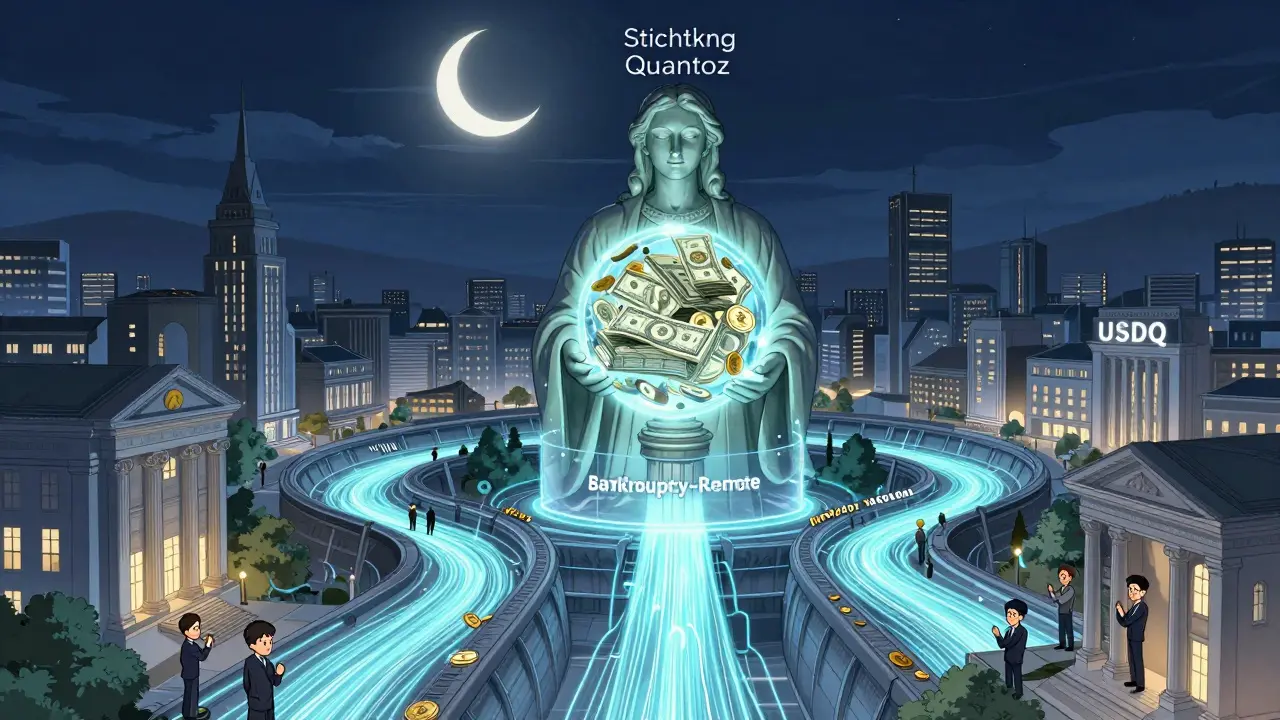
Most stablecoins say they’re 1:1 backed by US dollars. But how do you know? With USDQ, you can check. Every USDQ token is backed by $1.02 in reserves - that’s 102% coverage. The extra 2% acts as a buffer against market swings or bank fees. These reserves aren’t hidden in some offshore account. They’re held by Stichting Quantoz, a bankruptcy-remote foundation supervised by DNB. The money sits in two places: cash deposits at systemically important banks (like ING and Rabobank) and highly liquid US Treasury bills.
Transparency reports are published monthly. As of November 2025, the total reserves were over $8.1 million, matching the circulating supply of 7.98 million USDQ tokens. That’s not just marketing - it’s audited, public, and verifiable on-chain. You can even see the reserve address on Etherscan. This level of accountability is rare in crypto.
It Runs on Ethereum - But That’s Not the Whole Story
USDQ is an ERC-20 token on the Ethereum blockchain. That means you can store it in any wallet that supports Ethereum - MetaMask, Trust Wallet, Ledger, you name it. Transactions settle in seconds. Gas fees are low, usually under $0.05. But here’s the catch: USDQ isn’t meant for casual traders or memecoins. It’s designed for institutions, fintechs, and regulated businesses that need to move dollars across borders without running into compliance headaches.
Unlike USDT or USDC, which are available on over 100 exchanges, USDQ is listed on just seven major ones - including Bitvavo and Bitstamp. That’s not a bug; it’s intentional. Quantoz doesn’t want random retail users flooding the market. They want verified, regulated entities using it. If you’re a German fintech company sending payments to a French supplier, USDQ gives you legal certainty. If you’re a trader trying to cash out $500k, you’ll struggle.

Why Does This Matter in Europe?
Let’s put this in context. The entire European stablecoin market is worth about $18.5 billion. USDQ’s market cap is around $7.97 million - just 0.04% of that. But here’s what’s interesting: its monthly active addresses grew 68% in one month. That’s more than three times the European average. Why? Because MiCA is forcing companies to clean up their act.
Before MiCA, many EU firms used US-based stablecoins like USDC. But now, regulators are asking: "Is this token compliant? Can we audit its reserves? Is the issuer supervised?" USDC isn’t supervised by a European authority. USDQ is. So companies that need to pass audits - banks, payment processors, crypto exchanges - are switching. One user on Bitcointalk, a compliance officer at a German fintech, said: "The transparency reports from Stichting Quantoz give our auditors confidence that doesn’t exist with US-based stablecoins."
Who Uses It? Real-World Examples
According to RWA.xyz data from November 2025:
- 78% of USDQ volume comes from European fintechs and crypto exchanges
- 15% is used by institutional trading desks
- 7% flows through cross-border payment providers
That’s not random speculation - it’s based on real transaction patterns. You won’t find everyday users trading USDQ on Binance or Coinbase. But you will find:
- A Dutch crypto exchange using USDQ to settle dollar deposits from German clients
- A French payment processor moving funds between EU banks using USDQ instead of SWIFT
- A Belgian blockchain startup using USDQ as collateral for DeFi loans - because its bank won’t accept USDT
The token’s monthly transfer volume hit $5.8 million in November 2025 - a 151% jump from the previous month. That’s not viral growth. That’s institutional adoption.
How Does It Compare to USDT and USDC?
| Feature | Quantoz USDQ | Tether (USDT) | Circle (USDC) |
|---|---|---|---|
| Backing Ratio | 102% (cash + T-bills) | ~100% (mixed assets) | 100% (cash + T-bills) |
| Regulatory Oversight | DNB (Netherlands), AFM | None in EU | US regulators (FinCEN, NYDFS) |
| MiCA Compliance | Yes - fully approved | No | No - not supervised in EU |
| Market Cap (Nov 2025) | $7.97M | $112B | $34B |
| Exchanges Listed | 7 | 100+ | 100+ |
| Liquidity Depth | Low - high slippage on large trades | Very High | Very High |
| Best For | EU businesses needing regulatory certainty | Global trading, high volume | Global use, high liquidity |
USDQ doesn’t compete on size. It competes on trust. If you’re in the EU and need to prove to your lawyer, auditor, or regulator that your stablecoin is compliant - USDQ is the only one that checks every box.
What’s Next for USDQ?
Quantoz isn’t resting. In November 2025, they announced partnerships with ING and Rabobank to boost reserve liquidity. They’re also integrating with the European Central Bank’s TIPS system, which allows euro payments to settle in seconds. By January 2026, they plan to launch USDQ on additional blockchains beyond Ethereum - likely Polygon and Solana.
They’re also building programmable payment features that align with the EU’s upcoming Digital Euro framework. Think: smart contracts that only release funds if compliance checks pass. This isn’t science fiction - it’s already in testing.
Fitch Ratings gave USDQ an "A-" stability outlook through 2028. Deloitte predicts MiCA-compliant stablecoins will capture 25% of the European market by 2027. USDQ, as the first mover, could grab 15-20% of that.
Is USDQ Right for You?
If you’re a retail trader looking to make quick trades - skip it. The liquidity is too thin. Slippage on a $100k trade can hit 0.8%. USDC does it in 0.1%.
If you’re running a business in Europe that needs to:
- Send or receive dollar payments across borders
- Pass regulatory audits
- Use a stablecoin that’s legally supervised
- Integrate with EU banking systems
Then USDQ isn’t just an option - it’s becoming a requirement.
Is Quantoz USDQ the same as USDC?
No. USDC is issued by Circle, a U.S.-based company regulated by American agencies like FinCEN and NYDFS. USDQ is issued by Quantoz Payments BV, licensed by the Dutch Central Bank. USDC is designed for global use, while USDQ is built specifically to meet Europe’s MiCA rules. Both are dollar-pegged, but their legal foundations, oversight, and target users are completely different.
Can I buy USDQ on Coinbase or Binance?
Not directly on Coinbase or Binance. As of November 2025, USDQ is only listed on seven exchanges, including Bitvavo and Bitstamp. You can’t buy it on the biggest platforms because Quantoz deliberately limits distribution to regulated, institutional-grade exchanges. If you’re in the EU, you’ll likely find it on Bitvavo or MEXC.
Is USDQ backed by real U.S. dollars?
Yes - but not just cash. The reserves are 102% backed by a mix of cash deposits in major European banks and highly liquid U.S. Treasury bills. These are held in a bankruptcy-remote foundation supervised by the Dutch Central Bank. Monthly transparency reports show exactly what’s in the reserves, and you can verify the addresses on Etherscan.
Why is USDQ’s market cap so small compared to USDT?
Because USDQ isn’t trying to be big. USDT dominates because it’s available everywhere and used by retail traders globally. USDQ is focused on one thing: compliance in Europe. It’s designed for businesses that need to meet MiCA, not for speculators. Its market cap reflects its niche - not its value. It’s like comparing a luxury sedan to a delivery truck. Different purposes.
Can I use USDQ for DeFi or lending?
Yes - but cautiously. Some DeFi protocols in Europe accept USDQ as collateral because of its regulatory clarity. However, due to low liquidity, large deposits or withdrawals can cause slippage. It’s better suited for smaller-scale DeFi use cases, like earning yield on a business’s cash reserves, rather than high-volume trading or borrowing.
What happens if Quantoz goes bankrupt?
The reserves are held by Stichting Quantoz, a separate legal entity that’s bankruptcy-remote. That means if Quantoz Payments BV fails, the USDQ reserves are protected and still belong to token holders. The Dutch Central Bank supervises this structure. This is one of the key reasons regulators trust USDQ - it’s designed to survive even if the issuer collapses.
Is USDQ safe from U.S. sanctions or regulatory pressure?
Yes - because its operations are entirely based in the Netherlands, under EU law. While the reserves are in U.S. Treasuries, the issuer, oversight, and users are all in Europe. U.S. regulators have no authority over Quantoz Payments BV. This makes USDQ a politically neutral option for EU businesses that want to avoid U.S.-centric financial risks.
Final Thoughts
Quantoz USDQ isn’t here to beat USDT. It’s here to replace it - in Europe. For the first time, there’s a dollar-pegged stablecoin that doesn’t just claim to be compliant - it’s been legally approved by the same regulators that oversee banks. It’s slow, it’s niche, and it doesn’t have the trading volume of its rivals. But if you’re a business operating under MiCA, that’s exactly what you need. This isn’t a crypto experiment. It’s the future of regulated digital money - and it’s already live.
9 Responses
This USDQ thing is wild. 102% backing? Like, what even is this? 🤯 I’ve seen stablecoins with 80% reserves and still got 100k in profit. But this? This is like someone took a bank statement, glued it to a blockchain, and called it ‘innovation.’ I’m not mad… I’m just impressed. 😅
Ah yes, the holy grail of regulatory theater. A stablecoin that doesn’t want to be popular, only ‘compliant.’ It’s like a Tesla that only drives on Tuesdays because the algorithm says it’s ‘ethically optimal.’ 🤖 We’ve turned money into a compliance audit with a blockchain sticker on it. Beautiful. Truly.
MiCA-approved? Congrats, you’ve been certified by bureaucrats who think ‘transparency’ means publishing a PDF no one reads. Meanwhile, USDC just moves money. USDQ? It’s a PowerPoint deck with gas fees. 🎓
Honestly? This gives me hope. 🌱 I’ve watched so many crypto projects burn out because they chased volume over trust. But here? Someone built something for the long game. For the auditors. For the SMEs in Germany. For the ones who just want to get paid without a 30-page legal doc. Keep going, Quantoz. You’re doing good work.
You people are missing the point. This isn’t about compliance. It’s about control. The EU is creating a sovereign digital dollar to replace the USD’s dominance. USDQ is the Trojan horse. The ‘102% backing’? That’s just to make you feel safe while they quietly restructure global finance. You think this is about transparency? It’s about power. And you’re all cheerleading it. 🤡
It’s funny how the same folks who scream ‘decentralize everything’ are now lining up to praise a token issued by a licensed EMI under Dutch oversight. The irony is thicker than USDT’s whitepaper. But hey, if it helps my fintech client avoid a regulatory fine? I’ll take it. Still… surreal.
EU regulation? More like U.S. puppet strings. T-bills? That’s still American debt. They just moved the paperwork to Amsterdam. This is financial colonialism with a blockchain logo. 🇪🇺💀
I’m shocked anyone trusts this. The reserves are in ING and Rabobank? Those are the same banks that got fined for laundering Russian oligarchs in 2021. This isn’t secure-it’s just slower. 🤷♀️
The fact that this is only listed on seven exchanges is not a feature-it’s a flaw. Liquidity is the lifeblood of any financial instrument. This isn’t innovation. It’s isolation. And frankly, it’s dangerous for any business relying on it. You’re not building trust-you’re building a vulnerability.