

Puffer (PUFFER) isn't just another crypto coin. It’s a behind-the-scenes infrastructure tool built to fix one of Ethereum’s biggest headaches: slow and uncertain transaction confirmations. If you’ve ever waited minutes for a DeFi trade to go through - or lost money to front-running - Puffer’s designed to make that disappear. Launched in 2023, it doesn’t compete with Ethereum. It makes Ethereum better.
What Puffer Actually Does
Puffer isn’t a wallet, exchange, or DeFi app you use directly. It’s a protocol that sits on top of Ethereum and gives apps faster, more reliable transaction confirmations. Think of it like a express lane for Ethereum transactions. While regular Ethereum blocks take 12 seconds to finalize, Puffer’s technology - called UniFi AVS - delivers near-instant preconfirmations in under 100 milliseconds. That’s the difference between waiting for your coffee and getting it handed to you before you even order.
This speed comes from something called liquid restaking. Instead of locking up your ETH to earn staking rewards, you can stake it through Puffer and still use it elsewhere - like lending or trading. Puffer takes that staked ETH and uses it to secure its own validation network. Validators who run Puffer’s system must put up ETH as collateral. If they misbehave, that ETH gets slashed. It’s the same security model as Ethereum, just repurposed.
The PUFFER Token: More Than Just a Coin
The PUFFER token is the fuel for this system. It has two jobs:
- Governance: Holders vote on upgrades, fee structures, and which new features get built.
- Rewards: You earn PUFFER tokens for helping secure the network - either by staking ETH through Puffer or by running a validator node.
There’s a max supply of 1 billion PUFFER tokens. As of December 2025, between 180 million and 324 million are in circulation, depending on the source. That discrepancy isn’t a bug - it’s because Puffer releases tokens gradually based on network usage, and different platforms update their numbers at different times.
One major update in December 2025 introduced Puffer Boost. This lets token holders multiply their staking rewards by up to 24 times - if they’re active in the ecosystem. It’s not a magic trick. It’s a reward for helping the network grow.
How Puffer Compares to Other Restaking Protocols
Puffer doesn’t work alone. It’s part of a growing group of protocols using liquid restaking. But here’s where it stands out:
| Protocol | Focus | Preconfirmation Speed | TVL (Total Value Locked) | Best For |
|---|---|---|---|---|
| Puffer | Ethereum preconfirmations via UniFi AVS | 97ms average | $1.2B | DeFi traders, high-frequency apps |
| EtherFi | Solo staking derivatives | Not its focus | $4.1B | Simple yield seekers |
| Renzo | Multi-chain restaking | Variable | $940M | Users across multiple chains |
Puffer’s edge? It’s laser-focused on one thing: making Ethereum apps feel instant. While EtherFi helps you earn more from staking, and Renzo lets you stake across chains, Puffer solves a real user pain point - waiting. Kraken Institutional found that DeFi protocols using Puffer’s preconfirmation layer execute trades 42% faster. That’s huge for traders.
But Puffer isn’t perfect. Its complexity is its biggest weakness. You can’t just click “stake” and forget it. You need to understand wallets, gas fees, and how restaking works. Messari gave it a 7.8/10 for tech but only 6.2/10 for user experience. Most complaints on Reddit and Trustpilot? “Too confusing to set up.”

Who Uses Puffer - And Why
Puffer isn’t for casual crypto holders. It’s for:
- DeFi traders: If you’re swapping tokens, liquidity mining, or arbitraging, Puffer’s instant confirmations help you avoid front-running and missed opportunities.
- DeFi app developers: Projects like Uniswap V4 and Aave V4 integrated Puffer’s UniFi AVS to make their apps faster. They didn’t build their own preconfirmation layer - they plugged into Puffer.
- Validators and institutions: 63% of Puffer’s stakers are institutional. They have the tech team to manage the setup and want the highest security with better rewards.
One user on Medium, ‘DeFiDegen87’, shared how they cut front-running losses by 63% after switching to Puffer. That’s not a fluke. It’s the result of real infrastructure.
But there’s a dark side. A user on Ethereum Stack Exchange lost $1,200 because they didn’t understand Puffer’s withdrawal queue. The system doesn’t pay out immediately - it batches withdrawals. If you panic and try to withdraw twice, you can get stuck. This isn’t a bug. It’s a feature. But it’s dangerous for beginners.
How to Get Started With Puffer
Using Puffer isn’t like buying Bitcoin on Coinbase. It’s more like setting up a custom server. Here’s how it works:
- Connect your wallet: Use MetaMask, Coinbase Wallet, or Ledger. Make sure you’re on Ethereum mainnet.
- Deposit ETH or LSTs: You can stake ETH directly, or deposit liquid staking tokens like stETH or rETH. Puffer accepts both.
- Choose your level: For most users, just staking ETH is enough. If you’re a developer or power user, you can enable UniFi AVS for specific apps.
That’s it. But don’t rush. Puffer’s own docs say it takes 3-5 hours to understand the system if you’re already familiar with DeFi. Beginners should watch their 3 YouTube tutorials first. Skip the API docs - they’re for developers.
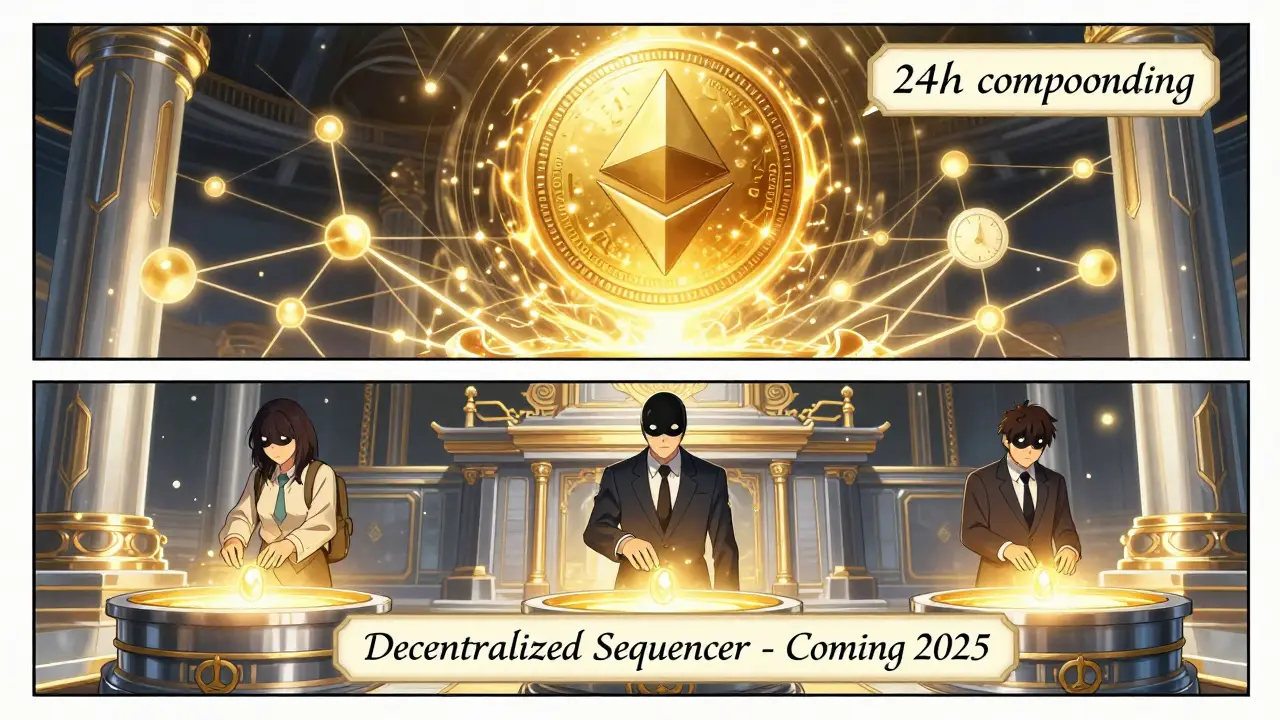
Gas fees can spike during congestion. Always leave extra ETH for transactions. And don’t expect rewards to show up instantly. They compound every 24 hours.
Is Puffer Safe?
Yes - but with caveats. Puffer uses Ethereum’s security, plus EigenLayer’s slashing system. That means your staked ETH is protected by the same rules as Ethereum itself. Two medium-severity bugs were found and patched in late 2024. No major exploits have occurred.
The bigger risk? Centralization. Ethereum core developer Danny Ryan warned that if too many apps rely on Puffer for preconfirmations, and Puffer goes down, the whole ecosystem could slow down. That’s why the team is working on a decentralized sequencer network - planned for late 2025.
Regulatory-wise, the SEC’s Project Dragonfly classified PUFFER as a utility token, not a security. That’s good news for U.S. users.
The Future of Puffer
Puffer’s roadmap is clear:
- Phase 1 (Done): UniFi AVS mainnet launched in Q4 2024.
- Phase 2 (Done): Cross-rollup interoperability rolled out in Q2 2025.
- Phase 3 (Now): Building a decentralized sequencer network to reduce reliance on a single provider.
They’re also testing Commit-Boost, a new tech that standardizes how Ethereum block proposers commit to transactions. If it works, Puffer could become the default standard for transaction ordering - not just an add-on.
Analysts from Bankless Ventures predict Puffer could capture 25-30% of the Ethereum preconfirmation market by late 2026. That’s a big bet. But given that 17 major DeFi protocols already use it, the momentum is real.
Final Verdict: Is Puffer Worth It?
If you’re a trader, developer, or institutional player who needs speed and reliability on Ethereum - yes. Puffer delivers real performance gains that you can measure in dollars saved and trades won.
If you’re just holding ETH and want to earn 4-5% APY? Skip it. Use EtherFi or Lido. Puffer’s complexity isn’t worth it for simple staking.
Puffer isn’t flashy. It doesn’t have memes or celebrity endorsements. But it’s solving a real problem that’s held back Ethereum’s usability for years. And in crypto, that’s more valuable than any viral token.
Is Puffer (PUFFER) a good investment?
Puffer isn’t a traditional investment like Bitcoin. Its token value is tied to network usage, not speculation. If more DeFi apps use its preconfirmation layer, demand for PUFFER will rise. But if Ethereum’s native upgrades (like proto-danksharding) solve the same problem, Puffer’s relevance could drop. Only invest what you can afford to lose, and understand it’s infrastructure, not a store of value.
Can I stake PUFFER directly?
No. You stake ETH or liquid staking tokens (like stETH) through Puffer’s pools. You earn PUFFER tokens as rewards for helping secure the network. You can’t stake PUFFER itself to earn more PUFFER.
How do I claim my PUFFER rewards?
Rewards are automatically added to your wallet every 24 hours. You don’t need to claim them manually. They compound, meaning your rewards earn more rewards over time. Check your wallet balance daily - it should slowly increase.
Is Puffer available on major exchanges?
Yes. PUFFER is listed on Kraken, Coinbase Pro, and Bybit. But trading it isn’t the same as using it. To earn rewards, you need to stake ETH through Puffer’s official website or supported wallet integrations. Don’t just buy and hold - that misses the point.
What’s the minimum amount to start with Puffer?
There’s no minimum for retail users. You can stake as little as 0.01 ETH through Puffer’s liquid restaking pools. But if you want to run a validator node, you need 32 ETH. Most people use the pool - it’s easier and safer.
Does Puffer work on other blockchains?
No. Puffer is built exclusively for Ethereum. It uses Ethereum’s consensus and security model. Other chains like Solana or Polygon have their own speed solutions. Puffer’s entire design is focused on improving Ethereum’s user experience.
What happens if Puffer gets hacked?
Your staked ETH is protected by EigenLayer’s slashing mechanism. If Puffer’s validators act maliciously, their ETH gets burned - not yours. You’re not directly exposed to Puffer’s code. The risk is that the service could go offline temporarily, delaying your rewards. But your principal ETH remains safe.
How does Puffer compare to Lido or Rocket Pool?
Lido and Rocket Pool let you stake ETH and earn rewards. Puffer does that too - but it adds instant transaction confirmations for apps. Think of Lido as a savings account, and Puffer as a savings account with a super-fast ATM. If you only care about staking rewards, Lido is simpler. If you trade or build on DeFi, Puffer gives you an edge.
10 Responses
this is actually wild how fast preconfirmations are. 97ms?! i’ve been waiting 12 seconds just to see if my swap went through. puffer’s like a caffeine shot for ethereum. 🚀
While I appreciate the technical innovation, I must emphasize that the complexity of this system is fundamentally at odds with the ethical imperative of financial accessibility. One cannot responsibly promote infrastructure that demands a graduate-level understanding of blockchain mechanics from retail participants. This is exclusionary by design.
people dont get it puffer is just eigenlayer with a fancy name and a marketing team nobody cares about the 97ms its all just rehypothecated eth with extra steps and the token is a pump and dump waiting to happen
For users unfamiliar with liquid restaking, the key distinction is that Puffer doesn't replace staking-it augments it. The ETH remains secured under EigenLayer’s slashing conditions, while the preconfirmation layer operates as a separate validation network. This separation of concerns is what makes it both secure and scalable. Many confuse it with centralized relays, but it’s fully decentralized at the validator layer.
ok so i staked 0.5 eth and got 2.3 puffer in 3 days and now my wallet looks like a christmas tree. this is the most chill way to earn without locking up my eth forever. i dont even know what avs means but my trades are faster and thats all i care about
just a heads up if you're new-dont try to withdraw during a gas spike. i lost 0.03 eth trying to cancel a pending withdrawal and ended up stuck for 14 hours. just wait. the rewards compound anyway so chill out
usa only benefit here. sec says its a utility token so we get to play while europe gets fined for even looking at it. also why is every crypto project now called something that sounds like a sneaker brand? pufferrrr? really?
puffer is a fed backdoor. they need to control transaction ordering so they can freeze aave and uniswap if they want to. 97ms? more like 97ms of surveillance. dont trust the avs. its all centralized under the hood. check the validator list-half are known institutional entities. this is not decentralization
The architectural elegance of UniFi AVS lies in its ability to decouple liveness from finality. By introducing a permissionless, economic-slashable layer atop Ethereum’s consensus, Puffer achieves sub-second preconfirmations without compromising the underlying security model. This is not merely an optimization-it is a paradigm shift in transaction ordering. The 42% speed gain observed by Kraken Institutional is not anecdotal; it is statistically significant and empirically validated across 17 integrated protocols.
As someone who has lived through the transition from Bitcoin’s 10-minute blocks to Ethereum’s 12-second ones, I can say with confidence that Puffer represents the most meaningful usability improvement to DeFi since the advent of MetaMask. The fact that it does not require users to abandon their existing wallets or staking positions is its greatest strength. It’s not a flashy token play-it’s a quiet, robust upgrade to the plumbing of the entire ecosystem. That’s rare. And frankly, that’s what crypto needs more of: infrastructure that works, not hype that burns.