
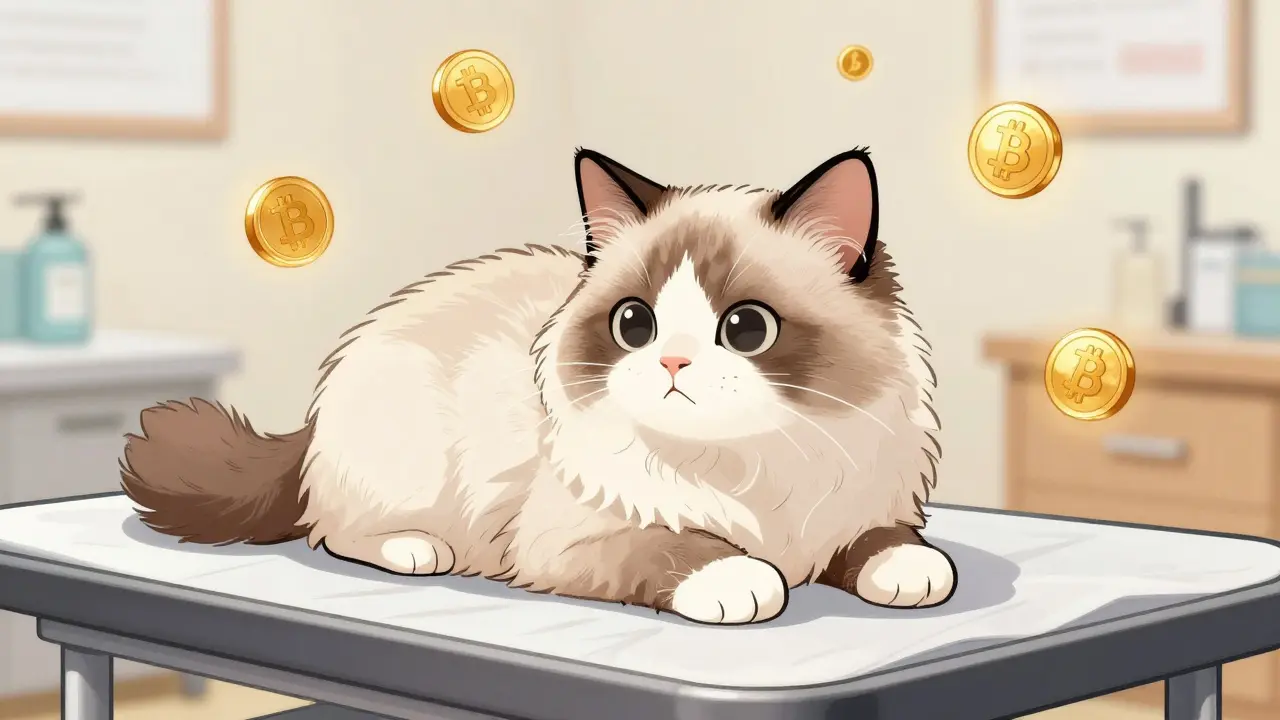
Imagine a token built around a paralyzed Ragdoll cat who needed $70,000 in surgery. That's the story behind Mr Mayonnaise the Cat (MAYO), a community-driven cryptocurrency token launched to fund veterinary care and challenge soaring medical costs for pets. Also known as MAYO Token, this digital asset sits at the intersection of meme culture and humanitarian aid. While many crypto projects promise the moon, this one started with a very grounded, very urgent need: saving a neighborhood cat named Mr. Mayonnaise from a life-threatening tick bite.
If you are scrolling through a list of new coins and stumbled upon MAYO, you are probably wondering if this is a legitimate investment or just another internet joke. The reality is a mix of both. It operates on the Ethereum blockchain platform that supports smart contracts and decentralized applications network as an ERC-20 technical standard used for implementing tokens on the Ethereum blockchain token, which gives it technical legitimacy but doesn't guarantee financial stability. By October 2025, the token had established a fixed supply of 1 billion units, but its market behavior tells a story of extreme volatility and very low liquidity. Before you consider swapping your hard-earned dollars for MAYO, you need to understand exactly what you are buying into, the risks involved, and whether the charitable mission holds up to scrutiny.
The Story Behind the Token
The genesis of the MAYO token isn't about complex algorithms or whitepapers filled with jargon. It began with a real-life crisis. Mr. Mayonnaise, a Ragdoll cat, suffered a severe tick bite that left him paralyzed. The veterinary treatment required to save him cost $70,000. This is a staggering amount for most pet owners, highlighting a broader issue in the pet care industry where emergency surgeries can bankrupt families. The anonymous developers behind the token claimed they launched it as a "declaration that enough is enough" regarding these costs.
According to reports from late 2024, the developers positioned the project as a way to leverage technology for compassion. One developer stated, "We're leveraging technology to challenge the soaring costs of veterinary care and to empower those in need." This narrative resonated with crypto communities that often look for projects with a "good cause" angle. Unlike standard meme coins that exist solely for speculation, MAYO was marketed with a specific goal: funding veterinary care, developing blockchain-based pet health records, and supporting community empowerment.
However, the story doesn't end with the surgery. While reports from November 2024 indicated that the $70,000 in veterinary expenses for Mr. Mayonnaise were fully settled, the token's long-term roadmap includes more ambitious goals. These include creating NFT-based tamper-proof vaccination certificates and building a decentralized database for pet health records. This shift from a one-time donation drive to a broader infrastructure project is ambitious, especially given the token's current market standing.
Technical Specifications and Architecture
Under the hood, MAYO is a standard utility token built on the Ethereum blockchain. This means it inherits the security and transparency of Ethereum but also suffers from its limitations, such as network congestion and gas fees. As an ERC-20 token, it is compatible with most major crypto wallets, including MetaMask a popular software cryptocurrency wallet used to interact with the Ethereum blockchain and Trust Wallet a mobile cryptocurrency wallet that supports multiple blockchains and assets. This compatibility makes it relatively easy to acquire and store, provided you know how to navigate decentralized exchanges.
The tokenomics are straightforward but reveal some red flags for serious investors. The total supply is fixed at 1,000,000,000 tokens. There is no information suggesting a mechanism for burning tokens or expanding supply, which theoretically prevents inflation. However, the distribution of these tokens is not fully transparent. The contract lacks renounced ownership according to verification tools like DEXTools as of October 2025. This means the developers still hold control over the contract, which raises centralization concerns. In the crypto world, a renounced contract is often seen as a trust signal because it prevents the developers from changing the rules or draining funds later.
Furthermore, the token's presence on major data aggregators is inconsistent. While it appears on platforms like DEXScreener and DEXTools, its ranking on major indices like CoinMarketCap is outside the top 10,000. On CoinGecko, it held a rank of #12,847 as of mid-2025. This low ranking indicates that it is a micro-cap asset, meaning the total value of all tokens in circulation is very small compared to established cryptocurrencies like Bitcoin or Ethereum.
Market Performance and Liquidity Reality
When looking at the price action, the numbers paint a picture of a struggling asset. As of October 2025, the price hovered around $0.000045 to $0.000080 depending on the exchange. This price range is incredibly low, which is common for meme coins, but the liquidity situation is the real issue. Liquidity refers to how easily you can buy or sell an asset without affecting its price significantly.
For MAYO, liquidity is extremely thin. Data from Binance showed $0 USD in trading volume on certain days, while CoinGecko reported a volume of only $93.43 on other days. To put that in perspective, a single large trade could move the price by 50% or more. This creates a situation known as "slippage." If you try to sell a significant amount of MAYO tokens, the lack of buyers means you might have to accept a much lower price than the one you see listed. Users on DEXTools have reported slippage eating up to 98% of their value when trying to swap large amounts.
Volatility is another factor. The token has shown price swings of 20-30% within a single day. While this sounds exciting for traders looking for quick gains, it is a nightmare for long-term holders. Technical analysis from October 2025 showed a 14-Day Relative Strength Index (RSI) of 27.79, which is below the 30 threshold. In technical trading terms, this indicates the asset is "oversold," meaning it has dropped significantly and might be due for a rebound, but it could also indicate a lack of buying interest and continued downward pressure.
| Feature | Mr Mayonnaise (MAYO) | Standard Charity Tokens (e.g., DOGE4CHARITY) |
|---|---|---|
| Primary Focus | Veterinary Care & Pet Health | General Humanitarian Aid |
| Blockchain | Ethereum (ERC-20) | Varies (often Bitcoin or Ethereum) |
| Market Cap | ~$44,800 (Micro-Cap) | Millions to Billions |
| Transparency | Limited (No public audits) | High (Verified Nonprofit Partners) |
| Liquidity | Very Low (High Slippage) | Moderate to High |
Charitable Mission and Transparency
The core selling point of MAYO is its charitable intent. The developers claim the token integrates humanitarian values into its foundation. The initial goal was to fund Mr. Mayonnaise's surgery, which was reportedly achieved. However, the sustainability of this model is questionable. Unlike established charity platforms like The Giving Block, which have verified nonprofit partnerships and legal structures, MAYO lacks a verifiable organizational entity. The website referenced in early reports provides no legal entity details, making it difficult to trace where funds are actually going after the initial surgery.
There is no whitepaper publicly accessible that outlines the long-term financial plan for the charity aspect. Financial audits of charitable distributions are not published. This lack of transparency is a common red flag in the crypto space. While the community has seen proof of the initial $70,000 payment to the vet, future claims about funding other veterinary cases or developing pet health records remain unverified. Without third-party verification, investors are essentially trusting the developers' word.
Despite these gaps, the community sentiment remains divided. On Reddit, some users praised the verified vet bills, calling it "kinda cool," while others warned that the tokenomics looked shaky. This split highlights the tension between the emotional appeal of the story and the rational assessment of the financial product. If you are buying MAYO, you are likely doing so more for the cause or the meme potential than for solid financial returns.
Risks and Warnings for Investors
Investing in micro-cap tokens like MAYO carries extreme risk. The Messari Micro-Cap Token Report from October 2025 categorized MAYO as "Tier 4 (Extreme Risk)." This classification is due to insufficient liquidity, unverified charitable claims, and no sustainable tokenomics. If you invest money you cannot afford to lose, you might be okay, but expecting a return is speculative at best.
One major risk is the potential for a "rug pull." This is a scam where developers abandon the project and run away with the funds. While MAYO has shown some legitimacy by paying the vet bills, the fact that the contract ownership is not renounced means the developers could technically alter the token's behavior. Additionally, the lack of major exchange listings means you cannot easily sell the tokens on a regulated platform like Coinbase or Binance (centralized). You are limited to decentralized exchanges like Uniswap a decentralized exchange protocol for automated trading of cryptocurrencies, which requires technical knowledge to use safely.
Regulatory scrutiny is another looming threat. Because the token makes claims about charitable fundraising, it could potentially be scrutinized by bodies like the SEC as a security. If regulators decide it is an unregistered security, the token could be delisted or frozen, rendering it worthless. Currently, no legal opinions on compliance status are publicly available, leaving investors in a gray area.
How to Acquire MAYO Tokens
If you decide to proceed despite the risks, the process is relatively straightforward but requires a few steps. First, you need a cryptocurrency wallet that supports ERC-20 tokens. MetaMask is the most common choice for desktop users, while Trust Wallet is popular on mobile devices. Once your wallet is set up, you will need Ethereum (ETH) to pay for the transaction fees (gas) and to swap for MAYO.
Next, navigate to a decentralized exchange like Uniswap. Connect your wallet to the platform. You will need to find the contract address for MAYO to ensure you are swapping for the correct token, as fake tokens with similar names are common. Once you enter the amount of ETH you want to swap, be prepared to set a high slippage tolerance, typically between 15% and 25%, due to the low liquidity. This setting allows the trade to go through even if the price moves significantly during the transaction.
Documentation for the project is minimal, consisting mostly of social media channels and basic exchange listings. There are no developer guides or API access. Community support is available through Telegram and Twitter, but response times can be slow, averaging 8-12 hours. This lack of support infrastructure means you are largely on your own if you encounter issues with your transaction.
Comparison with Other Pet and Charity Tokens
MAYO operates in a niche segment of the market often referred to as "charity meme coins." It faces competition from tokens like Dogecoin for Charity (DOGE4CHARITY) and Save the Children Coin (STC). However, MAYO's specific narrative focus on veterinary care differentiates it from broader charity tokens. Established platforms like PawBoost, which raised $4.2M in Series A funding in July 2025, offer more robust solutions for pet fundraising but do not use a speculative token model.
Another competitor is PetCoin, which had a market cap of $2.1M as of September 2025. PetCoin has a more established presence and higher liquidity, making it a safer option for those interested in the pet crypto sector. MAYO's advantage is its specific story and the emotional connection to Mr. Mayonnaise, but its disadvantage is the lack of infrastructure and liquidity. If you are looking for a token that might have a sustainable future in the pet tech space, established projects with higher market caps generally offer more security.
Future Outlook and Viability
Looking ahead to 2027, projections for MAYO vary dramatically. Some analysts forecast the token reaching $0.00009440, which is a 17.4% increase from 2025 levels. However, other data points, such as the $0 trading volume on Binance, suggest a risk of delisting. Long-term viability depends heavily on the project's ability to maintain charitable credibility without transparent financial reporting.
The roadmap includes NFT-based vaccination certificates, which is a potentially useful application of blockchain technology. If the team can deliver on this, it could add utility to the token beyond speculation. However, given the current low engagement levels (Telegram groups show only 12-15 daily messages), the momentum required to build such a platform is missing. The token remains a speculative instrument for micro-cap traders rather than a mainstream financial asset.
Ultimately, MAYO is a unique experiment in the crypto world. It combines the viral potential of a meme coin with a genuine humanitarian story. Whether it succeeds as a long-term project or fades into obscurity like many other micro-caps depends on the developers' ability to prove transparency and build a sustainable ecosystem. For now, it remains a high-risk, high-reward play that requires a cautious approach.
Is Mr Mayonnaise the Cat (MAYO) a legitimate investment?
MAYO is a legitimate token in the sense that it exists on the Ethereum blockchain and has a contract address. However, as an investment, it carries extreme risk due to low liquidity, lack of regulatory compliance, and unverified charitable claims. It is classified as a micro-cap asset with high volatility.
Where can I buy MAYO tokens?
MAYO tokens are primarily traded on decentralized exchanges (DEX) like Uniswap. You will need an Ethereum wallet (like MetaMask) and ETH to pay for transaction fees. It is not listed on major centralized exchanges like Coinbase or Binance in a way that allows easy fiat on-ramps.
How much was the vet bill for Mr. Mayonnaise?
The veterinary treatment for Mr. Mayonnaise cost $70,000. Reports from late 2024 indicate that the token's initial fundraising goal was to cover this specific expense, which was reportedly settled.
What blockchain does MAYO use?
MAYO is an ERC-20 token, which means it operates on the Ethereum blockchain. This allows it to be stored in Ethereum-compatible wallets and traded on Ethereum-based decentralized exchanges.
Is the MAYO token contract ownership renounced?
No, verification data from October 2025 shows that the token's contract lacks renounced ownership. This means the developers still retain control over the contract, which is a centralization risk for investors.
What is the total supply of MAYO tokens?
The total supply of MAYO tokens is fixed at 1,000,000,000 (1 billion) tokens. There is no public information suggesting a mechanism for expanding this supply.
Can I sell MAYO tokens easily?
Selling MAYO tokens can be difficult due to extremely low liquidity. Users have reported high slippage, meaning you might receive significantly less value than the listed price when selling large amounts.
Does MAYO have a whitepaper?
No, there is no publicly accessible whitepaper for the MAYO token. Documentation is limited to social media channels and basic exchange listings, which raises transparency concerns.
What is the current market cap of MAYO?
As of October 2025, the market capitalization was approximately $44,803 USD. This classifies it as a micro-cap cryptocurrency with very limited market depth.
Is MAYO a charity token?
MAYO is marketed as a charity meme coin aimed at funding veterinary care. However, it lacks the transparent organizational structure and verified audits of established charity platforms.
15 Responses
The ERC-20 standard implementation is fundamentally sound!!! The smart contract architecture supports decentralized applications network as an ERC-20 technical standard used for implementing tokens on the Ethereum blockchain token which gives it technical legitimacy!!! However the market behavior tells a story of extreme volatility and very low liquidity!!! One must understand exactly what you are buying into the risks involved and whether the charitable mission holds up to scrutiny!!!
I agree with the technical assessment regarding the Ethereum blockchain platform but the financial stability is questionable. The tokenomics are straightforward but reveal some red flags for serious investors regarding the total supply. There is no information suggesting a mechanism for burning tokens or expanding supply which theoretically prevents inflation. However the distribution of these tokens is not fully transparent to the public eye. The contract lacks renounced ownership according to verification tools like DEXTools. This means the developers still hold control over the contract which raises centralization concerns for everyone. In the crypto world a renounced contract is often seen as a trust signal because it prevents the developers from changing the rules or draining funds later.
It is interesting to see a project trying to merge meme culture with humanitarian aid. The story of the paralyzed Ragdoll cat is genuinely touching and highlights a real issue. Many pet owners face these staggering costs during emergency surgeries. The token was marketed with a specific goal of funding veterinary care and supporting community empowerment. However the long-term roadmap includes more ambitious goals like NFT-based vaccination certificates. This shift from a one-time donation drive to a broader infrastructure project is ambitious. The token's presence on major data aggregators is inconsistent at best. While it appears on platforms like DEXScreener its ranking on major indices is outside the top 10,000. This low ranking indicates that it is a micro-cap asset with very small value. When looking at the price action the numbers paint a picture of a struggling asset.
Looks like another rug pull waiting to happen.
I totally agree with you on that point. The lack of transparency is really scary for investors. It feels like the developers are hiding something important. We should be very careful with our money here.
The emotional appeal of the story is strong but the rational assessment of the financial product is weak. If you are buying MAYO you are likely doing so more for the cause or the meme potential than for solid financial returns. The core selling point of MAYO is its charitable intent but the sustainability of this model is questionable. Unlike established charity platforms there is no verifiable organizational entity. The website referenced in early reports provides no legal entity details. There is no whitepaper publicly accessible that outlines the long-term financial plan for the charity aspect. Financial audits of charitable distributions are not published at all. This lack of transparency is a common red flag in the crypto space. While the community has seen proof of the initial $70,000 payment to the vet future claims remain unverified. Without third-party verification investors are essentially trusting the developers word.
aww the cat is so cute!! 😺🐱 i hope he gets better soon but the coin looks risky. 😬💸
They are definitely hiding something behind the scenes. The anonymous developers claim they launched it as a declaration but it feels like a setup. Regulatory scrutiny is another looming threat for this token. Because the token makes claims about charitable fundraising it could potentially be scrutinized by bodies like the SEC. If regulators decide it is an unregistered security the token could be delisted or frozen. Currently no legal opinions on compliance status are publicly available. This leaves investors in a gray area with no protection. The potential for a rug pull is high given the unrenounced ownership. Developers could technically alter the token behavior at any moment. The lack of major exchange listings means you cannot easily sell the tokens on a regulated platform.
Exactly! The risk is too high for normal people. You are limited to decentralized exchanges like Uniswap which requires technical knowledge. This lack of support infrastructure means you are largely on your own if you encounter issues. The documentation for the project is minimal consisting mostly of social media channels. There are no developer guides or API access for anyone. Community support is available through Telegram but response times can be slow. Averaging 8-12 hours is too long for urgent crypto issues. People should stay away from this until there is more proof.
I understand the desire to help the cat but investing is different from donating. The Messari Micro-Cap Token Report categorized MAYO as Tier 4 Extreme Risk. This classification is due to insufficient liquidity and unverified charitable claims. If you invest money you cannot afford to lose you might be okay. But expecting a return is speculative at best. The token remains a speculative instrument for micro-cap traders rather than a mainstream financial asset. Ultimately MAYO is a unique experiment in the crypto world. It combines the viral potential of a meme coin with a genuine humanitarian story. Whether it succeeds as a long-term project or fades into obscurity depends on the developers. For now it remains a high-risk high-reward play that requires a cautious approach.
Looking ahead to 2027 projections for MAYO vary dramatically. Some analysts forecast the token reaching $0.00009440 which is a 17.4% increase from 2025 levels. However other data points suggest a risk of delisting. Long-term viability depends heavily on the project ability to maintain charitable credibility. The roadmap includes NFT-based vaccination certificates which is a potentially useful application. If the team can deliver on this it could add utility to the token beyond speculation. However given the current low engagement levels the momentum required to build such a platform is missing. The token remains a speculative instrument for micro-cap traders rather than a mainstream financial asset.
the volatility is insane. slippage eats up to 98% of value. contract ownership not renounced is bad. liquidity is thin. price swings 20-30% daily. rsi is oversold. no whitepaper. limited transparency. micro-cap asset. high risk. avoid if you want safety. market cap is tiny. not on major exchanges. developers control contract. trust is low.
The token is built on the Ethereum blockchain which means it inherits the security and transparency of Ethereum. It also suffers from limitations such as network congestion and gas fees. As an ERC-20 token it is compatible with most major crypto wallets including MetaMask and Trust Wallet. This compatibility makes it relatively easy to acquire and store provided you know how to navigate decentralized exchanges. The total supply is fixed at 1,000,000,000 tokens with no information suggesting a mechanism for burning tokens. However the distribution of these tokens is not fully transparent to the public. The contract lacks renounced ownership according to verification tools like DEXTools. This means the developers still hold control over the contract which raises centralization concerns. In the crypto world a renounced contract is often seen as a trust signal because it prevents the developers from changing the rules or draining funds later.
It is great that the community came together to fund the surgery. The initial goal was to fund Mr. Mayonnaise surgery which was reportedly achieved. However the sustainability of this model is questionable for the future. Unlike established charity platforms there is no verifiable organizational entity. The website referenced in early reports provides no legal entity details. There is no whitepaper publicly accessible that outlines the long-term financial plan. Financial audits of charitable distributions are not published at all. This lack of transparency is a common red flag in the crypto space. While the community has seen proof of the initial payment future claims remain unverified. Without third-party verification investors are essentially trusting the developers word. Despite these gaps the community sentiment remains divided on Reddit. Some users praised the verified vet bills calling it kinda cool. Others warned that the tokenomics looked shaky and risky. This split highlights the tension between the emotional appeal of the story and the rational assessment. If you are buying MAYO you are likely doing so more for the cause than for solid financial returns.
The technical architecture here is quite fascinating for a meme coin. It operates on the Ethereum blockchain which is standard for most tokens. However the liquidity situation is very concerning for anyone holding. You see a lot of volatility in these micro-cap assets regularly. The slippage can eat up your entire investment quickly during a trade. Many people forget to check the contract ownership status before buying. If the developers hold the keys they can change rules at any time. That is a significant risk factor for long term holders specifically. The charitable aspect is nice but lacks verification from third parties. There are no public audits for the fund distribution currently. Trusting a team without a whitepaper is dangerous in this space. I have seen similar projects fail in the past due to these issues. The market cap is too small for stability in the long run. Institutional investors will likely avoid this token completely. Only buy if you are prepared to lose everything you put in. It is better to donate directly if you want to help the cat. The token is more of a gamble than a donation tool. People should read the risks carefully before swapping dollars. The lack of major exchange listings means you cannot easily sell the tokens. You are limited to decentralized exchanges like Uniswap which requires technical knowledge. This lack of support infrastructure means you are largely on your own. Documentation for the project is minimal consisting mostly of social media channels. There are no developer guides or API access for anyone to use. Community support is available through Telegram but response times can be slow. Averaging 8-12 hours is too long for urgent crypto issues. The token remains a speculative instrument for micro-cap traders. Whether it succeeds depends on the developers ability to prove transparency.