
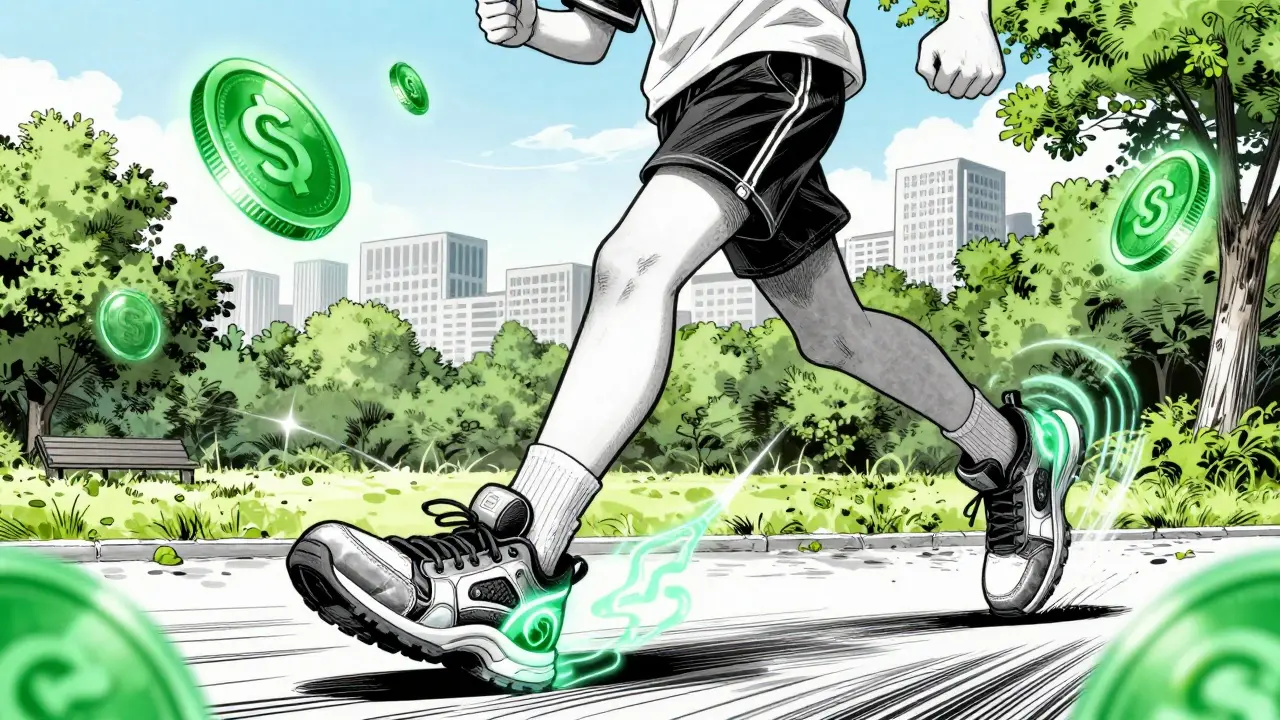
Imagine getting paid just for taking a walk around the block or jogging in the park. That's the core promise of Green Satoshi Token is the primary utility currency used within the STEPN ecosystem, a pioneer in the move-to-earn (M2E) movement. Also known as GST, this token turns physical activity into a digital asset, rewarding users for maintaining a healthy lifestyle. While the hype has shifted since its explosive debut, GST remains the fuel for one of the most ambitious Web3 lifestyle experiments to date.
How GST Works Within the STEPN Ecosystem
To understand GST, you first have to understand STEPN is a Web3 lifestyle application that uses NFTs and blockchain technology to incentivize fitness . You don't just download an app; you buy or rent NFT sneakers. These digital shoes are the keys to earning. Depending on how you use the app, you can generate GST in three different ways:
- Solo Mode: This is the bread and butter of the app. You walk, jog, or run, and the app tracks your movement via GPS. The more you move and the rarer your sneakers are, the more GST you earn.
- Marathon Mode: Think of this as a competitive event. Users register for weekly or monthly marathons to compete against others for a larger pool of rewards.
- Background Mode: This is for the passive earners. As long as you own a pair of sneakers, you earn a small amount of GST even when the app is closed, without wearing down your shoes' durability.
It's a clever loop: the app encourages you to move, rewards you with tokens, and then asks you to spend those tokens to keep your digital gear in top shape.
The Technical Side: Solana and BNB Chain
For a move-to-earn app to work, transactions need to be nearly instant and incredibly cheap. You can't wait ten minutes for a block to confirm just to repair a digital shoe. That's why GST was built on Solana is a high-performance blockchain known for its massive throughput and low transaction fees . The speed of the Solana network allows STEPN to process thousands of micro-transactions per second without eating up the user's profits in gas fees.
As the community grew, the developers expanded. In May 2022, GST was integrated into the BNB Chain is a blockchain network developed by Binance that offers a low-cost alternative for smart contracts . By existing on both networks, GST became more accessible to a wider range of traders and wallets, though it did create some pricing discrepancies between the two versions of the token.
| Feature | Solana Version (Native) | BNB Chain Version (Bridge) |
|---|---|---|
| Transaction Speed | Ultra-Fast | Fast |
| Primary Use Case | In-game utility and rewards | Trading and accessibility |
| Ecosystem Integration | Deeply integrated with STEPN | Cross-chain liquidity |
The Economy: Why Does GST Have Value?
If a token is only given out as a reward, it naturally crashes in price because everyone is selling and no one is buying. To fight this, STEPN uses "burn mechanisms." A burn is when tokens are permanently removed from circulation, reducing supply to help stabilize the price. You have to spend GST to:
- Repair Sneakers: Every time you move, your NFT shoes lose durability. You must spend GST to fix them, or you stop earning.
- Mint New Shoes: Creating a new pair of sneakers from existing ones requires a significant GST payment.
- Upgrade Assets: Want your shoes to be faster or more efficient? You'll need GST to level them up.
- Unlock Gem Sockets: To add powerful gems to your shoes, you first have to pay GST to open the socket.
This creates a circular economy. The value of GST crypto coin isn't based on external utility-you can't buy a coffee with it-but on how much people want to improve their performance within the STEPN game.

Market Performance and the Volatility Trap
Looking at the price history of GST is like looking at a mountain range. In April 2022, the token hit an all-time high of $8.51. It was a gold rush; people were buying sneakers for thousands of dollars, expecting to earn a full-time salary just by walking. However, the reality of tokenomics hit hard. As more people joined, the supply of GST exploded, and the price plummeted.
By early 2026, the token has seen lows around $0.00143. While this looks grim, it reflects a shift from a speculative bubble to a more sustainable, though much smaller, community. Current trading volumes across exchanges like Coinbase, KuCoin, and Bybit show that there is still active interest, but the days of "get rich quick" walking are largely over. Most current users treat it more like a fitness gamification tool than a financial investment.
Sustainability and the "Green" in Green Satoshi
The name isn't just for show. One of the biggest criticisms of early crypto (like Bitcoin) was the massive energy consumption of mining. STEPN takes a different route. They focus on Carbon Removal Credits is certified instruments representing the removal of carbon dioxide from the atmosphere . A portion of the app's revenue from trading taxes and minting fees is used to purchase these credits.
The goal is a net-zero carbon footprint. By linking the act of walking (a zero-emission activity) with a financial reward that funds carbon removal, they've attempted to build a brand that appeals to the environmentally conscious generation. It's a strategic move to distance themselves from the "dirty" image of traditional Proof-of-Work blockchains.
Risks and Things to Watch Out For
Before jumping into GST, you need to be aware of the risks. The most glaring is the utility lock. GST is almost exclusively useful inside STEPN. If the app loses popularity or the developers change the rules, the token's value could vanish because it has no use case in the real world.
There's also the regulatory grey area. Because the app involves spending money (buying NFTs) to earn money (GST), some jurisdictions might view it as gambling or an unregistered security. While the token is listed on major exchanges, the legal landscape for GameFi is still a work in progress. Finally, the physical risk: we've seen stories of people ignoring safety or health warnings just to maximize their GST earnings. No amount of crypto is worth a serious injury.
Can I earn GST without buying NFT sneakers?
Generally, no. You need an NFT sneaker to earn GST. However, you can rent sneakers from other users through the STEPN marketplace, which allows you to earn a portion of the GST without paying the full price of a new pair.
What is the difference between GST and GST-SOL?
GST-SOL refers specifically to the token on the Solana blockchain. Because GST also exists on the BNB Chain, exchanges use these labels to differentiate which network the token is on, as prices and liquidity can vary between the two.
Is GST a good investment for 2026?
GST is highly volatile. While some predictions suggest a modest recovery toward $0.02 or $0.03 by 2028, it remains a high-risk asset. It is best viewed as a utility token for the game rather than a stable long-term investment.
How do I spend my GST tokens?
You spend GST within the STEPN app to repair your shoes, mint new sneakers, upgrade your shoe's level, or unlock sockets to insert gems that improve your earning rate.
Why did the price of GST drop so much from its peak?
The massive drop was caused by hyper-inflation. Since GST is printed every time someone walks, the supply grew much faster than the demand for the token, leading to a price collapse after the initial speculative bubble burst.
Next Steps for New Users
If you're just starting out, don't go all-in on the most expensive shoes. Start by exploring the rental market to see if you actually enjoy the move-to-earn loop. If you're a trader, keep a close eye on the BNB Chain vs. Solana price gap, as this often creates short-term volatility.
For those focused on fitness, treat the GST as a "bonus" for doing something healthy, rather than a primary income source. The most sustainable way to interact with this ecosystem is to prioritize your physical health first and the digital rewards second.