

Have you ever stumbled upon a cryptocurrency that shares its name with a famous physical business and wondered if they are connected? That is exactly what happens when you look up Coinstar, often listed under the ticker CSTAR. It is an on-chain asset issuance platform designed for Web3 projects to drive user acquisition and asset growth.
If you are here, you probably saw the symbol CSTAR on an exchange or heard about it in a crypto community. You might be asking: Is this the same company that runs those coin-counting kiosks at grocery stores? How does the token actually work? And more importantly, is it safe to invest in?
The short answer is no, there is no link between the kiosk company and this crypto project. But the details matter a lot if you plan to hold or trade these tokens. Let’s break down what Coinstar (CSTAR) really is, how its technology works, and what the current market data tells us about its risk profile.
Coinstar (CSTAR) vs. The Kiosk Company: Clearing Up the Confusion
First things first, we need to separate two completely different entities that happen to share a brand name. On one side, you have Coinstar, LLC, formerly known as Outerwall, Inc. This is a well-established American company that operates coin-cashing machines found in retail locations across the United States. As of 2019, these kiosks processed roughly $2.7 billion worth of coins annually. They help people turn loose change into cash, gift cards, or donations. Recently, they even launched a service called CINQ by Coinstar, which allows users to buy Bitcoin, Ethereum, Dogecoin, and Litecoin at their kiosks.
On the other side, you have Coinstar (CSTAR), the cryptocurrency we are discussing today. Despite the identical name, there is zero corporate or technical linkage between the kiosk operator and the CSTAR token. The kiosk company does not issue, support, or mention CSTAR in any of their official materials. When you see CSTAR on a crypto chart, you are looking at a standalone digital asset launched in 2025, entirely unrelated to physical coin counting.
This naming overlap can be tricky. If you are used to trusting the traditional Coinstar brand, do not assume that trust transfers automatically to the crypto token. In the world of decentralized finance, names are cheap, but verification is everything. Always check the contract address and the underlying protocol before buying anything.
What Does the Coinstar Platform Actually Do?
So, if it isn’t about counting pennies, what is the point of the Coinstar protocol? According to data from major aggregators like CoinMarketCap, Coinstar positions itself as infrastructure for user acquisition and asset-driven growth in the Web3 space.
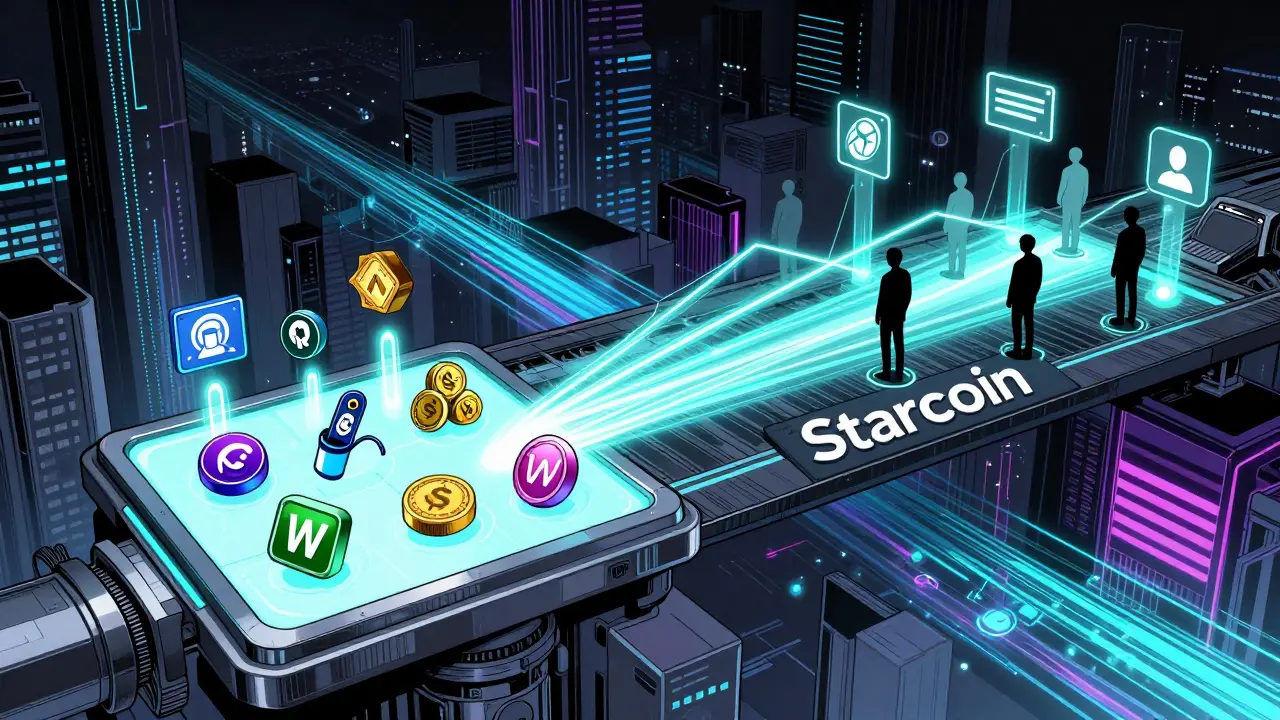
Here is how it works in simple terms. Many new Web3 projects struggle to find users. They have cool tokens, NFTs, or membership rights, but getting people to notice them is hard. Coinstar acts as a middleman or a distribution engine. Partner projects send their native assets-like tokens, non-fungible tokens (NFTs), or exclusive access passes-to the Coinstar platform.
Coinstar then repackages these diverse assets into its own native utility asset, referred to as Starcoin, which serves as the standardized medium for distributing partner assets to new users. By doing this, partners don’t need to build complex marketing campaigns from scratch. They leverage Coinstar’s existing "user pool" to reach high-quality new users. In return, Coinstar receives value from the partners and distributes Starcoin to facilitate these connections.
Think of it like a specialized launchpad or an advertising network, but instead of paying in dollars, the payment and reward system happens on-chain using standardized assets. The goal is to bridge three things: on-chain resources, user traffic, and asset value. It is a play on the growing market for tools that help crypto projects grow their communities without spending millions on traditional ads.
Technical Specs: BEP-20 on BNB Smart Chain
From a technical standpoint, knowing where a token lives is crucial for security and usability. Coinstar (CSTAR) is built on the BNB Smart Chain, also known as BSC. Specifically, it follows the BEP-20 token standard.
Why does this matter? Because BEP-20 is the industry standard for tokens on the Binance ecosystem. It means CSTAR is compatible with almost every major wallet that supports BNB Chain, such as Trust Wallet, MetaMask (configured for BSC), and the Binance Web3 Wallet. Transactions are fast and fees are generally low compared to networks like Ethereum Mainnet.
However, being a BEP-20 token doesn’t guarantee safety. Any developer can create a BEP-20 token in minutes. The key question is whether the smart contracts behind Coinstar have been audited. Currently, public listings on Coinbase, CoinGecko, and Bitget do not provide links to independent security audits, GitHub repositories, or formal verification reports. This lack of transparent technical documentation is a significant red flag for cautious investors. Without an audit, you are trusting the code blindly.
Tokenomics: Supply and Circulation Discrepancies
When evaluating any crypto asset, you need to understand the supply dynamics. For Coinstar (CSTAR), the numbers tell a story of inconsistency that requires careful attention.
| Platform | Total Supply | Max Supply | Circulating Supply | Data Reliability Note |
|---|---|---|---|---|
| CoinMarketCap | 1,000,000,000 | 1,000,000,000 | 1,000,000,000 | Self-reported by project; implies 100% circulation |
| Coinbase | 1,000,000,000 | 1,000,000,000 | 0 | No verified circulating data; treated as non-circulating |
| CoinGecko | 1,000,000,000 | N/A | Not explicitly stated | Price aggregated from 1 exchange/market |
As you can see, while everyone agrees the total maximum supply is fixed at 1 billion tokens, the circulating supply is a mess. CoinMarketCap says all 1 billion are out there. Coinbase says none are circulating. This discrepancy usually happens when a project launches but hasn’t established clear liquidity pools or trading volume that aggregators can verify independently. It suggests that the token might be heavily concentrated in a few wallets, or that trading activity is too thin to generate reliable data feeds.
Price Performance and Market Volatility
If you are looking at CSTAR for investment purposes, you need to brace yourself for extreme volatility. The available data from mid-2026 shows a pattern of sharp declines and inconsistent pricing across platforms.
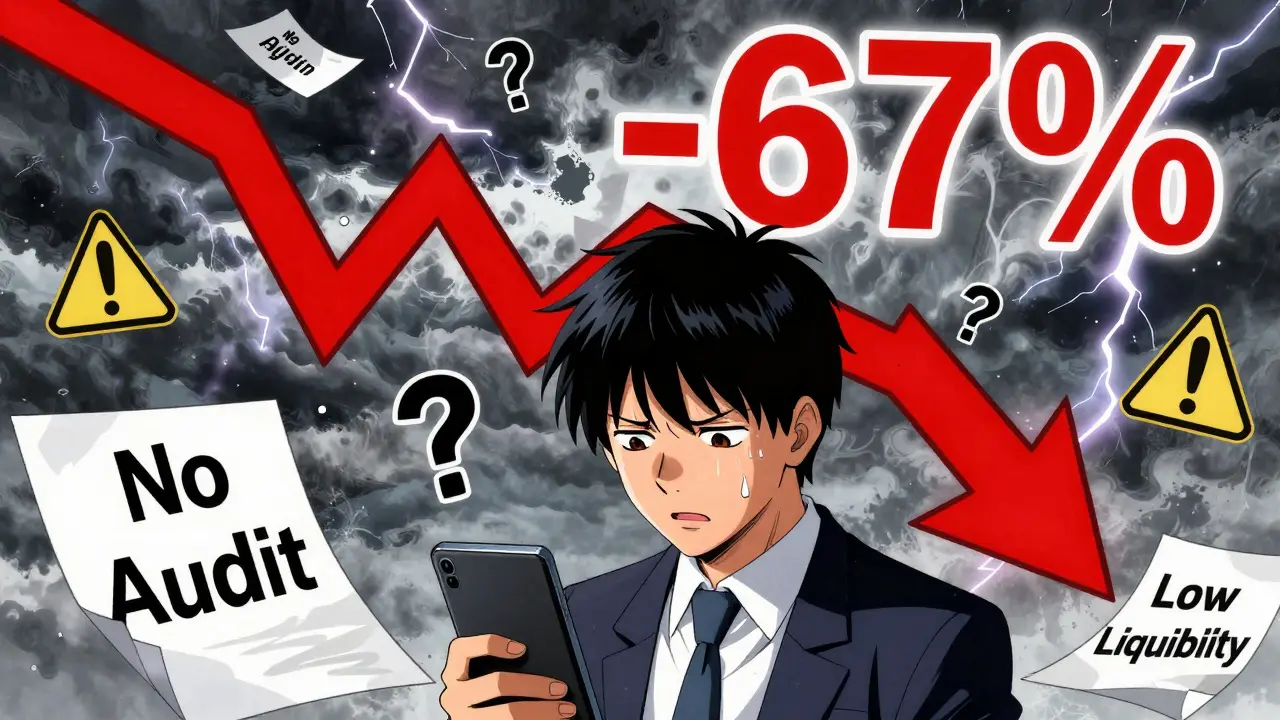
According to snapshots from Coinbase and CoinGecko, CSTAR has experienced daily drops of around -18% to -19% and weekly declines of approximately -66% to -67%. For context, losing two-thirds of your money in a week is catastrophic for most portfolios. This level of volatility is typical for micro-cap tokens with low liquidity.
Furthermore, the trading volume is modest. CoinGecko reported a 24-hour volume of roughly $526,979, but noted that this price is calculated from only one exchange and one market pair. When a token trades on just a single venue, it is highly susceptible to manipulation. A large sell order can crash the price instantly because there aren’t enough buyers to absorb the shock. Conversely, a small buy can spike the price artificially.
Bitget, another exchange listing CSTAR, sometimes shows placeholder data with prices at $0.00, despite having internal technical analysis levels. This further highlights the fragility of the data. You cannot rely on real-time charts from every source for this specific asset.
How to Buy and Trade Coinstar (CSTAR)
If you decide to proceed despite the risks, acquiring CSTAR follows standard procedures for BEP-20 tokens. Here are the two main paths based on current availability:
- Centralized Exchange (CEX): Platforms like Bitget list CSTAR for spot trading. To buy, you would register an account, complete identity verification (KYC), deposit fiat currency or another crypto, and then place a market or limit order for the CSTAR trading pair. This is the easiest method for beginners who want to avoid managing private keys directly.
- Decentralized via Binance Web3 Wallet: You can use the Binance App to access its integrated Web3 Wallet feature. After creating or importing a wallet and funding it with BNB (for gas fees), you can connect to decentralized exchanges (DEXs) on the BNB Smart Chain. From there, you swap BNB for CSTAR using liquidity pools. This method gives you direct custody of your tokens but requires careful handling of slippage settings and contract approvals.
Note that neither method guarantees instant liquidity. Due to the limited number of markets, you might encounter high slippage, meaning the price you see isn’t the price you get. Always double-check the transaction details before confirming.
Risks and Red Flags to Watch
Before you put any money into Coinstar (CSTAR), consider these critical risk factors:
- Lack of Audits: No public security audits are linked in major listings. Unaudited smart contracts carry a higher risk of bugs or hidden backdoors.
- Low Liquidity: Trading on a single exchange/market makes the price easy to manipulate and hard to exit quickly without crashing the value.
- Data Inconsistency: Conflicting circulating supply numbers indicate poor transparency or immature tracking.
- No Whitepaper or Roadmap: Major aggregators do not host a detailed whitepaper or development roadmap. Without a clear vision or team disclosure, it is hard to assess long-term viability.
- Brand Confusion: The name overlap with the legitimate kiosk company could be seen as misleading marketing, even if unintentional.
In the crypto world, "trust me bro" projects often start with hype and end with silence. Coinstar (CSTAR) currently lacks the foundational documentation that serious investors look for. Treat it as a high-speculative asset, not a stable investment.
Is Coinstar (CSTAR) related to the coin-counting machine company?
No. There is no corporate or technical relationship between the cryptocurrency Coinstar (CSTAR) and Coinstar, LLC, the company that operates physical coin-cashing kiosks. They are entirely separate entities that share a similar name.
Which blockchain does Coinstar (CSTAR) run on?
Coinstar (CSTAR) is a BEP-20 token that operates on the BNB Smart Chain (BSC). This means it is compatible with wallets and decentralized exchanges that support the Binance ecosystem.
What is the total supply of CSTAR tokens?
The total and maximum supply of Coinstar (CSTAR) is fixed at 1,000,000,000 (1 billion) tokens. However, data regarding the circulating supply varies significantly between platforms, with some reporting 1 billion and others reporting zero.
Where can I buy Coinstar (CSTAR)?
You can trade CSTAR on centralized exchanges like Bitget. Alternatively, you can acquire it through decentralized exchanges (DEXs) by using the Binance Web3 Wallet to swap BNB for CSTAR on the BNB Smart Chain.
Is Coinstar (CSTAR) a safe investment?
CSTAR carries high risk due to extreme price volatility, low liquidity, lack of security audits, and inconsistent data reporting. It should only be considered by investors who understand and can afford to lose the entire amount invested.
What is the purpose of the Coinstar platform?
The platform aims to serve as infrastructure for Web3 user acquisition. It helps partner projects distribute their assets (tokens, NFTs, memberships) efficiently by repackaging them into a standardized format called Starcoin to attract new users.
19 Responses
lol another scam token trying to ride the coattails of a legit business name 🤡
i mean seriously who falls for this crap? its always the same playbook dump and run
people are so gullible they think because its on bsc its safe 😂
just burn your money faster
You people really need to educate yourselves before commenting like idiots. The concept of asset-driven growth is sophisticated.
It's not just about counting coins it's about leveraging liquidity pools for user acquisition metrics which most of you wouldn't understand if i explained it in simple terms.
The fact that you're complaining about volatility shows your lack of financial literacy.
There is a deeper philosophical question here about identity in the digital age. When two entities share a name but exist in completely different realities, what does that say about our perception of truth?
We project trust onto symbols without examining the underlying substance. It is a mirror reflecting our own desire for stability in a chaotic market. 🌌
Hey guys just wanted to add that checking the contract address is super important as mentioned in the post.
I always double check before buying anything new especially with these naming confusions. Hope everyone stays safe out there!
This article is dangerously misleading by even giving this token airtime. You are enabling fraudsters by providing them with educational content.
If I were you I would remove this immediately to avoid liability. Do not pretend to be neutral when discussing obvious scams.
I totally get why people are confused though! It’s really tricky when names overlap like that.
Just take it one step at a time and verify everything yourself. You’ve got this!
im not sure i trust any of this data tho. the circulating supply numbers are all over the place which makes me nervous.
why would coinmarketcap say 1 billion and coinbase say zero? thats sketchy af
you think you know whats going on but you dont. the real story is hidden in the blockchain metadata that nobody reads. i bet the devs are washing their hands clean while we argue here
its all a simulation anyway
I have been following similar projects on BSC for quite some time now and it seems to me that the lack of audits is indeed a significant concern that cannot be overlooked by anyone who values their capital preservation strategies.
Furthermore, the discrepancy in supply data suggests that the team may not have established proper communication channels with major aggregators, which leads to confusion among retail investors who are looking for clarity and transparency in an otherwise opaque market environment where information asymmetry is prevalent.
Wake up sheeple! This is part of the great reset crypto narrative. They want you to buy CSTAR so they can track your spending habits through the kiosk connection even though they claim there isn't one.
Its a psyop designed to drain your wallets into black holes controlled by central banks. Don't fall for it the volatility is engineered to keep you addicted to checking prices every five minutes.
Listen up folks. If you don't have the stomach for 66% weekly drops then stay away from micro-caps. This is how you learn risk management.
Don't come crying to me when you lose money because you didn't do your due diligence on liquidity depth.
Bros listen to me right now. The BEP-20 standard is just a wrapper. What matters is the smart contract logic behind the Starcoin utility mechanism.
If you understand the gas optimization techniques used here you will see the alpha. Most degens are too dumb to read code so they miss the opportunity. Get in before the whale accumulation phase ends.
It is imperative to note that the absence of a whitepaper constitutes a fundamental breach of fiduciary duty expectations in traditional finance adapted to decentralized protocols.
Investors should exercise extreme caution as the regulatory landscape continues to evolve regarding unregistered securities offerings disguised as utility tokens.
I agree with the points made about the risks. We should all be careful and not rush into buying without verifying the sources.
Let's support each other by sharing accurate information instead of spreading fear or greed.
I am curious about the technical implementation of the Starcoin repackaging process. How exactly does the platform ensure that partner assets are fairly valued during the conversion?
Is there an oracle involved or is it purely based on manual input by the project teams?
Typical foreign scam targeting american victims. These indian devs always copy western brand names to trick unsuspecting patriots into losing their hard earned dollars. 🇺🇸
Stay woke and keep your money in gold not these digital ponzi schemes
boring article. i already knew it was a scam. why do u bother writing long posts about shitcoins? waste of my time tbh
Stop making excuses for bad coding practices. If you cannot provide an audit you do not deserve to operate in this space.
Take responsibility for your actions and secure your contracts or shut it down.
It is interesting to observe how the market reacts to ambiguity. Perhaps the true value lies not in the token itself but in the community's ability to discern truth from fiction.
We must remain balanced in our approach neither succumbing to hype nor despair.