
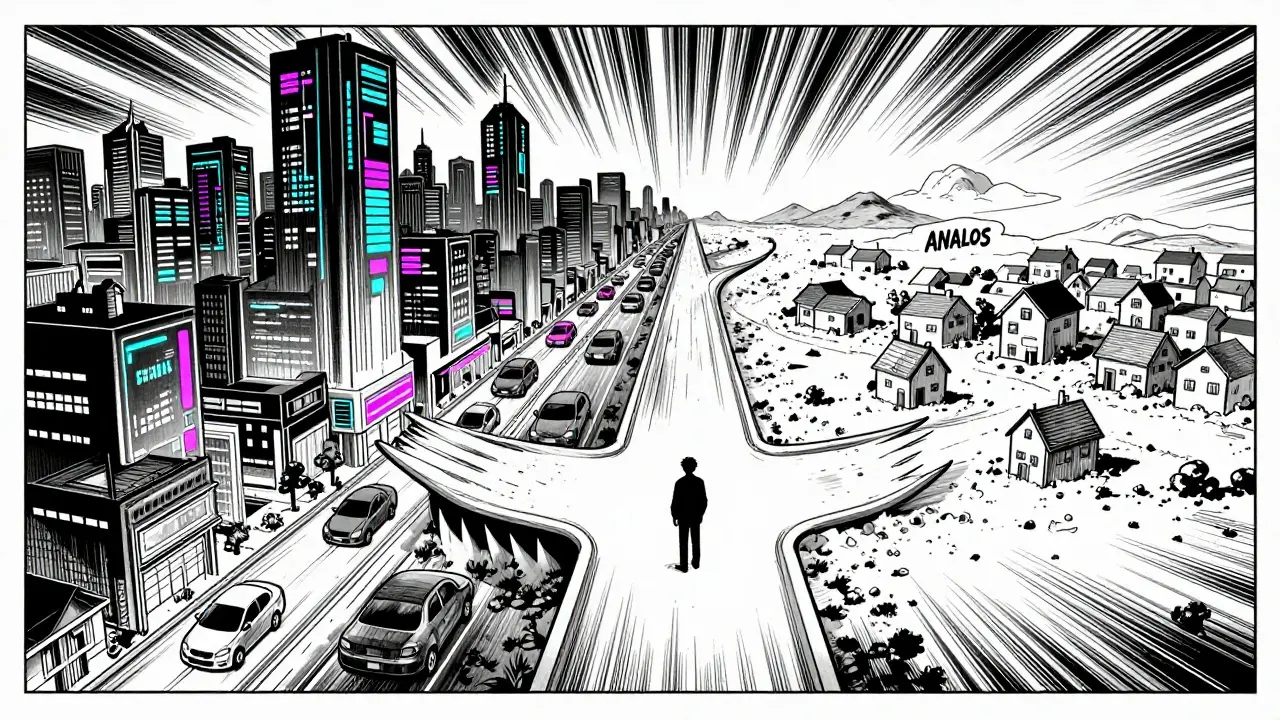
You’ve probably seen the ticker LOS pop up on a screen and wondered what it actually does. It’s not Bitcoin. It’s not Ethereum. And despite its name sounding like a major tech giant, it’s not Apple or Amazon either. ANALOS (LOS) is a cryptocurrency project launched as a complete fork of the Solana blockchain, aiming to build a self-contained ecosystem with native tools like a wallet, exchange, and explorer. In simple terms, it’s an attempt to copy the architecture of one of the world’s fastest blockchains and run it independently.
But here is the hard truth you need to know before you buy: this is a high-risk, low-liquidity asset. As of late 2025, it sits outside the top 3,000 cryptocurrencies by market cap. There is no famous founder attached to it, and there are very few real-world users. If you are looking for the next big thing that will make you rich overnight, this might not be it. But if you are curious about how blockchain forks work and why some projects fail while others succeed, ANALOS is a perfect case study.
The Core Concept: What Is a Blockchain Fork?
To understand ANALOS, you first have to understand what a "fork" is in the crypto world. Imagine a popular restaurant, let’s call it Solana. It has great food (fast transactions), reasonable prices (low fees), and a loyal customer base. Now, imagine a group of people takes the recipe book, copies it exactly, and opens a new restaurant right down the street called ANALOS.
This is what happened technically. Solana is a high-performance Layer 1 blockchain known for its speed and low transaction costs, serving millions of users daily. ANALOS took Solana’s underlying code-the rules that allow computers to agree on data without a central bank-and built its own separate network. The goal was to create a "vertical" ecosystem. Instead of relying on third-party apps to manage your money or trade tokens, ANALOS promised to build everything itself: the wallet, the bridge to move funds, the decentralized exchange (DEX), and even the launchpad for new coins.
Why do this? The creators argued that having all these tools native to the chain would make it smoother for developers and users. However, copying code is easy; building a community is hard. Most forks fail because they don’t solve a problem that the original network didn’t already solve better.
Technical Breakdown: How Does LOS Work?
Let’s look under the hood. The LOS Token is the native currency of the ANALOS blockchain, used to pay for transaction fees, staking rewards, and governance within its specific ecosystem. Here is how the technical pieces fit together:
- Native RPC System: This is the communication layer that lets wallets talk to the blockchain. ANALOS built its own to ensure independence from Solana’s infrastructure.
- Dedicated Wallet: A digital purse specifically designed to hold LOS and interact with ANALOS dApps (decentralized applications).
- Blockchain Explorer: A website where you can track transactions, verify addresses, and see the health of the network in real-time.
- Decentralized Exchange (DEX): A platform where users can swap LOS for other tokens directly on the network without a middleman like Binance.
On paper, this sounds robust. It’s a "full-stack" approach. But there is a catch. The technology relies heavily on the same proof-of-stake mechanism as Solana. This means validators stake their LOS tokens to secure the network. If there aren’t enough people staking, the network becomes vulnerable. Currently, with a circulating supply of nearly 1 billion tokens but a tiny market cap, the economic security of the network is thin compared to giants like Ethereum or Solana.
Market Reality: Price, Volume, and Liquidity
Data doesn’t lie, and the numbers for ANALOS are stark. Let’s look at the reality of trading this coin.
| Metric | ANALOS (LOS) | Solana (SOL) | Implication |
|---|---|---|---|
| Market Cap | ~$1.6 Million | ~$56 Billion | LOS is micro-cap; extreme volatility risk. |
| Ranking | #3,512+ | Top 5 | Low visibility and institutional interest. |
| 24h Volume | $5,894 - $0 | $2+ Billion | Hard to buy/sell large amounts without slippage. |
| Price Stability | Highly Volatile | Moderate | Prices swing wildly on small trades. |
Notice the volume? On some exchanges, the daily trading volume for LOS is less than $6,000. That is incredibly low. For context, if you tried to sell $10,000 worth of LOS at once, you could crash the price because there simply aren’t enough buyers waiting in the queue. This is called a liquidity crisis. It’s the biggest danger for holders of obscure forks.
Also, watch out for price discrepancies. One exchange might list LOS at $0.0016, while another lists it at $0.00006. This isn’t a glitch; it’s a sign that the markets are disconnected and inefficient. You might think you’re buying cheap, but you’re actually buying illiquid.

The Team and Transparency Issue
In crypto, who is behind the project matters. Bitcoin had Satoshi Nakamoto (anonymous but proven over time). Ethereum has Vitalik Buterin (public figure). Who runs ANALOS?
No one knows. The team is anonymous. While anonymity isn’t illegal, it raises red flags for several reasons:
- Accountability: If the smart contracts have bugs or if funds disappear, who do you sue? No one.
- Roadmap Execution: Anonymous teams often vanish when funding dries up. This is known as a "rug pull."
- Partnerships: Major companies rarely partner with faceless entities due to compliance risks.
There are no GitHub repositories showing active code commits from verified developers. There are no LinkedIn profiles of engineers working on the core protocol. This lack of transparency is a significant downside compared to established Layer 1 competitors.
Is ANALOS Better Than Solana? A Comparison
Since ANALOS is a fork, it claims to offer similar benefits: speed and low cost. But does it offer anything *more*?
Currently, the answer is mostly no. Solana has spent years building a massive developer ecosystem. Thousands of apps-from gaming platforms to DeFi protocols-run on Solana. Developers choose networks based on where the users are. Since almost all users are on Solana, developers stay on Solana. ANALOS tries to lure them away with a "built-in" ecosystem, but it lacks the network effect.
Think of it like social media. Facebook copied MySpace, but Facebook won because everyone moved there. Now, imagine a new site copies Facebook but has zero users. Why would you post your photos there? You wouldn’t. ANALOS faces this exact "chicken-and-egg" problem. Without users, developers don’t build apps. Without apps, users don’t join.

Future Outlook: Predictions and Risks
Some prediction sites, like Digital Coin Price, suggest LOS could reach $0.0147 by 2032. That sounds like a 10x return from its 2025 lows. But take these predictions with a grain of salt. These algorithms often assume linear growth and ignore the harsh reality of competition.
The real risks are:
- Obsolescence: If Solana improves its native tools (which it is doing), ANALOS loses its unique selling point.
- Regulatory Scrutiny: As governments tighten crypto laws, anonymous projects are often the first to be flagged or delisted from major exchanges.
- Security Vulnerabilities: New forks often have undiscovered bugs in their smart contracts. Hacking incidents are common in early-stage chains.
If you decide to invest, treat it as speculation, not investment. Never put in more than you can afford to lose completely. Use hardware wallets if possible, and be wary of phishing sites mimicking the official ANALOS portal.
How to Buy ANALOS (LOS) Safely
If you still want to proceed, here is the safest path. Do not use peer-to-peer transfers. Stick to reputable centralized exchanges that list the pair.
- Create an Account: Sign up on a major exchange like Bybit or Crypto.com. Complete identity verification (KYC) to protect your account.
- Deposit Funds: Add fiat currency (USD, NZD, etc.) or transfer stablecoins like USDT.
- Search for LOS: Look for the trading pair. Note that liquidity may be low, so check the order book depth.
- Execute Trade: Use a limit order rather than a market order to avoid slippage (paying more than expected due to low volume).
- Withdraw: If you plan to hold long-term, withdraw to a private wallet that supports the ANALOS network. Leaving assets on an exchange exposes you to exchange-specific risks.
Is ANALOS (LOS) a scam?
There is no definitive proof that ANALOS is a scam, but it carries high risk. The anonymous team, low liquidity, and lack of unique utility make it speculative. Always do your own research (DYOR) and never invest money you cannot afford to lose.
What is the difference between ANALOS and Solana?
ANALOS is a fork of Solana, meaning it uses similar code but operates as a separate blockchain. Solana has a massive user base, high liquidity, and thousands of apps. ANALOS is a smaller, independent chain with its own native tools but significantly fewer users and lower market value.
Can I mine ANALOS (LOS)?
No, you cannot mine LOS. Like Solana, ANALOS uses a Proof-of-Stake (PoS) consensus mechanism. Instead of mining with GPUs, participants "stake" their tokens to validate transactions and earn rewards.
Where can I store LOS tokens?
You should use a wallet that supports the ANALOS network. The project offers a native wallet, but for better security, consider using a multi-chain hardware wallet if it supports custom RPC endpoints for ANALOS. Never share your seed phrase with anyone.
Why is the price of LOS so volatile?
The price is volatile because of low trading volume and low market capitalization. With only thousands of dollars traded daily, a single large buy or sell order can drastically change the price. This is typical for micro-cap cryptocurrencies.