

Imagine walking into a town hall meeting where one person shows up with fifty clones. They all look different, wear different clothes, and sit in different seats, but they are all controlled by the same mind. When the vote starts, that single person wins every decision, not because they have more support, but because they have more voices.
This is exactly what happens in a Sybil attack, which is a cybersecurity threat where a single entity creates multiple fake identities to gain disproportionate control over a decentralized network. In the world of blockchain, this isn't science fiction. It is a fundamental vulnerability that threatens the very foundation of trust in peer-to-peer systems.
If you are new to crypto, you might assume that blockchain is unhackable because it is decentralized. But decentralization only works if the nodes (the computers running the network) are independent. If an attacker can flood the network with thousands of fake nodes, they can manipulate transactions, censor data, or even rewrite history. Understanding how this works is crucial for anyone holding digital assets or building on-chain applications.
The Origin of the Name and Concept
You might wonder why such a technical term sounds like a name from a novel. The concept was formally defined by Microsoft researchers Brian Zill and John R. Douceur in the early 2000s. They named it after the 1973 book Sybil, which documented the life of a woman diagnosed with Dissociative Identity Disorder (DID). Just as the patient had multiple distinct personalities within one body, a Sybil attacker has multiple distinct digital identities within one network.
In traditional centralized systems, like Facebook or Twitter, this problem is solved by requiring real-world verification-phone numbers, government IDs, or credit cards. This is known as "permissioned" access. However, blockchain networks are largely permissionless. Anyone can download the software, connect to the internet, and become a node. This openness is a feature, not a bug, but it leaves the door open for bad actors to spawn unlimited fake accounts without any cost.
How a Sybil Attack Works on Blockchain
To understand the mechanics, we need to look at how blockchain nodes communicate. A crypto node is a computer that stores a copy of the blockchain ledger and helps verify transactions. In a healthy network, these nodes are distributed globally and operated by independent entities. They gossip with each other to agree on the state of the ledger.
Here is the step-by-step process of a Sybil attack:
- Identity Proliferation: An attacker sets up hundreds or thousands of virtual machines or cheap cloud servers. Each machine runs the blockchain client software, appearing as a unique, legitimate node to the rest of the network.
- Network Infiltration: These fake nodes connect to the network. Because most blockchains use a gossip protocol (where nodes share information with a few random peers), the attacker’s nodes quickly spread their presence throughout the network topology.
- Isolation or Manipulation: Once the attacker controls a significant percentage of the visible nodes, they can start manipulating the flow of information. They might delay transaction propagation, hide blocks from specific users, or feed false data to targeted nodes.
The key insight here is that in many simple consensus models, influence is proportional to the number of nodes. If there are 100 nodes and you control 51, you control the truth. A Sybil attack breaks the assumption that "one node equals one vote" by proving that "one attacker can equal many votes."

The Real Dangers: From Eclipse to 51% Attacks
A Sybil attack is rarely the end goal itself; it is usually the first step toward more devastating exploits. Here are the primary risks associated with successful Sybil infiltration:
- Eclipse Attacks: This is a targeted form of Sybil attack. The attacker surrounds a specific victim node with their own fake nodes. The victim loses contact with the rest of the honest network and only sees information provided by the attacker. The attacker can then show the victim a fake version of the blockchain, causing them to mine blocks that will never be accepted by the main chain, wasting resources and confusing the user.
- Network Fragmentation: By controlling enough nodes, an attacker can partition the network. Different groups of nodes might believe different things about the current state of the ledger. This leads to forks that don't resolve naturally, creating confusion and potential loss of funds.
- Disruption of Finality: Blockchain finality means that once a transaction is confirmed, it cannot be reversed. If an attacker gains enough influence through Sybil nodes, they can challenge this finality. They might reverse their own transactions (double spending) or prevent others from transacting.
- Precursor to 51% Attacks: The ultimate nightmare scenario is a 51% attack, where a single entity controls the majority of the network's computing power (in Proof-of-Work) or stake (in Proof-of-Stake). A Sybil attack helps an attacker amass the necessary resources or visibility to execute this takeover.
For example, in smaller blockchain networks with low node counts, a Sybil attack can effectively halt operations. Even in large networks, it can degrade performance, increase latency, and compromise privacy by allowing attackers to correlate IP addresses with wallet activities.
Why Bitcoin and Ethereum Are Resistant
If Sybil attacks are so dangerous, why haven’t we seen Bitcoin or Ethereum collapse? The answer lies in their consensus mechanisms, which are protocols that ensure all nodes in a distributed system agree on the state of the database. Both major networks use designs that make Sybil attacks economically impractical.
| Consensus Type | How It Works | Sybil Resistance Factor | Weakness |
|---|---|---|---|
| Proof of Work (PoW) | Miners solve complex math puzzles using hardware. The probability of finding a block is proportional to hashing power. | High. Creating fake nodes doesn't help unless you also buy massive amounts of specialized hardware (ASICs). Energy costs act as a barrier. | High energy consumption; centralization of mining pools. |
| Proof of Stake (PoS) | Validators lock up cryptocurrency as collateral. Voting power is proportional to the amount staked. | Very High. To gain influence, you must acquire a huge amount of the native token. Buying fake nodes is useless without buying the asset. | "Nothing at stake" problem (mitigated in modern PoS); wealth concentration. |
| Simple Majority / Node Count | Decisions are made based on the number of participating nodes. | None. Easy to spoof by spawning infinite virtual machines. | Vulnerable to immediate takeover by resource-rich attackers. |
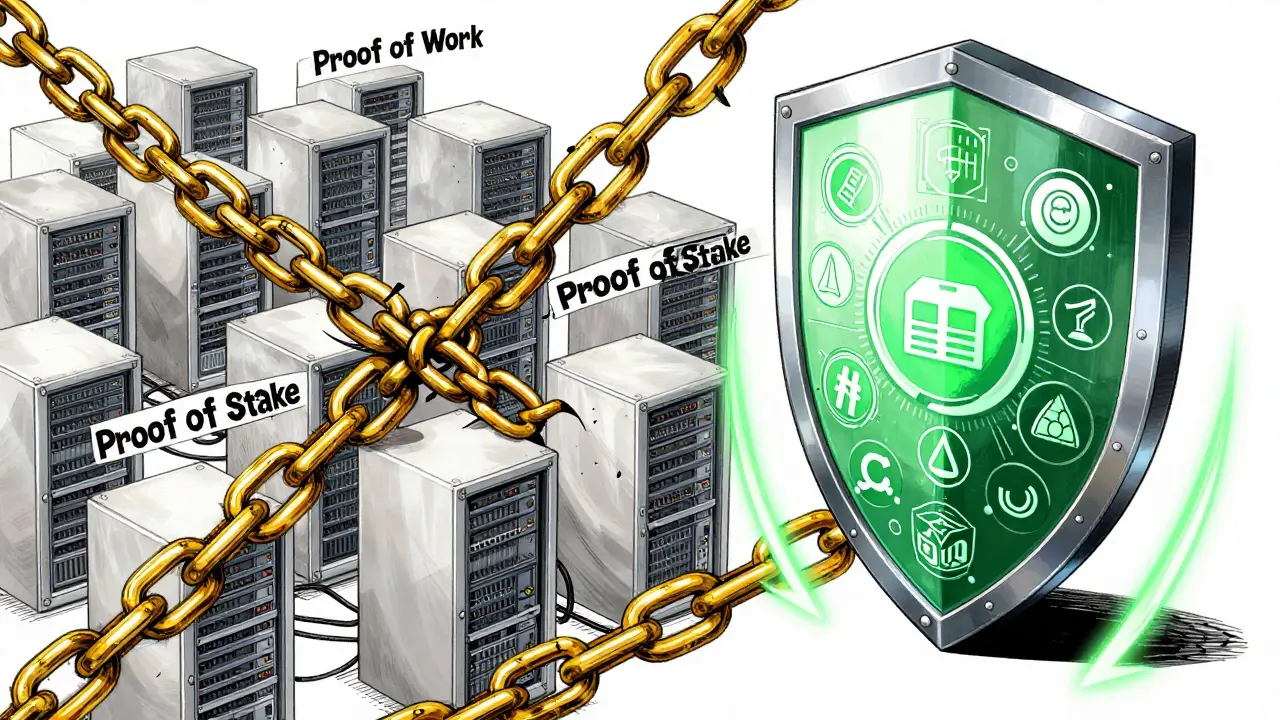
In Proof of Work, like Bitcoin, influence is tied to electricity and hardware, not just the number of connected computers. You can run 10,000 fake nodes, but if they don't contribute to the global hash rate, they have no say in which block gets added. In Proof of Stake, like Ethereum, influence is tied to economic value. You cannot vote unless you hold and lock up ETH. Therefore, a Sybil attack fails because the attacker cannot fake the underlying resource requirement.
Vulnerabilities in Newer and Niche Networks
While giants like Bitcoin are safe, newer projects often struggle. Many emerging Layer-1 blockchains, DAOs (Decentralized Autonomous Organizations), and DeFi protocols rely on governance tokens or simple node participation for voting. If a project uses a "one wallet, one vote" model without sybil-resistant identity verification, it is highly vulnerable.
We have seen instances where airdrop campaigns were drained by bots creating thousands of wallets. While this doesn't break the blockchain itself, it corrupts the distribution mechanism. More dangerously, some smaller chains with low total node counts have been susceptible to eclipse attacks, where developers noticed that certain nodes were only seeing blocks from a specific set of peers, indicating isolation.
Additionally, privacy-focused coins are particularly sensitive. If an attacker can map out the network topology via Sybil nodes, they can potentially deanonymize users by observing transaction flows between specific nodes.
Mitigation Strategies and Future Defenses
Developers are constantly evolving defenses against Sybil attacks. Here are the most effective strategies currently in use or development:
- Economic Staking: Requiring validators to put up collateral ensures that attacking the network is financially ruinous. If you act maliciously, your stake is slashed (destroyed).
- Web of Trust: Some networks implement reputation systems where new nodes must be vouched for by existing, trusted nodes. This makes it harder for an attacker to introduce fake identities rapidly.
- Atomic Ownership Models: Emerging architectures, such as Atomic Ownership Blockchains, bypass traditional node-voting consensus entirely. Instead, security relies on cryptographic signatures and broadcast timing for individual assets. Since there is no collective voting on the ledger state, spawning fake nodes provides no advantage to the attacker.
- Zero-Knowledge Proofs (ZKPs): Advanced cryptography can allow users to prove they are unique humans or entities without revealing their identity. This could enable "one person, one vote" systems in DAOs without compromising privacy.
- Node Verification Protocols: Techniques like SybilGuard and SybilLimit analyze the graph structure of the network to detect clusters of suspiciously connected nodes and isolate them.
For users, the best defense is awareness. If you are running a node, ensure you connect to diverse, reputable peers rather than relying on default settings that might route you through compromised paths. For investors, always check how a project handles governance and consensus. If it seems too easy to join or vote, ask who really controls the network.
Can a Sybil attack destroy Bitcoin?
No. Bitcoin uses Proof of Work, which ties influence to computational power and energy consumption, not the number of nodes. An attacker would need to control 51% of the global hash rate, which requires billions of dollars in hardware and electricity, making it economically irrational.
What is the difference between a Sybil attack and a 51% attack?
A Sybil attack involves creating multiple fake identities to gain influence. A 51% attack involves controlling the majority of the network's resources (hash power or stake). A Sybil attack is often a method used to facilitate or mask a 51% attack, but they are distinct concepts. You can have a Sybil attack without reaching 51% control, though its impact is limited.
Are DAOs vulnerable to Sybil attacks?
Yes, many DAOs are highly vulnerable. If governance is based solely on token holdings, a wealthy actor can buy enough tokens to dominate votes. If it is based on wallet count, bots can create thousands of wallets. Projects are increasingly adopting quadratic voting or soulbound tokens to mitigate this.
How do I protect my node from an Eclipse attack?
Ensure your node configuration connects to a diverse set of peers from different geographic locations and ISPs. Avoid connecting only to a single provider or a small group of nodes. Regularly update your client software to benefit from improved peer-discovery algorithms designed to resist isolation.
Why is the term 'Sybil' used in cybersecurity?
The term comes from a 1973 book about a woman with Dissociative Identity Disorder. Researchers Brian Zill and John R. Douceur adopted the name in the early 2000s to describe the phenomenon of one entity masquerading as many, drawing a parallel between the psychological condition and the digital deception.
18 Responses
Great breakdown of the mechanics here. It is fascinating how the concept originated from a psychological case study and found its way into distributed systems theory. The analogy of the town hall meeting really clarifies why decentralization fails without proper identity verification.
This is such a crucial topic for anyone serious about blockchain security! 🛡️ Most people think decentralization equals safety, but as you pointed out, it only works if nodes are independent. I always tell my friends that understanding Sybil attacks is step one in learning real crypto hygiene. Thanks for sharing this clear explanation! 👏
look at all these bots creating fake nodes lol. typical. i dont see why everyone is so worried about sybil attacks on bitcoin. its not like anyones gonna hack the main chain with a few virtual machines. you guys need to relax and stop crying about every little vulnerability. its just code after all.
Stay focused on the fundamentals. Security requires vigilance.
its kind of poetic isnt it? we named our digital demons after a woman with split personalities. maybe the blockchain is just reflecting our own fragmented selves back at us. i feel like we are all sybils in some way, hiding behind masks online. anyway good post.
you are missing the point entirely. proof of work is broken by design because it wastes energy. sybil resistance should be about social consensus not burning coal. your table is biased towards legacy tech. wake up sheeple.
I run a node in my basement and I never thought about eclipse attacks before. This makes me nervous tbh. I mostly just connect to default peers. Should I be manually adding trusted peers from different countries? I want to make sure my node is actually helping the network and not just sitting there vulnerable. Any tips for a beginner?
foreigners trying to mess with our blockchain infrastructure. its always the same story. weak governance leads to chaos. stick to american built protocols or suffer the consequences. lazy coding causes these issues.
You have to take control of your own security narrative! 😱 Don't let fear paralyze you. If you are running a node, diversify your connections immediately. It is empowering to know exactly who your peers are. You got this! 💪
Oh look another boring technical post about nodes and hashes 🙄. Can we talk about something that actually affects my wallet balance instead of hypothetical attacks? I am so bored reading this. Maybe if you spent less time writing articles and more time making money we wouldnt have these problems. #boring
The global elite use Sybil attacks to monitor your transactions. They map the graph structure to identify dissidents. Do not trust the gossip protocol. It is a surveillance tool disguised as peer-to-peer communication. Stay offline if you value your freedom.
I appreciate the detailed mitigation strategies section. It is helpful to see concrete steps like economic staking and zero-knowledge proofs. Collaborative efforts in developing these defenses will strengthen the entire ecosystem.
I disagree with the idea that DAOs are inherently vulnerable. Many projects are successfully using quadratic voting which effectively neutralizes Sybil behavior. You are painting with too broad a brush here. Not all governance models are equal.
It is imperative to understand that the fundamental weakness lies in the assumption of uniform node distribution. When one considers the economic incentives required to maintain honest participation versus the negligible cost of spawning virtual instances, the asymmetry becomes glaringly obvious. Therefore, any system relying solely on node count for consensus is fundamentally flawed and destined for failure unless augmented by robust cryptographic or economic barriers to entry.
Sarcasm aside, this is a decent overview. But let's be real, most users don't care about node topology. They just want their tokens to go up. The philosophy of decentralization is dying under the weight of convenience.
The distinction between Sybil and 51% attacks is often blurred in casual discourse. It is important to note that while related they are distinct mechanisms. One targets identity the other targets resource allocation. Understanding this nuance is critical for accurate risk assessment.
A well-researched article that highlights the importance of inclusive security practices. We must ensure that educational resources like this are accessible to all community members regardless of their technical background. Thank you for contributing to our collective knowledge base.
The author demonstrates a superficial understanding of consensus mechanisms. True security requires an appreciation for the nuanced interplay between game theory and cryptography. This analysis lacks the depth expected from serious academic discourse.