
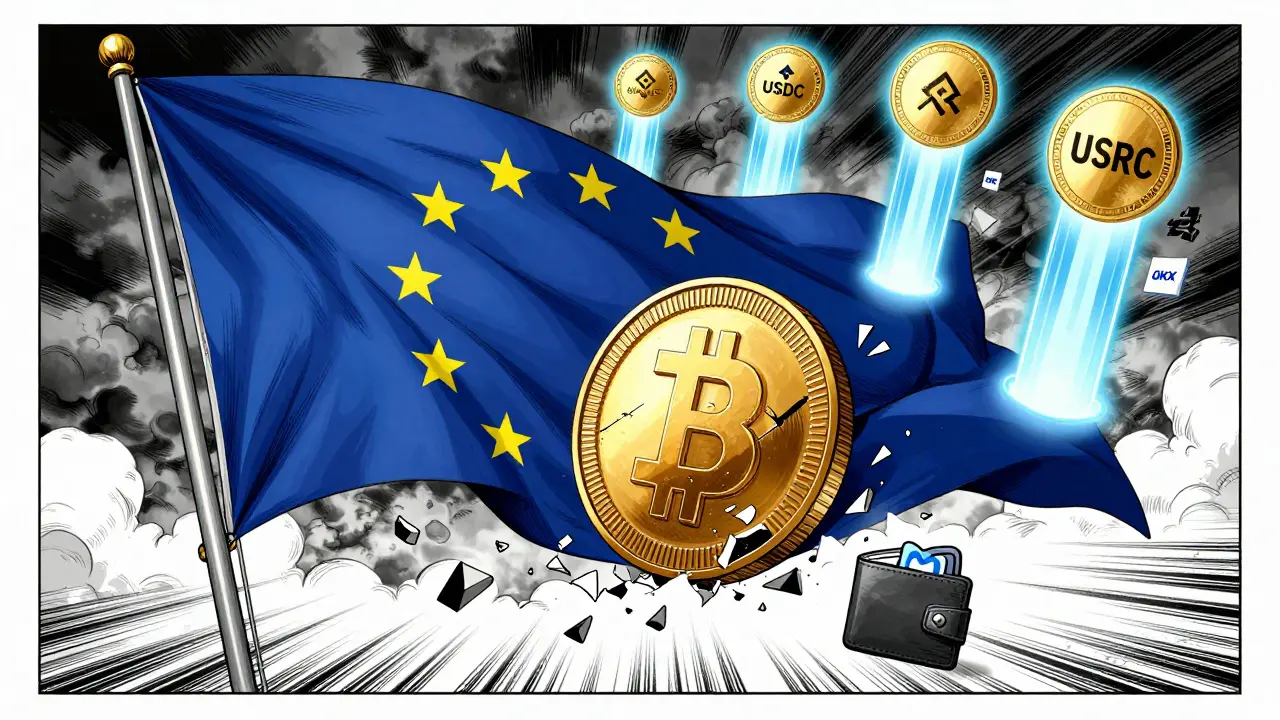
The USDT ban in European Union under MiCA isn’t just another regulatory update-it’s a full-scale reset for how stablecoins operate in one of the world’s largest financial markets. As of July 1, 2025, Tether’s USDT can no longer be traded on any EU-based crypto exchange. This isn’t a rumor. It’s law. And if you’re holding USDT in Europe, you need to know what happens next.
Why MiCA Changed Everything
The Markets in Crypto-Assets Regulation, or MiCA, didn’t just appear out of nowhere. It was years in the making. Passed in June 2023, its core rules for stablecoins kicked in on June 30, 2024. But the real deadline-when enforcement became unavoidable-was December 30, 2024. By July 1, 2025, any crypto platform operating in the EU had to stop offering non-compliant stablecoins. USDT failed that test. MiCA doesn’t ban stablecoins. It bans unregulated ones. To be legal in the EU, a stablecoin must prove it has:- 1:1 backing with liquid, audited reserves
- Full transparency on where those reserves are held
- Real-time reporting and independent audits
- Automated KYC/AML systems that track every transaction
- Corporate risk management policies approved by EU regulators
What Happened to USDT on Exchanges?
Exchanges didn’t wait for regulators to come knocking. They moved fast-because the alternative was losing their licenses. OKX was first. In early 2025, they removed all USDT trading pairs from their EU platform. No exceptions. No grace period. Users had to convert or withdraw. Coinbase followed in February 2025. They didn’t just delist USDT-they sent direct emails to every EU customer: “Convert your USDT to USDC or EURC before April 15.” Coinbase made it clear: they’d rather lose volume than risk regulatory action. Binance took a slightly different path. At first, they turned USDT into a “sell-only” asset for EU users. You could cash out, but not buy more. Then, on March 31, 2025, they pulled the plug entirely. USDT vanished from spot trading pairs alongside other non-compliant tokens like FDUSD, TUSD, and DAI. The message was loud and clear: if you’re not MiCA-compliant, you’re not welcome in the EU market.Who Else Got Hit?
USDT wasn’t the only one. A whole list of stablecoins got axed:- FDUSD (Faithful USD)
- TUSD (TrueUSD)
- USDP (Paxos USD)
- DAI (MakerDAO)
- AEUR (Euroc)
- UST and USTC (de-pegged and failed tokens)
- PAXG (Paxos Gold)

What Can EU Users Use Instead?
The market didn’t collapse-it just shifted. Five stablecoins have cleared MiCA’s hurdles and are now approved for trading in the EU:- EURC (Circle’s Euro-backed stablecoin)
- USDC (Circle’s USD-backed stablecoin, fully compliant)
- EUROC (Euro Coin, regulated by the ECB)
- FRAX (algorithmic, but now backed with MiCA-approved reserves)
- EURS (Stasis Euro, audited and registered in Luxembourg)
What About Cross-Border Payments?
Many businesses used USDT because it was cheap, fast, and didn’t require bank approvals. That’s over. Companies in Germany and the Netherlands that relied on USDT for cross-border payments are now stuck. Banks are refusing to process transactions involving USDT. Some have frozen accounts. Others have demanded proof of compliance-something Tether can’t provide. Legal firms like Aurum Law warn that using non-compliant stablecoins now carries real legal risk. If your company is found using USDT for payroll or supplier payments, regulators could classify it as a money laundering red flag. That means fines, audits, or even criminal investigations. The only safe path forward? Use MiCA-compliant tokens. Even if they cost a little more in fees, they’re the only ones that won’t get you flagged.
What’s Next for Tether?
Tether hasn’t gone quiet. They’ve launched a new legal entity in the UAE and are pushing for MiCA compliance in non-EU markets. But inside the EU? They’re effectively shut out. They’ve said they’re “working on solutions.” But two years after MiCA’s deadline, no registration has been submitted. No audit reports have been published under EU standards. No licensing application has been filed with the ACPR in France or BaFin in Germany. The writing is on the wall. Unless Tether completely rebuilds its compliance system from scratch-something that would take at least 18 months and cost hundreds of millions-they won’t be back in the EU anytime soon.What This Means for the Future
The USDT ban under MiCA isn’t just about one token. It’s a blueprint for how the world’s most powerful financial bloc will handle crypto. The EU didn’t ban innovation. They banned opacity. They didn’t ban stablecoins-they banned unregulated ones. And now, every crypto company outside the EU is watching closely. Will the U.S. follow? Will the UK? Will Singapore? The answer is yes-if they want their companies to access European markets. MiCA has already sparked a 37% growth in compliant stablecoin usage across Europe. That’s not because people love regulation. It’s because they want safety. They want to know their money won’t disappear because a company didn’t publish its balance sheet. For users, this is a win. For issuers, it’s a wake-up call. And for the future of crypto? It’s the moment the industry grew up.Is USDT completely banned in the EU?
Yes. As of July 1, 2025, USDT cannot be traded, bought, or sold on any EU-based crypto exchange. It’s no longer listed on platforms like Coinbase, Binance, and OKX for users in the European Economic Area. Holding USDT is still legal, but you can’t use it for trading or payments through regulated services.
Can I still hold USDT in my wallet?
Yes, you can still hold USDT in a personal wallet like MetaMask or Trust Wallet. But you won’t be able to convert it to euros or other currencies through EU exchanges. You’d need to use a non-EU exchange or peer-to-peer platform, which carries higher risk and no regulatory protection.
What’s the safest stablecoin to use in the EU now?
USDC and EURC are the top choices. Both are issued by Circle, fully compliant with MiCA, and regularly audited. Their reserves are held in cash and short-term U.S. Treasuries, fully segregated from company funds. EU regulators have explicitly approved them for trading and payments.
Why did DAI get banned if it’s decentralized?
MiCA doesn’t care if a stablecoin is decentralized. It requires legal accountability. DAI’s governance is controlled by a DAO, which isn’t a registered legal entity under EU law. Without a clear company responsible for audits, reserves, and compliance, regulators can’t enforce rules. So even though DAI’s collateral is strong, it doesn’t meet MiCA’s corporate structure requirements.
Will other countries follow the EU’s lead?
Yes. Countries like the UK, Japan, and Singapore are already reviewing MiCA as a model. The U.S. has no federal stablecoin law yet, but state regulators are watching. If you’re building a crypto business, MiCA compliance isn’t just for Europe-it’s becoming the global standard.
14 Responses
USDT got roasted so hard even its devs are probably crying into their crypto wallets 😭. MiCA didn’t ban stablecoins - it banned lazy, sketchy ones. Tether had years to get compliant and chose to gamble with EU users’ money. Now? They’re just another cautionary tale. USDC? Clean, audited, and actually trustworthy. No contest.
Honestly? This is how crypto should’ve been all along. No more ‘trust us bro’ stablecoins. If you want to be used like cash, act like cash. Regular banks have reserves, audits, compliance - why should crypto be any different? USDC is the new default now. And honestly? I’m fine with that.
So Tether spent 10 years building the world’s biggest stablecoin… and then refused to do the one thing that would’ve made it legal? 🤦♂️ Classic. Meanwhile, Circle just dropped $100M on lawyers and auditors and now they’re the golden child. The market rewarded compliance. Who saw that coming? 😏
DAI getting banned is wild. It’s literally coded to stay pegged, decentralized, and transparent. But EU doesn’t care about code - they care about paperwork. DAOs aren’t legal entities. So even if the algo works, the legal structure doesn’t. That’s the future: crypto meets corporate law. No more loopholes.
MiCA is the first time a major economy said no to crypto theater. No more pretending decentralization excuses negligence. If you’re a stablecoin you’re a bank. End of story. USDT’s downfall wasn’t technical it was moral. They chose opacity over trust and now they’re irrelevant in Europe
i always thought usdt was kinda sketchy but i used it cause it was everywhere 😅 now im just glad i switched to usdc before the ban. eu really did it right. no more gambling with your money. even if it costs a lil more its worth it to sleep at night
Biggest win here isn’t the ban - it’s the clarity. Before, you had to dig through whitepapers and Reddit threads just to guess if a stablecoin was safe. Now? If it’s on your exchange, it’s legit. That’s huge for normal people who just want to move money without becoming crypto detectives.
Oh so now the EU gets to decide what ‘real money’ is? How quaint. Next they’ll ban Bitcoin because it’s ‘too volatile’. This isn’t regulation - it’s centralization with a fancy acronym. USDT was the people’s coin. Now the banks get to pick your stablecoin. Thanks, regulators.
Let me be clear: the EU is not protecting consumers. They are protecting the dollar and the euro. USDT was a threat to the monopoly of state-backed currencies. This isn’t about transparency - it’s about control. The moment crypto threatened the Fed and ECB, they pulled the plug. MiCA is financial imperialism dressed in compliance.
Think about it - we’re witnessing the death of the ‘wild west’ era of crypto. No longer can a private entity, backed by opaque reserves and vague promises, function as a global currency. The EU didn’t kill USDT - it killed the illusion that decentralization absolves responsibility. A stablecoin isn’t just code. It’s a promise. And promises need legal teeth. The DAO can’t be sued. The company can. So the company must exist. And if it doesn’t? Then the token doesn’t either. This is evolution. Not revolution. The system didn’t break - it matured. And honestly? It’s beautiful.
People acting like this is some big win for users? Nah. It’s a win for Circle. Now they own 90% of the EU stablecoin market. USDC isn’t better because it’s more transparent - it’s better because it’s owned by a company that plays nice with regulators. That’s not freedom. That’s a monopoly with a compliance badge.
yo if u still hold usdt in eu u r basically holding digital confetti. no exchange will touch it. no bank will accept it. even p2p is risky now. just swap to usdc already. its 2025 not 2021. we got better options now 🙃
MiCA good. USDT bad. USDC good. End of story. 🇮🇳
It is not merely a regulatory development; it is the institutionalization of fiduciary integrity within the decentralized financial ecosystem. The European Union, through MiCA, has established a normative framework wherein the issuance of a stablecoin is no longer a technical exercise but a juridical obligation. The absence of a legal personality, the failure to submit to independent audit, and the refusal to implement real-time AML protocols constitute not mere technical noncompliance, but a fundamental breach of the social contract underpinning monetary trust. The market’s swift adoption of USDC and EURC is not preference - it is the rational recalibration of value to entities that honor the rule of law. This is not censorship. It is civilization.