
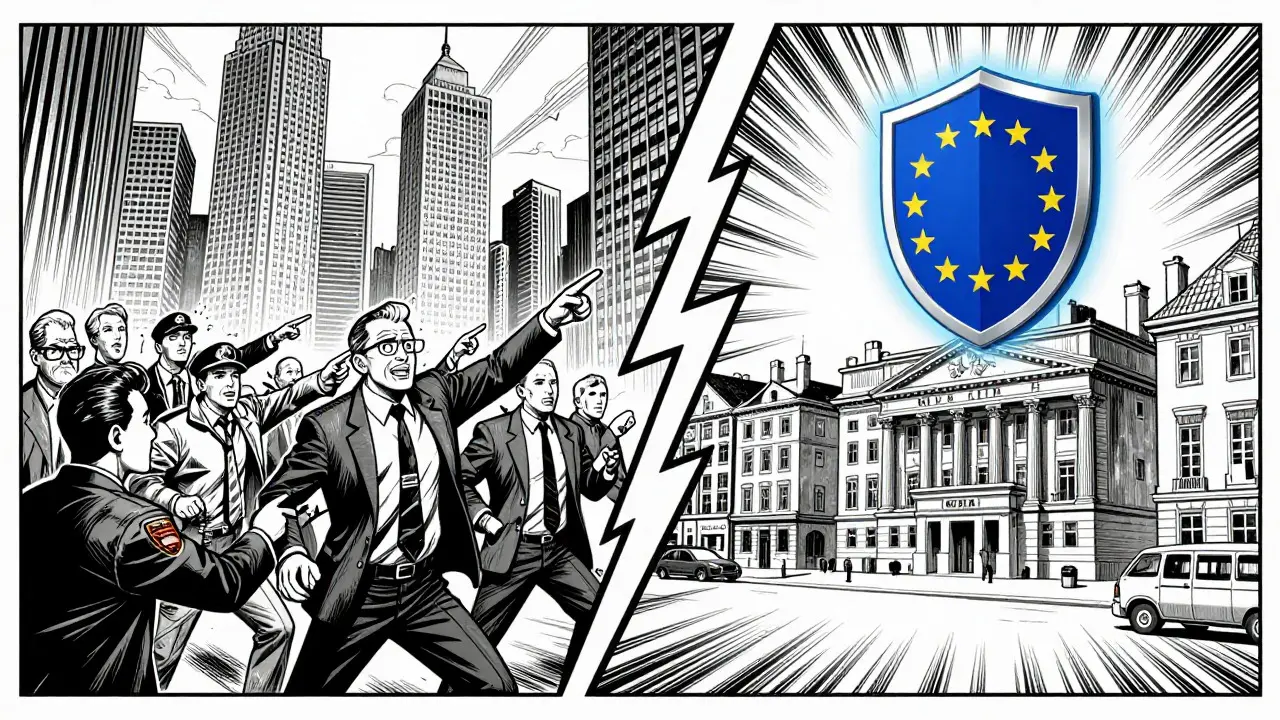
Imagine you’re a trader based in Austin who wants to open an account on a European exchange. Or maybe you run a small trading firm in London and want to expand into Texas. In the world of crypto trading, your location dictates more than just your tax bracket-it determines which rules apply, how much paperwork you need, and even whether your favorite coin is legally allowed to be traded at all. As of mid-2026, the regulatory gap between the United States and the European Union remains one of the biggest hurdles for global crypto businesses.
The core issue isn’t that one system is “better” than the other. It’s that they operate on completely different philosophies. The EU uses a single, comprehensive rulebook called MiCA (Markets in Crypto-Assets Regulation), while the US relies on a fragmented patchwork of agencies like the SEC and CFTC, plus state-level laws. Understanding these differences is no longer optional; it’s essential for anyone serious about long-term crypto participation.
The EU Approach: One Rulebook, Clear Pathways
In Europe, clarity comes from the MiCA is a comprehensive regulation adopted in May 2023 and fully applicable since December 2024 that standardizes crypto asset oversight across the EU. This means if you’re compliant in France, you’re largely compliant in Germany or Spain. There is no need to navigate fifty different state laws or argue with two federal agencies about whether a token is a security or a commodity.
MiCA categorizes digital assets into three main buckets: e-money tokens (EMTs), asset-referenced tokens (ARTs), and other crypto-assets. Each category has specific requirements. For example, issuing an EMT requires an e-money license, while ARTs require a banking or e-money license. This structure gives traditional banks a significant advantage because they already hold the necessary licenses. However, for traders, this brings stability. You know exactly what rights you have, what disclosures must be made by issuers, and who is responsible if something goes wrong.
One unique aspect of the EU framework is its focus on sustainability. The European Commission plans to include crypto-asset mining in the EU taxonomy regulation. This means that energy consumption and environmental impact are becoming part of the compliance checklist. While this adds a layer of complexity for miners and large exchanges, it signals a broader regulatory intent to align crypto with wider economic and social goals.
The US Approach: A Patchwork of Agencies and States
Across the Atlantic, the situation looks very different. The United States does not have a single federal law governing all cryptocurrencies. Instead, regulation is split between the Securities and Exchange Commission (SEC) is the federal agency responsible for regulating securities markets, including many digital assets deemed securities and the Commodity Futures Trading Commission (CFTC) is the federal agency that regulates commodity futures and options, including cryptocurrencies classified as commodities.
This split creates confusion. Is Bitcoin a commodity? Generally, yes. But what about a new DeFi token? The SEC might say it’s a security. What about a stablecoin? Recent court rulings have shown that even here, answers depend on context. In SEC v. Ripple Labs, Judge Torres ruled that only institutional sales of XRP were securities, leaving retail sales unregulated under securities law. Conversely, in SEC v. Terraform Labs, Judge Rakoff held that the UST stablecoin was a security. These contradictory decisions mean that legal certainty often depends on which judge hears your case.
To add another layer of complexity, state laws vary wildly. Louisiana, for instance, has its own Virtual Currency Business Act, requiring licenses or registrations for anyone engaging in virtual currency business activity. If you operate in multiple states, you might need to comply with dozens of different sets of rules. This “50-jurisdiction patchwork” makes scaling a US-based crypto business significantly more expensive and complex than operating within the unified EU market.
Key Regulatory Shifts: The GENIUS Act and Digital Clarity
Things are changing in the US, though. The passage of the GENIUS Act is a bipartisan stablecoin law passed in July 2025 that provides regulatory clarity for stablecoins in the US marked a major turning point. This law established clear rules for stablecoins, reducing uncertainty for one of the most widely used categories of crypto assets. It also sparked debate in the EU about whether MiCA needs updating to prevent regulatory arbitrage-where companies move operations to jurisdictions with lighter rules.
Another important development is the Digital Trading Clarity Act. This proposed legislation aims to address the classification problem. If a federal court or the SEC formally determines that a digital asset is a security, and the CFTC doesn’t object, intermediaries listing that asset get a two-year grace period. During this time, they avoid enforcement actions for failing to register as broker-dealers. This approach reflects the US preference for case-by-case determination rather than pre-emptive blanket regulation.

Comparing Compliance Burdens: US vs. EU
Let’s look at the practical differences in compliance. The table below highlights key distinctions that affect traders and businesses directly.
| Feature | United States | European Union (MiCA) |
|---|---|---|
| Regulatory Structure | Fragmented (SEC, CFTC, State Laws) | Unified (Single EU-wide Regulation) |
| Asset Classification | Case-by-case (Courts determine) | Pre-defined Categories (EMT, ART, Other) |
| Licensing Requirements | Varies by state and agency | Standardized across EU member states |
| Stablecoin Rules | GENIUS Act (2025) | Covered under MiCA (EMT/ART) |
| Environmental Focus | Minimal | High (Taxonomy Regulation integration) |
| Travel Rule Scope | $3,000+ transactions (FinCEN) | Aligned with FATF standards |
Notice the difference in predictability. In the EU, you know the rules before you launch. In the US, you might find out after you’ve invested millions. This unpredictability can deter some investors but allows for rapid innovation in others. For example, state-level innovations in places like Wyoming or Delaware create “crypto havens” within the US, offering friendlier terms than neighboring states.
Anti-Money Laundering: The Common Ground
Despite their structural differences, both regions share similar anti-money laundering (AML) requirements. In the US, the Bank Secrecy Act requires Virtual Asset Service Providers (VASPs) to follow the Travel Rule. This means for any transaction over $3,000, you must collect and transmit specific data: the name and address of the sender and receiver, the financial institution involved, the amount, the date, and identifiers like wallet addresses. The Financial Crimes Enforcement Network (FinCEN) oversees this process.
In the EU, MiCA aligns with Financial Action Task Force (FATF) standards, which means similar data collection requirements exist. Non-compliance in either region can lead to heavy fines or enforcement actions. Regulators in both areas have ramped up scrutiny in 2025 and 2026, making AML compliance a non-negotiable baseline for any serious crypto operation.

What This Means for Global Traders
If you’re a global trader, you need to think strategically about where you operate. The EU offers stability and legal clarity, making it easier to plan long-term strategies. The US offers potential for higher growth and innovation but comes with higher legal risk and compliance costs. Many large firms choose to maintain dual presences, adapting their products to fit each jurisdiction’s rules.
For individual traders, the impact is less direct but still significant. Exchange availability varies by region due to licensing. Some coins may be listed on US exchanges but restricted in the EU, or vice versa. Always check the local regulatory status of any asset you trade. Ignoring these nuances can lead to frozen accounts or unexpected tax liabilities.
Frequently Asked Questions
Is it harder to start a crypto business in the US or the EU?
Generally, the EU is considered easier for multi-country expansion because MiCA provides a single set of rules. In the US, you face a patchwork of federal and state regulations, which can increase legal costs and complexity, especially if you operate in multiple states.
What is the GENIUS Act and why does it matter?
The GENIUS Act is a US law passed in July 2025 that establishes clear regulatory rules for stablecoins. It matters because it reduces uncertainty for one of the largest sectors in crypto, providing a defined pathway for issuance and trading that wasn’t previously available at the federal level.
Do I need a license to trade crypto in the EU?
If you are a retail investor, you don’t need a license to trade. However, if you are running a platform or service that facilitates trading, you will need a MiCA license. This license ensures your platform meets transparency and consumer protection standards across the entire EU.
How does the Travel Rule affect my transactions?
The Travel Rule requires exchanges to share customer information for transactions over $3,000 (in the US). This means your identity and wallet details are transmitted between institutions. It’s a privacy trade-off for better money laundering detection, and it applies to both domestic and international transfers.
Will the US and EU regulations ever converge?
Full convergence is unlikely in the short term. The US prefers incremental, case-by-case regulation, while the EU favors comprehensive, pre-emptive rules. However, both systems are moving toward greater clarity, particularly around stablecoins and AML compliance, which may reduce some friction for cross-border operations.
10 Responses
Oh, how delightful. Another attempt to simplify the complex geopolitical chess match of crypto regulation into a digestible snack for the masses.
You see, while you are busy worrying about your "favorite coin," the real players understand that MiCA is not just a rulebook; it is a strategic moat designed to protect incumbent banking interests from the disruptive tide of DeFi innovation. It is, in essence, regulatory capture dressed up in the clothing of consumer protection. The EU has chosen stability over dynamism, which is perfectly fine if one prefers the slow, predictable decay of traditional finance models.
Meanwhile, the US patchwork, often mocked by the uninitiated, is actually a feature, not a bug. It allows for a natural selection process where only the most robust and legally sound innovations survive. The SEC's aggressive posture is merely the immune system responding to foreign pathogens. To suggest that the GENIUS Act is a "turning point" is to underestimate the sheer inertia of the American legal apparatus. We do not need clarity; we need adversarial tension to drive progress.
Ugh, reading this made me feel like my brain was being squeezed out through my ears
I just want to trade without feeling like I'm doing homework for law school but apparently now I have to know if my token is an EMT or an ART before I even buy it? Who decided we needed three buckets? Why can't it just be "crypto" and "not crypto"?
Also the part about the environmental impact making miners check their energy bills... that sounds exhausting just thinking about it. I don't want to be responsible for saving the planet AND making money at the same time, that's too much pressure
I think there is a lot of truth here but maybe we look at it differently
The EU way feels safe because you know what to expect. In the US it feels like walking on ice because you never know if the ground will hold. But sometimes the ice lets you move faster than the solid ground. So maybe both sides have something good going for them. It is just hard to pick a side when you are trying to make sense of all these laws.
Let’s dissect this carcass of a narrative, shall we?
The article paints MiCA as this benevolent guardian, but let us apply some rigorous alpha-beta analysis to its structural integrity. The tripartite classification-EMT, ART, Other-is not clarity; it is bureaucratic ossification. By pre-defining categories, the EU has effectively created a compliance tax on innovation, forcing agile startups to bloat their operations to fit rigid, archaic boxes designed for banks who already own the licenses. It is a moat, yes, but a moat filled with red tape rather than water.
Conversely, the US "patchwork" is often derided, yet this fragmentation acts as a distributed ledger of legal precedent. Each state is a node testing different regulatory hypotheses. Wyoming isn’t a haven; it’s a sandbox. The GENIUS Act is merely a consensus mechanism for stablecoins, not a solution for the broader DeFi ecosystem. The true metric here is not "safety" but velocity of iteration. The EU slows down the clock; the US accelerates the friction. Which do you prefer: a smooth, slow slide into obsolescence, or a jagged, painful climb toward relevance? The data suggests the latter wins in long-tail scenarios, despite the short-term volatility noise.
A very interesting perspective, indeed!
From a British standpoint, we find ourselves in a somewhat unique position, having left the EU single market but still heavily influenced by its regulatory frameworks. It is fascinating to observe how the divergence between the US and EU creates ripples that reach all the way across the Atlantic. One must appreciate the complexity of navigating such diverse legal landscapes, where every border crossed brings new sets of rules and expectations. It truly highlights the importance of understanding not just the local regulations, but the broader international context in which they operate. A nuanced view is certainly required to make sense of it all!
It is quite profound how location dictates our digital freedom, isn't it?
We often take for granted the invisible walls that jurisdiction builds around our assets. Whether we prefer the structured safety of the EU or the chaotic potential of the US, we are all participants in a global experiment. Perhaps the key is not to choose one side, but to remain adaptable and informed. After all, the best traders are those who can read the room, regardless of which room they are standing in. It requires a certain level of mental flexibility to thrive in such a shifting landscape.
Love the breakdown on the Travel Rule differences!
For anyone diving deep into cross-border OTC desk operations, the $3k threshold in the US vs. the FATF alignment in the EU is a critical pain point. You really need to map out your KYC/AML data flow before you even think about liquidity pools. The operational overhead for dual-compliance is non-trivial, so if you're scaling, budget for the legal tech stack early. Don't sleep on the state-level variations either; Delaware and Wyoming are playing different games entirely right now.
this whole article is biased towards the west anyway why should we care about their rules when india is building its own path with the virtual asset bill? the eu is just copying old banking models and calling it new. and the us is just confused. meanwhile we are looking at practical use cases for rupee settlement. stop obsessing over sec vs mica it is irrelevant for 90% of the world population who are not in these two jurisdictions. focus on growth not paperwork
The West always thinks they have the final word on technology. They regulate it to death. India knows better. We need speed. We need adoption. Not more committees. The EU is a museum. The US is a mess. India is the future. Let us build.
There is a subtle irony in the US approach that deserves attention: the very lack of centralization that frustrates many also serves as a hedge against total systemic failure. If the SEC were to misclassify a major asset class, the entire US market might freeze, whereas in the EU, a single regulatory error could similarly halt activity, but the unified framework makes recovery potentially slower due to the weight of bureaucracy. However, the philosophical divide remains stark: the US trusts the market to self-correct through litigation, while the EU trusts the state to prevent errors before they occur. Neither is inherently superior; they simply optimize for different risk appetites. For the individual trader, this means the cost of ignorance is higher in the US, but the ceiling for reward is arguably higher as well, given the greater tolerance for experimentation. It is a trade-off between security and opportunity, played out on a global stage.