
Imagine waking up to find your digital portfolio has jumped 20% overnight, only to watch it plummet 30% by dinner time. For anyone who has touched the world of digital assets, this isn't a nightmare-it's just a Tuesday. Cryptocurrency Volatility is the degree of variation in the price of a digital asset over a specific period of time. While traditional investors are used to the slow climb of a mutual fund, crypto investors deal with a rollercoaster that can make or break a portfolio in hours.
Why does crypto swing so much more than stocks?
If you compare Bitcoin is the first and largest decentralized cryptocurrency to a standard stock index, the difference is staggering. Between 2020 and 2024, Bitcoin's price swings were often three to four times more intense than those of major equity indices. But why?
One major reason is the Fixed Supply is a monetary policy where the total number of units of an asset is capped . With Bitcoin capped at 21 million coins, there is no "central bank" to print more coins to stabilize the market. When a wave of new buyers hits a fixed supply, prices don't just rise-they rocket. Conversely, when panic hits, there's often a lack of liquidity to catch the fall, leading to those famous 50% to 80% crashes.
Then there's the human element. Crypto is heavily driven by sentiment. While institutional investors use complex models, a huge portion of the market is made up of retail traders who react to tweets, news headlines, and FOMO (Fear Of Missing Out). This emotional trading creates feedback loops that push prices far away from their actual utility value.
The role of liquidity and "Whales"
Liquidity is essentially how easily you can buy or sell an asset without changing its price. In traditional markets, millions of shares change hands every second. In many Altcoins is alternative cryptocurrencies that are not Bitcoin , liquidity is thin. This is where "Whales" come in-individuals or entities that hold massive amounts of a specific coin.
When a whale decides to sell a huge position in a low-liquidity coin, it can create a price vacuum, dragging the value down instantly. This is why smaller coins are exponentially more volatile than Bitcoin or Ethereum. If you're trading a coin with a small market cap, you're essentially at the mercy of a few large players.
| Asset Class | Volatility Level | Primary Driver | Price Stability |
|---|---|---|---|
| S&P 500 Index | Low to Moderate | Corporate Earnings / Macro Economy | High |
| Gold | Low | Safe-haven Demand / Inflation | Very High |
| Bitcoin | High | Adoption / Sentiment / ETF Flows | Moderate (Improving) |
| Small-Cap Altcoins | Extreme | Whale Movement / Hype / Speculation | Very Low |
How do experts actually measure this chaos?
You can't just look at a chart and say "that looks volatile." Professionals use specific tools to quantify the risk. One of the most advanced methods is the Cryptocurrency Volatility Index is a tool (CVX) that uses option market data to predict future price swings . It works similarly to the VIX in the stock market, acting as a "fear gauge."
For the average person, technical indicators like Bollinger Bands is a technical analysis tool that plots a moving average and two standard deviation lines to identify volatility are more practical. When the bands widen, volatility is increasing; when they squeeze together, the market is quiet-often signaling a massive move is coming.
Another useful metric is the Average True Range (ATR). Instead of looking at percentages, the ATR tells you the average distance between the high and low price of an asset over a set period. If a coin usually moves $10 a day but suddenly starts moving $100, the ATR will spike, alerting you that the risk profile has changed.

Is volatility going away?
There is a general trend toward stability, but don't expect Bitcoin to become as boring as a savings account anytime soon. The introduction of Spot ETFs is Exchange Traded Funds that track the actual price of a cryptocurrency asset has been a game changer. These allow institutional money-pension funds and corporate treasuries-to enter the market. Institutional investors typically have longer time horizons and are less likely to panic-sell based on a single tweet.
Currently, ETFs and private companies control about 6% of the circulating Bitcoin supply. As this percentage grows, the market gains a "cushion." More deep-pocketed buyers mean that large sell-offs are absorbed more easily, which gradually lowers the realized volatility.
Practical strategies to survive the swings
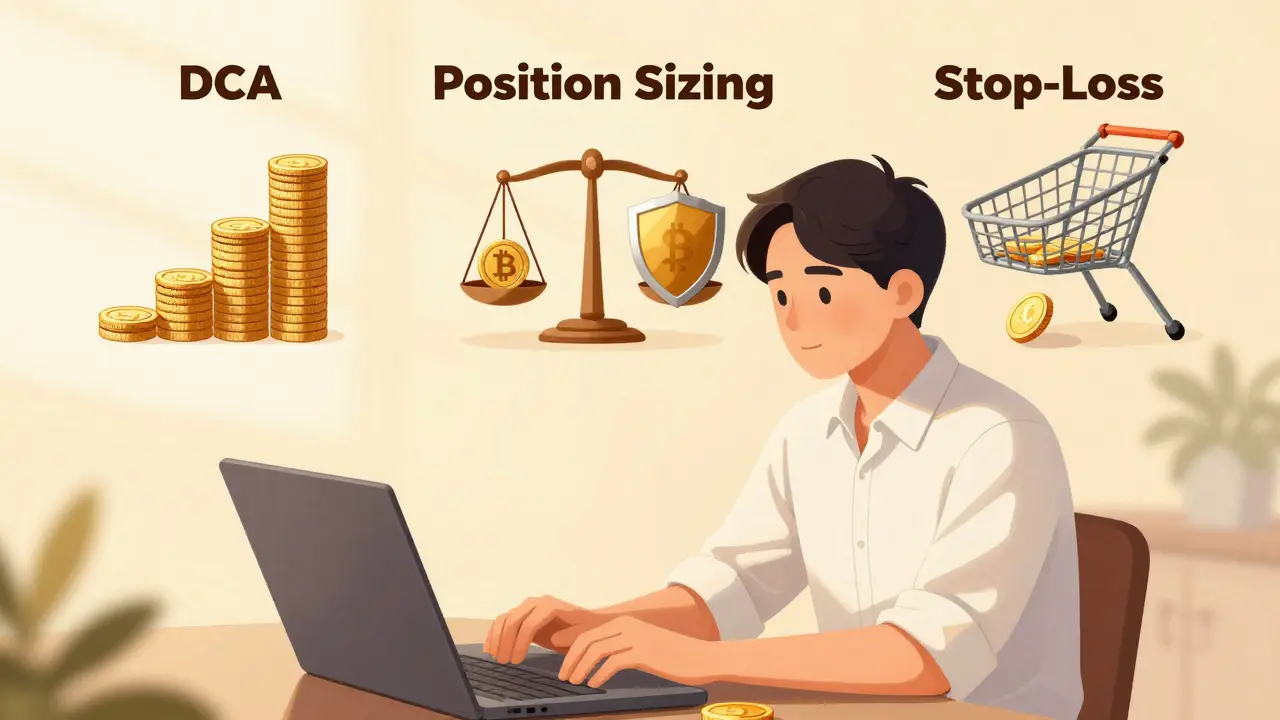
You don't have to be a math genius to handle volatility, but you do need a plan. Most people lose money in crypto because they trade based on emotion. To avoid this, consider these three proven approaches:
- Dollar-Cost Averaging (DCA): Instead of dumping $1,000 into a coin at once, invest $100 every month. This smooths out your entry price, so you don't accidentally buy the absolute peak of a bubble.
- Strict Position Sizing: Never put your entire life savings into a single volatile asset. Many financial advisors suggest limiting crypto exposure to just 1-5% of your total portfolio. If the asset drops 80%, it's a bummer, but it doesn't ruin your life.
- Using Stop-Loss Orders: Decide your "uncle point"-the price at which you admit you were wrong. A stop-loss automatically sells your asset if it hits a certain price, preventing a bad trade from becoming a total catastrophe.
The silver lining: Volatility as an opportunity
While volatility is usually framed as a risk, it's actually the reason why crypto is attractive. In a stable market, you can't make significant gains quickly. High volatility allows for "price discovery" and creates opportunities for traders to profit from swings.
The key is knowing the difference between a temporary dip and a fundamental collapse. A temporary dip in a strong project like Ethereum is a buying opportunity. A crash in a project with no utility is just a downward spiral. Understanding the underlying technology helps you stay calm when the red candles start appearing on the chart.
Does high volatility always mean a coin is a bad investment?
Not necessarily. Volatility is a measure of price movement, not a measure of value. Many of the most successful assets, including early-stage Amazon or Apple stock, were incredibly volatile before they became stable giants. The risk is the volatility itself, not the asset's quality.
What is the fastest way to reduce my portfolio's volatility?
Diversification is your best tool. Instead of holding only one altcoin, spread your investment across Bitcoin, Ethereum, and perhaps some stablecoins. Stablecoins are pegged to a steady asset like the US Dollar, providing a "safe harbor" during market crashes.
Why do some coins crash harder than Bitcoin?
It usually comes down to market cap and liquidity. Bitcoin has the highest market cap and the most trading volume, meaning it takes a massive amount of selling to move the price significantly. Small-cap coins have much less liquidity, so a few large sells can trigger a panic cascade.
Can I predict when a period of high volatility will start?
While you can't predict the future, you can look for "volatility squeezes." When Bollinger Bands become very narrow, it often indicates that the market is coiled like a spring and a major move-up or down-is likely imminent.
How do ETFs affect cryptocurrency volatility?
ETFs bring in institutional investors who typically trade in larger volumes but with a longer-term perspective. This increases the overall liquidity of the asset, which generally helps dampen extreme, irrational price swings caused by retail panic.
Next steps for managing your risk
If you're new to the space, don't let the charts scare you into inaction, but don't let the hype blind you to the risk. Start by auditing your current holdings. Do you have too much in one coin? Are you emotionally attached to an asset that has lost 90% of its value?
For those feeling the anxiety of price swings, try switching your view from a "Daily" chart to a "Weekly" or "Monthly" chart. You'll notice that most of the terrifying daily spikes are just small blips in a much larger trend. Focus on the long-term utility of the blockchain, and the daily volatility becomes much easier to ignore.
31 Responses
DCA is honestly the only way to stay sane in this market. Most people try to time the bottom and end up catching a falling knife, but just automating your buys takes the emotion out of it. It's a great way for anyone to get started without feeling like they're gambling their whole paycheck on a single coin.
stop pretending ETFs are a cushion they just bring in more sheep for the slaughter house lol
Imagine actually believing that
Imagine actually believing that ETFs save you. If you're still trading based on a
Imagine actually believing that ETFs save you. If you're still trading based on a blog post instead of reading the actual whitepapers, you deserve to get liquidated. Most of you just follow the herd and then cry when the
Imagine actually believing that ETFs save you. If you're still trading based on a blog post instead of reading the actual whitepapers, you deserve to get liquidated. Most of you just follow the herd and then cry when the market corrects. It's embarrassing how many people think a few institutional buyers make this
Imagine actually believing that ETFs save you. If you're still trading based on a blog post instead of reading the actual whitepapers, you deserve to get liquidated. Most of you just follow the herd and then cry when the market corrects. It's embarrassing how many people think a few institutional buyers make this a safe haven. This isn't a savings account, it's a digital jungle. If you can't handle a 30% swing, get out now. Stop pretending you're an investor when you're really just a gambler with a smartphone. Learn the tech or lose your money. Simple as that. Stop looking for a safety net in a system designed for volatility. The
Imagine actually believing that ETFs save you. If you're still trading based on a blog post instead of reading the actual whitepapers, you deserve to get liquidated. Most of you just follow the herd and then cry when the market corrects. It's embarrassing how many people think a few institutional buyers make this a safe haven. This isn't a savings account, it's a digital jungle. If you can't handle a 30% swing, get out now. Stop pretending you're an investor when you're really just a gambler with a smartphone. Learn the tech or lose your money. Simple as that. Stop looking for a safety net in a system designed for volatility. The irony is that the people who complain the most about the swings are the ones who bought the peak because a celebrity told them to. Do your own research for once in your life. Stop relying on curated lists of
Imagine actually believing that ETFs save you. If you're still trading based on a blog post instead of reading the actual whitepapers, you deserve to get liquidated. Most of you just follow the herd and then cry when the market corrects. It's embarrassing how many people think a few institutional buyers make this a safe haven. This isn't a savings account, it's a digital jungle. If you can't handle a 30% swing, get out now. Stop pretending you're an investor when you're really just a gambler with a smartphone. Learn the tech or lose your money. Simple as that. Stop looking for a safety net in a system designed for volatility. The irony is that the people who complain the most about the swings are the ones who bought the peak because a celebrity told them to. Do your own research for once in your life. Stop relying on curated lists of
Imagine actually believing that ETFs save you. If you're still trading based on a blog post instead of reading the actual whitepapers, you deserve to get liquidated. Most of you just follow the herd and then cry when the market corrects. It's embarrassing how many people think a few institutional buyers make this a safe haven. This isn't a savings account, it's a digital jungle. If you can't handle a 30% swing, get out now. Stop pretending you're an investor when you're really just a gambler with a smartphone. Learn the tech or lose your money. Simple as that. Stop looking for a safety net in a system designed for volatility. The irony is that the people who complain the most about the swings are the ones who bought the peak because a celebrity told them to. Do your own research for once in your life. Stop relying on curated lists of altcoins. Stop hoping for a miracle. Stop ignoring the fundamentals. Stop being so naive. Just stop.
The inclusion of Bollinger Bands as a
The inclusion of Bollinger Bands as a
The inclusion of Bollinger Bands as a practical tool is a bit quaint, isn't it? It's like suggesting someone use a compass in the age of GPS. While the basics are fine for the masses, anyone with actual intellectual curiosity knows that these indicators are lagging and often useless in a hyper-volatile environment.
This is so exciting! India is becoming the global hub for blockchain and our traders are the most fearless in the world! Truly a golden era for us! 🇮🇳
I agree with the sentiment here. Patience is a virtue in this market. 🧘♂️
fixed supply is the only thing that matters and the idiots think a few suits in NY with an ETF are gonna change the game... absolute clowns lol
the logic here is slightly flawed... you cant just say ETFs reduce volatility when they actually create new ways for mass panick sell-offs to happen through traditional brokerage channels. just a basic miss in the anlysis
it's just so scary when you see those red candles... i feel you all
Actually, the most moral way to invest is to avoid speculative assets entirely. These
Actually, the most moral way to invest is to avoid speculative assets entirely. These coins have no intrinsic value and only exist to transfer wealth from the uninformed to the few. It's a shell game and anyone pretending it's
Actually, the most moral way to invest is to avoid speculative assets entirely. These coins have no intrinsic value and only exist to transfer wealth from the uninformed to the few. It's a shell game and anyone pretending it's a legitimate investment strategy is just lying to themselves. You can't build a future on a bubble. It's just common sense.
Keep your head up everyone! 🌈 Just remember to only invest what you can afford to lose and keep that vibe positive! You've got this! ✨🚀
LITERALLY the most important part of this is the position sizing! I can't stress this enough! If you put 100% of your money in one coin, you aren't investing, you're praying! BE SMART PEOPLE!
I've been doing this for years and let me tell you, the
I've been doing this for years and let me tell you, the
I've been doing this for years and let me tell you, the
I've been doing this for years and let me tell you, the a-t-r is a joke for retail traders. By the time you see the spike, the move is already over. I've seen a thousand people try this and fail. You basically need a proprietary bot to even make a dent in the volatility before the whales eat your lunch. Trust me, I know how this works because I've lived it while everyone else was still figuring out what a wallet was.
There is something profoundly poetic about the way humans react to these digital numbers, as if the volatility is a mirror reflecting our own internal instability and desperate need for sudden transformation. We seek the
There is something profoundly poetic about the way humans react to these digital numbers, as if the volatility is a mirror reflecting our own internal instability and desperate need for sudden transformation. We seek the shortcut to freedom through a series of chaotic price movements, forgetting that true stability comes from within rather than from a digital ledger. It's an interesting sociological experiment, really, seeing how quickly
There is something profoundly poetic about the way humans react to these digital numbers, as if the volatility is a mirror reflecting our own internal instability and desperate need for sudden transformation. We seek the shortcut to freedom through a series of chaotic price movements, forgetting that true stability comes from within rather than from a digital ledger. It's an interesting sociological experiment, really, seeing how quickly a whole community can shift from euphoria to despair based on a single chart line. Perhaps the real value of cryptocurrency isn't the financial gain, but the lesson it teaches us about the fragility of our own expectations and the illusory nature of perceived value in a world that is increasingly detached from physical reality.
I really feel for those who lost money in the last crash, it must be so heartbreking... please be gentle with yourselves while lerning these things