
Imagine watching your Bitcoin position climb steadily. The chart is green, the momentum is strong, and your wallet balance is ticking up. Then, without warning, a sudden market dip wipes out half your gains before you can react. This scenario happens to traders every day-not because they lacked knowledge, but because they relied on manual execution during volatile moments.
This is exactly why take-profit orders exist. They are not just a feature; they are a psychological safety net. A take-profit order is a pre-set instruction that automatically closes your trade when the price hits a specific target level. It removes emotion from the equation, ensuring you secure profits even if you’re asleep, at work, or simply distracted by life outside the screen.
What is a take-profit order?
A take-profit order is an automated instruction to close a trading position at a predetermined price level to lock in profits. It acts as a conditional limit or market order that triggers only when the asset reaches your specified target.
How Take-Profit Orders Actually Work
To understand how these orders function, you need to look under the hood of your trading platform. When you place a long position (buying an asset expecting it to rise), you set a take-profit price higher than your entry point. For example, if you buy Ethereum at $3,000, you might set a take-profit at $3,300.
Once the order is active, the system monitors the market price in real-time. As soon as the price touches $3,300, the order executes. Depending on the broker’s infrastructure, this often converts into a limit order first, trying to fill at exactly $3,300 or better. In highly liquid markets like major forex pairs or top-tier cryptocurrencies, this happens instantly. However, in thinner markets, the system may convert it to a market order to ensure execution, which can lead to slight variations in the final price-a phenomenon known as slippage.
The beauty of this mechanism is its 'Good-Till-Canceled' (GTC) nature in many platforms. Unlike day orders that expire at the end of the trading session, a GTC take-profit order remains active until it is either filled or manually canceled by you. This means you don’t need to log in daily to check if your target has been met. The system does the heavy lifting while you focus on other opportunities.
Setting the Right Price: Strategy Over Guesswork
Placing a take-profit order is easy; placing it at the *right* level requires strategy. Many beginners make the mistake of setting arbitrary numbers, like "I want to make $100." This approach ignores market structure and often leads to missed opportunities or premature exits.
Instead, professional traders use technical analysis to identify natural barriers where price movement tends to pause or reverse. These include:
- Resistance Levels: Historical price points where selling pressure previously overwhelmed buying interest. If Bitcoin has struggled to break past $65,000 three times in the last month, that’s a logical place to set a take-profit.
- Fibonacci Extensions: Mathematical ratios derived from previous price swings. Traders often target the 1.618 extension level as a likely profit-taking zone for trend-following strategies.
- Support Zones: For short sellers (those betting on price drops), support levels act as resistance for upward movement, making them ideal take-profit targets.
Consider a swing trader analyzing the EUR/USD pair. After identifying a bullish trend, they enter at 1.1200. Instead of guessing, they look at the chart and see a clear resistance cluster at 1.1300. They set their take-profit there. If the price hits 1.1300, the order triggers, locking in a 100-pip gain. Without this plan, the trader might have held on, hoping for 1.1400, only to watch the price reverse and erase their potential profit.
Take-Profit vs. Stop-Loss: The Dynamic Duo
You cannot talk about take-profit orders without mentioning their counterpart: the stop-loss. While take-profit orders protect your gains, stop-loss orders protect your capital. Using them together creates a defined risk-reward framework, which is the cornerstone of sustainable trading.
Think of it as a sandwich. Your entry price is the bread. The stop-loss is the bottom slice, limiting how much you can lose if the trade goes wrong. The take-profit is the top slice, capping how much you can win if the trade goes right. Professional traders rarely open positions without both slices in place.
For instance, if you buy Solana at $150 with a stop-loss at $140 (risking $10) and a take-profit at $170 (aiming for $20 profit), you have a 1:2 risk-reward ratio. Even if you lose half your trades, you remain profitable overall because your winners are twice as large as your losers. This mathematical edge is impossible to maintain through manual trading alone, as fear and greed inevitably distort decision-making.
Navigating Slippage and Market Volatility
No discussion of automated orders is complete without addressing slippage. Slippage occurs when your order executes at a different price than expected. This is most common in volatile markets or during low-liquidity periods, such as weekends in crypto or holidays in traditional finance.
If you set a take-profit at $100, but the market is moving so fast that the next available buyer is offering $99.80, your order fills at $99.80. You’ve lost $0.20 per unit due to slippage. While small, this can add up over time, especially for high-frequency traders or those using large position sizes.
To mitigate this, consider these tactics:
- Trade High-Liquidity Assets: Major coins like Bitcoin and Ethereum, or major forex pairs like EUR/USD, have deep order books, reducing the chance of significant slippage.
- Avoid News Events: Economic announcements like Non-Farm Payrolls (NFP) or Federal Reserve decisions cause massive volatility. Prices can gap up or down, skipping your exact take-profit level entirely.
- Use Limit Orders Carefully: Some platforms allow you to specify whether your take-profit should be a limit order (exact price) or a market order (any price). Limit orders prevent slippage but risk non-execution if the price reverses quickly.
Platform Differences: Where Do You Set Them?
The implementation of take-profit orders varies slightly across platforms, though the core concept remains the same. On centralized exchanges like Binance or Coinbase Advanced, you’ll typically find the option when opening a new order or modifying an existing position. Look for fields labeled "TP" or "Take Profit."
In derivatives trading, such as futures or options on platforms like Crypto.com, the functionality is more integrated. You can set take-profit levels directly within the contract setup. For example, when buying a Call Option on Bitcoin, you can define the strike price and simultaneously set a take-profit target for the option’s value. This allows for complex strategies where multiple layers of profit-taking are automated based on different price movements.
Mobile apps have also revolutionized accessibility. Most modern trading apps allow you to set and adjust take-profit levels on the go. This flexibility is crucial for swing traders who monitor charts throughout the day but need to execute adjustments quickly without sitting at a desktop computer.
Psychological Benefits: Trading Without Emotion
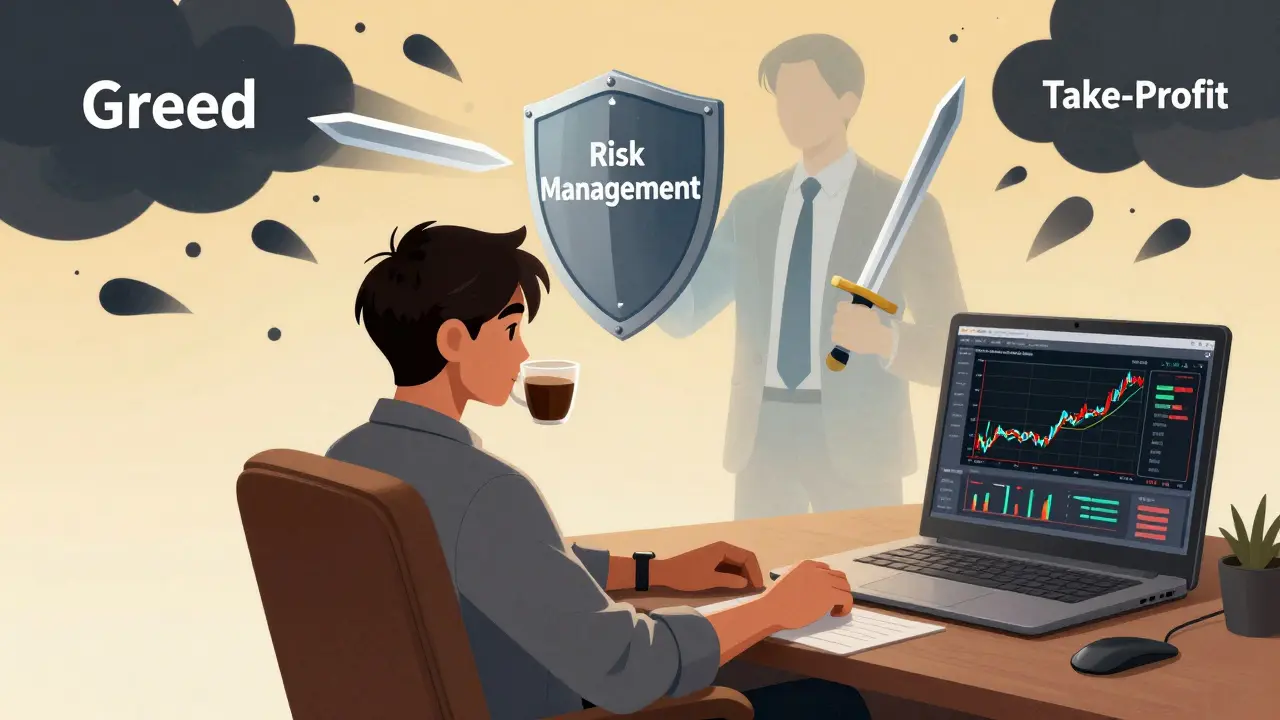
The greatest advantage of take-profit orders isn’t technical-it’s psychological. Human beings are wired for loss aversion and greed. When a trade is winning, the temptation to "let it run" is powerful. You tell yourself, "It could go higher," ignoring signs of exhaustion in the trend. Conversely, when a trade turns against you, hope replaces logic, leading to holding losing positions too long.
Automated orders remove this emotional noise. By pre-defining your exit strategy, you commit to a plan before the trade begins. This discipline is what separates amateur traders from professionals. Studies in behavioral finance consistently show that traders who use systematic exit strategies outperform those who rely on discretionary closing over the long term.
Furthermore, automation saves time. You don’t need to stare at screens all day waiting for the perfect moment to sell. This frees you to analyze new setups, manage other positions, or simply step away from the market, reducing burnout and improving overall well-being.
Common Mistakes to Avoid
Even with automated tools, mistakes happen. Here are the most frequent errors traders make with take-profit orders:
- Setting Targets Too Close: Placing a take-profit just above the current price ensures you get stopped out by normal market noise rather than capturing a meaningful move.
- Ignoring Transaction Costs: Always account for fees and spreads. If your take-profit profit margin is smaller than the trading fee, you’re technically losing money despite a "winning" trade.
- Over-Optimizing Past Data: Don’t set rigid rules based solely on historical performance. Markets change, and rigid systems can fail in new conditions. Use take-profit levels as guidelines, not absolute laws.
- Forgetting to Cancel: If you manually close a position, remember to cancel any associated pending orders. Leaving a take-profit order active after closing the main position can result in unintended executions if the price retraces.
Next Steps for Your Trading Journey
Start small. Before applying take-profit orders to live accounts with significant capital, practice on demo accounts. Test different placement strategies-support/resistance, Fibonacci, trailing stops-and observe how they perform in various market conditions. Track your results meticulously. Note which settings yielded the best risk-reward ratios and which led to frequent slippage.
As you gain confidence, integrate take-profit orders into a broader risk management plan. Combine them with stop-losses, proper position sizing, and thorough market analysis. Remember, the goal isn’t to predict the future perfectly; it’s to manage uncertainty effectively. With disciplined use of automated tools, you transform trading from a gamble into a structured business operation.
Can I change my take-profit order after placing it?
Yes, most trading platforms allow you to modify or cancel take-profit orders at any time before they are executed. This is useful if market conditions change or if you want to adjust your profit target based on new analysis.
Do take-profit orders guarantee execution at the exact price?
Not always. In highly liquid markets, execution is usually very close to the set price. However, in volatile or illiquid markets, slippage can occur, resulting in execution at a slightly different price. Using limit orders for take-profits can help mitigate this, but may risk non-execution if the price reverses quickly.
Should I use take-profit orders for long-term investing?
Take-profit orders are primarily designed for trading, not long-term investing. Investors typically hold assets for years, ignoring short-term fluctuations. However, some investors use them to rebalance portfolios or take partial profits during extreme market rallies.
What is the difference between a take-profit and a limit order?
A limit order is a general instruction to buy or sell at a specific price or better. A take-profit order is a type of conditional limit order specifically used to close an existing profitable position. Essentially, a take-profit order is a limit order triggered by the direction of your current trade.
How do I calculate the right take-profit level?
Calculate take-profit levels using technical analysis tools like support/resistance zones, Fibonacci extensions, or average true range (ATR) indicators. Aim for a risk-reward ratio of at least 1:2, meaning your potential profit is twice your potential loss.