
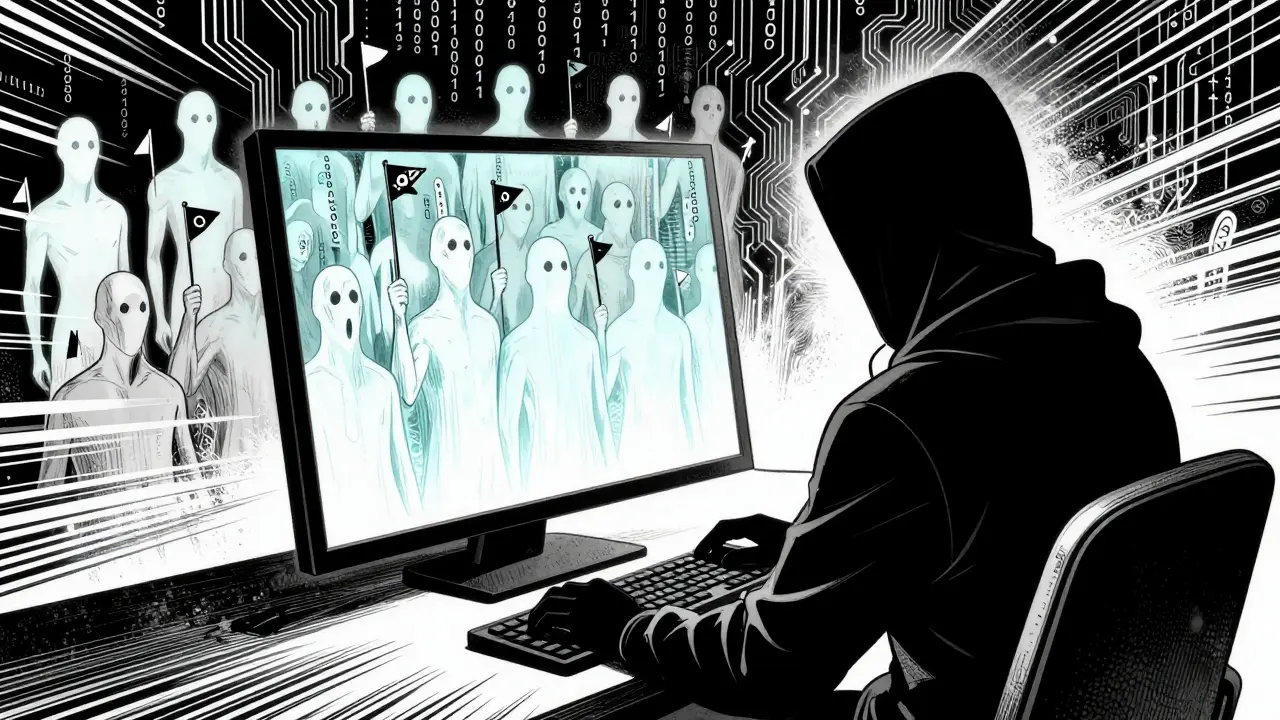
Imagine walking into a voting booth where one person has managed to bring in fifty clones. They all look different, they have different names, but they are all controlled by the same mind. That is essentially what a Sybil attack is in the world of digital networks. It is not just a theoretical glitch; it is a fundamental threat to the trust that holds decentralized systems together. If you rely on peer-to-peer (P2P) networks or blockchain technology, understanding how this attack works is not optional-it is survival.
In a healthy P2P network, every node (computer) is supposed to be an independent participant. The system assumes that if you have enough nodes, the majority will act honestly. A Sybil attack shatters this assumption. A single malicious actor creates hundreds or thousands of fake identities-nodes-to gain disproportionate control over the network’s operations. This isn't about hacking a password; it's about flooding the system with noise until the truth gets drowned out.
The Origin Story: Why Is It Called a 'Sybil' Attack?
The name sounds sinister, and it fits. The term comes from the 1973 book Sybil by Flora Rheta Schreiber, which documented the life of a woman named Sybil Dorsett who suffered from dissociative identity disorder. She had multiple personalities living inside one body. In the context of computer science, the analogy is perfect: one physical entity (the attacker) presenting itself as many distinct entities (the fake nodes).
This concept was first formally identified in peer-to-peer research by Brian Zill at Microsoft Research in 2002. Back then, the focus was on file-sharing networks like Gnutella. Today, the stakes are much higher. We are no longer just talking about sharing MP3 files; we are talking about financial ledgers, smart contracts, and billions of dollars in value. The core vulnerability remains the same: decentralized systems often assume that more nodes equal more security. A Sybil attack proves that quantity does not always mean quality.
How the Attack Works in Practice
To pull off a Sybil attack, the bad actor doesn't need to break encryption. They just need to be clever about identity. Here is the step-by-step breakdown of how it typically unfolds:
- Node Creation: The attacker uses automated scripts to spin up multiple virtual machines or botnets. Each of these acts as a separate "node" in the network.
- Network Joining: These fake nodes join the P2P network. Because most open networks allow anyone to connect without strict verification, the fake nodes are accepted as legitimate participants.
- Isolation: The attacker manipulates the routing protocols so that honest nodes primarily communicate with the fake nodes, rather than with each other. This creates an information bubble.
- Manipulation: Once the attacker controls a significant portion of the visible network, they can censor transactions, reorder blocks, or even attempt to rewrite history.
The goal is usually to achieve a majority influence. In blockchain terms, this often leads to a 51% attack where an entity gains more than 50% of the network's computing power. With that level of control, the attacker can double-spend cryptocurrency, block new transactions, or reverse their own payments. It turns the promise of decentralization into a dictatorship.
Why Bitcoin Resists Sybil Attacks (And Who Doesn't)
You might wonder why we don't hear about Sybil attacks taking down Bitcoin every day. The answer lies in economics. Not all P2P networks are created equal. Some rely on simple node counts for decision-making, while others tie influence to resource expenditure.
| Network Type | Defense Mechanism | Sybil Risk Level | Example Incident |
|---|---|---|---|
| Open File-Sharing (e.g., early Gnutella) | None / Reputation only | High | Spam flooding, search poisoning |
| Bitcoin (Proof of Work) | Computational Cost (ASICs/Electricity) | Extremely Low | No successful 51% attack since 2009 |
| Ethereum Classic (PoW) | Lower Hash Rate | Moderate/High | Successful 51% attack in 2019 |
| Ethereum 2.0+ (Proof of Stake) | Financial Stake (ETH holdings) | Low | None recorded post-merge |
Bitcoin uses Proof of Work (PoW). To create a valid block, a miner must solve complex cryptographic puzzles. This requires massive amounts of electricity and specialized hardware called ASIC miners. According to estimates from 2025, controlling enough hash rate to execute a 51% attack on Bitcoin would require over $20 billion worth of mining equipment and billions of units of electricity annually. Bitcoin consumes approximately 150 TWh per year-that is equivalent to the energy usage of a small nation. Creating fake nodes is useless if you cannot afford the energy to back them up.
However, smaller networks are not so lucky. Ethereum Classic, a fork of Ethereum, suffered a devastating 51% attack in 2019. Because its market cap and hash rate were lower, the economic barrier to entry was cheap enough for attackers to rent mining power and rewrite the chain's history. This highlights a critical rule: in PoW systems, security is directly proportional to the cost of attacking.
The Shift to Proof of Stake: A New Economic Barrier
As the industry evolved, many networks moved away from energy-intensive mining toward Proof of Stake (PoS). Ethereum’s transition to PoS in September 2022 (known as "The Merge") changed the game for Sybil resistance.
In a PoS system, you don't compete with electricity; you compete with capital. To become a validator-a node that proposes and attests to blocks-you must lock up, or "stake," your own cryptocurrency. For Ethereum, this requirement is 32 ETH. At prices seen in late 2023, that amounted to roughly $102,400 per validator.
So, how does this stop a Sybil attack? An attacker trying to flood the network with fake validators would need to acquire millions of dollars worth of ETH. If they try to act maliciously, the protocol can "slash" their stake, destroying their money. This aligns incentives perfectly: it becomes economically irrational to attack the network because you would lose more than you could ever gain. It transforms security from a battle of hardware into a battle of wealth.
Social Trust Graphs: Detecting the Clones
What if the network doesn't use expensive mining or staking? What if it's a lightweight social network or a decentralized app (dApp) that allows free participation? Here, economic barriers don't work. Instead, researchers rely on social trust graphs.
Tools like SybilGuard, SybilRank, and SybilLimit analyze the connections between nodes. The theory is based on human behavior: real people tend to cluster in communities. Fake nodes created by a single attacker often have abnormal connectivity patterns-they might connect to everyone equally or lack the "small-world" properties of natural social networks.
Microsoft Research published an improved variant of SybilLimit in 2023, showing that by analyzing the "distance" between nodes in a graph, the system can identify clusters of fake identities. If Node A, Node B, and Node C all behave identically and share unusual connection paths, the system flags them as potential Sybil identities. This method preserves privacy better than requiring ID checks, but it is computationally intensive and not foolproof against sophisticated attackers who mimic human social patterns.
Prevention Strategies for Network Operators
If you are building or managing a P2P network, you cannot rely on a single silver bullet. You need a layered defense strategy. Based on current best practices and expert analysis from 2024, here is what works:
- Implement Reputation Systems: Older, established nodes should have more weight than brand-new ones. As Georgia Weston noted in her 2024 analysis, reputation mechanisms discourage attackers because they force them to wait months or years to build trust, making the attack too slow to be profitable.
- Use Identity Validation (Carefully):strong>: Requiring some form of verification, such as phone numbers or email addresses, raises the cost of creating fake accounts. However, this conflicts with the ethos of anonymity in crypto. Wallarm’s 2023 analysis warns that excessive verification can reduce network participation by up to 40%. Find a balance.
- Leverage Consensus Economics: Always tie influence to cost. Whether it's CPU cycles (PoW), money (PoS), or reputation points, ensure that gaining power requires a tangible sacrifice.
- Monitor Network Topology: Use tools to visualize node connections. Look for hubs that have unusually high degrees of centrality compared to the rest of the network. These are often signs of a central controller behind a facade of decentralization.
The Future: Quantum Risks and Growing Concerns
The landscape is shifting. With the rise of Decentralized Finance (DeFi), the global blockchain security market is projected to reach $33.53 billion by 2028. More value means bigger targets. CipherTrace’s 2024 threat forecast predicts that Sybil attacks will target 37% of new blockchain projects. Why? Because developers often prioritize speed and low fees over robust security architecture.
There is also a looming shadow: quantum computing. While IBM’s 2023 roadmap suggests practical quantum attacks are still 10-15 years away, quantum computers could theoretically break the cryptographic signatures that protect node identities. If public keys can be derived from private keys instantly, the entire basis of digital identity in P2P networks could collapse. Researchers are already working on post-quantum cryptography, but it is not yet standard.
For now, the most comprehensive protection approach combines economic disincentives with social graph analysis. Networks that implement layered defenses-making attacks expensive, slow, and detectable-are the ones that survive. Those relying solely on node count for consensus are sitting ducks.
What is a Sybil attack in simple terms?
A Sybil attack occurs when a single user creates multiple fake identities (nodes) in a peer-to-peer network to gain unfair influence. It's like one person bringing fifty clones to a vote to sway the outcome.
Can Bitcoin suffer from a Sybil attack?
It is highly unlikely. Bitcoin uses Proof of Work, which requires massive amounts of electricity and expensive hardware to validate blocks. The cost to create enough fake nodes to control the network exceeds $20 billion, making it economically unfeasible.
How does Proof of Stake prevent Sybil attacks?
In Proof of Stake (PoS), users must lock up cryptocurrency to participate. For example, Ethereum requires 32 ETH per validator. An attacker would need to spend millions of dollars to gain control, and if they act maliciously, their funds can be confiscated (slashed).
What happened during the Ethereum Classic 51% attack?
In 2019, attackers rented enough mining power to control over 50% of Ethereum Classic's network. They rewrote the blockchain history to double-spend coins. This showed that smaller networks with lower hash rates are vulnerable to Sybil-style takeovers.
Are there tools to detect Sybil attacks?
Yes. Tools like SybilGuard and SybilLimit analyze social trust graphs. They look for abnormal connection patterns between nodes. If a group of nodes behaves identically or connects in unnatural ways, they are flagged as potential fake identities.