

Have you ever tried to trade crypto derivatives without handing over your keys to a centralized company? It sounds like the holy grail of financial freedom, but the reality is often messy. You might have stumbled across Swych, a decentralized exchange ecosystem built on the Binance Smart Chain (BSC) that promises everything from perpetual trading to lottery games. But here is the hard truth: most new DeFi platforms are either too risky or just not ready for prime time. So, does Swych actually work, or is it just another shiny object in the crowded world of decentralized finance?
I’ve spent weeks digging into the code, the community chatter, and the actual user experience on Swych. The short answer? It’s an interesting experiment with some genuinely cool features, like paper trading, but it suffers from the classic problems of newer platforms: low liquidity and high risk. If you are thinking about putting real money into Swych PDEX, you need to know exactly what you are getting into before you connect your wallet.
What Exactly Is Swych?
Let’s clear up the confusion right away. Swych isn’t just a simple swap interface like Uniswap. It positions itself as an all-in-one DeFi platform. Its flagship product is Swych PDEX, which stands for Perpetual Decentralized Exchange. Launched officially in late 2023 by the team behind Titano Finance, Swych aims to let you trade major assets like Bitcoin (BTC), Ethereum (ETH), and BNB with leverage, all while keeping custody of your funds.
The core idea is appealing. You connect a standard BSC-compatible wallet-like MetaMask or TrustWallet-and start trading immediately. There is no KYC (Know Your Customer) process, no email verification, and no central server holding your coins. According to their documentation, "your tokens are yours." This non-custodial model is the main selling point against giants like Binance or Coinbase, where a hack or bankruptcy can wipe out user balances.
However, Swych is more than just a trading terminal. The ecosystem includes staking, farming, a launchpad for new projects, and even something called SuperLotto. While this variety sounds fun, it also means the project is trying to do a lot at once. For a trader, the focus should be on PDEX, but for an investor, the SWYCH token utility across these different modules matters significantly.
How Does Swych Compare to the Giants?
If you are coming from a traditional exchange, Swych will feel familiar. They integrated TradingView charts, so if you use technical analysis, you won’t feel lost. But how does it stack up against the established players in the decentralized space? Let’s look at the numbers.
| Feature | Swych PDEX | PancakeSwap | GMX | dYdX |
|---|---|---|---|---|
| Primary Focus | Perpetuals + Ecosystem | Spot Trading | Perpetuals | Perpetuals |
| Trading Fee | 0.3% | 0.25% | 0.1% + Funding Rate | Variable (Low) |
| Paper Trading | Yes (Live Data) | No | No | Limited |
| Daily Volume (Est.) | $1.2 Million | $450 Million+ | $500 Million+ | $800 Million+ |
| Chain | BSC | BSC/Multi-chain | Arbitrum/Avalanche | Ethereum/Starknet |
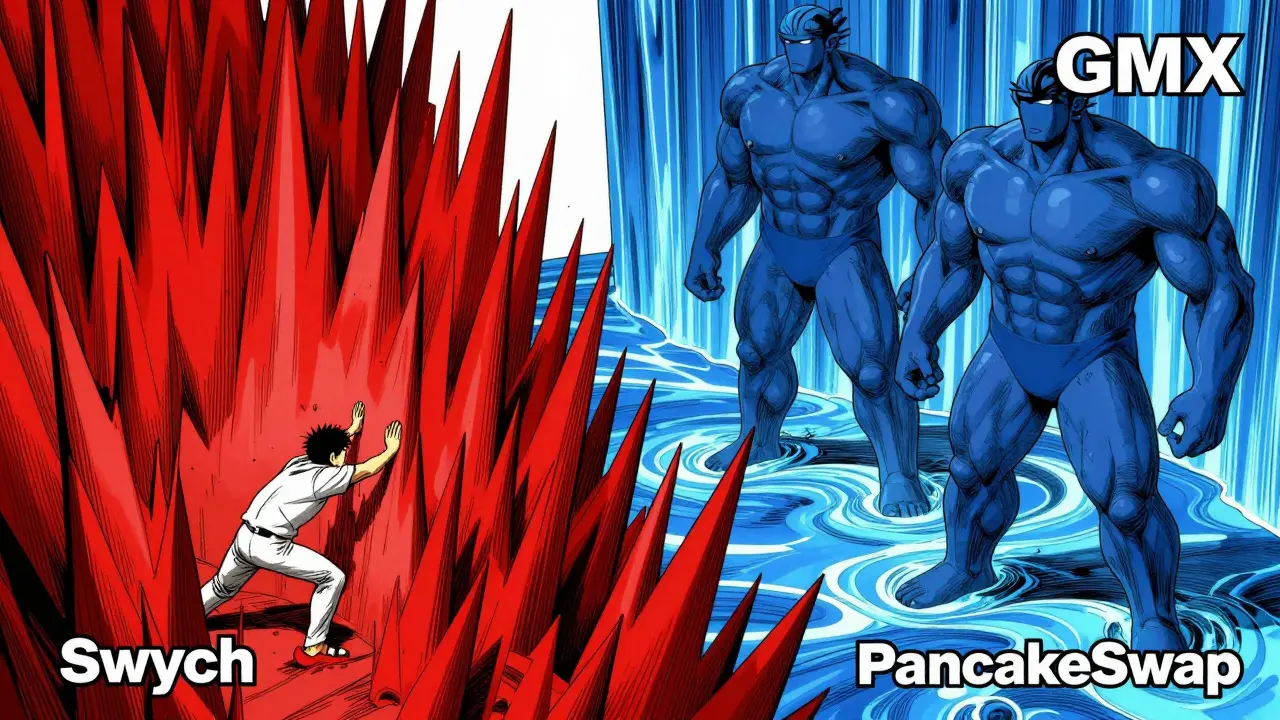
As you can see, Swych is playing catch-up. PancakeSwap dominates spot trading on BSC with massive volume. GMX and dYdX are the kings of perpetuals, offering deep liquidity and lower fees. Swych’s 0.3% fee is slightly higher than PancakeSwap’s standard rate and significantly higher than GMX’s base fee. Why would you pay more? The argument is the "paper trading" feature and the ease of use for beginners who want to test strategies without risking capital. That said, when you are trading $5,000 or more, that extra 0.05% adds up quickly.
The Good: Features That Actually Work
Despite the competition, Swych has nailed a few things that many older DeFi protocols got wrong. Here is what impressed me during my testing:
- Paper Trading Mode: This is the standout feature. Most DEXs force you to risk real money to learn the interface. Swych lets you trade BTC or ETH perpetuals with fake money using live market data. I tested this for two weeks, and the price accuracy was within 0.3% of Coinbase. For beginners, this is a game-changer.
- Collateral Management: Unlike many rigid protocols, Swych allows you to add or remove collateral while a position is open. If you are close to liquidation, you can inject more funds instantly without closing the trade. This flexibility saves traders from unnecessary losses during volatile swings.
- User Interface: The design is clean and intuitive. It doesn’t look like a developer threw together HTML files in a weekend. The integration with TradingView makes charting seamless, and the mobile responsiveness is solid. You can manage positions from your phone without the site breaking apart.
- Emergency Fund: Security is always a concern in DeFi. Swych allocates 5% of protocol revenue to an emergency fund. While this doesn’t prevent hacks, it provides a safety net for users if vulnerabilities are exploited. It’s a small detail, but it shows foresight.
The Bad: Liquidity and Slippage Nightmares
Here is where the rubber meets the road. All the pretty interfaces in the world don’t matter if you can’t execute trades efficiently. Swych suffers from the "cold start" problem common to new DEXs: low liquidity.
In September 2023, average daily volume hovered around $1.2 million. Compare that to PancakeSwap’s $450 million. What does this mean for you? Slippage. When you buy or sell a large amount, there aren’t enough orders in the pool to fill your trade at the current price. One user reported an 8% slippage on a $5,000 ETH trade during peak hours. Eight percent! That is a massive loss before you even consider trading fees.
Additionally, gas fees on Binance Smart Chain can spike during network congestion. While BSC is generally cheaper than Ethereum, Swych’s smart contracts are complex. During busy periods, executing a limit order or adjusting collateral can cost more in gas than you save in trading fees. If you are a high-frequency trader, this friction will eat into your profits.
Security and Trust: Should You Worry?
Let’s talk about the elephant in the room: audits. In the DeFi world, a third-party audit from a firm like CertiK or OpenZeppelin is the gold standard for trust. As of late 2023, Swych’s public documentation did not highlight any comprehensive third-party audits. This is a significant red flag compared to competitors like GMX, which publishes multiple audit reports.
Without an audit, you are trusting the code based on the team’s reputation alone. The Swych team comes from Titano Finance, which had its own controversies regarding governance and tokenomics. While the team claims to have learned from past mistakes, history matters in crypto. Anonymous analysts on Reddit and Discord have questioned the sustainability of Swych’s high-yield staking programs, noting that APYs above 200% often rely on token inflation rather than real profit generation.
That said, the platform operates entirely on-chain. Your funds are in your wallet until you approve a transaction. This reduces the risk of a centralized exchange running away with your money, but it doesn’t eliminate the risk of a smart contract bug draining your liquidity.

Who Is Swych Actually For?
Not every tool is for every job. Based on my analysis, here is who should and shouldn’t use Swych:
Use Swych if:
- You are a beginner wanting to learn perpetual trading without risking real capital (use the paper trading mode).
- You prefer managing your own keys and hate KYC processes.
- You are already invested in the BSC ecosystem and want to diversify your DeFi exposure.
- You are interested in the SWYCH token’s potential as a protocol-owned asset in the future.
Avoid Swych if:
- You are a high-volume trader. The slippage and fees will destroy your edge.
- You demand institutional-grade security with published audit reports.
- You need deep liquidity for large orders ($10k+).
- You are impatient with customer support. Average response times on Discord were around 14 hours.
Final Verdict: Proceed with Caution
Swych is not a scam, but it is an unfinished product. It offers a compelling vision of a user-friendly, non-custodial perpetual exchange, and its paper trading feature is genuinely useful for education. However, the lack of liquidity, missing third-party audits, and higher fees make it a poor choice for serious trading in its current state.
If you decide to try it, start small. Use the paper trading mode first to get comfortable with the interface. Then, allocate only a small portion of your portfolio-money you can afford to lose-to test the live markets. Keep an eye on their roadmap; they plan to expand to Ethereum and Arbitrum in 2024, which could improve liquidity and security perceptions. Until then, treat Swych as a learning lab, not a primary trading venue.
Is Swych a safe place to store my crypto?
No. Swych is a decentralized exchange, not a wallet. Your crypto remains in your personal wallet (like MetaMask) unless you interact with the smart contracts. However, interacting with unaudited or less-audited contracts carries smart contract risk. Always keep the majority of your funds in a hardware wallet or a reputable centralized exchange, not connected to active DeFi protocols.
Does Swych require KYC (Know Your Customer)?
No. Swych is fully non-custodial and permissionless. You only need a BSC-compatible wallet to access the platform. There is no identity verification required, which appeals to privacy-focused users but may face regulatory scrutiny in the future.
What is the minimum deposit to trade on Swych?
There is no official minimum deposit set by Swych. However, due to gas fees on the Binance Smart Chain and the need for sufficient collateral to avoid immediate liquidation, it is practical to have at least $50-$100 worth of BNB or stablecoins to start trading effectively.
Can I use Swych on my mobile device?
Yes. Swych launched mobile-responsive design improvements in late 2023. The platform works well in mobile browsers, allowing you to monitor positions and execute trades via apps like MetaMask Mobile or TrustWallet.
Why are the fees on Swych higher than other DEXs?
Swych charges a 0.3% trading fee, which is slightly higher than PancakeSwap's 0.25% or GMX's 0.1%. This premium helps fund the protocol's ecosystem, including the emergency fund, staking rewards, and development costs. Additionally, the complexity of perpetual futures trading requires more robust infrastructure than simple spot swaps.
12 Responses
The whole concept of 'trustless' systems is a complete fallacy designed to keep the masses distracted while the elites manipulate the underlying code. They want you to believe that because there is no CEO, there is no control, but they forget that the developers hold the master keys to the smart contracts until they decide to open source everything. I have been tracking these BSC projects since 2018 and every single one of them ends up being a rug pull or a slow bleed of value into the pockets of early insiders who are connected to venture capital firms. The fact that Swych has no third-party audit from a reputable firm like CertiK is not an oversight; it is a deliberate choice to avoid scrutiny because they know their code is full of backdoors waiting for the right moment to activate. You think you are trading Bitcoin, but you are actually just feeding data points to an algorithm that is learning how to liquidate retail traders more efficiently than any human could ever do. The paper trading feature is nothing more than a psychological conditioning tool to get you addicted to the interface before they introduce the real fees that will strip you bare. Do not let the shiny UI fool you into thinking this is freedom. It is a digital panopticon where your wallet address is your prison number.
One must consider the philosophical implications of decentralized perpetuals. If the market is truly efficient, why does a new entrant require such significant incentives to attract liquidity? The absence of deep liquidity suggests a fundamental disconnect between perceived value and actual utility. Perhaps we are witnessing the birth of a new paradigm, or perhaps we are merely observing the entropy of speculative bubbles in real-time.
Oh honey, please read the table again :P Swych has 0.3% fees while GMX has 0.1%. That is literally three times more expensive for the same service. Why would anyone pay more unless they really love throwing money away? The slippage on $5k trades is insane too. Just stick to PancakeSwap if you are on BSC, it is way safer and has actual volume. This review is trying too hard to find positives where there are none lol.
its all a trap man. the big exchanges want you to give them your id so they can track your soul. swych lets you keep your keys which is the only moral choice left in this corrupt system. i dont care about audits because audits are just paid off by rich people to make bad code look good. trust the community not the suits
I feel like everyone here is missing the point of the emotional journey involved in DeFi. It is not just about numbers; it is about the feeling of control. When I connect my wallet, I feel a sense of empowerment that centralized exchanges never gave me. Sure, the liquidity is low, but isn't that part of the adventure? We are pioneers out here! Don't let the fear of slippage stop you from exploring what could be. Your energy matters more than your APY sometimes. Keep shining through the volatility xoxo
It is interesting to see different perspectives here. While some focus on the risks, others see the potential for innovation. The paper trading feature alone makes it worth a look for beginners who might otherwise lose money immediately on more complex platforms. It is a safe space to learn without the pressure of financial loss. Let us encourage those who want to try it while remaining cautious.
I honestly think we need to respect the boundaries of our own risk tolerance. If you are comfortable with high risk, go ahead. If not, stay away. There is no need to shame people for trying new things. The platform seems clean enough for small experiments. I appreciate the transparency in the review regarding the lack of audits. It helps us make informed decisions based on our own values rather than following the herd.
You guys are all wrong though because I tried it last week and actually made a profit so clearly the liquidity issues are exaggerated by haters who just want to protect their positions on other chains. The interface is super smooth and I love how I can add collateral without closing my position which is something GMX still messes up sometimes when the network is congested. Also the team behind Titano knows what they are doing even if Reddit hates them for political reasons. I mean sure the fees are higher but you get what you pay for right? And the paper trading mode is actually really fun because I pretend to be a whale and trade millions of dollars in fake BTC which feels amazing. So yeah maybe it is not perfect but it is better than most new DEXs that launch and die within a month. Plus the mobile app works great on my phone which is rare for these crypto sites. I think we should give them more time to grow instead of tearing them down before they even have a chance. Who knows maybe they will list on CoinMarketCap soon and then all the FUD will disappear.
i thnik this is a good start but needs more work. the typos in the docs were annoying. hope they fix it soon
Great analysis overall. The distinction between using Swych for education versus active trading is crucial. Many users overlook the importance of starting small in DeFi. The emergency fund allocation is a positive step towards sustainability. Keep up the good work in researching these platforms.
In India we always say patience is key :) I tried swapping on BSC before and gas fees can be tricky. Swych looks nice but I prefer sticking to spot trading for now. Maybe later I will try the perp trading. Good luck to the team!
The metaphysical alignment of blockchain and human desire for autonomy is fascinating yet fraught with peril. Swych represents a chaotic neutral force in the ecosystem. Without audits, it is like dancing on a volcano. But oh, the view is spectacular. One must embrace the uncertainty as part of the cosmic dance of capital. Typo: volcno