
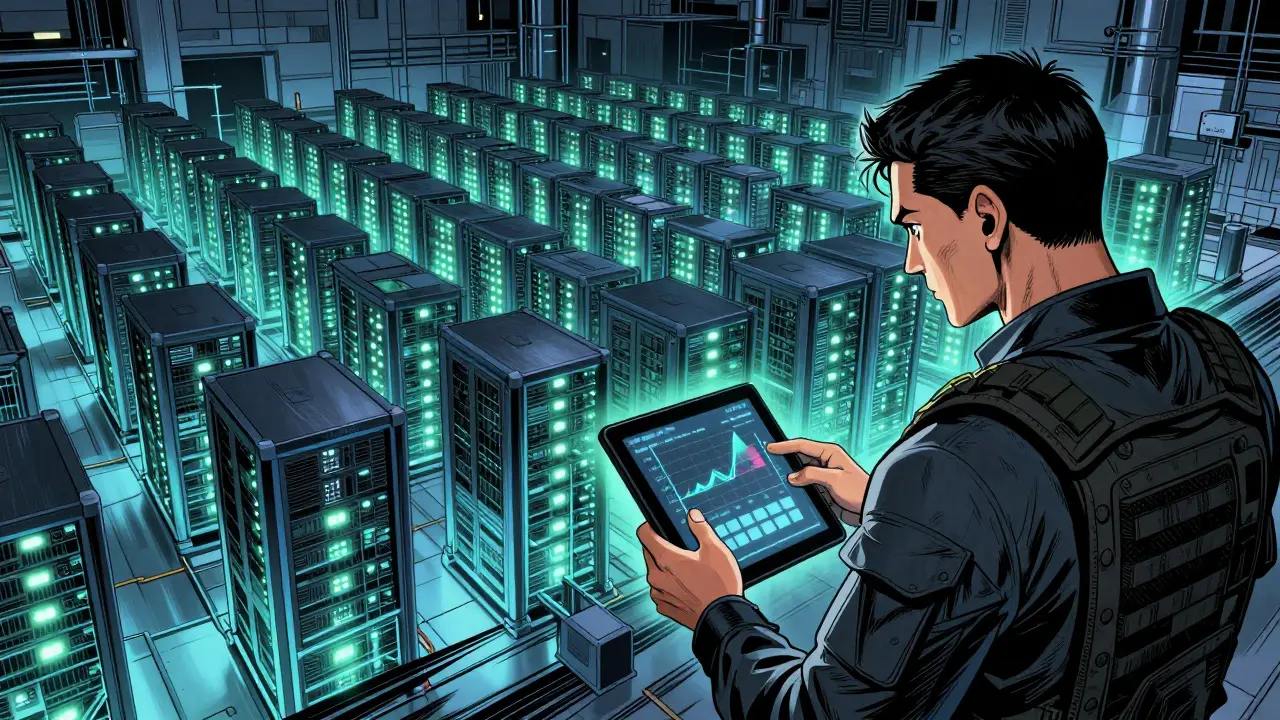
Imagine trying to buy a car from Germany while your bank account is frozen by international sanctions. For many Russian businesses in 2026, this isn't a hypothetical nightmare-it's daily life. To survive, Russia has quietly built a parallel financial system, and at its heart lies cryptocurrency mining, which the state has legalized not just for profit, but as a strategic tool for sanctions evasion. This shift marks a dramatic departure from earlier restrictive policies, turning digital assets into weapons of economic warfare.
The Shift From Restriction to Strategic Embrace
Before 2022, Russia’s stance on crypto was cautious, often leaning toward heavy regulation or outright bans. But the invasion of Ukraine and the subsequent freezing of central bank reserves changed everything. The government realized that traditional banking channels-SWIFT, correspondent accounts-were vulnerable to Western political pressure. So, they pivoted. Today, Russia operates one of the world’s largest virtual currency mining industries, ranking third globally. This isn’t accidental; it’s infrastructure building.
By legalizing mining and cross-border crypto payments, Moscow aims to create payment rails independent of the US dollar and Eurozone systems. It’s a bold move, but does it work? That’s where things get complicated.
A7A5 Stablecoin: The Engine of Shadow Trade
If you want to understand how Russia evades sanctions digitally, look no further than A7A5, a ruble-backed stablecoin launched in February 2025. Issued by Old Vector-a Kyrgyzstan-based company backed by Russia’s state-owned Promsvyazbank (PSB)-A7A5 has processed over $51.17 billion in transactions through July 2025. In its first four months alone, it facilitated an estimated $9.3 billion.
| Metric | Value |
|---|---|
| Total Transaction Volume (as of July 2025) | $51.17 billion |
| First Four Months Volume | $9.3 billion |
| Issuer | Old Vector (Kyrgyzstan) |
| Backing Bank | Promsvyazbank (Russia) |
| Primary Use Case | Cross-border trade & military procurement |
What makes A7A5 particularly effective is its pattern of use. Unlike retail-focused tokens, A7A5 shows clear business-day activity spikes, suggesting systematic adoption by commercial entities rather than casual investors. You can even buy A7A5 tokens directly using PSB bank cards, advertised openly on their website. This bridges the gap between traditional finance and the shadow crypto economy.
Garantex, Grinex, and the Insular Exchange Ecosystem
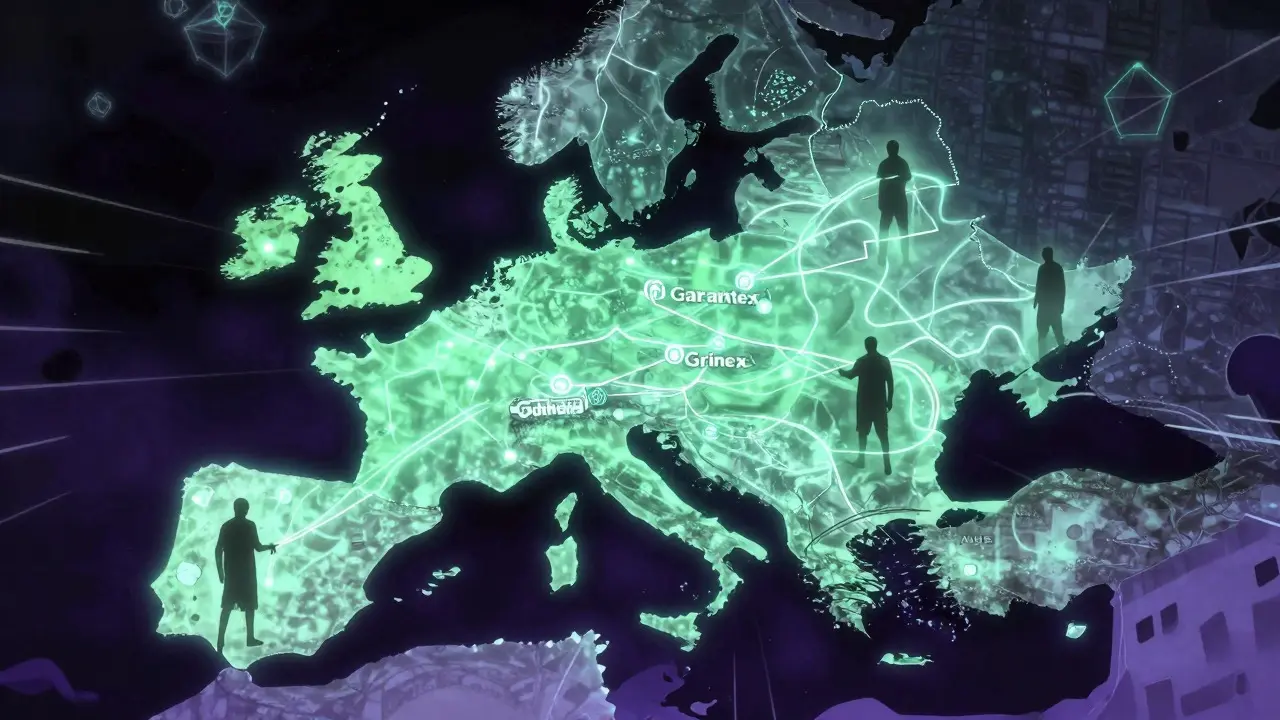
Stablecoins need places to trade. Enter Garantex, a crypto exchange with deep Russian ties. Sanctioned by the US in 2022, Garantex became a hub for A7A5 trading. But when the heat got too intense, former employees created Grinex in 2024 specifically to bypass sanctions. The US Treasury sanctioned Grinex in August 2025, calling it out explicitly for aiding evasion.
These platforms don’t operate in isolation. They form a tightly knit ecosystem, often referred to as a "fairly small subset" of exchanges with notable Russian connections. This insularity helps them avoid Western oversight but also creates single points of failure. When the UK’s Office of Financial Sanctions Implementation (OFSI) targeted eight individuals and entities linked to A7A5-including Luxembourg firms and Kyrgyz banks-the entire network felt the tremors.
Western Countermeasures: Targeting the Infrastructure
Don’t think Western governments are sitting idle. On August 20, 2025, the US Treasury’s Office of Foreign Assets Control (OFAC) made history by designating a virtual currency mining company for sanctions evasion. Under Secretary Brian E. Nelson didn’t mince words: "Treasury can and will target those who evade... U.S. sanctions against Russia."
This wasn’t just about exchanges. The sanctions hit the operational backbone-individuals linked to Kyrgyz banks paying for military goods, service providers supporting sanctioned institutions, and even global networks led by oligarchs like Konstantin Malofeyev. Over 40 individuals and entities were named in coordinated actions with the UK.
Blockchain analytics firm Chainalysis documents this cat-and-mouse game. They describe Russia’s setup as a "shadow crypto economy," encompassing money laundering services, military procurement networks, and commodity trade. Yet, they also point out a critical flaw: blockchain is transparent. Every transaction leaves a trace. While harder to monitor than dollar-based stablecoins, A7A5’s flows are still visible to authorities who know where to look.

Is Crypto Really Effective for Sanctions Evasion?
Here’s the hard truth: cryptocurrency might be useful for niche trades, but it’s ill-suited to replace the dollar or euro for large-scale commerce. According to the Bitcoin Policy Institute, Bitcoin is simply too small. Russia’s pre-war annual exports totaled around $400 billion-roughly 50% of Bitcoin’s market cap. Imagine trying to pay for billions in oil shipments with a volatile asset that swings 10% in a day. Most exporters would balk.
Volatility is the killer. Even stablecoins like A7A5 face liquidity constraints outside their closed loop. If a German supplier doesn’t trust Kyrgyz-issued tokens, they won’t accept them. And if they do, they risk secondary sanctions. So, while crypto offers a workaround, it’s more of a band-aid than a cure.
Other nations like North Korea and Venezuela have tried similar tactics, with mixed results. The consensus among experts? Crypto undermines authoritarian states less than it helps them adapt temporarily. As one analyst noted, the US should view bitcoin not as a threat, but as a tool that could eventually expose and disrupt these very networks due to its inherent openness.
The Future of Russia’s Crypto Strategy
So, what’s next? Russia will likely double down on mining legalization and expand retail access to tools like A7A5. Expect more integration between state banks and crypto platforms, blurring the lines further. But Western enforcement will tighten too. With AI-driven blockchain analytics becoming standard, hiding transactions grows harder every month.
The real battle isn’t just technological-it’s psychological. Can Russia convince global traders to rely on a fragile, sanction-heavy alternative? Or will the transparency of blockchain ultimately turn its own strategy against it? Only time will tell, but one thing is clear: the era of easy sanctions evasion via crypto is closing fast.
Why did Russia legalize cryptocurrency mining?
Russia legalized crypto mining to build an alternative financial infrastructure capable of operating outside Western-controlled systems like SWIFT. Following severe sanctions after the 2022 Ukraine invasion, the state recognized traditional banking vulnerabilities and turned to decentralized assets to facilitate cross-border trade and military procurement without direct reliance on dollars or euros.
What is the A7A5 stablecoin and how much has it processed?
A7A5 is a ruble-backed stablecoin issued by Old Vector, a Kyrgyzstan-based entity backed by Russia's Promsvyazbank. Launched in February 2025, it had facilitated over $51.17 billion in transactions by July 2025, primarily used for commercial and potentially military-related cross-border payments within Russia's shadow economy.
Are Garantex and Grinex the same platform?
No, they are distinct but related. Garantex is a long-standing crypto exchange with Russian ties, sanctioned by the US in 2022. Grinex was created in 2024 by former Garantex employees specifically to bypass new sanctions layers. Both were later sanctioned by Western authorities for facilitating Russian sanctions evasion.
Can blockchain technology help stop sanctions evasion?
Yes, ironically. While crypto provides privacy features, public blockchains are transparent. Firms like Chainalysis track transaction patterns, identifying clusters of activity linked to sanctioned entities. This visibility allows Western regulators to pinpoint and disrupt specific nodes in the evasion network, making pure anonymity increasingly difficult.
Is Bitcoin suitable for replacing the dollar in Russian trade?
Most experts say no. Bitcoin’s market capitalization is relatively small compared to Russia’s $400 billion in pre-war exports. Its high volatility makes it impractical for settling large commodity contracts. Stablecoins like A7A5 offer more stability but suffer from limited acceptance and liquidity outside Russia’s controlled ecosystem.
Which countries besides Russia use crypto for sanctions evasion?
North Korea and Venezuela are other notable examples. North Korea uses stolen crypto from hacks and illicit mining to fund operations, while Venezuela has explored petro-backed tokens and informal networks to maintain external financing despite heavy isolation. However, none have achieved the scale or systemic integration seen in Russia’s current efforts.
14 Responses
Let's be real for a second. Everyone knows this is just desperate improvisation, not some grand strategic masterplan. The idea that Russia can replace the dollar with a volatile digital token backed by a Kyrgyzstan shell company is laughable at best and terrifying at worst. They are basically burning their own financial future to keep the war machine running for another six months. It’s like trying to fix a leaking roof with duct tape while the house is on fire. The transparency of blockchain is their kryptonite, even if they pretend otherwise. Western intelligence isn't stupid, they see every single transaction. This whole 'shadow economy' is more of a spotlight than a shadow when you have Chainalysis watching your every move. Plus, who actually wants to hold A7A5? It’s not like German suppliers are lining up to accept ruble-backed crypto tokens. They’d rather take a loss than risk secondary sanctions. It’s a dead end strategy wrapped in tech buzzwords.
they think we dont know what they are doing but its all connected to the deep state banking cartel anyway so why does it matter if they use bitcoin or dollars its all the same money illusion controlling us all
I think there is merit in looking at how technology adapts under pressure. While the sanctions are intended to isolate, they often force innovation that might outlast the conflict itself. It is fascinating to see how decentralized finance tools are being repurposed for state-level transactions. Maybe one day this infrastructure could be used for good, helping unbanked populations bypass corrupt local systems. We should remain open to the possibility that these tools evolve beyond their current political context.
You people are so naive thinking this will stop anything. Look at history, look at trade routes, look at how black markets always thrive when official channels are blocked. Russia has been playing chess while everyone else is playing checkers. They don't need the whole world to accept A7A5, they just need enough partners who are tired of Western hypocrisy. China, India, Iran, all these countries are quietly moving away from the dollar anyway. Crypto is just the lubricant for that transition. You say it's a band-aid, I say it's the tourniquet saving their economy from bleeding out. And honestly, if the US keeps sanctioning everything, they're going to push more countries into this very ecosystem. So maybe the question isn't whether it works for Russia, but whether the West is shooting itself in the foot by making the dollar so politically toxic. People will find a way around restrictions, always have, always will. This is just the modern version of barter trade with better UX.
It really breaks my heart to see how much effort is being put into hiding instead of healing. The human cost of this economic warfare is immense, and yet we focus so much on the technicalities of stablecoins and mining rigs. I wonder if anyone is thinking about the families struggling to buy medicine because their bank accounts are frozen. Technology should connect us, not divide us further into sanctioned and unsanctioned zones. Let's hope for a resolution soon.
from india perspective we see similar things happening with informal remittances but scale is different here. interesting how kyrgyzstan is involved :)
The metaphysical weight of digital currency cannot be understated. It is pure energy, thought made manifest in code. When Russia embraces this, they are embracing the ether itself, untethered from the heavy chains of gold and paper. But beware, for the ether is chaotic and wild. To try and tame it with state control is like trying to hold water in a clenched fist. It slips through the cracks, yes, but it also drowns those who grasp too tightly. The volatility is not a bug, it is a feature of reality. Stability is an illusion we tell ourselves to sleep at night. A7A5 is just a mask over the void.
morality dictates that nations should be held accountable but the method matters. using crypto feels like cheating but then again was the initial invasion any less of a cheat against international law. perhaps we are all just players in a larger game where rules are written by the victors. i find myself questioning if transparency is truly virtuous when it leads to punishment rather than understanding
This is a crucial development that we must monitor closely. The integration of state banks with crypto platforms creates a hybrid system that is difficult to regulate but potentially powerful. If managed correctly, it could offer lessons for other emerging economies seeking financial sovereignty. We should encourage dialogue between regulators and technologists to ensure these systems are robust and secure. There is potential for positive change here if we approach it with an open mind and constructive criticism.
i mean its kinda scary how easy it seems to set up a new exchange just to avoid sanctions. grinxex appearing right after garantex got hit shows how resilient these networks are. makes you wonder what else is hidden in plain sight.
Hey folks! 👋 Just wanted to drop in and say that this is super interesting stuff. 🤔 The part about Garantex and Grinex reminds me of whack-a-mole. 🔨 One head gets chopped off, two more pop up. 😅 It's crazy to think that billions are moving through these channels without traditional banks knowing. 💸 Keep us posted on any updates! 🚀
Indeed; the implications are profound. One must consider the long-term viability of such a system. Is it sustainable? Probably not. Will it cause short-term disruption? Absolutely. The key lies in the enforcement mechanisms. If the West remains united, the network will fracture. If they falter, the alternative system gains legitimacy. We must remain vigilant and informed. Knowledge is power, after all.
liquidity traps are real. btc market cap vs russia exports is a mismatch no amount of ideology can fix. stablecoins only work in closed loops which means eventual collapse when external shock hits. it is a house of cards built on sand. watch it fall.
Honestly this whole situation is just exhausting to read about. People acting like they understand geopolitics when they barely understand their own bank statements. The article says it's a band aid and I agree completely. Nothing lasts forever especially when it's built on evasion. My gut tells me this whole crypto thing is gonna blow up in their faces sooner rather than later. Just wait and see. Karma is a bitch.