

Robinhood made waves when it launched crypto trading in 2018 by offering crypto trading with zero fees. That’s still its biggest draw today. If you’re new to digital assets and already use Robinhood for stocks, it’s tempting to just add crypto to your existing app. But is it the right move? Let’s cut through the hype and see what Robinhood really offers for crypto traders in 2025.
What You Get: Simple, Clean, and Limited
Robinhood isn’t a crypto exchange like Coinbase or Kraken. It’s a stock broker that added crypto as a feature. That shapes everything. You can buy and sell 15 to 22 cryptocurrencies - Bitcoin, Ethereum, Dogecoin, Solana, and a few others - with no commissions, no markups, and no hidden fees. Trade minimums are as low as $0.01. That’s rare. Most exchanges charge a spread or minimum trade size of $1 or $5.
The interface feels familiar if you’ve traded stocks on Robinhood. The same search bar, same portfolio view, same one-click trade button. You see your crypto holdings alongside your Apple shares and ETFs. No need to juggle apps. That’s a huge win for casual investors who want one place to track everything.
Robinhood also lets you send crypto to an external wallet. That’s unusual for a broker. Most, like Webull or SoFi, lock your crypto inside their system. Robinhood gives you the option to move it out - though they don’t make it easy to find the option in the app.
What You Don’t Get: The Real Deal
Here’s where Robinhood falls short - and why serious crypto users avoid it.
No crypto-to-crypto trading. You can’t swap Ethereum for Solana directly. You have to sell ETH for USD, then buy SOL with that cash. That means two trades, two settlement periods, and more time exposed to price swings. On a real exchange like Binance or Coinbase, you’d do it in one click.
No staking. If you hold Ethereum, Cardano, or Polkadot, you can’t earn passive income by locking up your coins. That’s a major missed opportunity. Staking rewards can add 3% to 8% annual returns. Robinhood doesn’t offer it.
No advanced orders. No limit orders beyond basic buy/sell. No stop-loss, no trailing stops, no OCO (one-cancels-the-other) orders. You can’t set a price target to automatically sell if Bitcoin hits $70,000. You have to watch the screen and click manually. That’s fine for weekend traders, but useless for anyone serious about timing the market.
No charting tools. The charts are basic. No indicators like RSI, MACD, or Bollinger Bands. No volume profiles. No multi-timeframe views. If you rely on technical analysis, you’ll be stuck using TradingView or another platform just to make decisions.
No customer support for crypto issues. Robinhood offers 24/7 phone support, but most users report that reps can’t help with crypto-specific problems - like delayed deposits, wallet errors, or transaction failures. You’re often sent to a help article or told to wait 3-5 business days.
How It Compares to the Competition
Let’s be clear: Robinhood doesn’t compete with Coinbase or Kraken. It competes with Webull and SoFi - brokers that added crypto to attract younger users.
Here’s how Robinhood stacks up against the big players in key areas:
| Feature | Robinhood | Coinbase | Kraken |
|---|---|---|---|
| Cryptocurrencies Available | 15-22 | 250+ | 200+ |
| Crypto-to-Crypto Trading | No | Yes | Yes |
| Staking Rewards | No | Yes | Yes |
| Advanced Order Types | No | Yes | Yes |
| Charting Tools | Basic | Advanced | Advanced |
| Withdrawals to External Wallet | Yes | Yes | Yes |
| Fees | $0 | Up to 1.5% spread | 0.1%-0.26% |
| Best For | Beginners, stock users | Active traders, stakers | Advanced traders, low fees |
Here’s something surprising: for small trades, Robinhood sometimes gives you a better price than Coinbase. In August 2025, a $100 Ethereum purchase on Robinhood delivered 0.002290 ETH. Coinbase gave 0.002246 ETH - nearly 2% less. Kraken was slightly better than Coinbase but still worse than Robinhood. That’s because Robinhood doesn’t add a spread - it routes orders to liquidity providers. But this edge disappears on larger trades or during volatile markets.

Who Should Use Robinhood for Crypto?
Robinhood is perfect for three types of people:
- Beginners who want to dip their toes in. If you’ve never owned crypto and just want to buy $10 of Bitcoin to see how it works, Robinhood is the easiest way.
- Existing Robinhood stock users. If you already have a Robinhood account, adding crypto means one app, one login, one portfolio. No need to learn a new platform.
- Casual investors who don’t care about advanced features. If you buy and hold, don’t trade often, and just want to own a little Bitcoin or Ethereum - Robinhood does the job.
It’s not for you if:
- You want to trade multiple cryptos back and forth.
- You want to earn interest on your holdings.
- You use technical analysis or set automated trades.
- You need fast, knowledgeable customer support.
The Hidden Costs: Time and Opportunity
Robinhood’s zero fees sound great - until you realize what you’re paying in other ways.
Because you can’t trade crypto-to-crypto, you’re forced to convert to USD every time you want to switch coins. That means you’re exposed to USD price swings twice: once when selling, once when buying. On a volatile day, that can cost you more than a 1% fee.
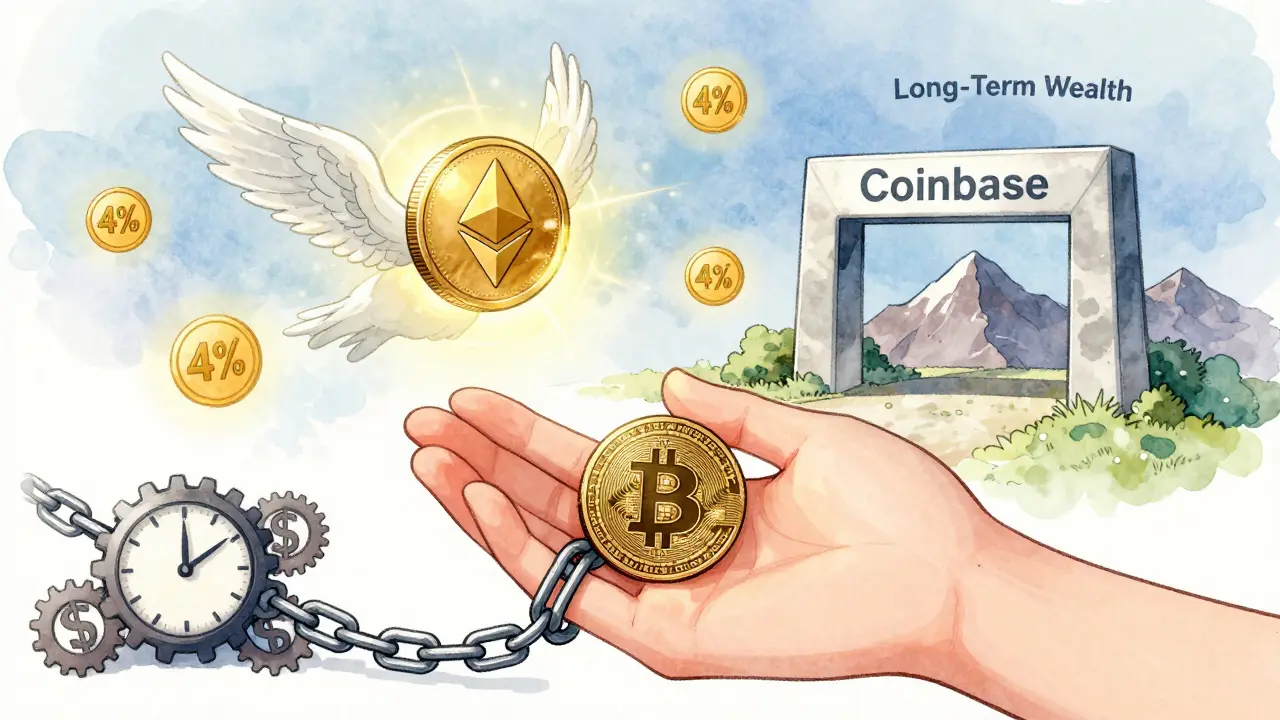
You also miss out on staking. If you hold 1 ETH and could earn 4% annually, that’s $100 a year on a $2,500 position. Robinhood doesn’t give you that. That’s a real opportunity cost.
And while Robinhood lets you withdraw crypto, the process is clunky. You have to navigate to a separate section, enter a wallet address, and wait 1-3 days. On Coinbase, it’s a 30-second tap.
Security and Regulation
Robinhood is regulated by the SEC and FINRA - the same bodies that oversee stock brokers. That means your funds are protected up to $500,000 under SIPC insurance - including $250,000 for cash. That’s more protection than most crypto-only exchanges offer.
But Robinhood has had security issues. In 2021, a social engineering attack let hackers take over user accounts. In 2023, the SEC fined them $65 million for misleading customers about order routing. They’ve improved since then, but trust is still fragile.
Your crypto is held in cold storage - good. But you don’t control the private keys. That means you’re trusting Robinhood to keep it safe. If they get hacked or go bankrupt, you’re not guaranteed to get your coins back. That’s different from self-custody wallets like Ledger or MetaMask.
Future Outlook: Will Robinhood Get Better?
Robinhood’s crypto volume jumped 400% in Q4 2024. That’s not because they added features - it’s because more people are using the app. They’re expanding into the EU and planning a launch in Asia by late 2025. That tells you they’re betting big on crypto.
But they’re moving slowly. They’ve added only a handful of new coins since 2022. No staking. No advanced trading. No API access. Their focus is clearly on keeping things simple for the masses, not attracting power users.
If you’re a beginner, that’s fine. If you’re serious about crypto, you’ll outgrow them fast.
Final Verdict
Robinhood is the best crypto platform for people who want to buy Bitcoin or Ethereum with zero fees and already use Robinhood for stocks. It’s simple, clean, and safe - for a broker.
It’s the worst crypto platform for anyone who wants to trade, earn rewards, or use advanced tools. You’re trading convenience for control.
Use Robinhood to get started. But if you plan to hold crypto long-term or trade actively, move your assets to a real exchange like Coinbase or Kraken. Don’t let the zero fees fool you. The real cost is what you can’t do.
Is Robinhood crypto trading really free?
Yes, Robinhood charges $0 in commissions, markups, or fees for buying or selling crypto. But they make money by routing your orders to market makers who pay them for order flow. This can sometimes result in slightly less favorable prices than exchanges that charge transparent fees. You won’t see a line item for fees, but the price you get might be 1-2% worse than on Coinbase or Kraken on large trades.
Can I stake crypto on Robinhood?
No, Robinhood does not offer staking for any cryptocurrency. You cannot earn rewards by holding Ethereum, Solana, or any other proof-of-stake coin. If you want to earn passive income from your crypto, you’ll need to use a platform like Coinbase, Kraken, or a dedicated staking service.
Can I transfer crypto from Robinhood to another wallet?
Yes, you can withdraw crypto from Robinhood to an external wallet. Go to your crypto holdings, select the coin, and choose "Send." You’ll need to enter the correct wallet address and network (like Ethereum for ETH). Withdrawals take 1-3 business days. Be extremely careful - sending to the wrong address is irreversible.
Is Robinhood safe for holding crypto long-term?
Robinhood stores crypto in cold storage and is regulated by the SEC, which adds a layer of protection. But you don’t control your private keys. That means if Robinhood gets hacked, goes bankrupt, or freezes your account, you’re not guaranteed to get your coins back. For long-term holding, a self-custody wallet like Ledger or Trezor is safer.
Why doesn’t Robinhood offer more cryptocurrencies?
Robinhood prioritizes regulatory compliance over variety. Adding new coins requires legal review, especially in the U.S. They focus on major, well-known assets like Bitcoin and Ethereum to reduce risk. This makes their offering smaller than exchanges like Coinbase or Binance, but it also means fewer sudden delistings or scams.
Should I use Robinhood if I’m already trading stocks there?
If you’re a casual investor who wants to keep everything in one place, Robinhood is convenient. But if you plan to trade crypto actively, use advanced tools, or hold for staking, you’ll eventually need to move your crypto to a dedicated exchange. You can still keep your stocks on Robinhood and use Coinbase or Kraken just for crypto.
15 Responses
Been using Robinhood for crypto since 2020 and honestly? Perfect for my $20 weekend buys. No stress, no fuss. I just want to own a little BTC and move on.
Robinhood’s order routing to market makers is essentially payment for order flow (PFOF) - a structural conflict of interest. You’re not getting the best execution, just the cheapest UI. This is retail investor exploitation disguised as ‘free.’
Zero fees?? 😂 Bro, I sold ETH and got 0.00224 ETH instead of 0.00230. That’s a 2.6% slippage. Free ain’t free when you’re getting robbed in decimal places. 🤡
For someone who only wants to hold Bitcoin and doesn’t care about trading mechanics, Robinhood is ideal. The simplicity reduces behavioral errors. Complexity often leads to worse outcomes for beginners.
Let’s be real - Robinhood’s entire crypto product is designed to lock you in. No staking, no cross-trading, no charting, no API - they don’t want you to become a serious crypto user. They want you to feel like you’re participating while keeping you safely contained in their walled garden. It’s brilliant business, terrible for your portfolio.
And don’t get me started on the withdrawal process. It’s like they’re trying to make it painful enough that you’ll just leave your coins there forever. Which, of course, means they can lend them out or use them for collateral. You’re not owning crypto. You’re owning a Robinhood IOU.
Compare that to Kraken - you send your ETH out, you get it in 20 minutes, you control the keys, you earn staking rewards, and you can trade 200+ tokens. The difference isn’t just features. It’s philosophy.
Robinhood is a gateway drug to crypto. But if you stay too long, you’ll never learn how to actually use the substance.
SEC fined them $65M for misleading order routing? That’s just the tip of the iceberg. They’re a brokerage that pretends to be a crypto platform - but they’re really a data farm. Every trade you make is sold to HFT firms. Your $10 BTC buy? It’s not a trade. It’s a commodity. You’re the product.
And don’t believe the ‘SIPC insurance’ myth. SIPC doesn’t cover crypto. They only cover cash balances up to $250K. Your ETH? Gone if they collapse. No FDIC. No blockchain backup. Just a corporate promise written in invisible ink.
They’re not here to help you. They’re here to monetize your ignorance. And they’re doing it beautifully.
why do people still use robinhood for crypto its so bad i mean like seriously you cant even swap eth for sol you gotta sell to usd first and then buy again its like trying to make a sandwich by first throwing away the bread
yo i started with robinhood and thought it was the bomb 🚀 then i moved to coinbase and holy cow the difference is night and day! staking rewards? yes please 🤑 and limit orders? i can sleep now 😴 don't let the free thing fool you - you're paying in time and missed gains!
if you're new? cool start there. but don't stay. upgrade. your future self will thank you 💪
While Robinhood's interface is undeniably accessible, the absence of key functionalities such as staking, advanced order types, and direct crypto-to-crypto trading fundamentally limits its utility as a long-term digital asset platform. The regulatory oversight provided by the SEC and FINRA offers a degree of institutional legitimacy, yet the lack of private key custody introduces significant counterparty risk. For the retail investor seeking minimal friction in initial exposure, Robinhood may serve as a transitional tool; however, for any meaningful participation in the cryptocurrency ecosystem, self-custody and full-service exchanges remain unequivocally superior.
you know what? i totally get why people love robinhood. i started there too, bought my first 5 bucks of btc, felt like a crypto king 😎 but then i tried coinbase and realized… i was just playing pretend. staking? i’m in now. limit orders? life changed. robinhood’s free but it’s like getting a free bike with no pedals. you can roll but you ain’t going nowhere fast.
It is worth considering that the appeal of Robinhood lies not in its feature set, but in its psychological alignment with the behavioral patterns of novice investors. The reduction of cognitive load - through simplified interfaces, absence of complex terminology, and the illusion of zero cost - creates a powerful onboarding experience. However, this same design philosophy actively discourages financial literacy. The absence of staking, advanced trading tools, and direct asset conversion is not merely an omission - it is a deliberate strategy to prevent users from developing the skills necessary to operate independently within decentralized financial ecosystems. The platform functions as a digital training wheel, and like all training wheels, its purpose is to be removed - not to be relied upon indefinitely.
Robinhood is a trap. They’re not even trying to be a crypto exchange. They’re a broker that sells your trades to HFT firms and then tells you you’re winning because you didn’t see a fee. Meanwhile your ETH sits there like a hostage and if they get hacked again you’re SOL. And they won’t even let you stake? That’s not incompetence. That’s malice. They want you to be passive. They want you to be dumb. And you’re letting them.
Robinhood is the TikTok of crypto platforms - flashy, addictive, and designed to keep you scrolling instead of thinking. You get the dopamine hit of buying crypto with one tap, but none of the real power. It’s like having a Tesla with no accelerator. Feels sleek, but you’re just coasting. Meanwhile, real traders are stacking sats, earning yield, and riding waves - while you’re stuck waiting 3 days to send your BTC to a wallet you didn’t even know you needed.
Start here? Sure. Stay here? That’s where the real money gets left on the table.
So you’re telling me I paid $0… but still lost money? Thanks for the insight, genius.
...I just bought 3 dollars of dogecoin. I don't care about anything else. Just leave me alone.