
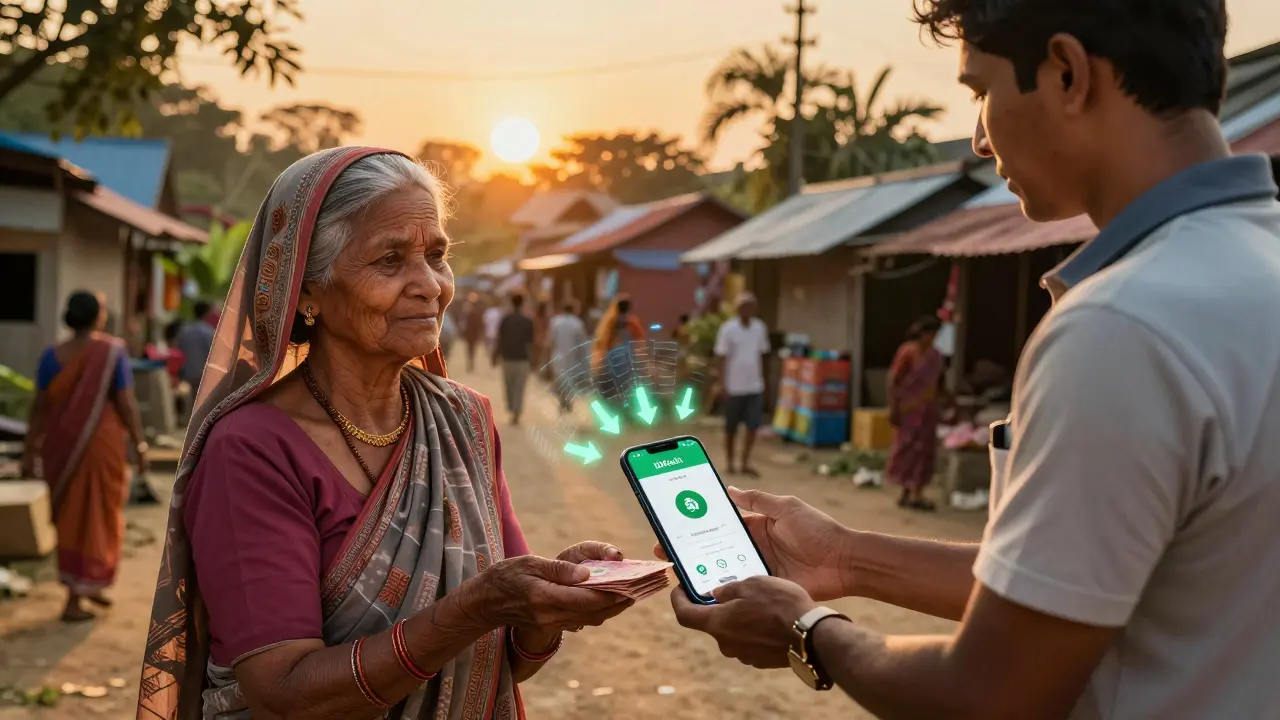
Every year, over $30 billion flows into Bangladesh from workers abroad - a record high in 2025. That’s more than the country earns from its entire garment industry. These are remittances: money sent home by millions of Bangladeshis working in the Middle East, the U.S., and Southeast Asia. For families in Sylhet, Chittagong, and rural villages, this cash pays for food, school fees, and medical bills. It keeps the economy afloat. But here’s the catch: crypto is not allowed to move this money.
How Remittances Are Actually Moving Through Bangladesh
Bangladesh doesn’t rely on wire transfers alone anymore. The system has changed. Today, most remittances arrive through mobile apps like bKash and Nagad. A worker in Dubai sends money via a licensed provider like Western Union or MoneyGram. The funds land in a local agent’s account, then get pushed instantly to the recipient’s phone. No bank branch needed. No paperwork. Just a 10-digit number and a PIN.In 2025, 87% of all remittances were received through mobile financial services. That’s up from 62% just two years ago. The Bangladesh Bank reports that the average transaction now takes under four hours thanks to a new real-time payment system. In 2023, it took days. Some users report getting money in under 12 hours - a huge improvement.
But it’s not perfect. Fees are still high. The World Bank says the average cost to send $200 to Bangladesh is 6.5%. That’s more than double the global target of 3%. Some users pay up to 7% when sending from the UK or the U.S. The government launched a new app called “Remittance Direct” in August 2025, cutting fees to 3.8% for users who go through official channels. It’s working - over $1.2 billion has flowed through it in just six months.
Why Crypto Is Still Illegal for Remittances
You might wonder: if digital money works so well, why not use Bitcoin or USDT? After all, crypto can skip banks, cut fees, and move faster. But Bangladesh Bank says no. Not even a little.The ban started in 2017 and got stricter in 2025. In September, the central bank issued Warning Notice No. BB/CC/2025/17. It says any bank, agent, or app that helps send crypto for remittances will lose its license. Users could face criminal charges. The reason? Monetary sovereignty. Financial stability. Fear of money laundering.
Deputy Governor Ahmed Munas said it plainly in a September press conference: “Cryptocurrencies pose unacceptable risks to our economy.” He’s not alone. The IMF, World Bank, and even former Bangladesh Bank chairmen agree: the country isn’t ready. The banking system is still catching up. Only 52% of adults have a bank account. Most people don’t understand crypto. If it went mainstream, scams, hacks, and untraceable flows could crash the taka.
Compare this to India or Pakistan. Both have explored regulated crypto remittance pilots. Bangladesh won’t even consider it. The central bank is watching CBDCs - central bank digital currencies - but only as a future tool for its own system, not for private crypto.
What Happens When People Try to Use Crypto Anyway
Despite the ban, some people try. There are Telegram groups, WhatsApp networks, and dark web forums where expats trade crypto for cash in Bangladesh. A user on Reddit said they used a peer-to-peer exchange to buy USDT, then met someone in Dhaka to swap it for taka. They lost $300 in fees and waited three weeks for the cash.Facebook groups with over half a million members show the tension. Sixty-three percent of Bangladeshi expats say they’re frustrated with slow, expensive remittance channels. But only 12% have tried crypto. Why? Fear. The risk isn’t just financial - it’s legal. Banks monitor transactions. If you send $500 in Bitcoin and it shows up as a cash deposit, you’re flagged. Your account gets frozen. You get called in for questioning.
There’s also the problem of trust. Most recipients in rural areas don’t have smartphones, let alone wallets. They need cash in hand. Crypto can’t do that without a middleman - and middlemen are exactly what the government is trying to eliminate.
Who Benefits From the Current System
The big winners are the banks and mobile money providers. Sonali Bank controls 18.7% of the market. bKash has 15.2%. BRAC Bank and Nagad are growing fast. These institutions make money on every transaction. They pay lower fees to international partners because they’re licensed. They get access to foreign currency reserves. They’re protected by law.The government wins too. By forcing remittances through official channels, they’ve shut down the hundi system - an informal network that moved billions in cash without records. In 2024, hundi accounted for nearly 20% of remittances. By mid-2025, it was down to 2%. That’s $5 billion a year now being tracked, taxed, and counted in the country’s foreign reserves.
As a result, Bangladesh’s foreign exchange reserves hit $25.63 billion in 2025 - the highest ever. The Balance of Payments went from a $4.3 billion deficit to a $3.3 billion surplus. That’s huge. It means the taka is stronger. Inflation is lower. Importers can buy more fuel and medicine.
The Real Problem: Fees, Access, and Trust
The system works better than before - but it’s still broken for many. Rural recipients often can’t access digital services. A UNDP study found 18% of people in villages lack the ID or mobile registration needed to receive remittances. They still rely on family members to travel to town and pick up cash.Exchange rates are inconsistent. One bank might give you 118 taka per dollar. Another gives 116.5. That’s a 1.2% difference - and it adds up. For someone sending $500 a month, that’s $60 a year lost just because of bad rates.
And what about the middleman? Even with mobile apps, there’s still a chain: sender abroad → international provider → local agent → mobile wallet. Each step takes a cut. The Bangladesh Bank says it wants to cut fees to 3% by 2027. But how? Without crypto, the only way is to cut out more intermediaries. That means more direct bank-to-bank deals - something only big players like Sonali or BRAC can do.
What’s Next for Remittances in Bangladesh
The government has a plan: go fully digital by 2027. That means 95% of remittances processed through apps, not cash. They’re linking up with India’s UPI system - which could make sending money from India’s 1.2 million Bangladeshi workers faster and cheaper. They’re expanding agent banking into remote areas. They’re training community volunteers to help elderly recipients use bKash.But crypto? Not on the roadmap. The Bangladesh Bank’s Digital Payment Strategy 2025-2027 doesn’t mention Bitcoin, Ethereum, or stablecoins once. It talks about blockchain for audit trails - but only for their own systems. No peer-to-peer. No decentralized networks.
Some economists warn this could backfire. Dr. Birupaksha Paul from Jadavpur University says, “Without innovation, growth will plateau at $33-35 billion.” He believes crypto could help if properly regulated. But the central bank isn’t listening. Not yet.
The truth is, Bangladesh is walking a tightrope. On one side: a booming remittance economy that’s lifting millions out of poverty. On the other: a rigid rule that says digital money must come from banks - and only banks. Until that changes, crypto will stay on the sidelines. Not because it’s bad. But because the system isn’t ready to trust it.
What You Can Do If You’re Sending Money to Bangladesh
If you’re an expat sending money home, here’s how to do it right:- Use licensed providers: Western Union, MoneyGram, Remitly, or Wise.
- Try the Bangladesh Bank’s “Remittance Direct” app - lower fees, faster delivery.
- Always send to a registered mobile wallet (bKash, Nagad, or Rocket).
- Keep your National ID and proof of employment handy - you might need it.
- Avoid crypto. Even if it seems faster, the risk isn’t worth it.
For recipients: if you don’t have a phone or ID, ask a relative to help you register. Many NGOs and post offices offer free training. Don’t wait. The system is getting better - but only if you use it.
Is cryptocurrency legal for remittances in Bangladesh?
No. Cryptocurrency is explicitly banned for remittances in Bangladesh. The Bangladesh Bank prohibits any entity - banks, agents, or apps - from facilitating crypto transactions for sending money home. Violators face license revocation and criminal charges under Section 33 of the Foreign Exchange Regulation Act 1947.
Why does Bangladesh ban crypto remittances?
Bangladesh Bank says crypto threatens monetary stability, enables money laundering, and undermines control over the national currency. The country’s financial infrastructure isn’t ready for decentralized systems. With only 52% of adults having bank accounts, the central bank fears widespread crypto use could lead to fraud, capital flight, or loss of control over foreign exchange reserves.
How much do remittances cost to send to Bangladesh?
The average fee is 6.5% for sending $200, according to the World Bank. This is higher than the global target of 3%. However, the Bangladesh Bank’s “Remittance Direct” app charges only 3.8%, making it one of the cheapest official options. Fees vary by sender country and provider - sending from the U.S. is usually cheaper than from the UK or Malaysia.
Can I use Bitcoin to send money to my family in Bangladesh?
Technically, you can trade Bitcoin for cash through peer-to-peer networks, but it’s illegal and risky. Bangladesh Bank actively monitors transactions. If detected, your bank account could be frozen, and you could face legal action. Recipients also risk losing money if they can’t convert crypto to cash safely. It’s not worth the risk.
What’s the fastest way to send money to Bangladesh?
The fastest option is through the Bangladesh Bank’s “Remittance Direct” app or licensed mobile financial services like bKash or Nagad. Transactions can be completed in under four hours. Traditional bank transfers still take 1-3 days. Avoid cash-based services like hundi - they’re illegal and unreliable.
Are remittance fees going down in Bangladesh?
Yes, slowly. Fees have dropped from over 8% in 2020 to 6.5% in 2025, thanks to digital adoption and competition from mobile apps. The government aims to reduce fees to 3% by 2027. The “Remittance Direct” app already achieves this target, and more providers are expected to follow. But without crypto or direct blockchain solutions, progress depends on scaling digital infrastructure.
14 Responses
This is why developing nations cling to outdated systems. Crypto isn't the problem - fear of disruption is. You're literally paying 6.5% to middlemen while Bitcoin moves in seconds. Sad.
The central bank is protecting the people from themselves. You think crypto is freedom but it's just another pyramid scheme with more hashtags
I just cried reading about rural families waiting weeks for cash. 😭 Why does innovation always exclude the most vulnerable? This isn't protection - it's neglect.
The IMF and World Bank are puppets of western banks they want to control money flow not help poor countries the real agenda is financial colonialism
I love how people act like crypto is the magic bullet but no one talks about the grandma in Sylhet who can't even use a smartphone. Tech doesn't fix human problems unless you meet people where they are
Bangladesh has every right to protect its sovereignty. Letting unregulated digital assets flood in is economic recklessness. This isn't about control - it's about survival.
You're all missing the point. The real issue is that mobile money providers like bKash are monopolies. They're not innovating - they're rent-seeking. Crypto could break their grip but the government is too cozy with them.
Honestly I think they're doing fine. People are getting money faster than ever. Fees are dropping. Let them keep improving what works instead of chasing shiny new things.
The 12% who tried crypto? They're the dumb ones. You think you're hacking the system but you're just handing over your life savings to scammers and the police.
I know folks in Dhaka who use bKash every week. It's not perfect but it's real. The system's messy, sure - but it's working. Let's fix the fees and access before we blow it up with crypto chaos.
The entire framework is a regulatory artifact. The central bank is operating in a pre-Web3 paradigm. They're not anti-innovation - they're anti-disruption. And that's the real bottleneck.
They banned crypto because they're scared. Scared of losing control. Scared of people becoming financially independent. Scared that the taka might actually be worth less than a meme coin
I used to send money home through Western Union. Paid $13 every time. Now I use Remittance Direct. $7.50. Took 2 hours. No drama. No risk. Just… work.
If you want crypto remittances, move to a country that can handle it. Bangladesh isn't Switzerland. Stop projecting your Silicon Valley fantasies onto a nation still figuring out basic banking.