
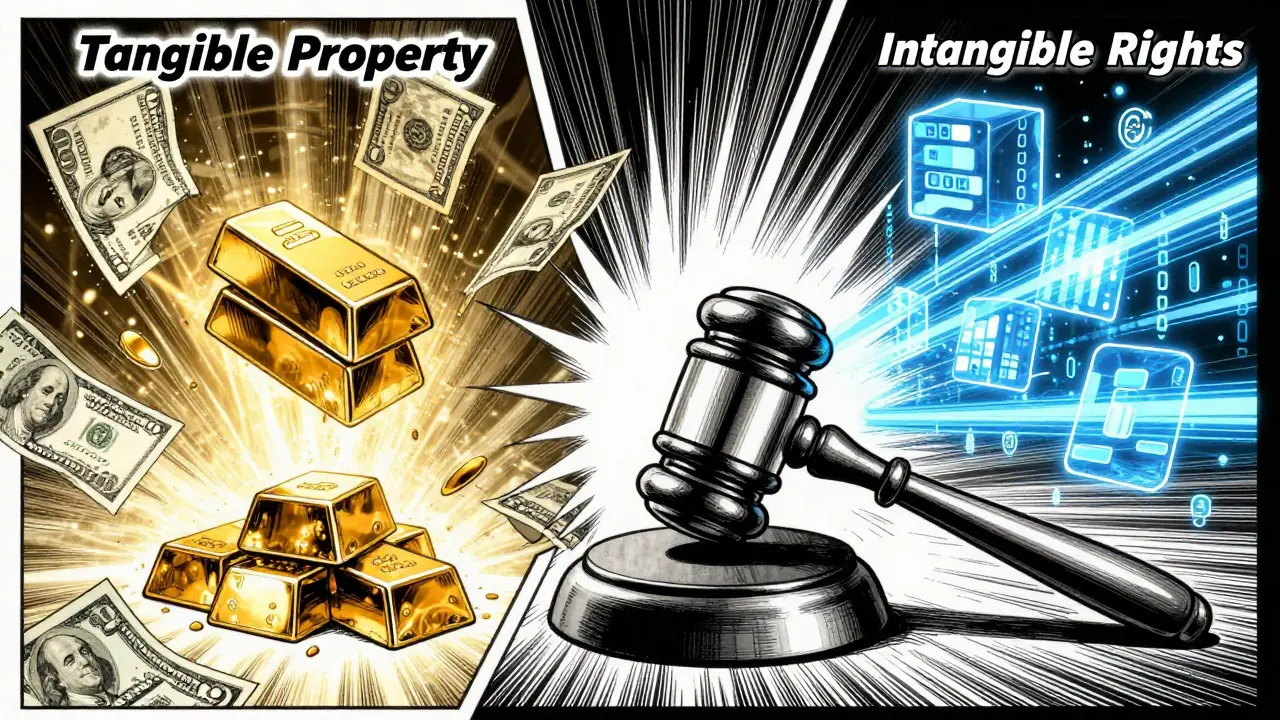
The Money Paradox: Is Your Cash Actually Property?
Think about the wallet in your pocket. You see cash as money-a tool to buy coffee or pay rent. But look closer at the law, and that same cash is classified as tangible personal property. It’s a physical object you own, just like your car keys or a book. Now think about the number in your bank account. That isn’t physical stuff; it’s a promise from the bank to pay you. Legally, that’s called a "chose in action," which is a type of intangible property. This distinction might sound like boring legal jargon, but it changes everything when you deal with taxes, divorce, or death.
For centuries, the law has drawn a hard line between what counts as property and what counts as currency. Real property means land and buildings. Personal property means movable things. Currency sits in a weird middle ground. It’s used to measure value, so courts often say it’s not property itself, but the standard for measuring property. But then Bitcoin showed up, and suddenly nobody knew where to put it. Is it a coin? Is it a stock? Is it just digital code that counts as property?
If you are holding crypto in 2026, this confusion costs you real money. The Internal Revenue Service (IRS) says one thing. Banks say another. Courts in different states rule differently. Understanding the difference between property and currency isn’t just academic-it determines how much tax you pay, who gets your assets if you die, and whether you can sue someone who stole them.
Is cash considered property under the law?
Yes. Physical coins and paper bills are classified as tangible personal property. However, money in a bank account is often treated as an intangible right (a chose in action), meaning you own the claim against the bank, not the specific dollars.
How the Law Defines What You Own
To understand why crypto is such a mess legally, you first need to know how traditional assets are sorted. The foundation comes from English common law, specifically William Blackstone’s work in the 1700s. He split the world into two buckets: real property and personal property. Real property is land and anything permanently attached to it, like a house or a fence. Personal property is everything else that moves-cars, furniture, jewelry, and yes, cash.
The American Law Institute updated this thinking in its Restatement of Property. They defined property not as a thing, but as a relationship between people regarding a thing. This matters because it means "ownership" is actually a bundle of rights: the right to use it, sell it, exclude others, and destroy it. When you own a house, you have all these rights. When you hold cash, you also have these rights, but the law treats the transfer of cash differently than the transfer of a house.
Here is where it gets tricky. If you sell your car, you sign a bill of sale. If you sell your house, you record a deed in county offices. If you spend $20 on groceries, no paperwork is needed. Why? Because currency is designed to move fast. The law gives currency special status as a medium of exchange. In the 1925 case Webb v. United States, the Supreme Court said that money in regular business use is not property itself, but the representative of property. This exception makes daily life possible, but it creates headaches when disputes arise.
| Asset Type | Legal Definition | Transfer Method | Tax Treatment |
|---|---|---|---|
| Real Property | Land and permanent fixtures | Recorded Deed | Annual ad valorem tax (avg 1.08%) |
| Tangible Personal Property | Movable physical items (cash, cars) | Bill of Sale / Delivery | Capped sales tax; some states tax annually |
| Intangible Personal Property | Rights and claims (bank accounts, stocks) | Assignment / Electronic Transfer | Capital gains rates (0%, 15%, 20%) |
The Fixture Problem: Where Does Property End?
Even without crypto, lawyers fight constantly over what counts as part of a building versus what counts as personal property. This is known as the fixture problem. Imagine you buy a house. The seller took out the chandelier. You argue it was screwed into the ceiling, so it stays. They argue it’s just a light fixture they brought with them.
Courts use a test called MARIA to decide this. It stands for Method of attachment, Adaptability, Relationship of parties, Intention, and Agreement. If something is glued down (Method) and built specifically for that room (Adaptability), it’s likely real property. If it’s easily removed and the buyer didn’t expect it (Intention), it’s personal property. In California, 23% of home sales involve disputes over fixtures. This shows how fragile the line between property types really is. If we can’t agree on a chandelier, imagine trying to classify a decentralized token.
Why Crypto Breaks the Old Rules
Bitcoin and other cryptocurrencies arrived in a legal system built for atoms, not bits. They don’t fit neatly into any box. Are they currency? They aren’t issued by a government. Are they securities? Some act like stocks, others don’t. Are they commodities? Maybe. So, regulators started picking and choosing based on their goals.
The IRS took the lead in 2014 with Notice 2014-21. They declared that virtual currencies are treated as property for federal tax purposes. This was a huge decision. It meant every time you swapped Bitcoin for Ethereum, or bought coffee with Dogecoin, you had a taxable event. You had to calculate capital gains or losses. For most people, this is impossible to track manually. The IRS ignored the fact that many users treat crypto exactly like cash. To them, it’s spending power, not an investment asset sitting in a vault.
Meanwhile, the Financial Crimes Enforcement Network (FinCEN) looked at the Bank Secrecy Act and treated crypto more like currency for anti-money laundering rules. If you run an exchange, you’re a money services business. This contradiction confuses businesses. You report crypto as property to the tax man, but as currency to the crime fighters.
In court, the rulings are even messier. In United States v. Gratkowski (2020), a judge looked at Bitcoin and noted its similarities to currency. But in other cases, judges treat stolen crypto as stolen property, allowing victims to sue for conversion. This inconsistency means your legal rights depend entirely on which agency or judge handles your case.
The Human Cost of Legal Confusion
This isn’t just theory. People lose money and assets because of these classification gaps. Estate planning is a major pain point. When someone dies, their will dictates who gets their property. But if your crypto is stored in a hardware wallet, is it property? Yes. But do your heirs know the password? Often, no. Unlike a bank account, where the bank freezes the funds until probate is settled, crypto doesn’t have a central authority to freeze it. It either transfers forever, or it disappears forever.
On forums like Reddit’s r/personalfinance, users frequently complain about this disconnect. One user shared that their mother’s bank accounts were frozen for three months after her death, delaying access to funds. Meanwhile, her physical jewelry was distributed immediately. If she had held significant crypto, the lack of clear legal procedure for accessing private keys could have resulted in total loss. Data from the American Academy of Estate Planning Attorneys shows that 42% of probate cases involving digital assets required judicial clarification, compared to just 7% for traditional assets. Judges are being forced to make up laws on the fly.
Divorce is another minefield. In high-net-worth divorces, spouses hide assets. Crypto makes this easier. But once found, how is it divided? A survey by the American Academy of Matrimonial Lawyers found that 31% of complex divorce cases involved disputes over crypto classification. Should it be treated as marital property to be split 50/50? Or as separate property if one spouse mined it before marriage? Courts vary wildly. In some states, it’s property. In others, judges struggle to value it because the price swings so much, unlike stable real estate.

New Frameworks Emerging in 2026
By mid-2026, the legal landscape is shifting again. The old binary of property vs. currency is cracking. Regulators realize they need a third category. The European Union’s MiCA regulation, fully effective since 2024, created a new class called "virtual assets." These are distinct from both e-money and traditional securities. This gives banks and investors clearer rules.
In the US, the momentum is building toward similar clarity. The Uniform Law Commission released updates to electronic transaction laws in 2023, which 18 states adopted by late 2023. These laws recognize that digital assets can be controlled by private keys, creating a new definition of ownership that doesn’t rely on physical possession. The IRS has also floated draft guidance proposing a three-tier system: Tier 1 for government currency, Tier 2 for stablecoins, and Tier 3 for volatile cryptocurrencies. While not yet final law, this signals a move away from the blunt "all crypto is property" hammer.
Professor Daniel Thürer of the University of Zurich argued in 2023 that the legal system’s binary classification is obsolete. We are moving toward a nuanced taxonomy where an asset can be property for tax purposes, currency for payment purposes, and data for privacy purposes, all at the same time. This multi-faceted approach is harder to grasp but much more accurate for the digital age.
What You Should Do Now
Until the laws settle down, you need to protect yourself. Don’t assume your lawyer knows crypto law. Many general practitioners still treat Bitcoin like gold bars. Make sure your estate plan includes explicit instructions for digital assets. List your wallets, explain how to access them, and specify whether you want them sold, gifted, or donated. Treat your crypto keys like the deed to your house-they are the ultimate proof of ownership.
For taxes, keep meticulous records. Since the IRS treats crypto as property, every swap is a potential tax event. Use software that tracks cost basis automatically. Don’t wait until April to figure out what you owe. And remember, classification affects liability. If you lend someone crypto, is it a loan of property or a transfer of funds? The answer changes your recourse if they default. In the current gray area, written contracts specifying the nature of the asset are your best defense.
Does the IRS treat Bitcoin as property or currency?
As of 2026, the IRS primarily treats Bitcoin and most cryptocurrencies as property for tax purposes. This means you must report capital gains or losses when you sell, trade, or spend them. However, draft guidance suggests future tiers may distinguish between stablecoins and volatile assets.
What happens to crypto if I die without a will?
If you die without a will (intestate), state laws determine who inherits your property. However, without access to your private keys or seed phrase, your crypto may be permanently lost. Unlike bank accounts, there is no central institution to notify or force open a crypto wallet. Clear estate planning documentation is essential.
Is cryptocurrency considered marital property in divorce?
In most jurisdictions, cryptocurrency acquired during the marriage is considered marital property subject to division. However, tracing the origin of funds can be difficult. Courts increasingly require forensic blockchain analysis to determine if assets are separate or marital, leading to higher legal fees.
How does the MARIA test apply to digital assets?
The MARIA test is traditionally used for physical fixtures in real estate. It does not directly apply to digital assets. Instead, courts look at control via private keys and intent. The Uniform Law Commission’s new frameworks focus on whether the asset is fungible and how it is transferred, rather than physical attachment.
Will crypto ever be legally recognized as currency?
Some stablecoins are already treated similarly to currency for banking regulations. However, widespread legal recognition of volatile cryptocurrencies as official currency is unlikely in the near future due to volatility concerns. Most experts predict a hybrid model where certain digital assets gain limited currency status for specific transactions while remaining property for tax and ownership purposes.
15 Responses
Hey there! This is such a crucial topic to break down for everyone.
I know legal jargon can feel like a wall of noise, but you really nailed the explanation of why this distinction matters for our daily lives. It’s empowering to understand that we aren’t just passive holders of assets but active participants in a complex legal framework. Keep up the great work making these heavy topics accessible!
The audacity of the IRS to treat digital currency as property while simultaneously ignoring the reality of how people use it is frankly insulting. We are forced to track every single micro-transaction as if we are day-trading stocks on Wall Street, yet we are treated like criminals by FinCEN when we try to move funds legally. It is a bureaucratic nightmare designed to bleed us dry through compliance costs and penalties. The system is rigged against the individual, favoring institutions that have armies of lawyers to navigate this absurd double standard.
So tired of this confusion 😩
You hit the nail on the head regarding the 'chose in action' concept. It’s fascinating how Blackstone’s ancient categorizations are now being stretched to their breaking point by blockchain technology. The idea that ownership is merely a bundle of rights rather than possession of a physical object is a profound shift. When you hold Bitcoin, you don't possess the coin; you possess the cryptographic key that grants you the right to transfer value. This decoupling of control from physical presence is what breaks the traditional MARIA test entirely. Courts are floundering because they are trying to fit a square peg into a round hole, using tools forged for chandeliers to judge decentralized ledgers.
its all a setup to destroy privacy. the government knows crypto threatens their monopoly on money creation so they classify it as property to tax it into oblivion. they want you to think its an investment so you pay capital gains on buying coffee. meanwhile the banks get away with fractional reserve banking which is essentially legalized theft. wake up sheeple. the maria test is irrelevant because the deep state controls the courts anyway. stop trusting the narrative.
This reminds me of the philosophical debates around nominalism versus realism. Is money a thing in itself, or is it merely a social construct agreed upon by participants? The law tries to force a binary classification on something that is inherently fluid. Perhaps the solution isn't to force crypto into old boxes, but to accept that digital assets exist in a superposition of states-property for tax, currency for exchange, and data for storage. It’s a beautiful mess of human ingenuity clashing with rigid tradition.
Man, I remember back in the early days when we thought crypto was just going to be free money. Now look at us, needing estate planners who understand private keys. It’s wild how fast things changed. But hey, at least we’re learning! The EU moving forward with MiCA is a huge step. Maybe the US will catch up eventually. Gotta stay positive and keep learning, folks!
I just sit here watching the chaos unfold. One minute it's gold, next minute it's a security, then it's property. It’s like playing musical chairs with your financial future. Honestly, I’m just glad I didn’t lose my seed phrase during the last market crash. That would’ve been the cherry on top of this legal sundae.
the whole thing about fixtures is so weird like why do we care about chandeliers when we could be talking about smart contracts. its all about control and intent really. the law is so stuck in the past trying to define bits with atoms. its giving major cognitive dissonance vibes.
The entire premise of this article is flawed because it assumes the legal system has any legitimacy in the digital age. The Federal Reserve is printing money out of thin air, devaluing our savings, and then they dare to lecture us on how to classify Bitcoin? It is a parasitic relationship where the state feeds on the productivity of the citizenry. The 'three-tier system' proposed by the IRS is merely a new shackle to tighten their grip on wealth extraction. Do not trust them. They are coming for your keys.
One must consider the implications of the Uniform Law Commission updates more deeply. If states adopt these frameworks, we may see a fragmentation of legal standards across the country. A transaction valid in California might be void in Texas due to differing interpretations of 'control.' This creates a patchwork quilt of regulations that increases transaction costs and uncertainty for cross-border digital commerce. It is a significant hurdle for the mainstream adoption of decentralized finance.
Everyone needs to read this if they haven't updated their wills. My aunt died last year and her crypto was lost because nobody knew where the hardware wallet was hidden. It was heartbreaking. So, please, write it down. Store it safely. Don't let your hard-earned assets vanish into the ether because you were too lazy to plan ahead. It’s not rocket science, it’s basic responsibility.
elites always find a way to control everything. first they controlled land then gold now they want to control code. its simple really. they fear losing power. the common man is told to follow rules made by people who dont even own crypto. laughable. keep your keys safe and ignore the noise.
Ugh, reading all this makes my head spin. Why does it have to be so complicated? I just want to buy stuff without filling out forms. It feels like they are punishing us for wanting freedom. Anyway, hope everyone stays safe out there. Sending good vibes!
Exactly! And don't forget the divorce cases. Hiding crypto in offshore wallets is the new favorite trick for the wealthy. It’s disgusting how the system protects the rich while squeezing the middle class. We need radical transparency and accountability, not more loopholes for the elite.