

Imagine posting every purchase you make on a public billboard that never gets taken down. That is essentially what happens when you use a standard public blockchain like Bitcoin or Ethereum. While the technology promises freedom from banks and intermediaries, it also creates a permanent, unchangeable record of your financial life. This is the core tension in modern distributed ledger systems: how do we keep the trust that comes with openness without sacrificing the basic human right to privacy?
In 2026, this isn't just a philosophical debate anymore. It is a technical hurdle that blocks enterprise adoption and keeps regulators awake at night. If you cannot hide sensitive data, companies won't use the tech. If you hide too much, governments will ban it. Finding the middle ground-selective transparency-is the single most important challenge facing blockchain developers today.
The Myth of Anonymity on Public Ledgers
We need to clear up a common misconception first. Most people think blockchain users are anonymous. They are not. They are pseudonymous. Your name isn't attached to your wallet address, but the address itself is a unique identifier that stays with you forever.
Think of it like using a nickname on social media. You might call yourself "CryptoKing99," but if everyone can see exactly who you talk to, when you talk to them, and how much money you send, it doesn't take long for someone to figure out who you really are. This process is called deanonymization.
Here is how it works in practice:
- KYC Exchanges: When you buy crypto on a regulated exchange like Coinbase or Binance, you link your real identity to your withdrawal address. Once that link is made, every transaction that flows through that address becomes traceable back to you.
- Pattern Analysis: If you pay your electricity bill from the same wallet every month, analysts can correlate that timing and amount with public utility records to identify your home address.
- IP Logging: In some networks, nodes can still log IP addresses during transaction propagation, adding another layer of exposure.
Tools like Chainalysis and Elliptic have become so sophisticated that they can cluster thousands of addresses into single entities. For the average user, this means your financial habits are effectively public knowledge if you know where to look.
Why Total Privacy Is Also a Problem
If public ledgers are too open, why don't we just switch to completely private blockchains? After all, there are coins designed specifically for secrecy, often called privacy coins. These systems use advanced cryptography to hide sender, receiver, and amount entirely.
The problem is that total opacity kills trust in a decentralized system. Here is why:
- Regulatory Pushback: Governments require Anti-Money Laundering (AML) and Know Your Customer (KYC) compliance. A system that hides everything is a dream for tax evaders and illicit actors, making it a target for bans. Several countries have already restricted or banned privacy-focused tokens because they cannot verify transactions.
- Lack of Auditability: Enterprises need to prove their financial health. If a company uses a fully private ledger, auditors cannot verify that the assets actually exist or that transactions were legitimate. This makes these chains useless for supply chain management or corporate finance.
- Network Security Risks: Some privacy protocols rely on centralized mixers or complex setups that, if compromised, could expose all user data at once. Decentralized transparency helps secure the network by allowing anyone to audit the code and state.
So, we are stuck between two extremes: a glass house where everyone sees everything, and a black box where no one can see anything. Neither works for mainstream adoption.
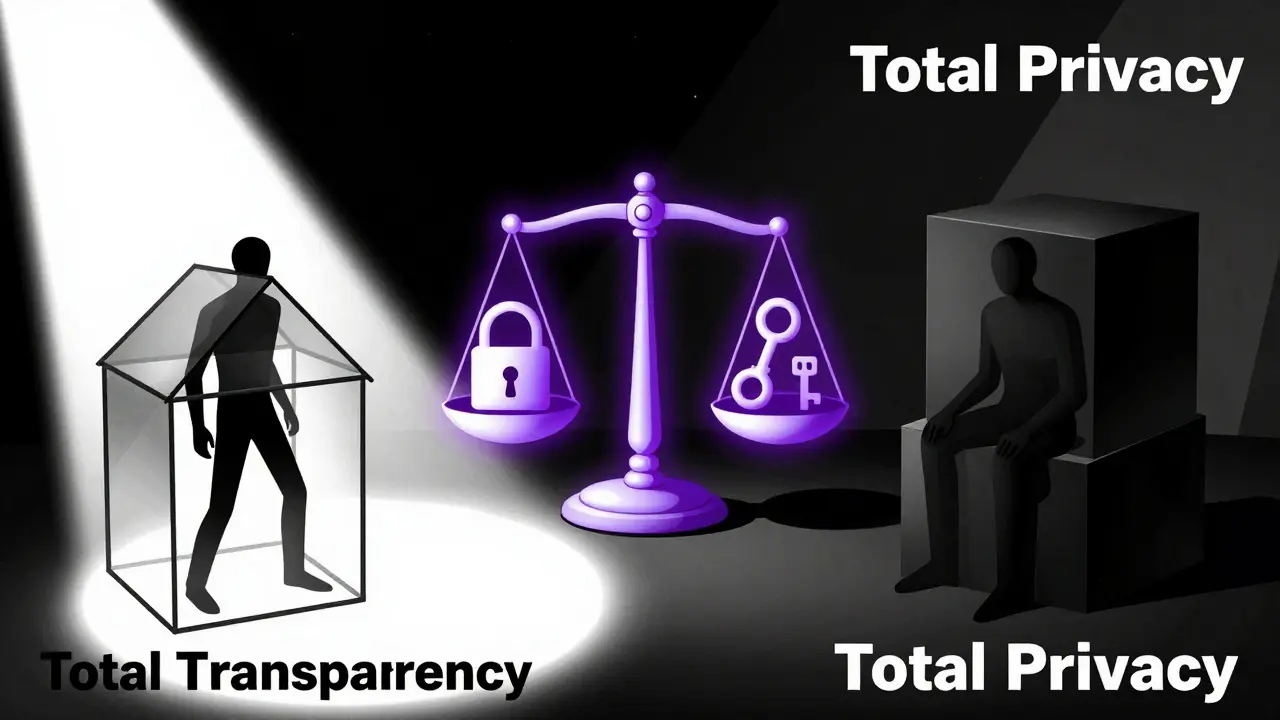
The Solution: Zero-Knowledge Proofs
This is where the magic of Zero-Knowledge Proofs (ZKPs) comes in. ZKPs are cryptographic methods that allow one party to prove to another that they know a value, without conveying any information apart from the fact that they know the value.
Let’s break that down with a real-world analogy. Imagine you want to prove to a bouncer that you are over 21 without showing your ID. Instead of handing over your driver's license (which reveals your name, address, and photo), you show a digital certificate that simply says "Age > 21: True." The bouncer verifies the proof mathematically, accepts it, and lets you in. They learn nothing else about you.
In blockchain terms, this means you can prove you have enough funds to make a payment, or that you are authorized to access a document, without revealing your balance, your identity, or the content of the document.
| Model | Transparency Level | Privacy Level | Best Use Case | Regulatory Risk |
|---|---|---|---|---|
| Public Ledger (e.g., Bitcoin) | High | Low | Currency, Store of Value | Low |
| Private Chain (e.g., Hyperledger) | None (Permissioned) | High | Internal Enterprise Data | Medium |
| Privacy Coin (e.g., Monero) | None | Maximum | Personal Untraceable Payments | Very High |
| ZK-Enabled Chain (e.g., zkSync) | Selective | Configurable | DeFi, Identity, Enterprise | Low |
The beauty of ZKPs is that they preserve the verifiability of the blockchain while encrypting the data. The network still knows the transaction is valid (you didn't spend money you don't have), but it doesn't know who spent it or how much.
GDPR and the Right to Be Forgotten
There is another elephant in the room: the General Data Protection Regulation (GDPR). In Europe, and increasingly elsewhere, citizens have the "right to be forgotten." This means if you ask a company to delete your personal data, they must comply.
But blockchain is immutable. By definition, you cannot delete data from a blockchain. Once a transaction is confirmed, it is etched in stone. This creates a direct legal conflict for any European business trying to use public blockchains to store user data.
How do developers solve this? They stop storing personal data on-chain altogether. Instead, they store only a hash (a digital fingerprint) of the data on the blockchain, while keeping the actual data off-chain in a secure database. If a user requests deletion, the company deletes the off-chain data. The hash remains on the blockchain, but without the original data, the hash is meaningless-it cannot be reversed to reveal the information.
This approach, combined with zero-knowledge proofs, allows companies to prove they are compliant with regulations without violating the core principles of blockchain integrity.

Selective Transparency: The Future Standard
By 2030, experts predict that most enterprise blockchains will operate on a model of selective transparency. This means users control exactly who sees what.
Imagine a healthcare app built on blockchain. Your medical records are encrypted. However, you can generate a temporary, time-limited key that allows your doctor to view your history. The insurance company can verify that you received treatment without seeing your diagnosis. The government auditor can verify that the hospital was paid correctly without seeing patient names.
This granular control is possible through smart contracts that manage access permissions dynamically. It shifts the paradigm from "all or nothing" to "need to know."
Key Technologies Enabling This Shift
- zk-SNARKs and zk-STARKs: These are specific types of zero-knowledge proofs used in production networks today. SNARKs are smaller and faster to verify, while STARKs are quantum-resistant and don't require a trusted setup.
- Ring Signatures: Used by privacy coins, these mix your signature with others to make it impossible to tell who signed the transaction. Newer versions allow for selective disclosure.
- Confidential Transactions: These hide the amount being transferred while still ensuring that the sum of inputs equals the sum of outputs, preventing counterfeiting.
Practical Steps for Users and Developers
If you are a user concerned about privacy, here is what you can do right now:
- Use Unique Addresses: Never reuse wallet addresses. Generate a new address for every transaction or interaction. This breaks the link between different parts of your financial life.
- Avoid KYC Links: Be aware that withdrawing from a KYC-compliant exchange links your identity to that wallet. Consider using non-custodial wallets for long-term storage.
- Check Network Protocols: Look for platforms that implement privacy features by default, such as those using ZK-rollups or confidential computing.
For developers building applications, the advice is simpler: design for privacy from day one. Do not assume you can add it later. Integrate zero-knowledge libraries early, and ensure your architecture separates on-chain verification from off-chain data storage.
The era of choosing between privacy and transparency is ending. We are moving toward a hybrid model where both coexist through advanced cryptography. The question is no longer which side you are on, but how well you can balance the two.
Is Bitcoin private?
No, Bitcoin is pseudonymous, not private. All transactions are recorded on a public ledger that anyone can view. While your name is not attached to your wallet address, sophisticated analysis tools can often link addresses to real-world identities through pattern recognition and exchange data.
What are zero-knowledge proofs in simple terms?
Zero-knowledge proofs (ZKPs) are a cryptographic method that allows you to prove you know something (like a password or a balance) without revealing the actual information. For example, you can prove you are over 18 without showing your birthdate or ID number.
Can blockchain comply with GDPR?
Yes, but not by storing personal data directly on the chain. Compliance is achieved by storing only hashes (digital fingerprints) on the blockchain and keeping the actual personal data off-chain. If data needs to be deleted, the off-chain copy is removed, rendering the on-chain hash useless for identifying the individual.
Why are privacy coins controversial?
Privacy coins like Monero or Zcash offer complete anonymity, which makes them attractive for illegal activities such as money laundering and ransomware payments. This has led to regulatory scrutiny and bans in several jurisdictions, as governments struggle to enforce AML (Anti-Money Laundering) laws on these networks.
What is selective transparency?
Selective transparency is a model where users control who can see their data and for how long. Instead of everything being public or everything being hidden, data is shared only with authorized parties (like a doctor or an auditor) using cryptographic keys, balancing privacy needs with verification requirements.
13 Responses
THIS IS ABSOLUTELY TERRIFYING. I mean, really? We are handing over our entire financial lives to a system that is basically a public diary for everyone to read? It is insane how little people understand about this. I feel like my privacy is being stripped away layer by layer and nobody even notices until it is too late. The fact that exchanges link your identity to your wallet is just the tip of the iceberg. It is a surveillance state in disguise. I am so angry about this. They sell us freedom but give us chains.
i totally get why u r worried brad but i think its not all bad tho. like yeah its scary but maybe we can learn to use it better? i mean if we just be careful with our wallets it might be ok. i try to stay positive about tech stuff because usually it helps people in the end right?
privacy is an illusion anyway bro you think anyone is safe these days every click every move is tracked by big corp and gov agencies blockchain is just another tool they use to control us dont let them fool you into thinking you have any secrets left the matrix is watching
I have been following the developments in zero-knowledge proofs for quite some time now, and I must say that the potential for selective transparency is genuinely exciting from a collaborative standpoint. It seems to me that if we can establish a framework where users retain control over their data while still allowing for necessary verification processes, we could see a significant shift in how enterprises adopt this technology. The analogy regarding the bouncer and the age verification is particularly effective in illustrating the concept without getting bogged down in overly technical jargon, which makes it accessible to a broader audience who might otherwise be skeptical or confused by the cryptographic details involved in such systems.
you guys are all sheep following the narrative fed to you by the elites who want to destroy crypto privacy they call it regulation but its really censorship and control zkp is just a way for them to keep track of everything while pretending to care about your rights do not trust these devs they are working for the deep state to implement cbdc and kill bitcoin as we know it wake up sheeple before its too late and they steal your money
Look, Filbert, conspiracy theories don't help the community here. What we need is education on how to actually protect ourselves using the tools available. ZKPs are not a government plot; they are mathematical proofs that allow for privacy-preserving transactions. If you want to stay private, stop using KYC exchanges for daily spending and start using non-custodial wallets with unique addresses. Take responsibility for your own security instead of blaming imaginary cabals.
The integration of zk-SNARKs and zk-STARKs represents a paradigm shift in distributed ledger architecture, enabling verifiable computation without data exposure. From a cultural perspective, especially in regions with high surveillance concerns, this technology aligns with the growing demand for digital sovereignty. However, the interoperability between legacy systems and these new ZK-enabled chains remains a significant bottleneck for widespread enterprise adoption, requiring robust middleware solutions to bridge the gap between traditional databases and immutable ledgers.
Exactly what Kwon said. The tech is solid but the implementation is tricky. I've been testing some ZK-rollup solutions and the gas fees are still a bit high for small transactions. But honestly, if you are serious about privacy, you have to accept some friction. You cannot have instant, free, and private transactions all at once. Pick two. Also, stop reusing addresses! It is the number one mistake I see people making. Just generate a new one every time. It takes five seconds.
great points fede! i agree that address reuse is huge no-no. also check out those new confidential tx protocols they are pretty cool and easy to set up. dont worry too much about the complexity just start small and learn as you go. u got this!
Hey team! Let's keep the vibe positive and constructive here. The discussion around GDPR compliance via off-chain hashing is super interesting for us developers in India and globally. It shows that we can innovate within regulatory frameworks rather than fighting them. I am motivated to build more apps that prioritize user consent and data minimization. Who else is experimenting with selective transparency models in their current projects? Let's share our experiences and help each other out!
Hi friends, very nice article indeed. In my experience building fintech solutions, the balance between auditability and privacy is key. We often use ring signatures for certain internal transfers to maintain some level of anonymity while keeping the total sum verifiable. It is a good middle ground. Hope everyone stays safe and keeps learning about these new techs. Namaste!
The article presents a comprehensive overview of the technical challenges associated with blockchain privacy. However, it is imperative to consider the national security implications of unrestricted privacy features. While individual privacy is important, it must not compromise the ability of state authorities to monitor illicit financial flows. The proposed selective transparency model may require stricter oversight to ensure it does not become a loophole for criminal activities that threaten societal stability.
It is evident that the architects of this system intend to erode fundamental civil liberties under the guise of technological advancement. The concept of 'selective transparency' is merely a euphemism for state-sanctioned surveillance. By allowing entities to control access to data, we are creating a hierarchy of information that benefits only those in power. One must remain vigilant against these encroachments on personal autonomy and question the true motives behind the push for standardized compliance protocols.