
Imagine building a bank that never sleeps, processes loans in seconds, and operates without any human employees. That is the promise of Decentralized Finance (DeFi), a financial ecosystem built on public blockchains using smart contracts to automate lending, trading, and other services. But there is a massive flaw in this vision: blockchains are isolated islands. They cannot see outside their own walls. They don’t know the price of Bitcoin, the outcome of an election, or whether it rained in London yesterday.
This isolation creates what experts call the "oracle problem." Without external data, smart contracts are blind. This is where blockchain oracles come in. Oracles act as bridges, fetching real-world information and delivering it securely onto the blockchain so smart contracts can execute correctly. From keeping stablecoins pegged to the dollar to triggering insurance payouts after a flight delay, oracles are the invisible nervous system of DeFi.
The Core Problem: Why Blockchains Need Oracles
To understand why oracles matter, you have to look at how blockchains work. A blockchain like Ethereum, the leading platform for smart contracts and decentralized applications is deterministic. This means if you give two computers the same code and the same starting data, they will always produce the exact same result. This consistency is crucial for security and agreement among thousands of nodes.
However, determinism also means Ethereum cannot make phone calls, browse the web, or check a weather API. If a smart contract needs to know the current price of ETH to decide if a loan is under-collateralized, it cannot go fetch that number itself. It has to wait for someone else to bring it. That "someone" is the oracle.
The risk here is significant. If you trust a single person to tell your bank the stock market closed, you’re back to square one with centralization and potential fraud. This is why modern DeFi relies on decentralized oracle networks (DONs). Instead of one source, these networks aggregate data from dozens of independent nodes and data providers, ensuring no single point of failure can manipulate the outcome.
Primary Use Case: Lending and Borrowing Markets
The most common and critical use of oracles in DeFi is pricing collateral for lending protocols. Platforms like Aave or Compound allow you to deposit crypto assets (like ETH) to borrow stablecoins (like USDC). The protocol must constantly monitor the value of your deposited ETH. If the price of ETH drops too low, your loan becomes risky, and the protocol needs to liquidate your position to protect its lenders.
Without accurate, real-time price feeds, this system collapses. Imagine if an oracle reported ETH was worth $5,000 when it was actually $3,000. You could borrow far more than your collateral supports, leaving the protocol insolvent. Conversely, if the oracle lagged behind a crash, you might get liquidated unfairly at a bad price.
Leading oracle providers like Chainlink, a decentralized oracle network widely used in DeFi for secure data feeds provide these price feeds by pulling data from multiple exchanges, calculating a median value, and updating the smart contract. This ensures that the collateral ratios remain accurate, protecting both borrowers and lenders from manipulation and volatility shocks.
Stablecoins and Synthetic Assets
Stablecoins are the backbone of DeFi liquidity, but many of them rely heavily on oracles. Algorithmic and collateralized stablecoins, such as DAI, need to know the value of the underlying assets backing them. If the value of the collateral drops, the system must mint less stablecoin or trigger liquidations to maintain the $1 peg.
Synthetic assets take this a step further. These are tokens that track the value of real-world assets like gold, oil, or even Apple stock, without holding the actual asset. For a synthetic Apple stock token to trade fairly, its price must update continuously based on the NASDAQ closing prices. Oracles feed this external market data into the smart contract, allowing users to gain exposure to traditional markets entirely on-chain. This use case highlights how oracles expand the utility of blockchain beyond just cryptocurrency.
Derivatives and Perpetual Futures
If lending is the bread and butter of DeFi, derivatives are the high-stakes casino. Trading platforms like dYdX or GMX offer perpetual futures, options, and leveraged positions. These instruments require extreme precision and speed. In traditional finance, a millisecond delay can mean millions in losses. In DeFi, a delayed oracle update can lead to "flash crashes" or unfair liquidations.
This specific demand has led to specialized oracle solutions. For example, Pyth Network, an oracle service focused on high-frequency, low-latency financial data for derivatives sources data directly from major institutional market makers and exchanges. By bypassing the slower aggregation methods of general-purpose oracles, Pyth provides the rapid updates needed for complex derivative strategies. This distinction shows that not all oracles are created equal; different DeFi sectors require different data speeds and structures.
Prediction Markets and Event-Driven Contracts
Not all data is about money. Prediction markets, such as those built on Augur or Polymarket, bet on real-world events: Who will win the presidential election? Will interest rates be cut next month? Here, the oracle’s job isn’t to find a price, but to verify a fact.
This is arguably harder than pricing. Prices are numerical and continuous. Election results or sports scores are discrete events that can be ambiguous. Did the candidate win by 0.1%? Was the goal ruled offside? To handle this, prediction market oracles often incorporate governance mechanisms. Multiple data reporters submit the outcome, and if they disagree, token holders vote to resolve the dispute. This turns the oracle into a quasi-judicial body, blending technology with social consensus to determine truth.
Insurance and Parametric Products
Traditional insurance involves lengthy claims processes, adjusters, and paperwork. DeFi aims to replace this with parametric insurance, which pays out automatically when a predefined condition is met. For example, a farmer buys crop insurance that triggers if rainfall falls below a certain level in their region.
In this scenario, the oracle connects to meteorological APIs. When the rain gauge data confirms the threshold was missed, the smart contract instantly releases funds to the farmer. No forms, no arguments. This efficiency extends to travel insurance (flight delays), event cancellation coverage, and even cyber-risk products. The oracle acts as the unbiased adjudicator, removing human error and bias from the claims process.

Real-World Asset (RWA) Tokenization
A growing trend in 2024-2026 is the tokenization of real-world assets (RWAs). This involves putting traditional assets like government bonds, treasury bills, or real estate deeds on the blockchain. These tokens represent ownership in physical or legal entities.
For these tokens to function, they need constant updates from the real world. Does the bond pay interest? Has the property been sold? Are there new regulations affecting the asset? Oracles bridge this gap by feeding yield data, regulatory status, and corporate actions into the smart contracts managing these RWAs. This integration allows institutional investors to access blockchain liquidity while maintaining compliance with traditional financial reporting standards.
| Provider | Primary Strength | Best For | Data Source Model |
|---|---|---|---|
| Chainlink | Reliability & Ecosystem Size | Lending, General DeFi | Decentralized Node Operators + Premium Data Providers |
| Pyth Network | Low Latency / High Frequency | Derivatives, Perps | First-Party Institutional Market Makers |
| Tellor | Censorship Resistance | Privacy-Focused Apps | Competitive Reporting with Staking |
| DIA | Customizability | Niche/NFT Markets | Open-Source Community Driven |
Security Risks and the Oracle Problem
While oracles enable DeFi, they also introduce its biggest vulnerability. Since smart contracts are immutable code, if they receive bad data, they will execute bad logic perfectly. This has led to billions of dollars in losses due to oracle manipulation.
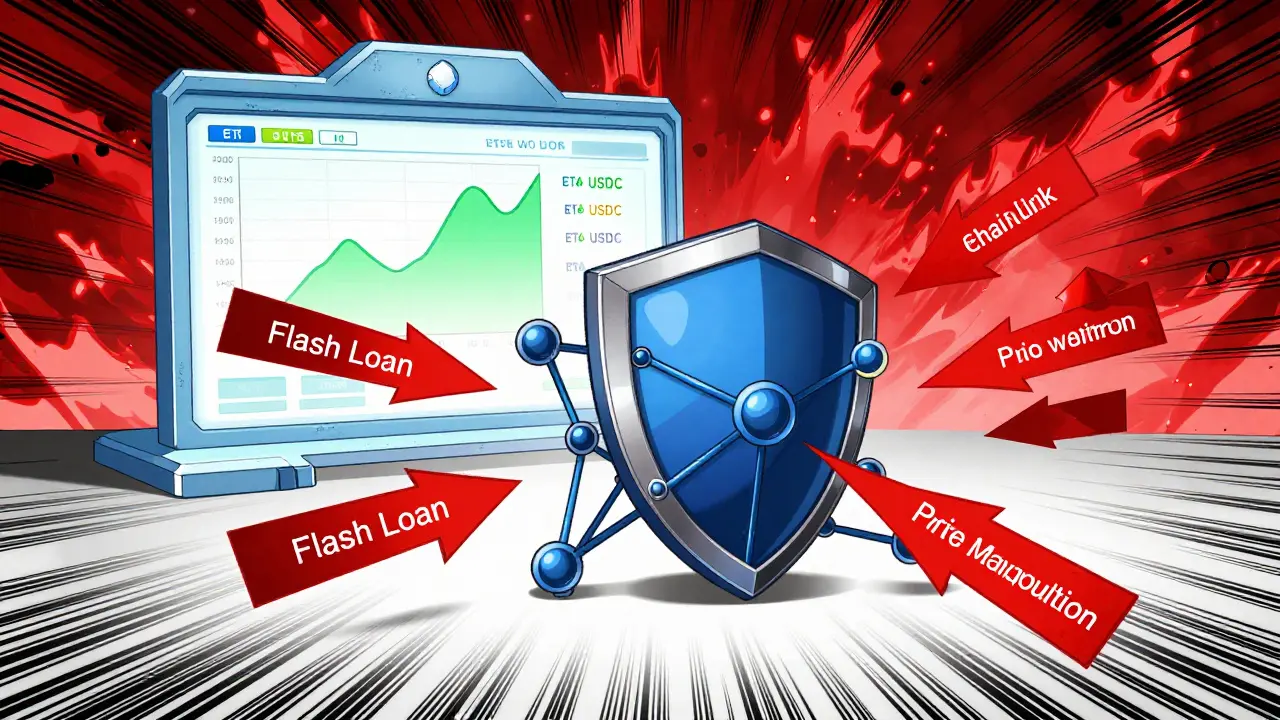
One common attack vector is "sandwiching" or flash loan attacks against centralized exchange prices. If a DeFi protocol uses only one small exchange’s price feed, an attacker can buy up the entire supply on that exchange to spike the price, borrow massive amounts against the inflated collateral, and then sell everything back, crashing the price and leaving the protocol bankrupt. The oracle didn’t fail technically; it just reported the manipulated market price accurately.
To combat this, developers use several defenses:
- Time-Weighted Average Price (TWAP): Instead of looking at the current price, the oracle calculates the average price over the last hour or day, smoothing out temporary spikes.
- Multi-Source Aggregation: Using data from ten different exchanges makes it exponentially harder and more expensive to manipulate all of them simultaneously.
- Deviation Thresholds: Oracles only update the price if it changes by a certain percentage (e.g., 0.5%), preventing minor noise from triggering unnecessary transactions or exploits.
Researchers have even developed formal verification tools like OVer, which mathematically simulate how a smart contract behaves under skewed oracle inputs, helping developers identify weak points before launching.
Future Trends: AI and Cross-Chain Interoperability
The role of oracles is expanding beyond simple data feeds. As DeFi grows across multiple blockchains (Solana, Arbitrum, Polygon), oracles are becoming essential for cross-chain communication. Protocols like Chainlink CCIP (Cross-Chain Interoperability Protocol) allow smart contracts on different chains to talk to each other securely, enabling seamless asset transfers and unified liquidity pools.
Another emerging frontier is the integration of Artificial Intelligence. Projects like RedStone are exploring how AI models can analyze vast amounts of market data to detect anomalies or predict trends, providing smarter, context-aware data feeds to DeFi protocols. This could lead to dynamic risk management systems that adjust collateral requirements in real-time based on predictive analytics, rather than just historical averages.
Ultimately, as DeFi matures and attracts institutional capital, the demand for robust, auditable, and compliant oracle infrastructure will only increase. Oracles are no longer just a technical detail; they are the foundational layer that allows decentralized finance to interact with the real economy.
What happens if a DeFi oracle fails?
If an oracle fails to update or provides incorrect data, smart contracts may malfunction. This can lead to unfair liquidations of user positions, inability to withdraw funds, or systemic insolvency in lending protocols. In severe cases, attackers can exploit stale or manipulated data to drain the protocol's reserves, resulting in significant financial losses for users.
Why can't blockchains get data directly from the internet?
Blockchains are designed to be deterministic and secure. Allowing nodes to connect directly to the internet would expose them to malware, DDoS attacks, and inconsistent data sources. Furthermore, if every node fetched data differently, the network would lose consensus. Oracles solve this by aggregating data off-chain and presenting a single, verified value on-chain.
Is Chainlink the only oracle provider?
No, while Chainlink is the most widely adopted and established provider, there are several others. Pyth Network specializes in high-frequency data for derivatives. Tellor focuses on censorship resistance through competitive reporting. DIA offers customizable, community-driven feeds. Different DeFi applications choose providers based on their specific needs for speed, cost, and decentralization.
How do oracles prevent price manipulation?
Oracles prevent manipulation by aggregating data from multiple independent sources (exchanges, market makers) and using statistical methods like medians or time-weighted averages (TWAP). This makes it prohibitively expensive for an attacker to manipulate all data sources simultaneously. Additionally, deviation thresholds ensure that only significant, sustained price changes trigger updates.
Can oracles be used for non-financial data?
Yes, oracles are used for various non-financial data types. Examples include weather data for parametric insurance, sports scores for prediction markets, flight status for travel insurance, and even IoT sensor data for supply chain tracking. Any smart contract that needs to react to a real-world event requires an oracle to verify that event occurred.