
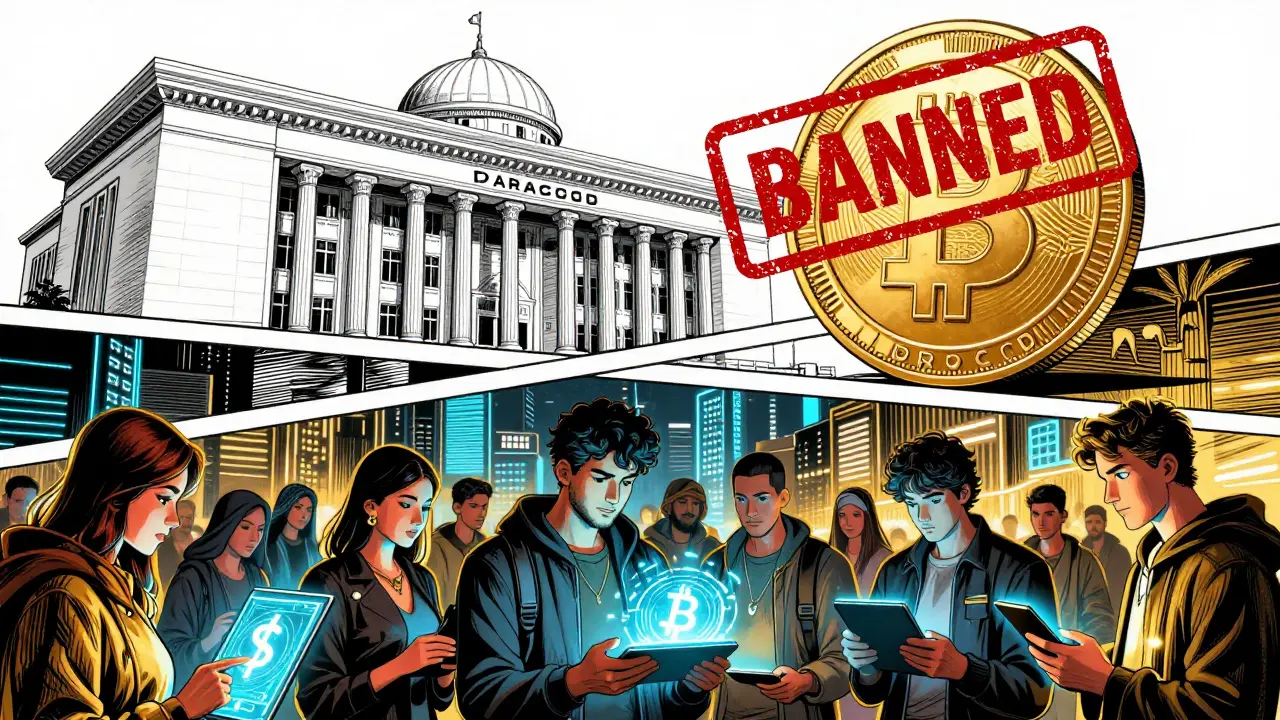
Imagine a country where owning a piece of Bitcoin is technically illegal, yet millions of people do it anyway. That is the reality in Morocco. Since November 21, 2017, the government has maintained a strict ban on all things digital currency. But here is the twist: the more the government tried to shut it down, the more the underground market exploded. This is what experts call the 'Crypto Paradox'-a situation where official prohibition actually fuels a hidden, high-growth economy.
For those on the outside, it seems like a risky gamble. For those inside, it is a lifeline for remittances and a way to escape the limitations of traditional banking. Despite the legal threats, the market is not just surviving; it is thriving. By 2026, the underground crypto market in Morocco is expected to hit roughly USD 292.4 million. How does a market grow this fast when the central bank is actively fighting it? The answer lies in a sophisticated web of VPNs, secret chat groups, and a level of resilience that has forced the government to finally rethink its entire strategy.
The 2017 Crackdown and Why It Failed
To understand the current chaos, we have to look back at the joint declaration by Bank Al-Maghrib is the central bank of the Kingdom of Morocco, responsible for monetary policy and financial stability. Also known as the Central Bank of Morocco, it holds the authority to regulate all financial transactions within the country. and the Office de Changes. They didn't just ban Bitcoin; they banned NFTs, mining, and DeFi. The government had four big fears: losing control over capital flight, the erosion of central banking authority, money laundering, and a total lack of consumer protection.
But bans on digital assets are notoriously hard to enforce. Unlike a physical business, you can't just padlock the door of a decentralized network. While the government focused on the legal theory of "monetary sovereignty," Moroccans focused on utility. Between 2018 and 2024, an estimated 1.2 million people-about 3.2% of the population-dived into the crypto world. The ban didn't stop the demand; it just pushed the activity into the shadows, where it grew by a staggering 140% since 2017.
How the Underground Ecosystem Actually Works
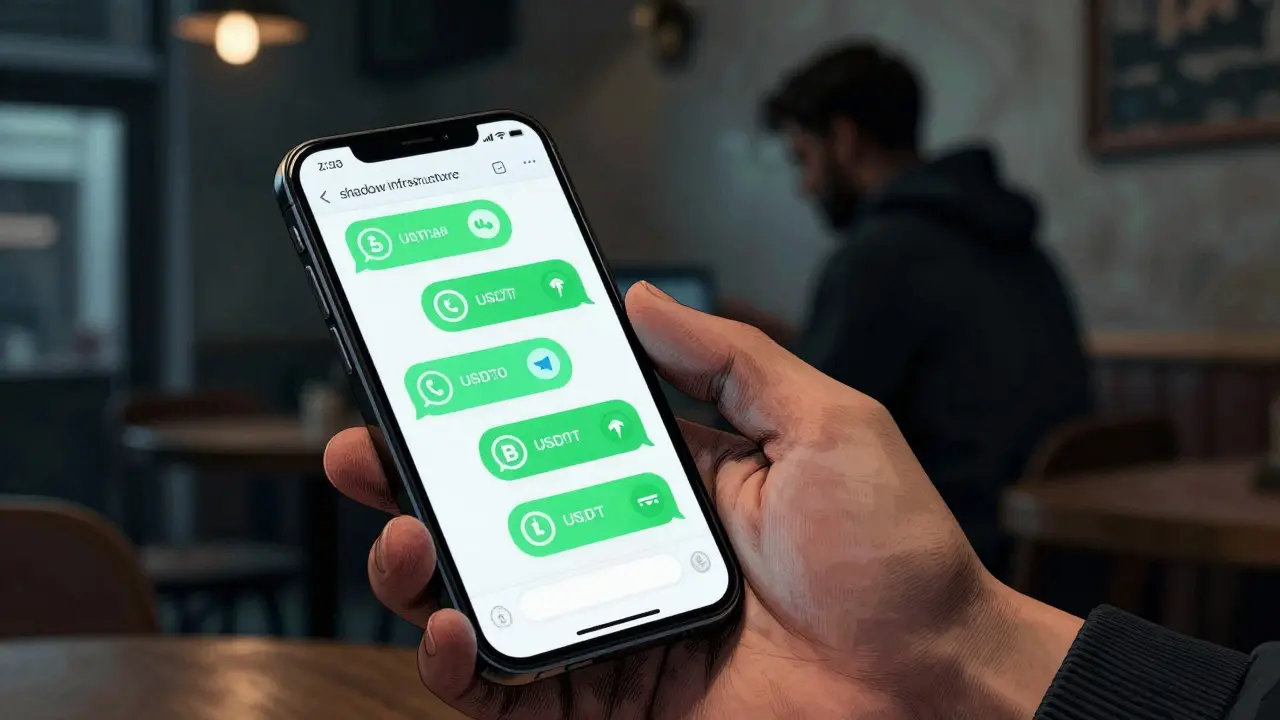
Since there are no legal local exchanges, Moroccans have built a "shadow infrastructure." It isn't based on shiny apps in the App Store, but on trust and technology workarounds. Most users rely on VPN is a Virtual Private Network that encrypts a user's internet connection and masks their IP address to bypass geo-blocking and censorship. to access international platforms. In fact, 82% of users use apps like Binance, Bybit, or OKX via these tunnels to avoid local detection.
The real action, however, happens in a way that feels more like a digital black market. About 68% of transactions are coordinated through informal networks-specifically WhatsApp and Telegram. These groups act as the clearing houses for the country. Users find a seller, agree on a price for USDT (Tether) or Bitcoin, and settle the payment via local bank transfers or cash meetings. This is known as Over-the-Counter (OTC) trading.
| Feature | Underground (Morocco) | Regulated Markets |
|---|---|---|
| Avg. Transaction Fees | 3.8% - 5.2% | 0.1% - 0.5% |
| Settlement Time | Up to 72 hours | Near-instant |
| Primary Access Method | VPN + P2P Groups | Direct App/Web Access |
| Counterparty Risk | High (Reliance on Trust) | Low (Exchange Escrow) |
The High Price of Playing Hide-and-Seek
Operating in the shadows isn't free. If you trade crypto in Morocco, you pay a "risk tax." Because there is no one to mediate a dispute, transaction fees are significantly higher than in countries like the US or UK. You aren't just paying the network fee; you're paying the intermediary's risk premium.
Then there is the danger of scams. In communities like r/CryptoMorocco, users frequently warn others about "non-delivery scams." Imagine sending 5,000 MAD to a stranger on WhatsApp, only for them to block you immediately. About 32% of underground users report encountering these fraud attempts. One trader mentioned making a decent profit over three years but losing a chunk of it in a single scam when a seller vanished. It's a wild west environment where the only rule is "trust no one."
Beyond scams, there's the looming threat of the law. While most users fly under the radar, about 12% have experienced account freezes when trying to move large sums of crypto back into Moroccan Dirhams (MAD). This happens because banks notice unusual patterns, triggering flags for the very "capital flight" the government feared back in 2017.
Who is Actually Buying?
Crypto in Morocco isn't for everyone. It's a niche, high-income, urban phenomenon. The data shows that 83% of users live in cities with more than 500,000 people, and 68% are between the ages of 18 and 35. If you earn more than 10,000 MAD a month, you're much more likely to be holding a wallet.
But why take the risk? For many, it's about money coming from abroad. Around 44% of all underground transactions are for international remittances. Sending money via traditional banks is slow and expensive; crypto is faster and often cheaper, even with the underground fees. Speculative trading comes in second at 31%, as young Moroccans try to grow their wealth in a volatile global market.
The Great Pivot: From Ban to Regulation
The government finally realized that you can't stop a digital tide with a piece of paper. In November 2024, the Governor of Bank Al-Maghrib, Abdellatif Jouahri, admitted that a draft law to regulate cryptocurrency is in the works. This is a massive shift. The state has moved from "This is illegal" to "How do we tax this?"
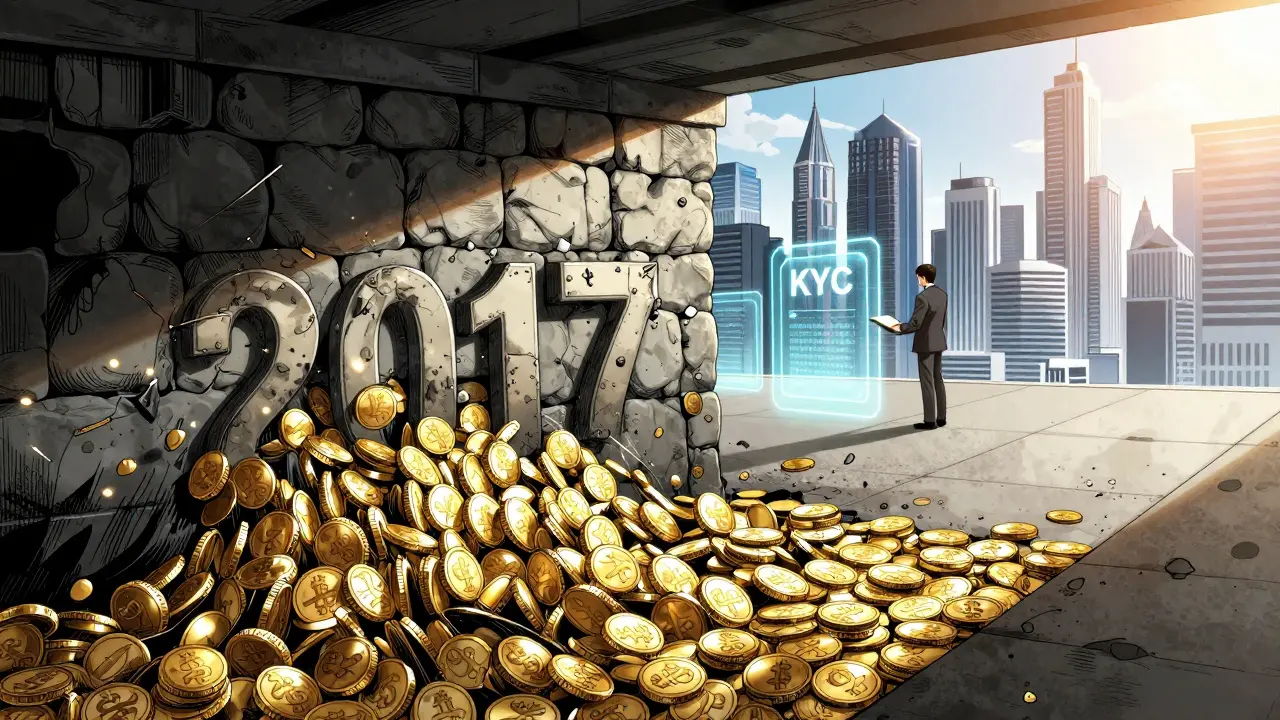
The new framework isn't going to be a free-for-all. It's designed to bring the underground into the light where the government can watch them. The plan includes mandatory KYC is Know Your Customer, a mandatory process of identifying and verifying the client's identity to prevent fraud and money laundering. protocols and strict Anti-Money Laundering (AML) compliance. If you want to run an exchange in Morocco, expect to pay a licensing fee between MAD 150,000 and 200,000. Plus, there will be a 15% capital gains tax on your profits. The government is essentially saying: "You can have your crypto, but we want our cut."
Interestingly, the new laws will still forbid using crypto for actual commercial payments. You can't go to a café in Marrakech and pay for your mint tea with Bitcoin. Businesses must still use traditional banking for trade, keeping the "monetary sovereignty" the bank so desperately wants to protect.
What This Means for the Future
The transition from a ban to a regulated market will likely cause a massive surge in adoption. When the fear of jail or account freezes disappears, the "silent majority" will enter the market. Analysts predict the market size could jump by 40% within 18 months of the law's implementation. We are looking at a shift where Morocco could become a regional fintech hub, competing with Egypt's more open approach.
For the average person, this means the end of the 72-hour wait for an OTC trade and the end of the "WhatsApp prayer" that your seller is honest. It replaces the shadow economy with a professional one. While the 15% tax might sting, it's a small price to pay for the security of a regulated exchange and the ability to trade without a VPN.
Is cryptocurrency actually illegal in Morocco right now?
Technically, yes. Since 2017, Bank Al-Maghrib and the Office de Changes have banned all cryptocurrency activities. However, the government is currently in the process of transitioning to a regulated framework, meaning the legal status is shifting from a total ban to a controlled, licensed environment.
How do Moroccans buy crypto if it is banned?
Most users use a VPN to access international exchanges like Binance or OKX. To turn local currency (MAD) into crypto, they use Peer-to-Peer (P2P) networks and Over-the-Counter (OTC) groups on WhatsApp and Telegram, where they trade directly with other individuals.
What are the biggest risks of the underground market?
The primary risks are fraud and scams, with roughly 32% of users reporting attempted scams. There is also the risk of bank account freezes if the bank detects large, unusual transfers related to crypto trading, as well as higher-than-average transaction fees due to the lack of regulated infrastructure.
Will the new laws allow me to pay for things with Bitcoin?
Likely not. Current draft legislation indicates that while owning and trading crypto through regulated exchanges will be legal, using cryptocurrency for commercial payments and settlements will remain prohibited. Businesses will still need to use traditional banking channels.
Which cryptocurrencies are most popular in Morocco?
Bitcoin dominates the market with over 57% of the volume, followed by Ethereum (22%) and the stablecoin USDT (16%). USDT is particularly popular because it allows users to hold a digital dollar and avoid the extreme volatility of other coins.
Next Steps for Users
If you are currently navigating the underground market, the best move is to start diversifying your exit strategies. Don't rely on a single WhatsApp group for your fiat on-ramps. As the country moves toward the Q3 2025 implementation of the new laws, keep an eye on official announcements from Bank Al-Maghrib regarding licensed providers.
For those new to the space, be wary of "guaranteed" returns offered in Telegram channels. The current environment is high-risk. Until the regulatory framework is fully active, the safest approach is using reputable international exchanges with a high-quality VPN and sticking to smaller, verified P2P transactions to minimize potential losses from scams.
12 Responses
Classic gov move 📉
The reliance on P2P networks in Morocco is quite similar to what we saw in early crypto adoption in other regions. It is a testament to the necessity of financial autonomy when traditional systems are too restrictive.
It is absolutely naive to assume that a 15% capital gains tax will deter users when they have already spent years operating in a high-risk black market. The government is simply admitting defeat while attempting to salvage some revenue from a trend they were too slow to understand.
Oh great, so the government finally figured out how to tax things. What a shocking plot twist. 🙄
This whole 'paradox' is just a fancy word for people liking things that are forbidden. The state trying to swoop in now is a total circus act.
We must consider if the desire for decentralized currency is actually a symptom of a deeper moral decay in the youth's relationship with authority. It is perhaps more interesting to ponder why these people feel the need to circumvent the law for the sake of a digital token rather than contributing to the social contract of their nation through legitimate means, even if those means are flawed.
Honestly it is just so exhausting to see these cycles repeat everywhere and the fact that 32% of people are getting scammed is just a nightmare 😩 because why would anyone trust a WhatsApp group over a regulated exchange unless they were absolutely desperate and the government basically forced them into this chaotic mess which is honestly just typical of how these bans work 🙄
just keep staying safe with those vpns until the law drops. it is all about managing the risk for now
The tension between state sovereignty and individual digital agency is an old struggle appearing in a new form. The state views currency as a tool of control, while the user views it as a tool of liberation. Neither is inherently wrong, but they are fundamentally incompatible in a closed system.
It is really heartening to see that the government is moving toward a more inclusive framework. This will definitely help the youth find better ways to manage their wealth safely!
Too many words for a basic story about people using VPNs. 🥱
Love the shift toward regulation! 🌟 It's going to be such a relief for everyone not to worry about those scary account freezes anymore ✨