

iZiSwap Fee & Slippage Calculator
How iZiSwap Works
Despite claiming "zero fees," iZiSwap's trading cost comes from slippage. This calculator shows how much your trade might cost in real terms when using the platform.
iZiSwap (Mode) isn’t another copycat DEX. It promises something bold: zero slippage and zero fees. But if you’ve ever tried to trade on it, you know the reality doesn’t match the hype. This isn’t a platform for casual traders. It’s a niche tool built for developers and DeFi tinkerers who want to test how discretized liquidity works in the wild. And honestly? It’s a fascinating experiment-with serious flaws.
What Is iZiSwap (Mode)?
Trading Pairs and Volume: A Ghost Town
As of late 2023, iZiSwap (Mode) supports just four tokens across five trading pairs. Compare that to Uniswap’s 8,500+ pairs or PancakeSwap’s 500+. You’re not trading ETH for USDC here. You’re trading obscure tokens like $IZI, $MODE, $SEI, and $USDC on a network with barely any users. The 24-hour trading volume? $171.58. That’s not a typo. That’s less than the cost of a decent coffee in Auckland. For context, Uniswap does nearly $1 billion in volume every day. PancakeSwap clears over $400 million. iZiSwap’s volume is so low it barely registers on the radar. Why does this matter? Because zero slippage only works if someone’s on the other side of the trade. If you try to swap $200 worth of $IZI for $USDC, you’ll likely get crushed by slippage anyway. The system says it’s zero-slippage. The market says otherwise.Zero Fees? Yes. But Is It Worth It?
This is iZiSwap’s one undeniable win: 0.00% fees for both makers and takers. No platform charges less. Not even Uniswap V3, which runs at 0.05% to 0.3%. Even SushiSwap and Curve take a cut. On iZiSwap, you pay nothing. Not a single cent in gas fees for the exchange itself. But here’s the twist: you still pay Ethereum network gas fees. If you’re on Mode, those are cheap-but they’re not free. And if you’re trying to add liquidity, you’re dealing with a complex interface that’s harder to use than setting up a router. One Reddit user spent three hours figuring out how to deposit liquidity. On Uniswap? Fifteen minutes. The fee advantage only makes sense if you’re doing tiny, frequent trades. If you’re moving $500 or more, the risk of failed transactions and poor pricing outweighs the savings.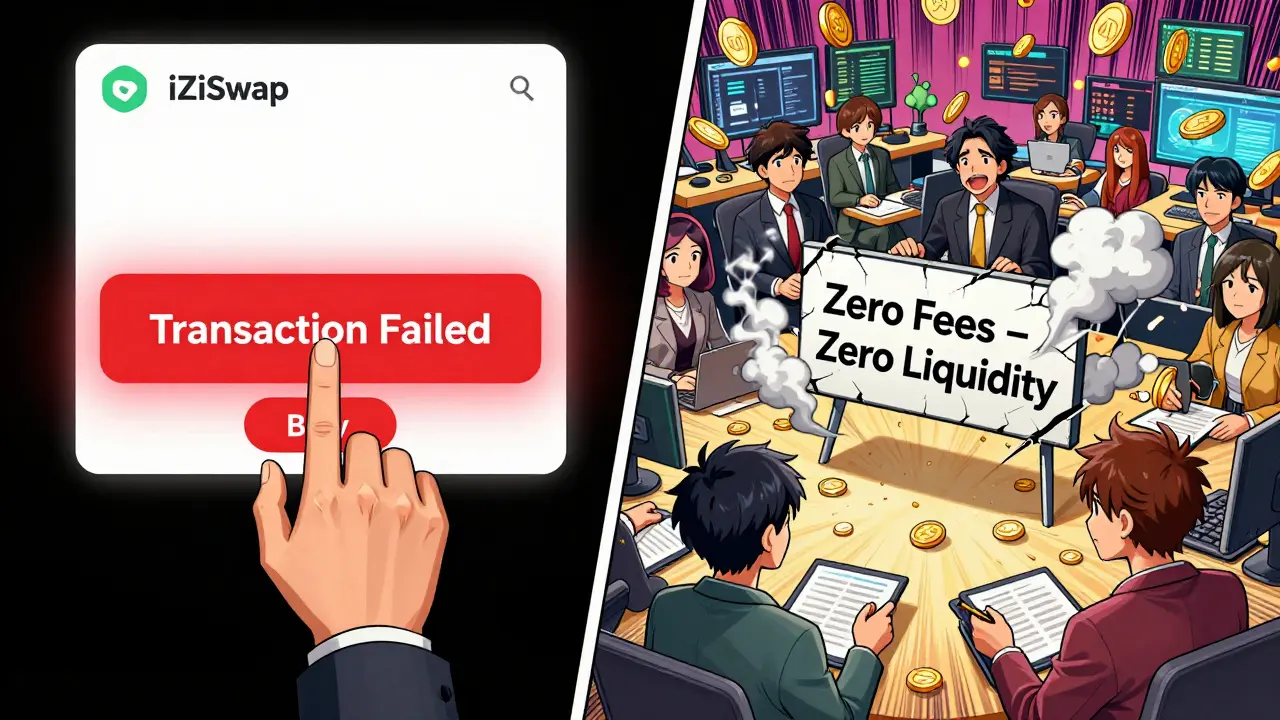
Who Is This For?
iZiSwap (Mode) isn’t for beginners. It’s not for people who want to buy ETH or swap USDT for DOT. It’s for two types of users:- DeFi developers testing how discretized liquidity performs under real conditions.
- Speculators betting on $IZI or $MODE tokens with tiny positions.
Security and Transparency: A Big Question Mark
No one’s audited iZiSwap’s smart contracts publicly. No CertiK report. No Hacken audit. Nothing. That’s a red flag. Even lesser-known DEXs like SushiSwap or Trader Joe have had their code reviewed by reputable firms. iZiSwap doesn’t even publish audit results-if they exist at all. It’s also not regulated by any government. That’s normal for DEXs. But when combined with zero transparency and near-zero volume, it raises questions: Is this a real project, or just a prototype that got left running? The team behind iZUMi Finance has experience. They built the original liquidity protocol. But iZiSwap (Mode) feels like a side experiment. There’s no roadmap. No marketing push. No institutional partnerships. Just a website and a handful of devs.User Experience: Clean, But Clunky
The website looks good. Simple layout. No clutter. But usability? Poor. - No mobile app. Just a mobile-friendly website. That’s fine, but competitors like PancakeSwap offer a near-native experience. - 55% bounce rate. People land, see the empty pools, and leave. - Average session: 1 minute and 15 seconds. You’re not exploring. You’re trying to figure out why your trade failed. - 2.46 pages viewed per visit. That means users are jumping between help docs, forums, and the exchange trying to make sense of it. One verified user on SourceForge wrote: “I tried to swap $100. Took 4 tries. Each time, the price changed mid-trade. I lost $12 in gas and slippage.” That’s not zero slippage. That’s a broken promise.
How It Compares to the Big Players
| Feature | iZiSwap (Mode) | Uniswap V3 | PancakeSwap | Curve |
|---|---|---|---|---|
| Trading Pairs | 5 | 8,500+ | 500+ | 150+ |
| 24-Hour Volume | $171.58 | $987M | $412M | $189M |
| Fees (Taker/Maker) | 0.00% | 0.05%-0.3% | 0.02%-0.2% | 0.02%-0.04% |
| Liquidity Model | Discretized | Concentrated | Concentrated | Stablecoin-optimized |
| Audits | None publicly available | Multiple (CertiK, Trail of Bits) | Multiple | Multiple |
| Mobile App | No | No (PWA) | Yes | No |
| Best For | Experimenters, small $IZI trades | General trading, deep liquidity | BNB chain users, low fees | Stablecoin swaps |
Is iZiSwap (Mode) Worth Using?
Here’s the truth: iZiSwap (Mode) is not a replacement for any major DEX. It’s a prototype. A lab experiment. A proof of concept that’s still missing the one thing that makes DeFi work: users. If you’re a developer and want to see how discretized liquidity behaves under real conditions, go ahead. Connect your wallet. Try a $10 trade. See how it feels. Take notes. Share feedback. If you’re a regular crypto user looking to swap tokens, save your gas fees. Use PancakeSwap on BSC. Use Uniswap on Ethereum. Use Curve for stablecoins. They’re faster, safer, and actually have liquidity. iZiSwap (Mode) doesn’t feel like a product. It feels like a GitHub repo someone forgot to close.Final Verdict
Pros:- Zero trading fees
- Unique discretized liquidity model
- No KYC
- Multi-chain wallet support
- Almost no trading volume
- No public audits
- Impossible to trade anything over $50
- Complex liquidity setup
- No mobile app
- Zero community support
Is iZiSwap (Mode) safe to use?
iZiSwap (Mode) is non-custodial, so your funds stay in your wallet. But there are no public smart contract audits from firms like CertiK or Hacken. That means there’s no independent verification that the code is secure. If you’re trading small amounts ($10-$50), the risk is low. For anything larger, avoid it. No audits = no safety net.
Can I make money trading on iZiSwap (Mode)?
Not really. With only $171 in daily volume and five trading pairs, there’s almost no price movement to exploit. Even if you’re trading $IZI or $MODE, the spreads are wide, and slippage is high. You’re more likely to lose money on failed transactions and gas fees than profit from price swings.
Why does iZiSwap have zero fees?
The platform doesn’t charge any trading fees to attract early adopters and test its liquidity model. But it still costs you network gas fees to execute trades. The zero-fee claim only applies to the exchange’s cut-not the blockchain fees. It’s a marketing advantage, not a cost-free experience.
Does iZiSwap have a mobile app?
No. iZiSwap (Mode) is only accessible via a web browser. There’s no iOS or Android app, and even the mobile web version lacks optimizations found in competitors like PancakeSwap. If you want to trade on the go, this isn’t the platform for you.
How does iZiSwap’s liquidity model work?
Instead of letting liquidity flow continuously across a price range (like Uniswap V3), iZiSwap divides it into fixed intervals. Think of it like setting price points at $1.00, $1.10, $1.20, etc. Your funds are only active at those exact levels. This saves capital but requires deep liquidity at each interval-which iZiSwap doesn’t have. That’s why trades fail or get slippage despite the “zero slippage” claim.
Should I add liquidity to iZiSwap (Mode)?
Only if you’re experimenting. The interface is complex, and your funds will sit idle in shallow pools. You’ll earn little to no fees because there’s so little trading. Plus, impermanent loss risks are higher due to the discretized model. If you’re serious about earning yield, use Uniswap, SushiSwap, or Curve-they have volume, audits, and better tools.
18 Responses
Zero fees? More like zero users. This thing is a ghost town with a fancy whitepaper.
Oh honey, you think zero fees means it works? Sweetie, I’ve seen more liquidity in a Walmart parking lot.
This is the most beautiful dumpster fire I’ve ever seen. The UI looks like it was coded in Notepad during a power outage. Slippage? Nah, it’s just… gone. Like my will to live after trying to swap 0.0001 ETH.
What’s really being tested here isn’t discretized liquidity-it’s human patience. We’ve built a system that removes friction but forgets to add meaning. The absence of fees is a philosophical statement, not a UX decision. Are we optimizing for efficiency or for the illusion of control? iZiSwap doesn’t solve anything-it just removes the symptoms while letting the disease thrive.
Honestly? It’s a dev’s playground. If you’re not writing smart contracts or tweaking liquidity curves, you’re gonna hate it. But for the right crowd? It’s like a lab where DeFi goes to experiment without the noise. Just don’t expect a Coinbase clone.
I tried it once. Took me 20 minutes to figure out how to connect my wallet. Then the transaction failed silently. No error message. No confirmation. Just… nothing. I felt like I’d been ghosted by a robot.
If you’re building something for devs, make the docs better. This is like handing someone a Ferrari and saying 'figure out the gears'.
I respect the vision. Zero fees is a radical idea. But if no one can use it, does it even exist? Maybe the real innovation is in the conversation it sparks-not the trades it executes.
Works fine if you know what you’re doing. Docs are trash though.
I used it last week to swap some testnet tokens. It was clunky but functional. Took me three tries but I got it done. Would recommend if you’re patient and don’t mind reading GitHub issues.
It’s fine. I don’t care. Whatever.
The aspiration behind iZiSwap is deeply admirable. It dares to imagine a financial system unburdened by extractive fees-a radical departure from the rent-seeking norms of traditional DeFi. Yet, the current implementation reveals a profound tension between idealism and usability. The interface lacks intuitive scaffolding, assuming a level of technical literacy that even seasoned users may not possess. In this way, the platform doesn’t merely exclude casual participants-it inadvertently reinforces the very elitism it seeks to dismantle. Perhaps the next iteration should prioritize accessibility not as an afterthought, but as the foundation.
This is the future 🤖💸 but right now it’s like trying to microwave soup with a fork. I love the idea but my brain hurts trying to use it.
People are too lazy to learn. If you can’t use it, you shouldn’t be trading. Crypto is not for babies.
Is zero fee really freedom? Or just a mirror reflecting our desire to avoid responsibility? Fees are a social contract. Removing them doesn’t erase cost-it just hides it in complexity.
If you’re into DeFi experiments, give it a shot. It’s rough but worth the ride.
Oh wow, another ‘zero fee’ scam. You guys really think people are dumb enough to fall for this? The devs are probably siphoning liquidity through backdoor MEV bots and laughing all the way to the bank. This isn’t innovation-it’s a honeypot with a fancy logo.
I appreciate your perspective, Renelle. But I think you’re over-indexing on accessibility. The beauty of iZiSwap is that it filters out the noise. The people who use it are the ones who care about the mechanics, not the marketing. Maybe the platform isn’t broken-it’s just intentionally narrow. Not every tool needs to be for everyone.