
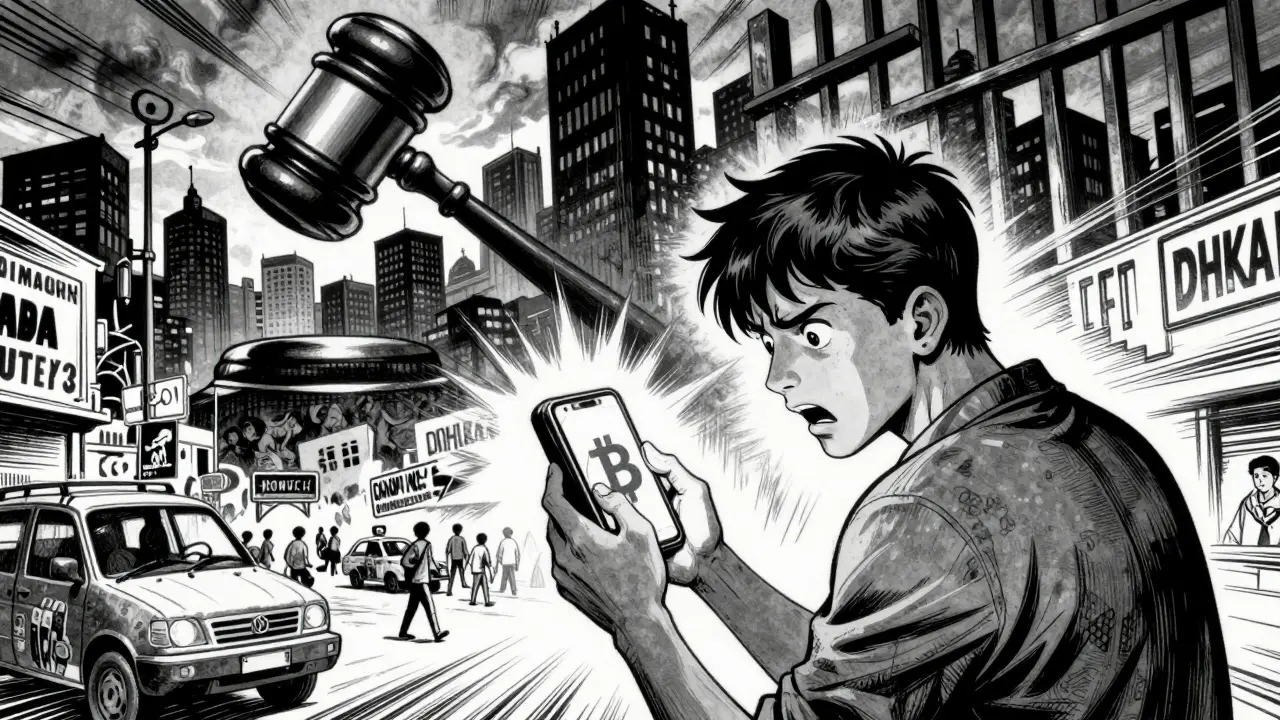
To understand why this 12-year figure keeps popping up, we have to look at how Bangladesh Bank is the central bank of Bangladesh responsible for monetary policy and financial regulation handles digital assets. They haven't passed a single law that specifically says "Cryptocurrency is illegal." Instead, they use a strategy of "cautionary notices." Since 2014, they've warned the public that Bitcoin and other virtual currencies aren't legal tender. The threat of long prison sentences doesn't come from a "crypto law," but from old laws designed to stop money laundering and terrorism financing.
Where does the 12-year prison threat come from?
The scary number usually comes from a misinterpretation of the Money Laundering Prevention Act 2012. This law was updated in 2015 to include "virtual assets" under its umbrella. Specifically, Section 9(1) of this act allows for rigorous imprisonment. While the actual written law typically mentions terms up to 10 years and heavy fines, bank officials in public statements have often rounded this up to 12 years to scare people away from the market.
It's not just about money laundering, though. The government also leans on the Anti-Terrorism Act 2009 and the Foreign Exchange Regulation Act 1947 (FERA). Under FERA, any foreign exchange transaction must go through an authorized dealer. Since you can't find a local bank that will officially process a trade for Ethereum or Solana, almost every crypto trade technically violates this act. This creates a legal trap where the act of buying crypto is seen as an illegal foreign exchange transaction.
| Law/Act | Primary Concern | Potential Penalty |
|---|---|---|
| Money Laundering Prevention Act 2012 | Hiding origin of funds/Virtual Assets | Up to 10-12 years imprisonment |
| Foreign Exchange Regulation Act 1947 | Unauthorized foreign currency trade | 2 to 5 years imprisonment |
| Anti-Terrorism Act 2009 | Funding prohibited organizations | Varies (Severe) |
| Digital Security Act 2018 | Unauthorized electronic transactions | 5 to 7 years imprisonment |
The Gap Between Law and Reality
Here is the strange part: despite the terrifying warnings, Bangladesh is actually one of the top countries for crypto adoption. According to data from Chainalysis, transaction volumes surged by over 200% between 2021 and 2022. Millions of people are using P2P (peer-to-peer) platforms like Binance to trade, effectively bypassing the banking system entirely.
If the 12-year sentence was being handed out routinely, we would see thousands of people in jail. But we don't. In 2022, the Anti-Money Laundering Department reported only 37 cases of "digital financial crimes" nationwide. None of these resulted in a 12-year sentence for simply trading crypto. The government seems to be focusing its energy on large-scale scams and major money laundering rings rather than the average person buying a few hundred dollars of Bitcoin for their portfolio.
Is Owning Crypto Different from Trading?
This is where the legal gray area gets really blurry. Some legal experts, including those from Mahbub & Company, argue that simply owning a digital asset isn't a crime. They suggest that the crime only happens when you use that asset to facilitate something else illegal-like tax evasion or funding a banned group. In their view, Bitcoin is just a tool, and using it isn't a crime unless you're using it to break a law that already exists.
However, the Bangladesh Securities and Exchange Commission (BSEC) has a different take. They acknowledge that because there is no specific "Crypto Act," enforcement is inconsistent. This means you are essentially at the mercy of how a specific judge or officer interprets the law at that moment. While you might not be "banned" in a legislative sense, you are definitely "discouraged" in a regulatory sense.
The Blockchain Paradox
The most confusing part of this whole situation is that the government actually likes Blockchain. In 2020, Bangladesh released a National Blockchain Strategy. They want to use the technology for government records, supply chains, and transparency. It's a weird contradiction: the state wants the engine (blockchain) but hates the fuel (cryptocurrency). This creates a confusing environment for developers who want to build Web3 apps but are afraid of being labeled as "crypto traders."
Practical Risks for Residents
Even if you don't end up in prison for 12 years, trading crypto in Bangladesh carries real risks. The biggest danger isn't actually the police-it's the bank. Since Bangladesh Bank has ordered commercial banks to block crypto-related transactions, many users find their bank accounts frozen. If a bank notices frequent, unexplained P2P transfers from unknown individuals, they may flag the account for suspicious activity under AML (Anti-Money Laundering) rules.
Once your account is flagged, you have to prove where the money came from. Since you can't legally admit to trading Bitcoin, you're stuck in a loop of trying to explain transactions that the government views as a punishable offense. This is where the "selective enforcement" mentioned by Lightspark becomes a nightmare for the individual.
Is it actually possible to get 12 years in prison for crypto?
Technically, if the government charges you with money laundering under the Money Laundering Prevention Act 2012, a judge could sentence you to a long term. However, there are no public records of individual crypto traders receiving 12-year sentences. Most cases are focused on large-scale financial crimes, not small-scale trading.
Can I use a crypto exchange like Binance in Bangladesh?
Many people do use Binance and other P2P platforms, but it is not legally recognized or supported by the central bank. Doing so puts you at risk of having your bank account frozen if the bank detects suspicious P2P transfers.
Is owning Bitcoin illegal in Bangladesh?
There is no specific law that makes "owning" a digital key illegal. However, the process of acquiring that Bitcoin usually involves violating the Foreign Exchange Regulation Act 1947, which is where the legal trouble starts.
Why does the government hate crypto but like blockchain?
The government values the efficiency and security of blockchain for administrative tasks (like land registry) but fears that cryptocurrency undermines the central bank's control over the money supply and enables capital flight from the country.
What should I do if my bank account is frozen due to crypto?
You should seek professional legal counsel immediately. Because crypto is in a legal gray area, attempting to "explain" the trades without a lawyer could potentially lead to an admission of a punishable offense under the Money Laundering Prevention Act.
Final Thoughts on Navigating the Risk
Whether you are a casual investor or a tech enthusiast, the takeaway is clear: the 12-year figure is largely a scare tactic used by the central bank to maintain a restrictive environment. However, that doesn't mean the risk is zero. The real danger is the loss of access to your traditional banking services and the potential for harassment under broad laws like the Digital Security Act.
If you're operating in this space, be aware that enforcement is selective. While the average user might fly under the radar, those moving large volumes of money are much more likely to trigger an investigation. Until Bangladesh moves from a system of "cautionary notices" to actual, transparent legislation, the market will remain a high-stakes game of cat and mouse.
16 Responses
Typical central bank behavior. They want all the perks of the tech without giving up a shred of control over the currency. Hilarious that they think a 'cautionary notice' is a real law.
Oh please, anyone with a brain can see this is just a smokescreen for the globalists to keep the population in check. They don't care about 'money laundering', they care about total financial surveillance. It's so obvious it's almost boring that people actually fall for the 12-year scare tactic. Just wait until they implement a CBDC and then you'll really see the chains.
The P2P arbitrage happening here is a classic case of market inefficiency. The delta between the official rate and the black market rate creates a massive incentive for liquidity providers to operate in the shadows despite the regulatory headwinds.
Keep exploring the tech, everyone! Just be safe and maybe use a VPN or cold storage to keep your assets secure while the laws catch up.
Its absulutely disgracefull that people think its okay to bypass the laws of a sovereign nation just to make a quick buck on some fake internet money!! We should support the authorities in clamping down on this nonsense because if every country just let people trade unregualted assets then the whole global economy will colapse into chaos and its high time we stop glamorizing this criminal behavior under the guise of innovation!!
Money is just a social construct anyway. Why fear a law that governs a fiction?
It's the same playbook everywhere. First they ban it, then they tax it, then they control it. The 'blockchain strategy' is just a way for them to build the cage before they put us in it. They aren't fighting terrorism; they're fighting the possibility of a currency they can't print into oblivion.
The sheer audacity of the government to claim a 12-year sentence while simultaneously admitting they have no specific law against it is simply breathtaking. It is a farce of the highest order!
I can't even deal with this right now. Like, imagine actually believing the bank is your friend?? its literally the biggest joke of the century lol. The way they just block accounts without a trial is just... wow. Just WOW. Absolute madness!
They probably use the blockchain for thier own secret funds anyway. The govment always has a back door into these things... its all rigged.
It is utterly distressing to contemplate the legal precariousness of the Bangladeshi citizenry. The juxtaposition of state-sponsored blockchain initiatives and the draconian threats of imprisonment is a most profound contradiction. One must wonder if the judiciary possesses the fortitude to resist such administrative pressures in the event of a high-profile prosecution.
Eh, just don't get greedy and you'll be fine. I mean, if you're moving millions, yeah, you're a target, but for a few bucks? Who cares.
I truly believe that through open dialogue between the tech community and the regulators, we can find a middle ground that ensures financial security while fostering innovation for the youth of Bangladesh. Let us remain hopeful for a transparent legal framework!
Exactly! Education is key 📚. If we can show the government the real-world benefits of decentralized finance, they might actually stop the scare tactics 🚀. Stay strong and keep learning! 💪
its so sad when people just want to save money for there famillys and they get treatd like criminels for using a phone app.
We'll get through this transition period. History shows that technology always wins over restrictive laws eventually, so just be patient and cautious with your bank transfers.