

India’s 30% Crypto Tax: A Hard Reality for Bitcoin Traders
If you’re trading Bitcoin or any other cryptocurrency in India, you’re paying 30% in taxes on every profit - no matter how long you held it. That’s not a typo. Unlike stocks or real estate, where holding an asset for over a year lowers your tax rate, crypto gains in India are taxed at the same flat rate whether you held Bitcoin for 10 days or 10 years. And there’s no relief if you lost money elsewhere in your portfolio. This isn’t just strict - it’s unique in the world.
How the 30% Tax Actually Works
The tax comes from Section 115BBH of the Income Tax Act, introduced in April 2022. It applies to all Virtual Digital Assets (VDAs), including Bitcoin, Ethereum, Solana, NFTs, and even meme coins. The math is simple: (Sale Price - Purchase Price) × 30% = Tax Due.
Here’s an example: You bought 0.5 BTC for ₹15,00,000 in January 2023. In June 2025, you sold it for ₹22,00,000. Your profit? ₹7,00,000. Your tax? ₹2,10,000. That’s 30% of the gain - gone. No deductions. No offsets. Not even for the ₹1,200 in exchange fees you paid or the ₹800 gas fee on the transfer.
And here’s the kicker: if you bought another coin and lost ₹5,00,000 on it, you can’t use that loss to reduce your ₹7,00,000 profit. You still pay tax on the full ₹7,00,000. That’s not how taxes work anywhere else. In the U.S., you can net losses against gains. In Germany, you pay zero after one year. In India? You pay 30% on every single profit, even if your total portfolio is down for the year.
The Hidden 1% TDS - And Why It Matters
On top of the 30% tax, there’s a 1% Tax Deducted at Source (TDS) under Section 194S, active since July 2022. This applies to every crypto sale or transfer over ₹50,000 in a financial year (₹10,000 for certain cases like P2P trades). That means if you sell ₹1,00,000 worth of Bitcoin, ₹1,000 is taken out before you even see the money.
Many traders don’t realize this is separate from the 30% tax. The TDS is a prepayment - it gets credited against your final tax bill when you file your return. But if you’re a frequent trader, that 1% adds up fast. Sell ₹10 lakh across 10 trades? That’s ₹10,000 withheld. You’ll get it back if your total tax liability is less, but if you’re in the 30% bracket, you won’t. It’s just another layer of cash flow disruption.
Worse, not all platforms handle TDS the same way. Some Indian exchanges auto-deduct it. Others don’t. If you trade on international platforms like Binance or Kraken, you’re still legally required to report and pay the TDS yourself. Many traders miss this and get hit with penalties later.
The New 18% GST on Exchange Fees - Another Bite
Starting July 2025, India added an 18% Goods and Services Tax (GST) on fees charged by crypto exchanges and wallet services. That includes trading fees, withdrawal fees, staking rewards processing, and even API access fees.
Let’s say you pay ₹500 in trading fees on WazirX. Now, you’re paying ₹90 extra in GST. If you make 20 trades a month, that’s ₹1,800 a year in GST - just on fees. And it’s not refundable. Even if you break even or lose money, you still pay this tax on every service you use.
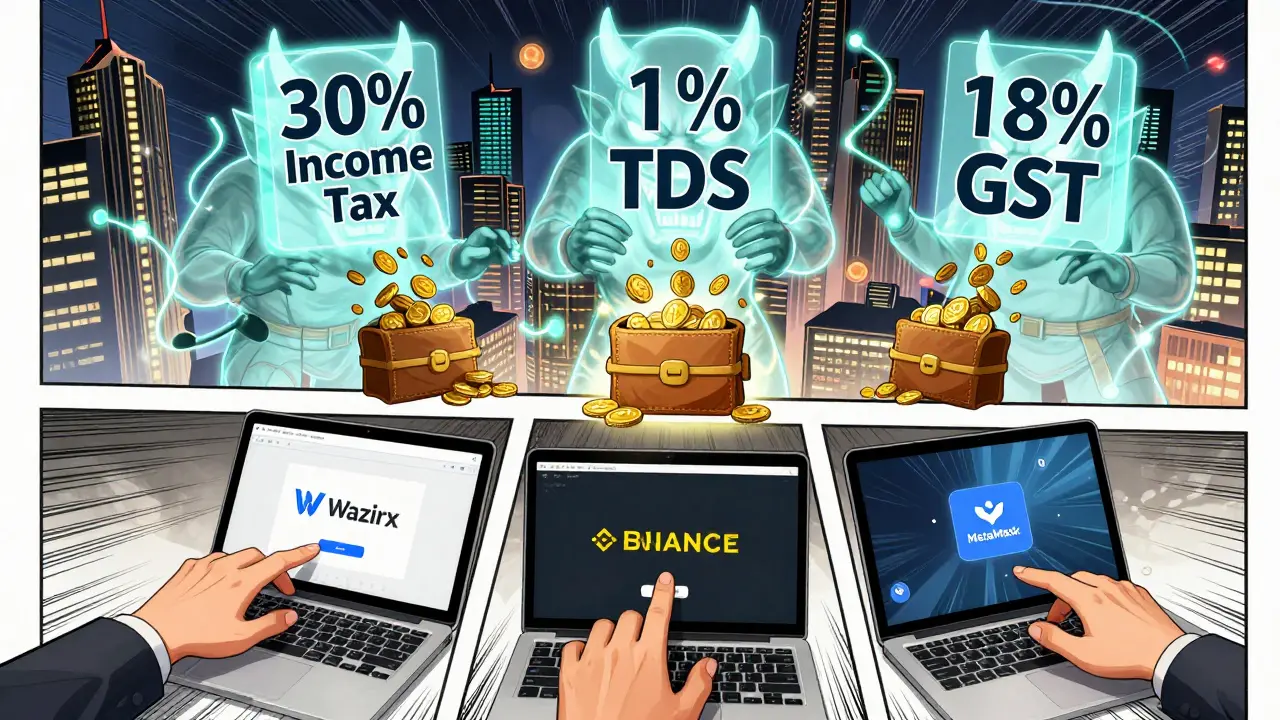
This three-tier system - 30% income tax, 1% TDS, and 18% GST - makes India the most heavily taxed crypto market in the world. No other country combines all three. You’re being taxed on your profit, on your transaction, and on the platform’s service fee. It’s a triple tax burden.
Why Losses Don’t Count - And Why That’s a Problem
Most countries let you offset crypto losses against gains. India doesn’t. This is the most damaging rule for active traders.
Imagine this: You trade 15 different coins in a year. You make ₹4,00,000 on Bitcoin, lose ₹3,50,000 on Dogecoin, gain ₹1,00,000 on Solana, and lose ₹1,50,000 on Shiba Inu. Your net gain? ₹0. But under Indian law, you still owe 30% on the ₹4,00,000 from Bitcoin and ₹1,00,000 from Solana. That’s ₹1,50,000 in taxes on zero net profit.
It forces traders to pay taxes on paper gains while carrying real losses. Many end up selling winning coins just to cover their tax bills - even if they still believe in the asset. That’s not investing. That’s survival.
There’s no carry-forward either. If you lose money this year, you can’t use it next year. The loss disappears. The tax doesn’t.
What You Need to Track - And How to Do It
Keeping records isn’t optional. The Income Tax Department now requires you to report all crypto transactions in Schedule VDA on your ITR. You need:
- Date of every purchase and sale
- Amount bought/sold in INR and crypto
- Exchange or wallet used
- Transaction ID and proof of payment
- Cost basis (what you paid, including fees)
Manual tracking is a nightmare. If you’ve traded across 5 exchanges, used Trust Wallet, MetaMask, and a P2P app, you’re looking at hundreds of transactions. One missed entry can trigger an audit.
Most serious traders now use crypto tax software like Koinly or ClearTax. These tools connect to exchanges via API and auto-calculate your gains, losses, TDS, and GST. They even flag if you forgot to report a P2P trade. For active traders, spending ₹2,000-₹5,000 a year on software saves hours and avoids penalties.

How This Tax Has Changed India’s Crypto Market
Since April 2022, trading volumes on Indian exchanges dropped by 40-60%. Retail traders left. Many moved to international platforms or P2P markets to avoid TDS and reporting. But that’s risky - you’re still liable under Indian law, and the government can track blockchain addresses.
Long-term holders are now the majority. Why? Because the tax punishes activity. If you’re buying and holding Bitcoin for 5+ years, you’re less affected. But if you’re day trading, swing trading, or arbitraging - you’re paying a premium just to participate.
Indian exchanges have lost market share to Binance, Bybit, and OKX. Institutional investors stay away. Why invest in crypto when you’re taxed like a high-income trader with no loss protection? The government’s goal was to generate revenue. It did. But it also choked innovation.
What’s Next? No Changes in Sight
As of September 2025, there are no plans to change the 30% rate, TDS, or GST rules. The Finance Ministry says the system is working - it brought in ₹1,800 crore in crypto tax revenue in FY 2024-25. But experts warn it’s unsustainable. Traders are leaving. Startups are relocating. Tax professionals say the system is too complex for average users.
Some hope the government will allow loss offsetting by 2027. Others think the TDS threshold might rise from ₹50,000 to ₹2,00,000. But until then, you’re stuck with the rules as they are.
What Should You Do?
Here’s the reality: You can’t avoid the tax. But you can manage it.
- Use tax software - don’t guess.
- Track every transaction, even small ones.
- Don’t assume your exchange is handling everything - verify TDS deductions.
- Hold longer if you can. The tax doesn’t care, but your wallet will.
- Don’t trade on P2P without recording it - the government can trace it.
- Consult a chartered accountant familiar with crypto - it’s worth the fee.
India’s crypto tax isn’t fair. It’s not logical. But it’s the law. The only way to win is to know it inside out - and plan around it.
Is the 30% crypto tax in India applicable to losses?
No, the 30% tax applies only to profits. But you can’t use losses from one cryptocurrency to reduce your tax on gains from another. Even if your overall portfolio lost money, you still pay tax on every individual profit. Losses cannot be carried forward to future years.
Do I have to pay tax if I trade crypto on international exchanges?
Yes. If you’re an Indian tax resident, you owe taxes on all crypto gains worldwide, regardless of where you trade. Indian law applies to your income, not your exchange’s location. Failing to report can lead to penalties or legal action.
What happens if I don’t pay the 1% TDS on crypto?
If you don’t pay TDS and the exchange didn’t deduct it, you’re still responsible for paying it yourself during tax filing. The Income Tax Department can match blockchain data with your return. Non-compliance can lead to notices, interest, and penalties of up to 100% of the unpaid tax.
Can I claim expenses like gas fees or exchange fees as deductions?
No. Only the original purchase price of the crypto counts as a deduction. Fees, gas charges, wallet costs, and even subscription fees to tax software are not deductible under Section 115BBH. The tax is calculated on gross profit, not net profit.
Is gifting crypto taxable in India?
Yes. If you receive crypto as a gift and its value exceeds ₹50,000 in a year, it’s treated as income and taxed at your slab rate. The giver doesn’t pay tax, but the receiver does. This applies even to gifts from family members.
How do I report crypto on my income tax return?
You must file ITR-2 or ITR-3 and include Schedule VDA (Virtual Digital Assets). You need to report total gains, total losses, TDS deducted, and GST paid. All transactions must be listed by date, asset, amount, and exchange. Use tax software to generate the report - manual entries are error-prone.
Will India ever lower the 30% crypto tax?
There’s no official indication yet. The government has collected over ₹1,800 crore since 2022, and there’s strong resistance to lowering the rate. However, pressure from traders, industry groups, and falling volumes may lead to changes by 2027 - possibly allowing loss offsetting or raising TDS thresholds. But don’t count on it.
16 Responses
Bro this tax is insane 😭 I sold my ETH last month and got slapped with 30% tax plus 1% TDS then another 18% on the fee... I ended up with less than I started with 💸 India really wants us to stop trading lmao
It's fascinating how India treats crypto like a luxury good rather than a financial instrument. The 30% flat tax ignores the entire economic principle of capital gains progression. In a functioning system, holding periods matter. In India, it's as if the government believes every crypto trade is a speculative binge. And the fact that losses vanish into thin air? That's not taxation, that's financial nihilism. You're penalizing risk-taking while rewarding stagnation. It's the opposite of innovation. It's a tax on hope.
I feel for Indian traders so much honestly I know people who used to day trade crypto and now they just hold BTC and forget about it because the tax burden is just too much to bother with the math every time you sell and dont even get me started on the TDS it's like they want you to pay twice and the worst part is you cant even deduct the gas fees or exchange fees like its not even a real transaction its just a number on a screen and you still have to pay tax on it
USA would never be this dumb. We have loss offsets we have long term rates we have deductions. India is just punishing its own people for trying to build wealth. 30% on every profit? No carryforward? Youre literally rewarding failure and punishing smart people who took risks. This is why startups leave. This is why innovation dies. You dont tax people into prosperity you tax them into silence
Hey guys just wanted to add a practical tip - if you use Koinly or ClearTax they auto-calculate your TDS and GST and even flag missing P2P trades. I used to manually track everything and messed up last year. Now I just sync my wallets and it spits out the ITR-2 schedule. Costs like 3k/year but way cheaper than a notice from IT dept. Also make sure your exchange is deducting TDS - some dont and you get hit later
wait so if i buy btc on binance and sell on wazirx do i still pay tds and gst? like what if i never even used an indian exchange? does the it dept just magically know?
yeah i think they can track it through blockchain analysis theyve been doing it for a while now i heard they even have partnerships with chainalysis and stuff so dont think you can hide your binance trades just cause you think youre being smart
The structure of this tax system is fundamentally misaligned with the nature of digital assets. It treats every transaction as if it were a cash register sale, ignoring the speculative, volatile, and portfolio-based reality of crypto investing. The absence of loss offsetting creates perverse incentives: you’re forced to sell winners to pay taxes on paper gains while holding onto losers, hoping they’ll rebound. This isn’t revenue generation-it’s behavioral manipulation. And the 18% GST on fees? That’s a tax on infrastructure. You’re taxing the tools that enable the market to function. It’s like taxing the pen you use to write your income tax return.
This is why India will never be a crypto hub. You tax people into submission. You don’t tax them into wealth. The US has 15% long-term capital gains. Germany has zero after a year. Even Singapore doesn’t tax individuals. But India? 30% flat. No deductions. No carryforwards. And now GST on fees? You’re not building a financial future-you’re building a graveyard for traders. The government thinks they’re collecting revenue. They’re actually exporting talent. And they don’t even realize it.
Interesting system. Not necessarily fair, but it does generate significant revenue. The lack of loss relief is unusual, but perhaps the government prioritises simplicity over nuance. The TDS and GST layers do seem burdensome for small traders though.
Stop complaining. You knew the rules when you started. If you can't handle 30% tax, don't trade crypto. This isn't a charity. You want to gamble? Pay the price. And stop acting like you're being persecuted. Most countries tax income. India just doesn't pretend it's something else.
I appreciate the clarity of the post. The triple taxation model is indeed unique. I wonder if the government has considered the psychological impact on retail investors-being taxed on paper gains while carrying real losses must be deeply demoralizing.
I just want to say I love how India is trying to take control of this space 🇮🇳✨ even if it feels harsh right now. Maybe it's the only way to bring order to chaos. I'm not saying it's perfect but at least they're trying to build something instead of ignoring it like other countries. 🤝🙏
This tax is a joke. You're punishing innovation. People are leaving. Startups are moving. The government is short-sighted. If you want to build a crypto economy, you don't tax it into the ground. You incentivize it. This isn't policy. This is revenge.
I used to trade crypto daily... now I just HODL. The TDS + 30% + GST made it feel like I was paying to play. I lost $12k on a bad trade last year and still had to pay tax on my $8k profit from another coin. I cried. I’m not even joking. 😢💸
Just to clarify for anyone confused-yes, you have to report P2P trades even if no TDS was deducted. The IT dept has access to UPI and bank data too. I got a notice last year for a ₹25k P2P trade I forgot to report. Fixed it with Koinly in 20 mins. Save yourself the stress. Also, don't trust your exchange's auto-report. Verify everything.