
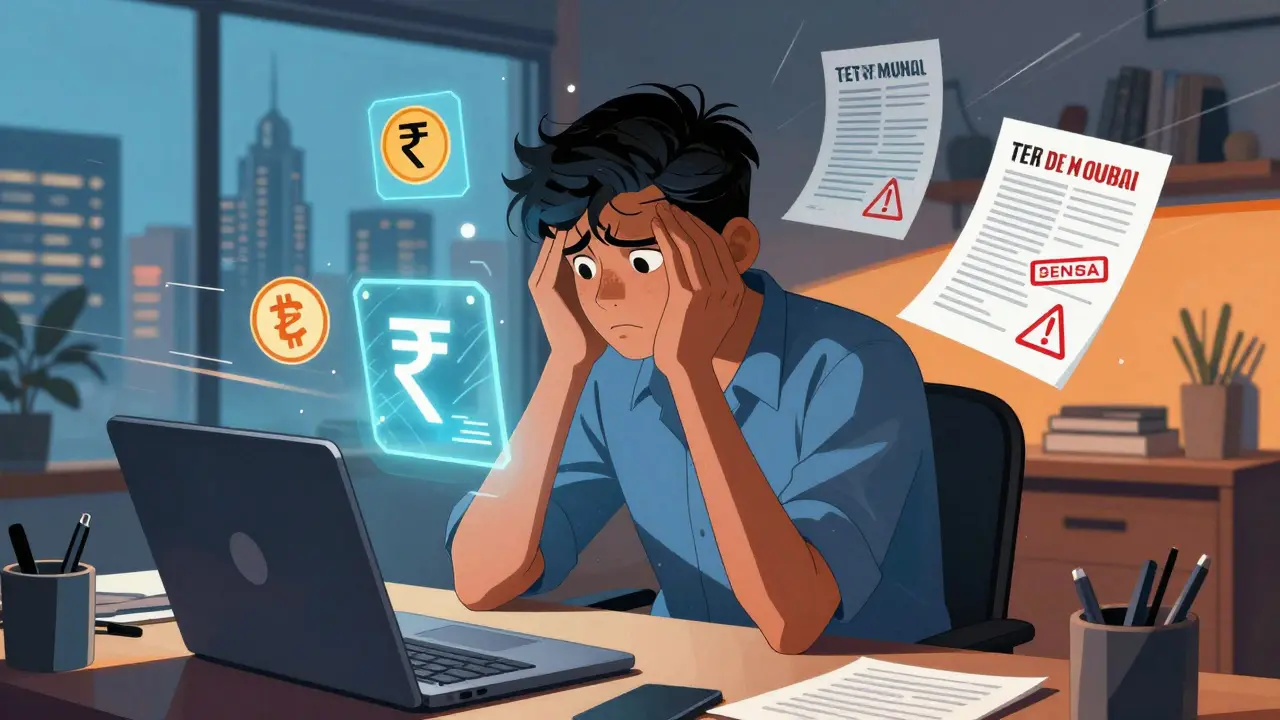
Buying cryptocurrency with Indian Rupees (INR) feels like navigating a maze where the walls keep moving. One day you’re hearing about bans, the next about booming adoption. The truth? It’s legal, but it’s expensive and heavily monitored. If you want to buy Bitcoin or Ethereum in India today, you need to understand three things: the strict tax rules, the mandatory identity checks, and which platforms actually work without freezing your funds.
This isn’t just about clicking 'buy.' It’s about surviving the regulatory environment set by the Income Tax Department and the Reserve Bank of India (RBI). You can own crypto, but the government wants its cut upfront. Here is how to do it safely, legally, and without losing money to hidden fees or compliance errors.
The Legal Reality: It’s Legal, But Heavily Taxed
First, let’s clear the air. Owning and trading cryptocurrency is legal in India. The Supreme Court struck down the RBI’s 2018 ban on crypto transactions back in March 2020. So, no one is going to arrest you for holding Bitcoin.
However, the government made it financially painful to trade frequently. Since April 1, 2022, every profit you make from selling crypto is taxed at a flat rate of 30%, plus a 4% health and education cess. That totals 31.2%. There are no deductions for losses against profits, and you cannot claim input tax credit. This means if you lose ₹10,000 on one trade and gain ₹10,000 on another, you still pay tax on the gain.
Then there’s the TDS (Tax Deducted at Source). Under Section 194S of the Income Tax Act, any exchange must deduct 1% TDS on your crypto transactions if they exceed certain thresholds. This money goes directly to the government, not to your pocket. If an exchange doesn’t comply with this, they risk being shut down under the Prevention of Money Laundering Act (PMLA). This is why major global players like Coinbase left India in June 2023-they couldn’t navigate the compliance cost.
Step-by-Step: How to Actually Buy Crypto
The process itself is straightforward if you pick the right platform. Most Indian users rely on domestic exchanges because they handle UPI payments and TDS automatically. Here is the workflow:
- Choose a Compliant Exchange: Stick to platforms registered with the Financial Intelligence Unit (FIU) of India. Top choices include WazirX, CoinDCX, and ZebPay. These platforms have integrated the necessary legal safeguards.
- Create an Account and Complete KYC: You cannot trade anonymously. You will need your PAN card (Permanent Account Number) and Aadhaar card. Most apps require a photo of these documents and a selfie holding your PAN card. This step usually takes 15-30 minutes to verify.
- Add Funds via UPI or Bank Transfer: Unified Payments Interface (UPI) is the fastest way to deposit INR. Platforms like WazirX settle UPI deposits in under 15 seconds. Bank transfers take longer, often 24-48 hours, and may have higher minimums (e.g., ₹500 on some platforms).
- Place Your Order: Once your INR wallet is funded, you can buy fractional amounts. You don’t need to buy a whole Bitcoin. You can start with as little as ₹100. Select BTC/INR or ETH/INR and execute the trade.
- Secure Your Assets: For small amounts, leaving them on the exchange is common. For larger holdings, transfer them to a hardware wallet like the Ledger Nano S+ (costing around ₹11,999) to avoid exchange hacks.

Top Exchanges Compared: Who Should You Use?
Not all exchanges are created equal. Some offer better speeds, others lower fees, and some have weaker security. Based on 2025 data, here is how the major players stack up.
| Exchange | Best For | Min. Deposit | TDS Compliance | Key Feature |
|---|---|---|---|---|
| WazirX | Beginners & Speed | ₹100 | Yes | Instant UPI settlement (~15 sec) |
| CoinDCX | Security & Education | ₹100 | Yes | Strong KYC protocols, auto-tax reports |
| ZebPay | Mobile Experience | ₹100 | Yes | One-tap trading, biometric login |
| Binance India | Coin Variety | ₹500 | No (Manual) | 500+ coins, but high regulatory risk |
WazirX is widely considered the best overall choice for new users. With over 300 cryptocurrencies and seamless UPI integration, it removes friction. However, customer support can be slow-users report waiting up to 72 hours for responses during outages.
CoinDCX is ideal if you prioritize security and tax clarity. They provide automated tax reports, which saves you hours when filing your returns. Their interface is slightly more complex but very robust.
ZebPay offers the smoothest mobile app experience with a 4.7/5 rating on Google Play. It’s great for quick trades, but their fee structure (up to 0.50% for low-volume traders) can eat into profits if you trade frequently with small amounts.
Avoid Binance India unless you know exactly what you’re doing. While it offers the widest selection of coins, it does not automatically deduct TDS. This means you must calculate and pay this tax manually, leading to significant compliance risks. Many users have faced issues due to underpayment of taxes because the exchange didn’t withhold it.
Hidden Costs: Fees and Taxes You Must Know
Before you buy, understand the real cost. It’s not just the price of Bitcoin.
- Trading Fees: WazirX charges a flat 0.20% per trade. ZebPay charges between 0.15% and 0.50% depending on your monthly volume. Kraken, while excellent for advanced traders, has higher minimum deposits (₹2,000) and no UPI support, making bank transfers slow and costly.
- TDS (1%): Remember, 1% of your transaction value is deducted at source. This isn’t a fee; it’s a pre-payment of your income tax. You can claim this back when you file your annual return, but it reduces your immediate buying power.
- Capital Gains Tax (31.2%): When you sell for a profit, you owe 30% tax + 4% cess. This applies to both short-term and long-term gains. There is no benefit for holding assets longer than a year, unlike stocks.
For example, if you invest ₹10,000 and it grows to ₹20,000, your profit is ₹10,000. You will owe ₹3,120 in capital gains tax. Plus, you likely paid ₹100 in TDS during the buy/sell process. Effective planning is crucial.
Security: Protecting Your Investment
In 2024, a hot wallet breach on ZebPy compromised ₹18.7 crore. While the exchange covered user losses, it highlights a critical rule: Not your keys, not your coins.
Only 28% of Indian crypto users use hardware wallets. Most leave funds on exchanges for convenience. This is risky. For amounts above ₹50,000, consider buying a Ledger Nano S+ or Trezor. These devices store your private keys offline, making them immune to online hacks.
Also, enable Two-Factor Authentication (2FA) on every account. Do not use SMS-based 2FA if possible; use an authenticator app like Google Authenticator or Authy. Reusing passwords across exchanges is a major cause of theft-Cyble reported 217 crypto theft incidents in India in late 2025, mostly due to poor password hygiene.
Future Outlook: Digital Rupee and Regulatory Changes
The landscape is shifting. The RBI launched Phase 3 of the Digital Rupee (CBDC) pilot in November 2025, involving 1 million users. While the Digital Rupee is not a cryptocurrency-it’s a centralized digital version of the INR-it signals the government’s focus on digital payments.
Expect stricter regulations. The proposed Crypto Asset Regulation Bill has been in committee review since 2023. Analysts predict India could reach 25 million crypto users by 2027, driven by young investors (67% of users are aged 18-34) seeking inflation hedges against India’s 6.8% annual inflation rate. However, the heavy tax burden may limit institutional participation compared to countries like Singapore.
Is buying crypto illegal in India?
No, buying and owning cryptocurrency is legal in India. The Supreme Court lifted the banking ban in 2020. However, it is heavily regulated with a 30% tax on profits and mandatory TDS deductions.
Which exchange is best for beginners in India?
WazirX is recommended for beginners due to its simple interface, low minimum deposit (₹100), and instant UPI integration. CoinDCX is also a strong alternative for those prioritizing security features.
Do I need to pay tax on crypto gains?
Yes. All crypto profits are taxed at a flat 30% plus a 4% cess (total 31.2%). Additionally, 1% TDS is deducted at the time of transaction by compliant exchanges.
Can I use UPI to buy crypto?
Yes, most domestic Indian exchanges like WazirX, CoinDCX, and ZebPay accept UPI for depositing INR. This is the fastest method, often settling within seconds.
What documents are needed for KYC?
You typically need your PAN card and Aadhaar card. Most exchanges require photos of these documents and a live selfie holding your PAN card for verification.
Is Binance safe to use in India?
Binance operates in India but faces regulatory scrutiny because it does not automatically deduct TDS. Using it requires manual tax compliance, which increases the risk of errors and penalties. Domestic exchanges are safer for compliance.
16 Responses
honestly this guide is pretty solid but i still think the tds part is a bit of a headache for us small investors. like why do they have to make it so complicated just to buy some bitcoin? feels like they are trying to scare people away instead of regulating properly.
You need to stop complaining and start reading. The regulations are there for a reason. If you can't handle the tax implications, maybe crypto isn't for you. It's not that hard to understand basic compliance.
Look, I get the frustration, but let's paint a clearer picture here. The regulatory maze is indeed a labyrinth of bureaucratic nightmares, yet it’s also an opportunity for those who dance with the rules rather than fight them. WazirX might be your trusty steed in this wild west, offering speed and simplicity that feels like a breath of fresh air amidst the chaos. But remember, every step forward requires two steps of caution because the ground is always shifting under our feet. So grab your helmet and buckle up, folks!
I really appreciate how detailed this breakdown is, especially considering the cultural nuances involved in financial regulation across different regions, which often leads to confusion for international observers who might not fully grasp the local context, but it is important to remember that while the taxes are high, the accessibility through UPI is a game changer for many everyday citizens who previously had no way to participate in global markets, and we should encourage more educational resources that help people navigate these complex systems without feeling overwhelmed or discouraged by the initial hurdles presented by government agencies.
The epistemological framework of Indian crypto regulation demonstrates a profound misunderstanding of decentralized autonomous organizations' inherent sovereignty. By imposing fiat-centric TDS mechanisms upon non-sovereign digital assets, the state engages in a category error that undermines the very essence of cryptographic liberty. One must question whether such heavy-handed fiscal policies serve the populace or merely entrench bureaucratic hegemony through pseudo-legalistic obfuscation.
stop whining about taxes and start making money if you cant handle the heat get out of the kitchen its simple math really
i mean sure you can buy it but lets be real most people lose their shirts anyway so why bother with all the kyc hassle unless you are actually planning to hold long term which nobody does anymore honestly its just gambling with extra steps
oh wow another article telling us how to give our money to the government before we even make a profit what a concept truly revolutionary in its mediocrity i suppose
just a quick note that hardware wallets are worth the investment if you plan on holding anything significant. saw too many friends get hacked last year.
It is fascinating to observe how the intersection of technology and policy shapes our financial behaviors. We must consider the broader implications of these regulations on individual autonomy and economic freedom. While the immediate costs seem high, the long-term stability provided by regulated exchanges might outweigh the initial friction for many users seeking legitimate investment avenues.
I believe that despite the challenges posed by the current regulatory environment, there is immense potential for growth and innovation within the Indian cryptocurrency sector, as evidenced by the increasing number of users adopting digital assets, which suggests that with proper education and supportive infrastructure, the market will continue to expand and mature over time, ultimately benefiting both investors and the broader economy through enhanced financial inclusion and technological advancement.
hey man i feel ya on the tax thing its rough but at least its legal now right? used to be scary thinking about getting in trouble just for having bitcoin in your wallet.
The analysis provided here is superficial at best. Failing to account for the liquidity fragmentation between domestic and offshore exchanges renders this advice obsolete for serious traders. Furthermore, the assumption that retail investors will simply accept the 31.2% tax burden ignores behavioral economics principles regarding loss aversion and risk tolerance in emerging markets.
Thanks for sharing this info! I was wondering if anyone else has had issues with UPI deposits failing during peak hours? Just curious if its a common problem or just bad luck.
Pah. Another pedestrian guide written for the masses who lack the sophistication to understand true value. Real investors do not rely on these clunky domestic platforms with their exorbitant fees and inferior interfaces. They use offshore derivatives and leverage. This entire piece reeks of mediocrity and fails to address the nuanced strategies required for actual wealth preservation in volatile markets.
Hey everyone, hope you are all doing well today. Just wanted to say that this guide is super helpful for beginners like me. Good luck with your investments!