

Imagine walking into a bank and asking for $10 million. The banker asks for your house, your car, and your life savings as security. You tell them, "I don't have those, but I'll pay you back in exactly twelve seconds." In the traditional world, you'd be laughed out of the building. In the world of Decentralized Finance is an ecosystem of financial applications built on blockchain networks that remove intermediaries by using smart contracts. Also known as DeFi, it allows for a financial tool that makes this scenario possible: the flash loan.
A flash loan allows you to borrow any amount of assets from a liquidity pool without putting up a single cent of collateral. The only catch? You must repay the loan, plus a small fee, within the same blockchain transaction. If you can't pay it back by the time the transaction finishes, the entire deal is cancelled as if it never happened. It is a high-stakes, high-speed financial instrument that has completely changed how capital is used on the blockchain.
The Magic of Transaction Atomicity
You might wonder why a lender would risk millions with a total stranger. The answer lies in a technical concept called Atomicity is a property of blockchain transactions where a series of operations are bundled together, ensuring that either every step succeeds or the entire batch is reverted. In simple terms, the blockchain treats the borrow, the trade, and the repayment as one single event.
If you borrow 1,000 ETH and try to use it to make a profit, but your strategy fails and you can't pay back the 1,000 ETH plus the fee, the network triggers a "revert." This means the blockchain rewinds the clock to the state it was in before the transaction started. The lender never actually loses their money because the assets never truly left the protocol if the repayment didn't happen. This removes the "counterparty risk" that makes traditional loans so slow and restrictive.
How a Flash Loan Actually Executes
You can't just click a "borrow" button on a website to get a flash loan. Because these loans must be repaid in seconds, they require a Smart Contract is self-executing code residing on a blockchain that automatically triggers actions when predefined conditions are met. You have to write a piece of code that tells the blockchain exactly what to do with the money.
- The Request: Your smart contract calls a lending protocol (like Aave) and asks for a specific amount of assets.
- The Transfer: The protocol sends the funds to your contract.
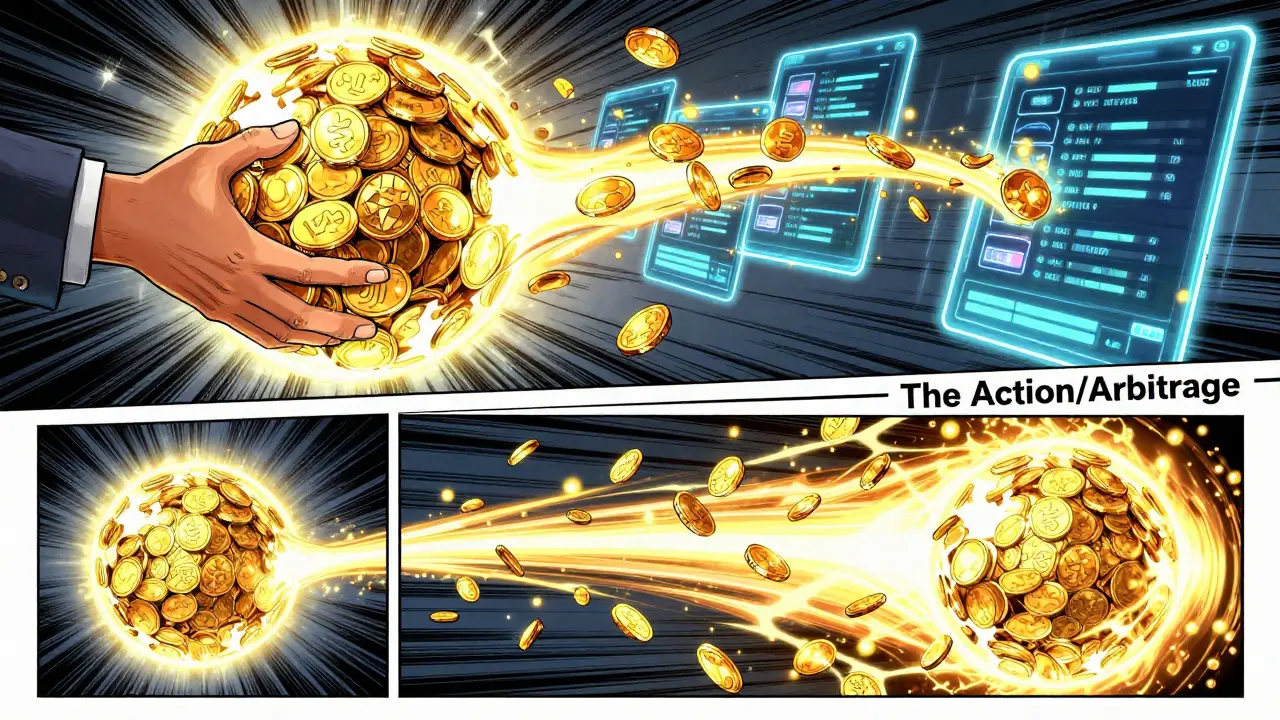
- The Action: Your contract executes a set of instructions. This could be buying a token on one exchange and selling it on another for a higher price.
- The Repayment: Your contract sends the original loan amount plus the protocol's fee (for example, 0.09% on Aave) back to the lender.
- The Finish: The transaction is mined into a block, and you keep whatever profit is left over.
The entire process usually takes between 1 to 3 seconds. However, you are limited by the network's gas limit. On Ethereum, most flash loan operations are capped at around 30 million gas, meaning you can't make your strategy *too* complex or the transaction will fail simply because it ran out of computing power.
What Are Flash Loans Used For?
Since you have instant access to massive liquidity, flash loans are mostly used by sophisticated traders and developers. They aren't for saving for a house; they are for exploiting tiny market inefficiencies.
Arbitrage Trading
This is the most common use case. Imagine a token is trading at $100 on Uniswap is a decentralized trading protocol that allows users to swap cryptocurrencies using automated liquidity pools. But on Sushiswap is a community-driven decentralized exchange built on the Ethereum blockchain, the same token is trading at $101. With a flash loan, you can borrow $1 million, buy the token on Uniswap, sell it on Sushiswap, pay back the loan, and pocket the $10,000 difference-all without using your own money.
Collateral Swapping
If you have a loan on a platform and your collateral is about to be liquidated because the price dropped, you can use a flash loan to pay off that debt, withdraw your collateral, swap it for a more stable asset, and put that new asset back as collateral-all in one go.
Self-Liquidation
When a borrower's collateral falls below a certain threshold, other users can "liquidate" them to earn a fee. A user can use a flash loan to liquidate their own position if they don't have the liquid cash to pay back the loan and unlock their assets, essentially using the protocol's own money to save their position.
Comparison: Flash Loans vs. Traditional DeFi Loans
| Feature | Flash Loans | Standard DeFi Loans (e.g., Aave V3) |
|---|---|---|
| Collateral Required | 0% | 110% - 150% |
| Duration | 1 Transaction (Seconds) | Days, Months, or Years |
| Technical Skill | High (Solidity Coding) | Low (UI Interaction) |
| Risk to Lender | Near Zero (due to atomicity) | Moderate (Price Volatility) |
| Main Use Case | Arbitrage / Liquidations | Leverage / Liquidity |
The Dark Side: Flash Loan Attacks
While flash loans democratize access to capital, they also provide a massive weapon for hackers. In a typical "flash loan attack," a bad actor borrows a huge sum of money to artificially manipulate the price of an asset on a specific exchange. Because they have so much capital, they can push the price of a token way up or down.
If another protocol relies on that manipulated price (using a flawed Oracle is a service that provides real-time external data, such as asset prices, to a smart contract on the blockchain), the attacker can trick that protocol into thinking an asset is worth more than it is, allowing them to withdraw funds they aren't entitled to. We've seen this happen in numerous exploits, with some totaling hundreds of millions of dollars in losses.
The risk often comes down to "slippage" and oracle design. If a project doesn't protect its price feeds or uses a single source of truth for prices, a flash loan can be used to create a temporary market imbalance that drains the protocol's reserves.
Getting Started: Requirements and Pitfalls
If you're thinking about trying this, be aware that it's not a "get rich quick" button. You need a deep understanding of Solidity and the specific interfaces of the protocols you're using. For instance, to use Aave, your contract must implement the `IFlashLoanReceiver` interface and the `executeOperation()` function.
Here are the most common traps for beginners:
- Gas Costs: Even if your loan is free, the gas fees for a complex transaction can be expensive. If your arbitrage profit is $10 but the gas costs $50, you've lost money.
- Slippage: In the time it takes for your transaction to be processed, the price might change. If the price moves against you, the transaction will revert, and you'll still pay the gas fee.
- MEV Bots: Maximal Extractable Value is the profit a blockchain validator can make by choosing the order and composition of transactions in a block. Sophisticated bots scan the "mempool" for profitable flash loan transactions. If they see yours, they might "front-run" you, executing the same trade a millisecond before you and stealing the profit.
Can I use a flash loan for long-term investing?
No. By definition, a flash loan must be borrowed and repaid within the same block. You cannot hold the funds overnight or even for a minute. If the funds aren't returned by the end of the transaction, the entire process is reverted.
What happens if the trade loses money?
If the trade doesn't generate enough profit to cover the loan and the fee, the transaction will fail to meet the repayment condition. The blockchain will then revert the entire transaction, meaning you don't lose the borrowed money, but you do lose the gas fees paid to the network for attempting the transaction.
Who provides the liquidity for flash loans?
Liquidity is provided by DeFi protocols like Aave, Uniswap, and Balancer. These protocols have massive pools of assets deposited by other users who earn interest. The protocol allows these assets to be "flash borrowed" because the risk of loss is zero due to the atomicity of the transaction.
Do I need to be a professional coder to use them?
Generally, yes. You need to write a smart contract in a language like Solidity to interact with the lending protocol's interface. While some "no-code" flash loan tools exist, they often charge high fees and may be less secure than a custom-built contract.
Why are flash loans called "democratizing capital"?
In traditional finance, only people with millions of dollars (institutional players) can perform large-scale arbitrage. Flash loans allow anyone with a bit of coding knowledge and some gas money to access millions of dollars in liquidity, leveling the playing field for retail traders.
Next Steps for Exploring DeFi
If you're a developer, the best way to start is by reading the Aave V3 documentation and experimenting on a testnet (like Sepolia) where you don't risk real money. Focus on mastering reentrancy guards to ensure your contract is secure.
For non-coders, the best approach is to study how price oracles and liquidity pools work. Understanding the "plumbing" of DeFi will help you see why these loans are possible and where the risks lie. You might also want to look into "flash swaps," a similar concept used specifically on Uniswap for token exchanges.
16 Responses
the concept of atomicity is basic but most people here act like it's some kind of divine revelation just because they can't read a whitepaper without getting a headache
Imagine thinking a few lines of Solidity makes you a financial genius. Most of you will just burn your gas fees and cry when the MEV bots eat your lunch because you're too slow to actually optimize a contract
Actually, calling this 'democratizing capital' is a complete misnomer. It doesn't democratize anything; it just shifts the advantage from institutional capital to those with superior algorithmic execution. The barrier to entry isn't money, it's technical expertise, which is just another form of exclusivity. If anything, it creates a new class of 'code-elite' who can extract value from the less tech-savvy retail traders who think they're participating in a fair market
I've seen far more elegant explanations of this in academic papers. This summary is just so... pedestrian. It barely scratches the surface of the liquidity pool dynamics
It is truly fascinating to see how these mechanisms are evolving. For those just starting, please remember to always test your code on a testnet first. Safety is paramount in DeFi. :)
I must agree with the sentiment that education is key!! It is truly inspiratinal to see such complex financial tools become accessible to the broader public, though one must be wary of the laaaastingly high risks involvd in such ventures!
boring as hell. just print more money and let the bots fight it out in the mempool while we watch the chaos from the sidelines lol
Quite a clever bit of engineering, really.
you think its just code but the whole thing is a setup to track every move you make with money they pretend isnt there its all just a game to see how much we can be manipulated by the invisible hand and the people running the oracles probably work for the same three banks anyway
Exactly. They tell you its decentralized but they just want your data and your gas fees while they control the flow of the coins
It's interesting to think about how this changes our fundamental perception of 'ownership' and 'debt' when the time scale is reduced to seconds. We're basically treating capital as a fleeting energy state rather than a stored value
money for free sounds cool
the ethics of this are just nonexistent :( just a bunch of people using math to steal from each other in a digital void 🙄
India is going to lead the world in the implementation of these smart contracts because our developers are just on another level of brilliance!! The sheer scale of talent we have will make these DeFi tools a staple in every village soon! Absolutely stunning progress!
I wonder how the gas limit on Layer 2 solutions like Arbitrum or Optimism changes the complexity of the strategies one can deploy compared to the mainnet
That's a great point about the L2s. It would be wonderful to see a comparison of the execution costs across different networks to help newcomers decide where to deploy their first contract