
Imagine walking into a bank to deposit money, but instead of handing your cash to a teller who locks it in a vault, you keep the cash in your pocket while simultaneously buying a stock. That sounds impossible in traditional finance, right? Yet, this is exactly how Decentralized Exchanges (DEXs) are peer-to-peer cryptocurrency marketplaces that allow users to trade digital assets directly without a central intermediary or custodian. They operate without banks, brokers, or customer support teams, relying entirely on code and mathematics to facilitate trades.
If you have ever wondered how a trade can happen between two strangers without anyone holding the keys to their funds, you are asking the right question. The answer lies in blockchain technology, specifically through mechanisms like Automated Market Makers (AMMs) and smart contracts. This guide breaks down the technical and functional reality of DEXs, explaining how they replace human intermediaries with algorithmic efficiency.
The Core Mechanism: Smart Contracts Replace Brokers
In a centralized exchange (CEX) like Coinbase or Binance, you send your Bitcoin to the exchange’s wallet. They hold it; you just see a number on a screen. If the exchange goes bankrupt or gets hacked, your money might disappear. This was the harsh reality for millions during the collapse of FTX in November 2022.
DEXs eliminate this counterparty risk by using Smart Contracts are self-executing contracts with the terms of the agreement directly written into code on a blockchain. These programs live on the blockchain (most commonly Ethereum, Solana, or BNB Chain). When you trade on a DEX, your funds never leave your personal wallet, such as MetaMask or Phantom. You sign a transaction that instructs the smart contract to swap Token A for Token B. The code executes the trade instantly, and the new tokens arrive in your wallet. No middleman touches your assets.
This architecture fulfills a core promise of cryptocurrency: financial sovereignty. According to data from DeFi Llama, top DEX platforms collectively process over $12 billion in daily trading volume. Despite this massive scale, no single entity controls the user funds. The trust is placed in the audited code, not a company.
Automated Market Makers (AMMs): The Engine of Most DEXs
You might ask, "If there is no broker matching buyers and sellers, how is the price determined?" This is where the Automated Market Maker (AMM) is a type of decentralized exchange protocol that uses liquidity pools and mathematical formulas to determine asset prices. AMMs account for approximately 85% of current DEX volume. Instead of an order book where buyers and sellers post bids and asks, AMMs use liquidity pools.
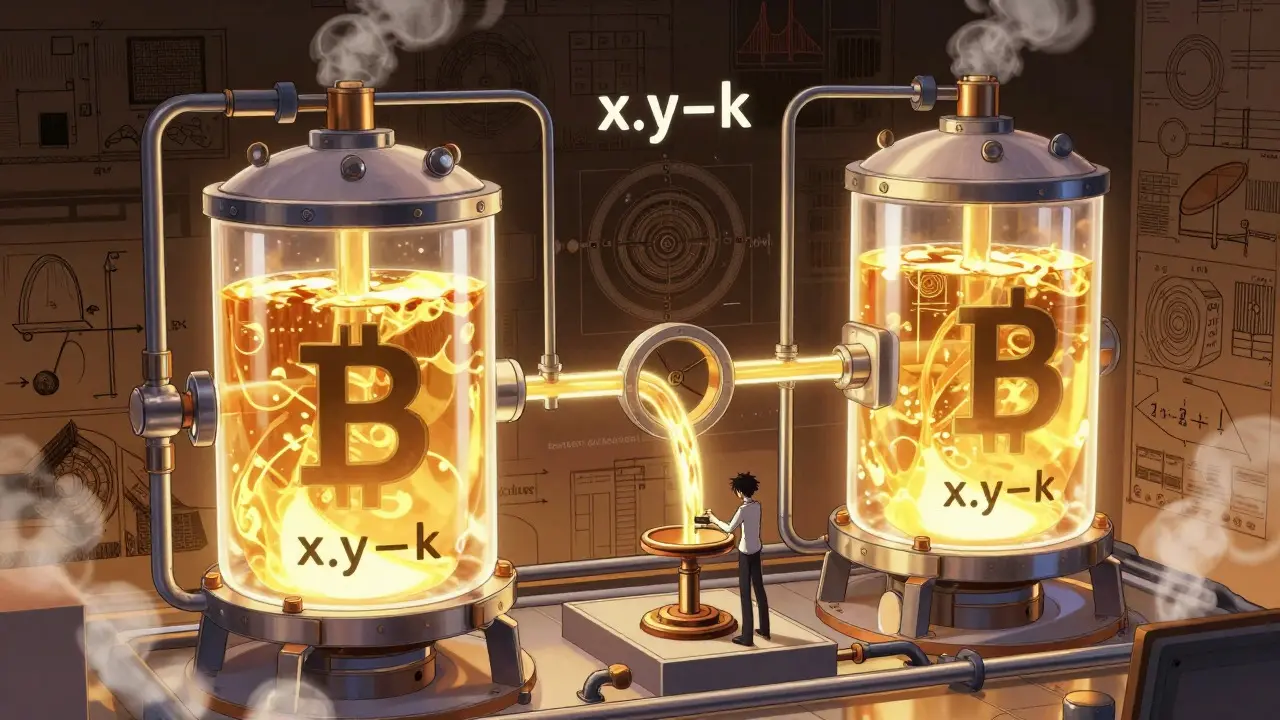
A liquidity pool is a smart contract containing pairs of tokens, such as ETH and USDC. Anyone can deposit these tokens into the pool to become a Liquidity Provider (LP). In return, LPs earn a share of the trading fees generated by swaps. The price of the tokens is determined by a simple formula, most famously x * y = k, known as the constant product formula.
- X represents the amount of Token A in the pool.
- Y represents the amount of Token B in the pool.
- K is a constant value that must remain unchanged after any trade.
When you buy ETH with USDC, you add USDC to the pool and remove ETH. To keep k constant, the ratio changes, effectively raising the price of ETH. Uniswap V2, launched in May 2020, popularized this model with a standard 0.3% fee. Later, Uniswap V3 introduced "concentrated liquidity," allowing providers to allocate capital within specific price ranges, improving capital efficiency by up to 4,000x according to their whitepaper.
Order Book DEXs and Aggregators: Alternative Models
While AMMs dominate, they are not the only way to build a DEX. Some protocols mimic traditional exchanges by using order books, but they execute trades via smart contracts. This model represents about 12% of market volume.
dYdX is a decentralized exchange platform that processes order matching off-chain but settles transactions on-chain. It handles approximately $150 million in daily volume. By processing matches off-chain, dYdX achieves faster execution speeds closer to centralized exchanges, while still ensuring final settlement occurs on the blockchain for security.
Then there are DEX Aggregators like 1inch and Matcha. These tools don’t hold liquidity themselves. Instead, they scan multiple DEXs (Uniswap, SushiSwap, Curve) to find the best price for your trade. They split your order across different pools to minimize slippage. Blockpit’s analysis in 2023 showed aggregators reduce slippage by an average of 0.37%. For a trader, this means getting more tokens for the same amount of money.
| Feature | AMM (e.g., Uniswap) | Order Book DEX (e.g., dYdX) | Aggregator (e.g., 1inch) |
|---|---|---|---|
| Pricing Mechanism | Mathematical Formula (x*y=k) | Buy/Sell Orders | Best Price Across Multiple DEXs |
| Liquidity Source | User Deposits (Pools) | Market Makers/Users | Other DEX Protocols |
| Slippage Risk | Higher for large trades | Lower for liquid pairs | Minimized via routing |
| Complexity | Low | Medium | Low |
Security and Control: Why Users Choose DEXs
The primary driver for DEX adoption is security through self-custody. Between 2011 and 2022, Chainalysis documented $3.8 billion lost to centralized exchange hacks. In contrast, only 0.2% of DeFi Total Value Locked (TVL) was compromised in security incidents during 2022, according to Immunefi. While smart contract bugs exist, the risk profile is different. You are not trusting a CEO with your funds; you are trusting open-source code that anyone can audit.
Furthermore, DEXs offer censorship resistance. During the Terra/Luna collapse in 2022, several centralized exchanges halted trading to protect themselves. Uniswap remained operational, allowing users to exit positions freely. This permissionless nature means any ERC-20 token can be traded immediately upon pool creation. Uniswap supports over 140,000 token pairs, compared to Binance’s 1,200.
However, this freedom comes with responsibility. There is no "Forgot Password" button. If you lose your private key or seed phrase, your funds are gone forever. This high barrier to entry has led to a 47% drop-off rate for new users at the wallet connection stage, as noted in a 2023 a16z blog post.

Challenges: Slippage, Gas Fees, and UX Friction
DEXs are not perfect. The lack of intermediaries introduces friction points that centralized exchanges have smoothed over decades.
Slippage: Because AMMs rely on pool depth, large trades can significantly move the price against you. Kaiko Research measured average slippage at 0.45% on Uniswap versus 0.05% on Coinbase for similar trades. If you try to sell $10,000 worth of a token in a pool with only $5,000 total liquidity, you will get far less than expected.
Gas Fees: Every interaction with a DEX requires a blockchain transaction. On Ethereum Mainnet, gas fees averaged $15.75 in October 2023. During network congestion, this can spike to $50+. Layer-2 solutions like Arbitrum and Optimism have mitigated this, with fees averaging around $1.20. However, users must understand these costs before trading.
User Experience: Connecting a wallet, approving token allowances, and setting slippage tolerance settings are steps that confuse beginners. A study by Coinbase Learn found novice users need 8-12 hours of learning to safely navigate basic swaps. Phishing remains a critical threat; 32% of DeFi hacks in 2022 involved fake DEX interfaces tricking users into signing malicious transactions.
Regulatory Landscape and Future Outlook
The regulatory environment for DEXs is evolving rapidly. In July 2023, the SEC issued a Wells Notice to Uniswap Labs, alleging securities violations. This highlights the tension between decentralized code and centralized development teams. SEC Chairman Gary Gensler has argued that some DEXs are not as decentralized as they claim due to concentrated developer control.
Despite this, growth continues. Delphi Digital projects a 34% Compound Annual Growth Rate (CAGR) for DEXs through 2027. Innovations like Uniswap V4, planned for release with customizable "hooks," and Ethereum’s Dencun upgrade, which reduces Layer-2 costs by 90%, are addressing scalability issues. Hybrid models that combine the speed of centralized order books with the security of on-chain settlement are also emerging, suggesting a future where the line between CEX and DEX blurs further.
What is the main difference between a DEX and a CEX?
The main difference is custody. On a Centralized Exchange (CEX), the platform holds your funds in its own wallets. On a Decentralized Exchange (DEX), you retain custody of your funds in your personal wallet throughout the entire trading process. Trades are executed via smart contracts rather than internal database entries.
How do DEXs determine the price of a cryptocurrency?
Most DEXs use Automated Market Makers (AMMs) and liquidity pools. Prices are determined by mathematical formulas, such as x*y=k, based on the ratio of assets in the pool. Other DEXs use order books similar to traditional stock markets, but matched and settled via smart contracts.
Are DEXs safer than centralized exchanges?
DEXs eliminate counterparty risk because you control your private keys, meaning you are not exposed to exchange insolvency or internal theft. However, they introduce smart contract risk (bugs in the code) and user error risk (losing keys or falling for phishing scams). Statistically, less TVL has been lost in DeFi hacks compared to CEX hacks in recent years.
What are liquidity providers and why are they important?
Liquidity Providers (LPs) are users who deposit pairs of tokens into a DEX's liquidity pool. They provide the capital necessary for traders to execute swaps. In return, LPs earn a portion of the trading fees generated by the pool. Without LPs, there would be no assets available to trade on an AMM-based DEX.
Why are gas fees higher on Ethereum DEXs?
Ethereum is the most congested blockchain with high demand for block space. Each DEX transaction requires computational power validated by miners or validators, costing "gas." Layer-2 solutions like Arbitrum or Polygon offer cheaper alternatives by processing transactions off the main Ethereum chain while inheriting its security.
Can I trade fiat currency (USD/EUR) on a DEX?
Generally, no. DEXs trade cryptocurrencies for other cryptocurrencies. To trade fiat, you first need to convert it into a stablecoin (like USDC or USDT) using a centralized exchange or a fiat on-ramp service, then transfer those stablecoins to your wallet to use on the DEX.