
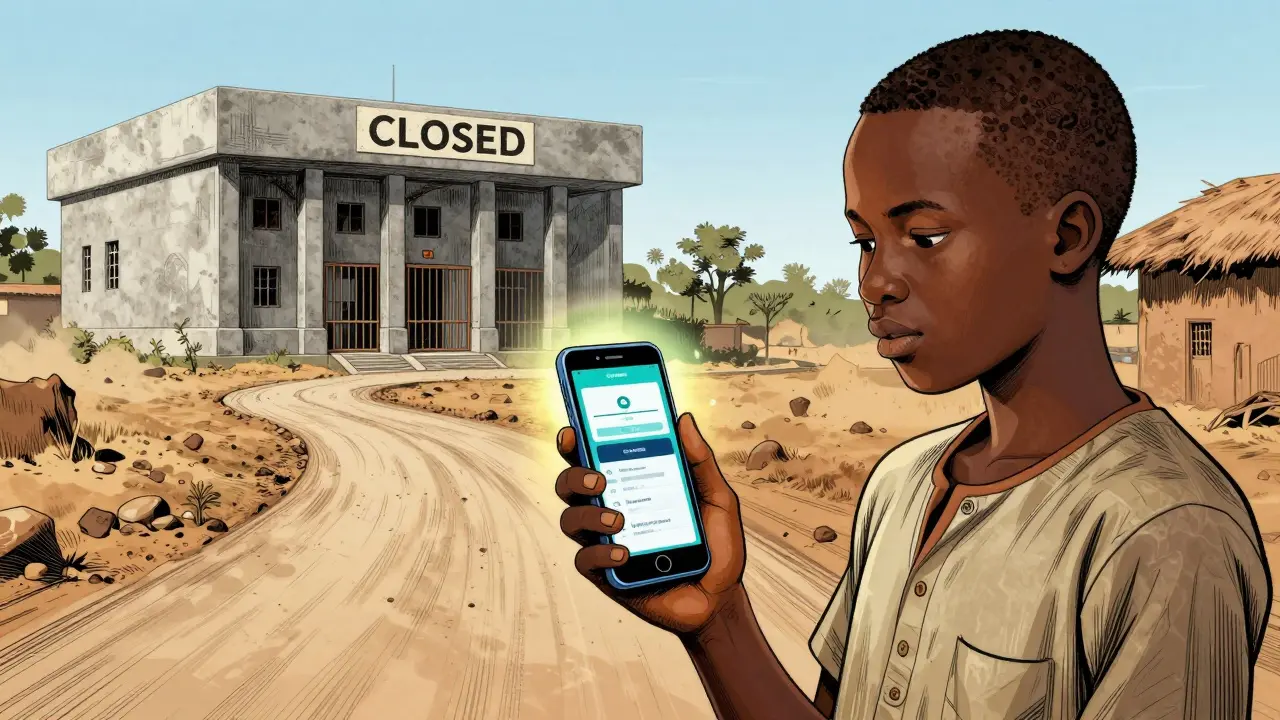
Imagine having to travel four hours on a dusty road just to reach the nearest bank branch, only to be told you can't open an account because you lack a formal government ID or a minimum deposit. For about 1.4 billion adults worldwide, this isn't a hypothetical scenario-it's daily life. Traditional banking is built on walls of paperwork and physical infrastructure that simply don't exist in many rural parts of the world. This is where financial inclusion is the effort to make financial products and services accessible and sustainable to all individuals, regardless of their income level . While banks have struggled to bridge this gap, digital assets are stepping in to tear those walls down.
The Fast Track to Financial Access
The magic of this shift lies in the fact that you don't need a banker's permission to use a digital wallet. You just need a smartphone and a basic internet connection. In places like Sub-Saharan Africa, where less than half of the adults had a bank account as of 2021, Blockchain is a decentralized ledger technology that records transactions across many computers so the record cannot be altered retroactively provides a way around the red tape. In Nigeria, Kenya, and South Africa, people aren't just using crypto for speculation; they're using it as a functional replacement for banks.
Think about the contrast: a traditional bank requires a physical address, a credit history, and often a hefty fee just to keep an account open. A crypto wallet can be set up in seconds. This removes the geographic and bureaucratic barriers that have kept millions in poverty for decades. It turns a mobile phone into a personal bank branch that never closes.
Cutting Out the Middleman in Remittances
If you're a migrant worker sending money home to your family in a developing country, you've probably felt the sting of remittance fees. Traditional services often eat up between 6% and 15% of the total amount sent. On top of that, the money can take days or even weeks to arrive. When you're sending money for emergency medical bills or school fees, that delay can be devastating.
By using Cryptocurrency is a digital or virtual currency that is secured by cryptography, making it nearly impossible to counterfeit or double-spend , these costs plummet. Transactions that used to cost a significant percentage of the principal now often cost less than 1%. Because the network operates 24/7, the transfer is nearly instant. This means more money actually reaches the people who need it, rather than lining the pockets of intermediary banks.
| Feature | Traditional Banking | Crypto Solutions |
|---|---|---|
| Account Setup | Requires ID, Proof of Address | Smartphone & App (Instant) |
| Remittance Cost | 6% - 15% per transfer | Typically under 1% |
| Processing Time | Days to Weeks | Minutes to Seconds |
| Accessibility | Physical Branches | Internet-enabled devices |
A Shield Against Hyperinflation
In many developing economies, the local currency is a leaking bucket. When a country experiences chronic high inflation, the money people save today might be worth half as much next month. This makes traditional savings accounts useless for wealth preservation. People in these regions often find themselves in a desperate race to spend their money before it loses value.
This is where assets like Bitcoin is the first decentralized cryptocurrency, launched in 2009, featuring a capped supply of 21 million coins act as a digital hedge. Because Bitcoin has a fixed supply and is priced on a global market, it doesn't depend on the stability of a single government's central bank. For someone living in a country with a crashing currency, moving their savings into a digital asset is often the only way to protect their purchasing power and ensure their family's future stability.
The Hurdles: Why Isn't Everyone Doing It?
If the benefits are so clear, why hasn't every unbanked person switched? The reality is that the road to adoption is full of potholes. The biggest issue is regulatory uncertainty. Many governments are still figuring out how to handle digital assets, and some have even banned them. This leaves users in a legal gray area, making them hesitant to move large sums of money.
Then there's the "digital divide." While smartphones are common, reliable internet in rural areas is still a luxury. If your connection drops during a transaction, or if you lose the private keys to your wallet, your money is gone forever. For someone living on a few dollars a day, that risk is far too high. Digital literacy is also a major barrier; managing a seed phrase is a lot more complex than using a physical ATM.
Finally, market volatility is a huge psychological barrier. If you're using crypto for a store of value, a 20% price drop in a week can be catastrophic. This is why we're seeing a rise in Stablecoins are cryptocurrencies pegged to a stable asset, such as the US Dollar, to reduce price volatility . These provide the speed and accessibility of blockchain without the stomach-churning price swings of Bitcoin.
Beyond Payments: Tokenizing the Future
We're now moving past simple transfers and into the realm of Tokenization is the process of converting rights to an asset into a digital token on a blockchain . This could be a game-changer for small businesses in developing nations. Normally, a small farmer or a local artisan can't get a loan because they don't have a credit score or collateral that a big bank recognizes.
Through tokenization, these entrepreneurs can access private capital flows from all over the world. By fractionalizing assets, they can secure funding from a diverse group of global investors rather than relying on a local loan shark. This doesn't just help one business; it creates jobs and boosts the local tax base, fueling a cycle of growth that traditional finance has ignored for decades.
Governments are also starting to take notice. Central banks in countries like Ghana and Nigeria are exploring their own digital versions of national currencies. The goal is to combine the stability of a government-backed currency with the efficiency of blockchain technology to reach the unbanked more effectively.
The Road Ahead
Crypto isn't a magic wand that will end poverty overnight, but it is a powerful tool. The most successful path forward isn't about crypto replacing banks entirely, but rather complementing them. We'll likely see a hybrid system where traditional banks integrate blockchain for backend efficiency, while grassroots crypto apps provide the "on-ramp" for those who were previously told they weren't "creditworthy." To make this work, the focus must shift toward education and consumer protection, ensuring that the most vulnerable users aren't wiped out by scams or technical errors.
Do you need a bank account to use cryptocurrency?
No, that is one of the primary advantages. You only need a digital wallet and an internet connection. You can receive and send funds without ever interacting with a traditional financial institution.
Isn't crypto too volatile for poor people to use?
It can be. This is why many users in developing countries prefer stablecoins, which are pegged to the US Dollar. These provide the technical benefits of blockchain-like low fees and instant transfers-without the price volatility of assets like Bitcoin.
What happens if someone loses their private key?
In a decentralized wallet, the user has total control, but that means there is no "forgot password" button. If the private keys are lost, the funds are generally inaccessible. This is why digital literacy and the use of custodial services are critical for new users.
How does crypto help with inflation?
In countries with hyperinflation, local currencies lose value rapidly. Assets with a fixed supply, such as Bitcoin, or those pegged to a stable foreign currency, allow people to store their wealth in an asset that doesn't depreciate due to local government policy.
Can governments stop people from using crypto for financial inclusion?
Governments can implement restrictions or ban exchanges, but because blockchain is decentralized, it is very difficult to stop entirely. Peer-to-peer (P2P) trading often continues even in restrictive environments.
13 Responses
Very promising shift for the global south.
The point about seed phrases is the most critical part here. For someone who has never dealt with digital security, losing a 12-word phrase is a devastatingly easy mistake to make. We need better social recovery mechanisms if this is actually going to scale for the unbanked. It is not enough to just give them a wallet; we have to ensure they can actually keep their funds safe from their own human error.
I've spent quite a bit of time researching the infrastructure in Sub-Saharan Africa and it is honestly fascinating to see how leapfrogging is happening. Just like how many of these regions skipped landlines and went straight to mobile phones, they are now skipping the traditional brick-and-mortar banking system and moving straight into decentralized finance. It is an incredible opportunity for empowerment, though I do think we need to be mindful of the energy costs associated with some of these chains, although the move toward Proof of Stake has largely mitigated that concern for the average user. The real win here is the reduction of that predatory 15% remittance fee which is basically a tax on the poor.
u think its about inclusion but its just another way for the elites to track every single cent you spend on a ledger. total surveillance state in the making lol.
Oh sure, because the government banks aren't already tracking everything. Absolute genius logic right there.
This is a kaleidoscopic shift in how we perceive value! We are talking about a vibrant revolution that shatters the stale, monochromatic boredom of traditional banking. It is absolutely electrifying to imagine a farmer in a remote village wielding the same financial power as a Wall Street shark with just a few taps on a screen. Let's blast these bureaucratic shackles into oblivion and embrace a world where financial agility is a universal right, not a luxury for the few! The sheer audacity of this technology to dismantle systemic exclusion is nothing short of breathtaking!
Stablecoins are the real MVP here. Bitcoin is too wild for a daily budget.
Imagine thinking a 'digital wallet' solves systemic poverty. Cute.
It's all about the mindset shift. We're moving from a world of 'permission' to a world of 'access' :) That's a huge philosophical leap for humanity. Imagine the freedom when your wealth isn't tied to a failing government's whim. It's a total vibe shift for the global economy!
One must consider the ethical imperatives of such a transition. While the efficiency is undeniable, we must ensure that the pursuit of profit does not overshadow the humanitarian goal of upliftment. ⚖️ It is a grave responsibility to manage the wealth of the destitute.
idk man just seems like another way for scams to happen. poor people getting ripped off by some "investment guru" on telegram is a classic.
i think its grate that more peopel can get access to money. maybe we can find a way to make it simpler for the elderly too
The tokenization part is where the real money is. If we can fractionalize land ownership, that changes the entire game for collateral.