
By 2025, the idea of a green cryptocurrency isn’t just a nice-to-have-it’s a requirement. The old days of mining Bitcoin with racks of GPUs that guzzled electricity like a gas-guzzling truck are fading fast. Today’s blockchains aren’t just about speed or security. They’re being judged on how little energy they use. And the numbers are staggering.
Bitcoin alone has emitted over 200 million tons of CO2 since 2009. That’s more than the entire country of Colombia in a single year. Global crypto emissions hit 110-170 million metric tons of CO2 annually, according to a White House study. That’s 0.3% of all human-caused emissions. It’s not huge compared to aviation or steel production-but for a technology still in its teens, it’s unsustainable. So the industry had to change. And it did.
How Green Cryptocurrencies Work
Bitcoin uses Proof-of-Work (PoW). That means miners compete to solve complex math problems using powerful computers. The more computing power you have, the better your chance of earning rewards. But that also means massive electricity use. A single Bitcoin transaction can consume over 900 kWh-enough to power a home for a month.
Green cryptocurrencies ditch PoW. Instead, they use consensus methods that don’t require brute-force computing. The most common ones today are:
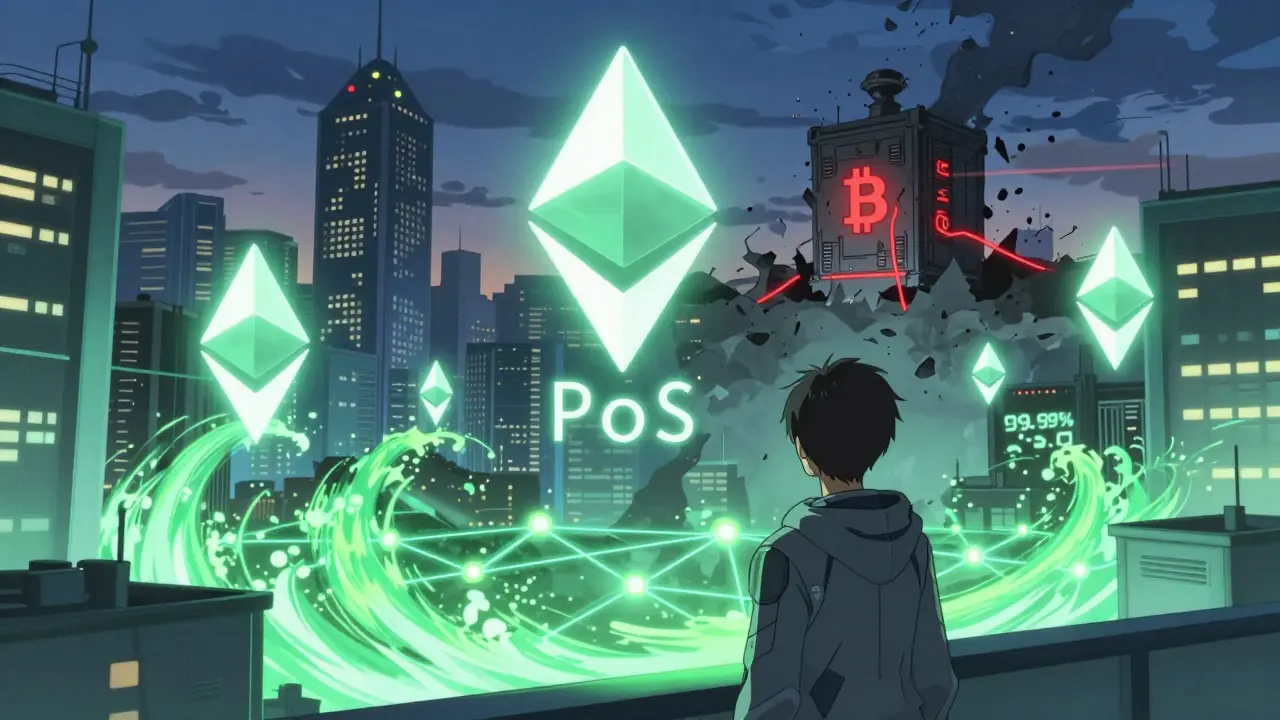
- Proof-of-Stake (PoS): You lock up (or "stake") your coins to help verify transactions. No mining needed. Ethereum switched to this in 2022 and cut its energy use by 99.95%.
- Proof-of-Space-and-Time (PoST): Used by Chia. Instead of computers, you use spare hard drive space. Your "plots" act like digital land. No GPUs. No overheating. Just storage.
- Directed Acyclic Graph (DAG): Hedera Hashgraph uses this. It doesn’t chain blocks-it connects transactions in a web. This lets it process thousands of transactions per second with almost zero energy.
These aren’t just theoretical. They’re live, running, and handling real money every second.
The Top Green Cryptocurrencies in 2025
Not all "green" coins are created equal. Some are truly efficient. Others are just slapping on a carbon offset sticker and calling it sustainable. Here’s what’s actually working in 2025.
| Coin | Consensus Mechanism | TPS (Transactions Per Second) | Energy per Transaction | Annual CO2 Emissions (Est.) |
|---|---|---|---|---|
| Ethereum | Proof-of-Stake | 100-200 | 0.001 kWh | 0.01 TWh |
| Solana | Proof-of-History + PoS | 65,000 | 0.00051 kWh | 0.003 TWh |
| Cardano | Ouroboros PoS | 250 | 0.002 kWh | 0.008 TWh |
| Chia (XCH) | Proof-of-Space and Time | 20 | 0.00001 kWh | 0.0005 TWh |
| Hedera Hashgraph | DAG + Hashgraph | 10,000 | 0.00000017 kg CO2 | Near zero |
| Bitcoin (for contrast) | Proof-of-Work | 7 | 932.63 kWh | 110+ TWh |
Let’s break down the leaders.
Ethereum: The Giant That Changed
Before 2022, Ethereum was the second-largest crypto by market cap-and the biggest energy hog after Bitcoin. It used more electricity than the Netherlands. Then came "The Merge." Ethereum switched to Proof-of-Stake. Overnight, its energy use dropped from 112.66 TWh per year to 0.01 TWh. That’s a 99.99% reduction. Today, it’s the most widely used green blockchain, powering DeFi, NFTs, and enterprise apps. But staking still requires 32 ETH-about $90,000. That puts it out of reach for most regular users.
Solana: Speed Without the Sacrifice
Solana isn’t just fast. It’s absurdly efficient. It handles 65,000 transactions per second using less energy than a Google search. Each transaction uses 0.00051 kWh. That’s 1.8 million times less than Bitcoin. Its Proof-of-History system timestamps transactions before they’re even sent, cutting down on network chatter. In Q1 2025, Solana cut its energy use another 40% with a network upgrade. It’s the go-to for apps that need speed-payments, gaming, DeFi. And its transaction fees? Less than a penny. One user on Reddit said they sent $10,000 across borders for $0.00015. No bank could do that.
Chia: The Storage-Based Alternative
Chia’s approach is wild. Instead of mining, you use unused space on your hard drive. You create "plots"-files that sit idle until needed. No GPUs. No fans spinning. Just a regular laptop or NAS drive. It’s so low-power that one user reported running Chia on an old laptop that used less energy than their fridge. But there’s a catch. Chia’s popularity spiked demand for high-capacity SSDs. Some critics say it just shifted environmental impact from energy to e-waste. Still, for non-technical users, it’s one of the easiest ways to participate in a green blockchain without spending thousands.
Hedera Hashgraph: The Quiet Leader
Hedera doesn’t even use blocks. It uses a DAG structure that lets nodes agree on order without broadcasting every message. Each transaction emits just 0.00017 kg of CO2. That’s 500,000 times less than Bitcoin. It’s not as well-known as Ethereum or Solana, but it’s quietly powering enterprise use cases-supply chain tracking, digital identity, carbon credit registries. Companies like Google and IBM use it. And it’s one of the few projects with verifiable, audited emissions data.

The Dark Side of "Green" Crypto
Not every project calling itself "green" deserves the label. A Stanford study found that 68% of green crypto projects make carbon offset claims without third-party verification. That’s greenwashing.
Some coins claim to be carbon neutral by buying offsets-planting trees or funding wind farms. But if you can’t prove the offsets are real, permanent, and additional (meaning they wouldn’t have happened anyway), it’s just marketing. PwC’s March 2025 audit found 52% of green crypto projects lack verifiable documentation.
Another issue: PoS can centralize power. The more coins you hold, the more likely you are to be chosen to validate blocks. That means wealthier players dominate. Cambridge researchers warned in late 2024 that PoS could create a new kind of inequality-where the rich get richer by simply holding crypto, not by contributing to the network.
And then there’s the hardware problem. Chia’s use of storage led to a global shortage of 10TB+ drives. Ethereum’s staking requirements lock up billions in capital. These aren’t just technical issues-they’re social ones.
Who’s Investing in Green Crypto?
Institutional money is pouring in. BlackRock allocated 12% of its digital asset portfolio to green cryptocurrencies in Q1 2025. The global green blockchain market hit $12.7 billion-up 29% from last year. Why? Because investors now demand ESG compliance. The EU’s MiCA regulation, effective July 2025, will force every crypto project to disclose its environmental impact. The SEC launched a dedicated task force to monitor green claims. If you can’t prove it, you can’t list it.
Even Fortune 500 companies are using green blockchains. Walmart, Maersk, and Unilever now track supply chains on Hedera and Polygon. Carbon credit platforms run on Cardano. The shift isn’t just ethical-it’s financial. Investors won’t touch projects that look risky or irresponsible.

What’s Next in 2025 and Beyond
The next wave isn’t just about efficiency. It’s about integration.
One new trend is "virtual eco-mining." Projects like Pepenode ($PEPENODE) reward users not for computing power, but for real-world eco-actions-recycling, biking to work, planting trees. Users earn tokens by proving they did something good for the planet. It raised $28.7 million in presale in February 2025. It’s gamifying sustainability.
Ethereum’s "Prague" upgrade in September 2025 will introduce account abstraction, making wallets easier to use and slashing gas fees even further. Solana’s team is testing a new validator coordination protocol that could reduce energy by another 30%.
Gartner predicts that by 2027, 85% of new blockchain deployments will prioritize sustainability over speed or cost. That’s a massive shift. Five years ago, sustainability was a footnote. Now, it’s the main feature.
How to Get Started
Want to use or invest in green crypto? Here’s how:
- If you’re new: Try Chia. All you need is a computer with spare hard drive space. No upfront cost. Just download the app and start plotting.
- If you want speed: Use Solana. Its mobile wallets are simple. Send money across the world for less than a cent.
- If you’re serious: Stake Ethereum-but only if you have $90,000+ and technical know-how. Otherwise, use a staking pool like Lido or Coinbase.
- If you’re skeptical: Look for third-party audits. Projects like Hedera and Algorand publish real-time emissions data. Avoid those that just say "carbon neutral" without proof.
Don’t chase hype. Check the numbers. Look at the energy use per transaction. See if the project has verifiable offset programs. And remember: the greenest crypto is the one you actually use.
Are green cryptocurrencies really better for the environment?
Yes-but only if they don’t use Proof-of-Work. Ethereum, Solana, Cardano, and Chia use methods that cut energy use by 99% or more compared to Bitcoin. However, some projects make false claims about carbon offsets without proof. Always check for third-party audits or public emissions data.
Can I mine green cryptocurrency on my home computer?
You can’t mine most green cryptos-they don’t use mining. But you can participate in Chia using spare hard drive space. No special hardware needed. You can also stake Ethereum or Solana through wallets like Phantom or MetaMask, but staking usually requires holding a minimum amount of coins.
Is Solana truly the most energy-efficient crypto?
Yes, among major blockchains. Solana processes 65,000 transactions per second using just 0.00051 kWh per transaction. That’s 1.8 million times less energy than Bitcoin. Its efficiency comes from its Proof-of-History design, which reduces communication overhead between nodes. It’s the fastest and greenest high-throughput blockchain available today.
Why does Ethereum still use so much energy if it’s Proof-of-Stake?
It doesn’t. After The Merge in 2022, Ethereum’s energy use dropped from 112.66 TWh per year to just 0.01 TWh. That’s a 99.99% reduction. Any claim that Ethereum is still energy-intensive is outdated. Today, it’s one of the most efficient blockchains in the world.
What’s the difference between carbon neutral and zero emissions?
Zero emissions means the process itself produces no CO2-like Chia or Hedera. Carbon neutral means the project emits some CO2 but offsets it by funding environmental projects. The difference matters because offsets can be unreliable. A project with zero emissions is more trustworthy than one that just buys trees to balance out its footprint.
15 Responses
so like... green crypto is just crypto that doesn't melt your electricity bill? cool. i'll believe it when i see my solar panels paying for my solana txns.
also why is everyone acting like bitcoin is the devil? it's just the OG. let it be.
chia is literally just turning your old hard drive into a digital garden. no heat, no noise, just your laptop humming like it's napping.
and yeah, i bought a 16tb drive for it. no regrets. my fridge uses more power than my chia plot.
SOLANA IS THE FUTURE 🚀
0.00051 kWh per transaction? that's less energy than your phone uses to load this comment.
why are we still talking about ethereum like it's the only game? solana's doing 65k tps for less than a penny. banks can't even process a wire transfer that fast.
and yes, i sent $10k to my cousin in mexico for $0.00015. he got it in 2 seconds. his bank took 3 days and charged $45.
if you're not using solana, you're doing crypto wrong.
lol green crypto? more like greenwashing with a blockchain tattoo.
everybody's screaming about poS and dag like they invented the wheel.
guess what? your "zero emissions" coin still runs on servers powered by coal in texas.
and don't get me started on hedera. google uses it? yeah, because they're trying to avoid paying taxes on crypto.
also, chia caused a global ssd shortage? nice. you're not saving the planet, you're just turning it into a warehouse.
india is ready for green crypto. no need for fancy hardware. just a phone and wifi.
solana and cardano are the real winners. cheap fast and clean.
bitcoin? waste of time. energy crisis is real. we need solutions not excuses.
I just want to say-eth’s energy use isn’t 0.01 TWh. That’s a typo. It’s 0.01 TWh per year? That’s not right. It’s more like 0.01 TWh per day? Wait no-
Actually, I looked it up again. It’s 0.01 TWh per year. I’m sorry. I thought it was per day. My bad.
But still. Ethereum is the only one that actually changed. The Merge was a miracle. I cried.
Also, staking pools are the way. Don’t lock up 32 eth. Just use lido. It’s like a mutual fund for crypto.
And hedera? yeah, it’s quiet. But quiet doesn’t mean boring. It means it’s actually doing the work.
And don’t even get me started on carbon offsets. I’ve seen projects that say they’re carbon neutral but their whitepaper has 3 typos. How can I trust them?
i live in a country where the internet goes down for 3 hours a day.
so when i hear people talking about 65k tps, i just laugh.
my grandma sends money via western union. she doesn’t care about dag or poS.
but if i can get her to send crypto with one tap, on her android 9 phone, then yes. green crypto matters.
solana’s wallet is simple. chia runs on a potato.
that’s the real innovation-not the emissions chart. it’s access.
While I appreciate the thoroughness of this analysis, I must respectfully point out that the environmental impact of hardware procurement-particularly in the case of Chia-cannot be divorced from the energy consumption metrics.
The lifecycle analysis of SSDs, including mining, manufacturing, and e-waste disposal, introduces a significant externalized cost that is often omitted from green crypto claims.
Furthermore, the concentration of staking power within PoS systems raises legitimate concerns regarding democratic governance of decentralized networks.
True sustainability requires holistic evaluation-not just kilowatt-hours per transaction.
i love how we’re all acting like green crypto is some new invention.
it’s just crypto that stopped being dumb.
bitcoin was like a gas guzzler. solana’s a tesla. chia’s a bicycle.
and hedera? that’s the self-driving electric bus nobody asked for but everyone’s riding.
also-carbon offsets? bro, if you’re planting trees to offset a blockchain, you’re not saving the planet. you’re just doing yoga while the world burns.
real sustainability? zero emissions. no offsets. no lies.
usa always thinks they invented everything.
india has 1.4 billion people. we don’t have enough power for lights, let alone mining.
chia? no. solana? maybe. but we need something that runs on 500mbps 4g.
cardano? yes. because it’s slow. because it’s simple. because it doesn’t need a gaming rig.
stop talking about tesla. we need rickshaw crypto.
green crypto? more like american crypto.
you think we care about your 0.00000017 kg of co2?
we’re over here trying to feed our families.
if you want to save the planet, stop flying to conferences and use your laptop.
also-bitcoin is still the king. the rest are just trying to look good in a photo op.
i love how we act like chia is the solution.
you’re using a hard drive? cool. now imagine 10 million people doing that.
we just replaced one resource with another.
instead of burning coal, we’re burning rare earth metals.
and don’t get me started on the fact that the guy who bought 100 16tb drives to "farm" chia? he’s not saving the planet. he’s trying to flip a drive shortage into a payday.
we’re not solving sustainability. we’re just moving the pollution around.
and yet somehow, everyone’s clapping.
let’s be real. the only reason green crypto is trending is because the eu is forcing it.
if mica didn’t exist, no one would care.
ethereum switched because they were getting crushed by regulators.
solana? they just got lucky with their architecture.
chias? a marketing gimmick.
and hedera? funded by google and ibm.
so no, this isn’t about sustainability.
this is about compliance.
and if you’re still buying into this as some moral revolution? you’re the one who needs to wake up.
everyone talking about green crypto like they’re prophets.
you know what’s greener? not using crypto at all.
stop pretending you’re saving the planet because you staked 10 eth.
you’re just gambling with someone else’s electricity.
and chia? please. you’re not farming. you’re hoarding ssds like a hoarder with a bitcoin dream.
real solution? stop mining. stop staking. stop pretending.
the greenest blockchain is the one you never touch.
if you’re new to crypto, start with chia. no money needed. just an old laptop.
if you’re scared of tech? use a wallet like phantom.
if you’re worried about ethics? look for audited projects.
and if you’re still mad that bitcoin uses more power than a small country?
that’s fine.
but don’t let that stop you from trying something better.
the future isn’t about perfection.
it’s about progress.