
When a blockchain project wants to become truly decentralized, it doesn’t just launch a token - it builds a governance system. And at the heart of that system is how those governance tokens are distributed. It’s not just about giving out coins. It’s about who gets to vote, how they earn their voice, and whether the system stays fair as it grows. Poor distribution can lead to whales controlling everything. Smart distribution can turn users into stakeholders who actually care about the protocol’s future.
What Are Governance Tokens and Why Do They Matter?
Governance tokens are digital assets that give holders the right to vote on changes to a decentralized protocol. Think of them like shares in a company - but instead of a board of directors, decisions are made by the community. These tokens let people propose and vote on things like fee structures, new features, treasury spending, and even emergency fixes.
Early projects like Dash in 2014 tested the idea, but MakerDAO’s MKR token in 2017 set the standard. Today, over 85% of major DeFi protocols use governance tokens. Uniswap (UNI), Compound (COMP), Aave (AAVE), and MakerDAO (MKR) are the biggest names. Their success isn’t just about trading volume - it’s about how they distributed those tokens to real users, not just investors.
The goal? Balance. You need enough people involved to make decisions democratic, but not so many that nothing gets done. You need to raise money to build the protocol, but not at the cost of centralizing control. And you need to stay legal - because regulators are watching closely.
How Governance Tokens Are Typically Distributed
There’s no one-size-fits-all model. But most successful projects follow a mix of these five allocation categories:
- Team (10-15%) - Developers and core contributors. Tokens here usually vest over 4 years with a 12-month cliff. No early cashouts.
- Investors (15-20%) - Early backers who funded development. Often use SAFT agreements (Simple Agreement for Future Tokens) to comply with securities laws.
- Community (30-50%) - The most important part. Distributed via airdrops, liquidity mining, or usage rewards. This is how you turn users into owners.
- Ecosystem/Reserves (20-25%) - Reserved for future grants, partnerships, bug bounties, or unexpected needs. Locked up for years.
- Advisors (2-5%) - Experts who help guide the project. Also subject to vesting.
Uniswap’s 2020 airdrop gave 400 UNI tokens to over 250,000 addresses - mostly users who had traded on the platform before September 2020. That’s a textbook example: reward real behavior, not speculation.
Public Sales vs. Airdrops vs. Private Sales
There are three main ways to get tokens into people’s hands - and each has trade-offs.
Public Sales (Launchpads)
Platforms like CoinList or Coinlist allow anyone to buy tokens before the mainnet launch. These are popular because they raise capital fast. But they also attract speculators. The SEC fined CoinList in 2024 for selling unregistered securities. And if only 50 people buy 80% of the supply, decentralization is dead on arrival.
Airdrops
Airdrops are free token distributions to users who’ve already used the protocol. Uniswap’s airdrop was a win because it targeted real users. But many airdrops get gamed. Bots create hundreds of wallets just to claim tokens. Balancer’s 2020 airdrop saw 37% of tokens go to farming bots - people who never used the platform, just exploited the system.
Private Sales
These are deals with institutional investors or strategic partners. They help fund development but come with big risks. EOS’s 2018 launch gave 40% of tokens to exchanges and whales within six months. That led to concentrated voting power and weak community input.
The best models blend all three. MakerDAO started with private sales to trusted partners, then moved to community incentives. Today, they distribute new MKR through protocol revenue - meaning the more the system earns, the more users get rewarded. That’s sustainable.
What Makes a Distribution Strategy Successful?
It’s not enough to just hand out tokens. You need a system that encourages long-term participation and prevents manipulation.
- Lock tokens to earn votes - Curve Finance’s veCRV model gives users 2.5x voting power if they lock their CRV for four years. This turns short-term traders into long-term builders.
- Use delegation - Uniswap lets token holders delegate their vote to others. 78% of voting power is now delegated to trusted community members who study proposals. This fixes the problem of low participation.
- Lower proposal thresholds - MakerDAO requires 10,000 MKR to submit a proposal - that’s $12 million at current prices. That locks out 92% of token holders. Projects like Snapshot let anyone propose off-chain votes with zero cost.
- Prevent sybil attacks - If bots can create fake wallets, they can dominate votes. Projects are now testing decentralized identity systems (like Soulbound Tokens) to ensure one person = one vote.
According to Electric Capital’s 2025 report, protocols with balanced token distribution live 3.2 times longer than those where top 100 addresses control over 40% of voting power. The data doesn’t lie: fair distribution = longer survival.
Legal Risks and Global Regulation
Regulators aren’t ignoring governance tokens. In 2023, the SEC ruled that tokens with voting rights can be classified as securities - unless they’re widely distributed.
The EU’s MiCA framework (effective January 2025) requires governance tokens to prove they have “substantial utility” - meaning they must be used for something beyond speculation. The SEC’s 2024 guidelines say a token must have at least 5,000 unaffiliated holders controlling 75% of voting power to avoid being labeled a security.
This means projects now split their distribution: one strategy for U.S. users (with KYC, limits, and vesting), and another for international users (with airdrops and open participation). This isn’t ideal - but it’s necessary.
What Goes Wrong? Common Pitfalls
Not all governance token launches succeed. Here’s what fails - and why:
- Too much control in team/investor hands - If insiders hold over 25% of voting power, the DAO is just a corporation with a blockchain logo.
- No vesting - If early investors can sell their tokens immediately, they have zero incentive to help the project grow.
- High proposal thresholds - If only whales can submit votes, regular users feel powerless. That kills engagement.
- No voting incentives - If voting takes time and gas fees, people won’t bother. 87% of DAOs now use Snapshot for free off-chain voting.
- Ignoring community feedback - Projects that treat governance as a checkbox, not a conversation, end up with angry users and abandoned proposals.
Steemit’s downfall in 2021 is a warning: the top 20 accounts controlled 51% of voting power. The community lost trust. The platform collapsed.
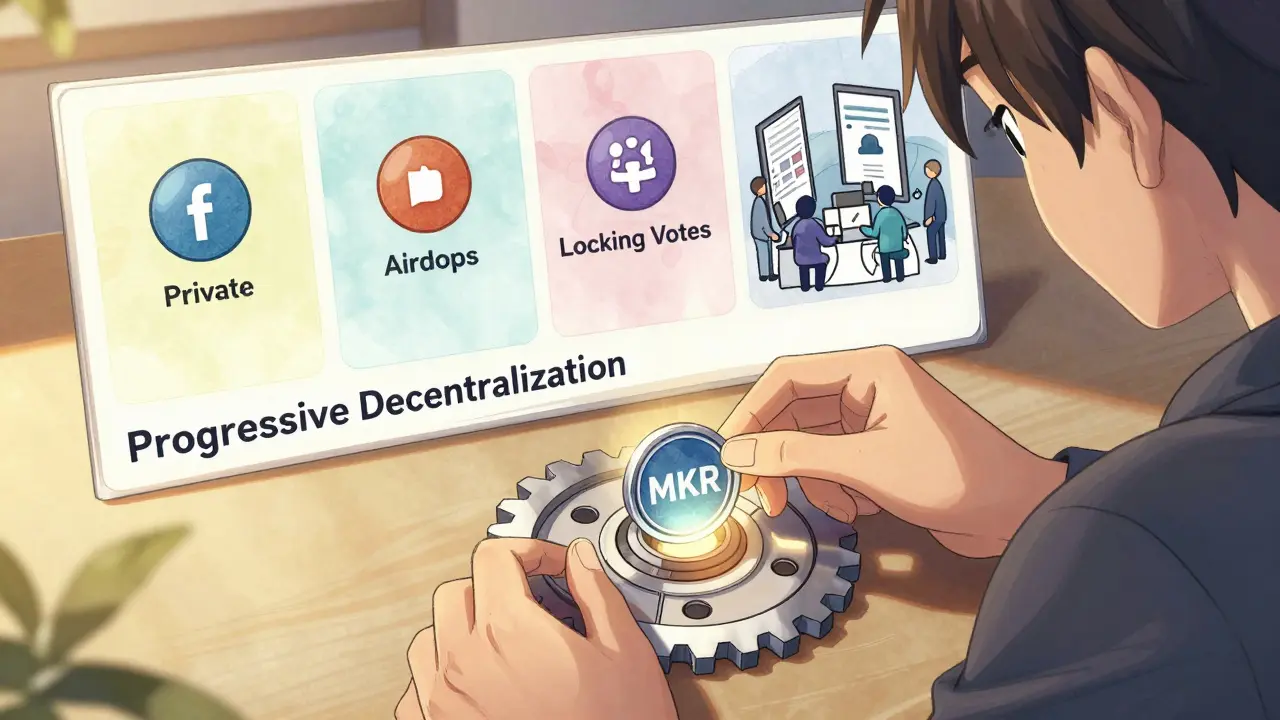
The Future: Progressive Decentralization
The best projects aren’t trying to be 100% decentralized on day one. They’re using a progressive decentralization model.
Here’s how it works:
- Start with controlled distribution (private sales, team allocations).
- Use early revenue to fund community incentives (airdrops, grants).
- Gradually reduce team/investor voting power over 2-3 years.
- Introduce quadratic voting or delegation to reduce whale dominance.
- Eventually, hand over full control to the community.
MakerDAO’s 2026 “Endgame” upgrade plans to integrate decentralized identity and phase out team control. Aave is testing quadratic voting in Q3 2025. These aren’t gimmicks - they’re the future.
According to Messari, governance token distribution will keep evolving toward this model. The goal isn’t just to give out tokens. It’s to build a self-sustaining ecosystem where users don’t just hold coins - they help build the future.
Key Takeaways
- Don’t just hand out tokens - reward real usage. Airdrops work when they target actual users.
- Never let team or investor allocations exceed 25% of voting power. Anything higher risks centralization.
- Use vesting. 4-year cliffs with 12-month locks are the industry standard for insiders.
- Lower barriers to participation. Use off-chain voting (Snapshot), delegation, and gasless proposals.
- Plan for regulation. Have separate strategies for U.S. and international users.
- Long-term success comes from aligning incentives. The more users benefit from the protocol’s growth, the more they’ll defend it.
Can governance tokens be sold like regular crypto?
Yes, governance tokens can be traded on exchanges just like any other cryptocurrency. But selling them doesn’t mean you lose your voting rights - unless the protocol has a vote-escrow system like Curve’s veCRV. Most tokens let you vote even if you hold them on an exchange. However, if you sell early, you’re not helping the protocol’s long-term health. The real value of governance tokens comes from participating, not just trading.
Why do some DAOs have such low voting turnout?
Voting turnout is often below 15% because most users don’t understand the proposals, or they don’t think their vote matters. Gas fees, complex interfaces, and long voting periods discourage participation. Many projects now use Snapshot for free, off-chain voting and let users delegate their vote to experts. This boosts turnout significantly - some DAOs now see 30-40% participation thanks to delegation.
Are airdrops still a good way to distribute governance tokens?
Airdrops can be powerful - but only if they’re designed to reward real users. Uniswap’s airdrop worked because it targeted people who had used the platform for months. Many newer airdrops fail because bots farm them. To avoid this, projects now use time-based eligibility (e.g., “used the protocol before X date”) and anti-sybil checks like wallet history analysis or identity verification.
What’s the difference between governance tokens and utility tokens?
Utility tokens give you access to a service - like paying for storage on Filecoin or computing power on Render. Governance tokens give you voting rights on protocol decisions. A token can be both - like UNI, which lets you swap on Uniswap and vote on future upgrades. But if a token only lets you vote and has no other use, regulators may classify it as a security.
How do I know if a governance token is well-distributed?
Check three things: First, look at the top 100 wallet addresses - if they hold more than 40% of the supply, it’s too concentrated. Second, see if the team and investors have long vesting schedules (4+ years). Third, check if community allocations are large (30%+) and tied to real usage, not just sales. Tools like DeepDAO and Nansen can show you voting power distribution and wallet activity.
17 Responses
Let me stop you right there. Airdrops? Please. Most of these are just bot farms with 10k wallets. Uniswap got lucky. The rest? Garbage. You think some guy in Bangalore who ran a script for 3 hours deserves a vote? Nah. This whole thing is a clown show.
i mean… kinda makes sense? like if you use the app a lot, why not get some coins? but yeah, bots are wild. my friend tried to claim 3 airdrops and got flagged for ‘suspicious wallet activity’ lol. what even is that??
Ohhh so now we’re pretending that giving tokens to people who used a platform 4 years ago is ‘fair’? Meanwhile, the dev team still holds 12% with a 4-year cliff… but sure, let’s act like this is democracy. 😌
As someone who’s lived in 7 countries, I’ve seen how these systems play out differently. In the US? Everyone wants a free token. In India? People trade them for groceries. In Germany? They file tax reports on their UNI. Decentralization isn’t tech-it’s culture.
THIS IS THE FUTURE!!! 🚀 Let’s build, let’s vote, let’s OWN the system! No more Wall Street middlemen! If you’re not holding, you’re losing! 💪🔥
Pro tip: if you’re using Uniswap, keep your wallet active. Even small swaps count. I’ve gotten 3 airdrops just from swapping ETH for DAI once a month. It’s not hard. Just show up. 🤝
Okay, real talk: vesting schedules are NON-NEGOTIABLE. If your team gets 15% and can cash out on day one? That’s not decentralization-that’s a pump-and-dump. 4-year cliff? 12-month lock? YES. Anything else? You’re just playing pretend. And yes, I’ve seen too many DAOs fail because of this. Don’t be one of them.
Man, I just want to say-this whole thing is like a really weird family reunion. You got the uncle who only shows up for free food (the speculators), the cousin who’s always on Zoom calling everyone out (the degens), and the grandma who quietly runs the whole thing with her 300 MKR (the OGs). It’s messy. It’s beautiful. And honestly? It’s the only way this shit survives.
It is a disgrace that Western projects distribute governance tokens to anonymous wallets while Indian developers work 18-hour days to maintain these protocols. This is not equity. This is exploitation disguised as decentralization. India deserves its fair share-not as a user, but as a builder.
SEC says 5,000 unaffiliated holders? LMAO. You think they can’t track 10k wallets made with burner phones? They’re just waiting for the right moment to shut it all down. This whole ‘decentralized’ thing? A trap.
The claim that ‘fair distribution = longer survival’ is statistically invalid. Correlation ≠ causation. The sample size is cherry-picked. And you ignored the fact that 89% of DAOs with ‘balanced’ distribution still failed within 18 months. This article reads like a whitepaper written by a marketing intern.
Look, I don’t care if it’s decentralized or not. I just want to know: if I use your app, will I get paid? If yes, I’m in. If no, I’m out. Stop overthinking it. Just make it work.
I’ve been in this space since 2017. I’ve seen the dreams. I’ve seen the collapses. I’ve watched people I cared about lose everything. And every time? It’s because they thought ‘community’ meant ‘free money.’ It doesn’t. It means work. It means sacrifice. It means showing up even when no one’s watching. And most? They never do.
Just wanted to say-thank you for writing this. I’m new to DeFi, and I’ve been confused about why some tokens feel ‘real’ and others feel like casino chips. This broke it down in a way that actually made sense. Also, delegation is genius. I delegate to my favorite dev. Feels good knowing I’m helping.
Let’s be real: if you’re not a venture capitalist with a legal team and a Swiss LLC, you’re not part of the real governance. This ‘community’ nonsense? It’s a performance for retail investors. The real decisions are made in private Discord channels with 12 people. Don’t flatter yourself.
While the theoretical underpinnings of governance token distribution are intellectually stimulating, the practical implementation reveals a fundamental flaw in human nature: the tendency toward oligarchic consolidation. The very mechanisms designed to democratize power-airdrops, delegation, quadratic voting-are inevitably subverted by the emergent hierarchy of capital accumulation. Thus, the paradox: decentralization, as a social construct, is inherently self-contradictory. One must ask: is governance possible without hierarchy? Or is the blockchain merely a new cathedral for the priesthood of wealth?
And don’t forget: if a DAO lets anyone propose a vote for free? That’s a recipe for spam. Snapshot is great-but you still need a minimum token stake to submit. Otherwise, you get 200 proposals a day about ‘rename the logo to a cat.’ We’ve been there. Don’t go back.