

The Hardware Security Module (HSM) is the silent guardian behind every major cryptocurrency transaction. Without it, the billions of dollars flowing through exchanges like Coinbase and Binance would be sitting ducks for hackers. In 2026, the role of these tamper-resistant cryptographic processors has shifted from a nice-to-have compliance checkbox to the absolute root of trust for the entire digital asset ecosystem. But the landscape is changing fast. Quantum computing threats, rising costs, and new regulatory demands are forcing the industry to rethink how we protect private keys.
What Is an HSM and Why Does Crypto Need It?
To understand where the industry is heading, you first need to grasp what an HSM actually does. An HSM is a dedicated physical device designed to generate, store, and manage cryptographic keys securely. Unlike software wallets that run on your laptop or phone, an HSM is isolated from the network and built with hardware-level defenses. If someone tries to physically break into the device, sensors detect the intrusion and instantly erase all stored keys-a process called zeroization.
In the context of blockchain, this isolation is critical. Private keys are the only thing standing between a user’s funds and theft. When an exchange signs a withdrawal request, that signature must happen inside a secure environment. If the signing process occurs on a general-purpose server, malware can intercept the key. An HSM ensures the key never leaves the hardware, making it nearly impossible for attackers to steal assets even if they compromise the surrounding network.
The Current State of HSM Adoption in 2026
As of early 2026, the adoption rates reveal a stark divide in the crypto industry. Among the top 50 cryptocurrency exchanges, 92% rely on enterprise-grade HSMs for their cold storage and hot wallet operations. These firms cannot afford the reputational damage or financial loss associated with a breach. For example, Kraken engineers reported that their Thales HSM setup blocked 147 intrusion attempts in Q3 2024 alone.
However, the picture looks different for decentralized finance (DeFi) protocols. Only about 38% of DeFi projects use dedicated HSMs. The barrier here is primarily cost and complexity. Setting up an on-premises HSM cluster can cost upwards of $50,000, plus months of integration time. Many smaller DeFi teams opt for cloud-based solutions or cheaper software alternatives, which carry higher risks but lower upfront costs.
| Feature | On-Premises HSM | Cloud HSM (AWS/Azure/GCP) | Software-Based (SoftHSM) |
|---|---|---|---|
| Security Level | FIPS 140-3 Level 3 (Highest) | FIPS 140-3 Level 3 (High) | FIPS 140-2 Level 1 (Low) |
| Cost Structure | $15k-$50k+ upfront + maintenance | $1,200-$5,000/month | Free / Low license fee |
| Throughput | Up to 50,000 ops/sec (RSA 2048) | Variable based on instance size | ~1/10th of hardware units |
| Best For | Large Exchanges, Custodians | Startups, Mid-sized Firms | Development, Testing, Low-risk apps |
| Market Share (Crypto) | 22% | 68% | 10% (mostly non-production) |
The Quantum Threat: The Biggest Shift Ahead
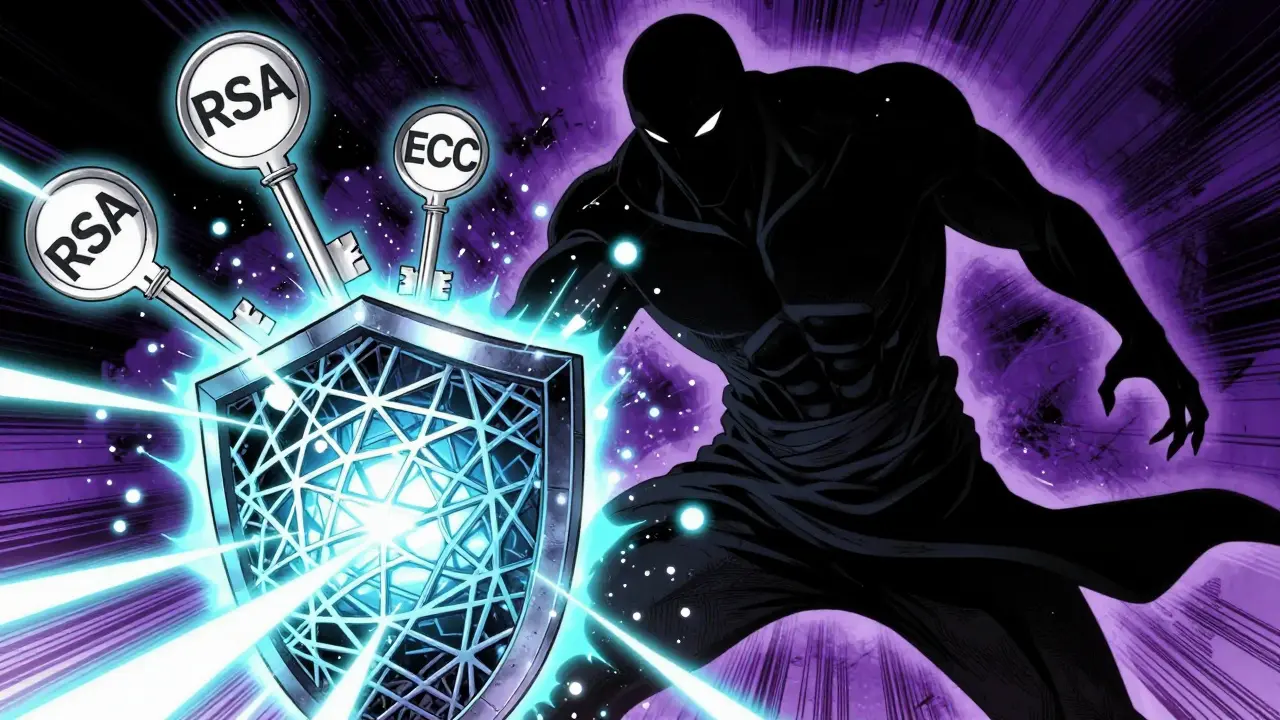
The most significant driver shaping the future of HSMs is the looming threat of quantum computing. Today’s blockchain security relies heavily on RSA and Elliptic Curve Cryptography (ECC). A sufficiently powerful quantum computer could break these algorithms, exposing private keys to decryption. This isn’t science fiction; NIST’s Post-Quantum Cryptography Project Manager Dustin Moody warned in January 2025 that HSMs must integrate post-quantum cryptography (PQC) algorithms by 2026 to prevent catastrophic breaches.
We are already seeing vendors respond. Thales released its 'Quantum Shield' firmware in Q3 2025, which adds support for CRYSTALS-Kyber, a lattice-based algorithm recommended by NIST. Utimaco followed with its 'PQC Bridge' in Q1 2026. However, the transition is not seamless. Dr. Lily Chen from NIST noted that 60% of current HSM firmware lacks the 'crypto-agility' needed to switch algorithms without major downtime. During migration phases, throughput can drop by 30-40%, a painful trade-off for high-frequency trading platforms.
By 2030, Gartner predicts that all HSMs in the crypto industry will evolve into 'Quantum Root of Trust' appliances. By 2035, traditional RSA and ECC keys will likely be phased out entirely in favor of quantum-resistant standards. For crypto businesses, this means planning your HSM upgrades now, not later.
AI Integration: Smarter Security Monitoring
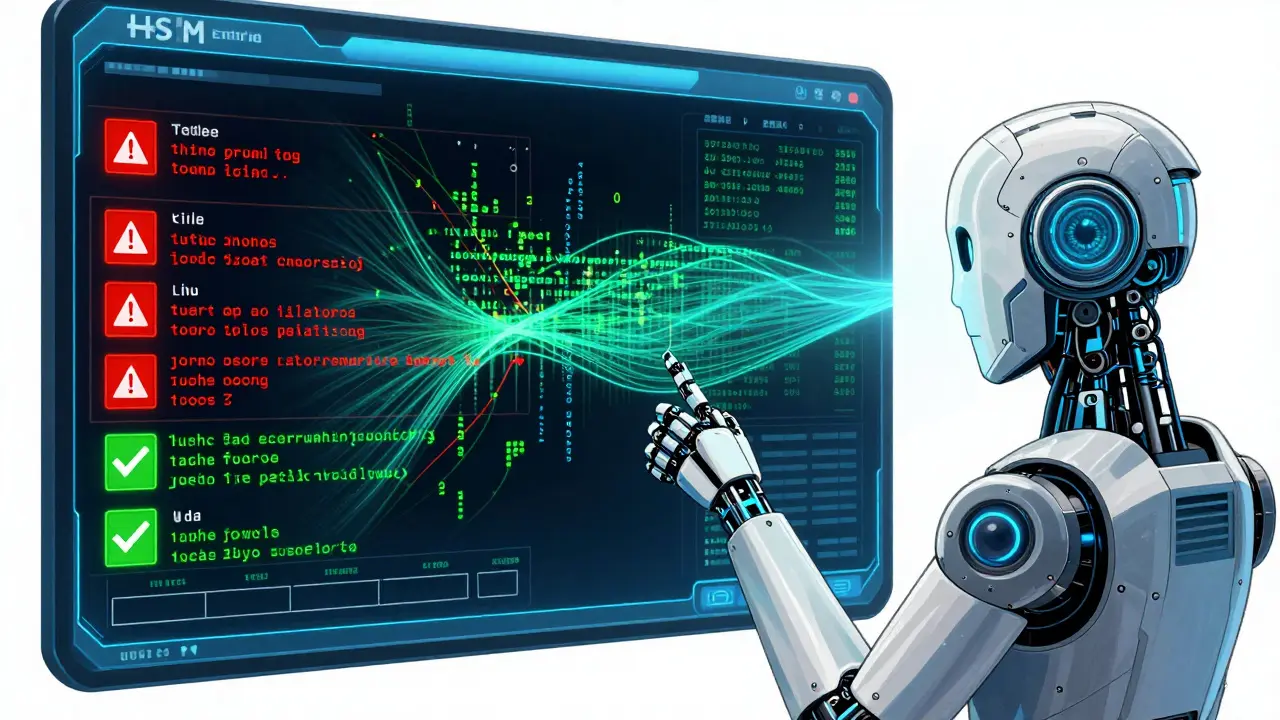
Another major trend is the integration of artificial intelligence within HSM architectures. Traditionally, HSMs were passive devices-they signed transactions when asked. Today, advanced models like Futurex’s EdgeTrust HSM use machine learning to analyze transaction patterns in real-time. If an unusual withdrawal request is detected-say, a large transfer to an unknown address at 3 AM-the AI can flag or block the operation before it completes.
This proactive approach has proven effective. Data from 2024 shows that HSMs equipped with AI threat detection reduced breach response times by 73%. For exchanges managing millions of daily transactions, this automation is essential. Human operators simply cannot monitor every cryptographic event manually. As MIT Cryptography Lab Director Vinod Vaikuntanathan cautioned, however, hybrid implementations must be carefully tested to avoid introducing new side-channel vulnerabilities during the transition period.
Regulatory Pressure and Compliance Costs
Regulations are also forcing the hand of many crypto firms. The EU’s MiCA regulations mandate 'tamper-proof key storage' for all licensed exchanges operating within the bloc. Similarly, PCI DSS v4.0, which came into effect in March 2025, requires HSMs for all crypto transaction signing processes involving payment data. These rules effectively ban the use of insecure software wallets for institutional custody.
While this boosts security, it raises barriers to entry. Small DeFi projects complain about the prohibitive costs. Uniswap V4 contributors have discussed on GitHub how monthly cloud HSM fees of $15,000 can eat into development budgets. This regulatory pressure may accelerate consolidation in the industry, as smaller players struggle to meet compliance standards or are forced to partner with larger, compliant custodians.
Challenges and Risks in Modern HSM Deployment
Despite their benefits, HSMs are not without flaws. One major issue is vendor lock-in. Migrating from one HSM provider to another, such as moving from Thales to Utimaco, can require over 200 hours of re-engineering due to proprietary APIs. This creates dependency and limits flexibility for crypto firms.
Complexity is another hurdle. A Gartner case study found that 41% of crypto firms experience deployment cycles longer than six months. Configuring FIPS 140-3 mode alone can take weeks of dedicated effort, according to Coinbase engineers. Furthermore, supply chain risks remain a concern. The 2024 'HSM Heartbleed' incident exposed firmware flaws in 12% of deployed units, reminding us that even hardware needs rigorous auditing.
Finally, there is the issue of latency. While modern HSMs handle 20,000-50,000 operations per second, ultra-low-latency DeFi applications sometimes find this too slow. In those niche cases, pure software solutions like Libsodium might still be preferred for sub-millisecond response times, though at the cost of security.
How to Choose the Right HSM Strategy for Your Business
If you are building or securing a crypto platform in 2026, here is a practical checklist to guide your decision:
- Assess Your Risk Profile: If you hold customer funds (custody), an FIPS 140-3 certified HSM is non-negotiable. For experimental DeFi protocols, consider starting with cloud HSMs to balance cost and security.
- Plan for Quantum Migration: Ensure your chosen vendor supports CRYSTALS-Kyber and Dilithium algorithms. Ask specifically about their roadmap for PQC integration.
- Evaluate Throughput Needs: Calculate your peak transaction volume. If you expect more than 15,000 TPS, look into clustering capabilities offered by providers like Utimaco or Thales.
- Budget for Hidden Costs: Factor in not just hardware/cloud fees, but also integration time, compliance audits, and ongoing maintenance. Cloud HSMs offer predictable monthly costs, while on-prem requires capital expenditure.
- Demand Transparency: Avoid vendors with opaque documentation. Thales provides extensive crypto-specific guides, whereas some competitors lack clear Ethereum integration examples.
Conclusion: The Evolution of Trust
The future of HSMs in the crypto industry is bright but demanding. As the value of digital assets grows, so does the sophistication of attacks. HSMs are evolving from simple key vaults into intelligent, quantum-resistant security hubs. For exchanges and custodians, investing in robust HSM infrastructure is no longer optional-it is the foundation of survival. For developers and startups, understanding these trends is crucial to building products that users can trust with their life savings.
What is the main difference between an HSM and a standard hardware wallet?
A standard hardware wallet (like Ledger or Trezor) is designed for individual users to store personal keys. An HSM is an enterprise-grade device used by institutions like exchanges to manage thousands of keys and sign high-volume transactions securely. HSMs offer higher throughput, stricter compliance certifications (FIPS 140-3), and centralized management capabilities that consumer wallets lack.
Are cloud HSMs as secure as on-premises HSMs?
Yes, major cloud providers like AWS, Azure, and Google Cloud offer Dedicated HSM services that meet FIPS 140-3 Level 3 standards. They provide similar tamper-resistance and key isolation as on-prem units. However, on-prem HSMs give organizations full physical control and audit access, which some highly regulated entities prefer. Cloud HSMs are generally easier to scale and manage.
When will quantum-resistant algorithms become mandatory for crypto HSMs?
NIST recommends integrating post-quantum cryptography (PQC) algorithms like CRYSTALS-Kyber by 2026. By 2030, most industry experts predict that HSMs will fully transition to quantum-resistant standards. Traditional RSA and ECC keys are expected to be phased out by 2035. Early adopters should start testing hybrid PQC implementations now to avoid last-minute disruptions.
Why do some DeFi projects avoid using HSMs?
The primary reasons are cost and complexity. Enterprise HSMs can cost tens of thousands of dollars upfront, plus significant integration time. Many small DeFi teams operate with limited budgets and prioritize speed over heavy infrastructure. They often rely on multi-signature software wallets or cloud-based key management services, which are cheaper but less secure than dedicated HSMs.
Which HSM vendors dominate the crypto market in 2026?
Thales leads with approximately 32% market share, followed by Utimaco (24%) and Futurex (18%). Cloud providers like AWS also capture a significant portion (15%) through their managed HSM services. Thales is known for its comprehensive management tools, while Futurex is gaining traction for its AI-integrated security features.
10 Responses
You really think a $50k box is the bottleneck for DeFi? Please. The bottleneck is your inability to manage risk properly. Most of these 'intrusion attempts' blocked by Kraken are just automated scripts hitting open ports, not sophisticated state-level actors. It's fear-mongering disguised as analysis. The real issue is that exchanges hoard liquidity and blame hardware when their code is spaghetti.
Oh darling, if you think quantum computing is just a 'looming threat' you can ignore until 2030, you simply haven't been paying attention to the NIST standardization process. 🙄 The transition to CRYSTALS-Kyber isn't optional; it's existential. Your 'spaghetti code' argument is adorable but irrelevant when the underlying cryptographic primitives are mathematically obsolete. Read up on lattice-based cryptography before you post again. ;)
Wait, hold on! 😱 Are we saying my Ledger could be hacked by a quantum computer next week?! I literally have my life savings in there. This is terrifying. Why isn't anyone screaming about this more? I feel like I'm being gaslit by the entire crypto industry. My hands are shaking just thinking about Shor's algorithm breaking my private keys. Is it too late to move everything to gold? 📉😭
Actually, Winston, you are conflating consumer hardware wallets with enterprise HSMs. While both use elliptic curve cryptography, the timeline for a cryptographically relevant quantum computer (CRQC) is widely estimated to be at least five to ten years away. Therefore, immediate panic is unwarranted. Furthermore, the article explicitly states that NIST recommends integration by 2026, which implies a gradual migration path, not an overnight collapse. Please verify your sources before inducing mass hysteria. 😒
HSMs are overhyped. Cloud KMS is fine for 99% of use cases. Stop gatekeeping security.
I totally agree with Tawny! I mean, look at how easy it is to set up AWS CloudHSM now. Its so much simpler than dealing with physical boxes. And honestly, who has time for all that maintenance?? I think its great that technology is making things easier for everyone. We should focus on accessibility rather than perfect security, right? 😊✨
While cloud solutions offer convenience, it is important to acknowledge the shared responsibility model. If the provider's root infrastructure is compromised, or if there is a insider threat within the cloud provider, the isolation guarantees of an on-premises FIPS 140-3 Level 3 device are lost. For custodial services holding billions, that trade-off is often unacceptable. However, for smaller protocols, your point regarding accessibility is valid.
It is fascinating to observe how the discourse around security shifts from purely technical specifications to broader philosophical questions about trust and decentralization. When we rely on centralized HSM vendors like Thales or Utimaco, are we truly securing our assets, or are we merely shifting the point of failure from a decentralized network to a corporate entity? One might argue that the very concept of an HSM contradicts the ethos of Bitcoin, yet here we are, building fortresses around keys that were meant to be self-sovereign. It is a paradox that keeps many of us awake at night, wondering if we are solving the wrong problem entirely.
Nick, you're missing the forest for the trees. 🌳 The HSM is just a tool. The real question is: why do we need intermediaries at all? If we had better UX for non-custodial wallets, nobody would care about HSM throughput. But no, let's just build bigger vaults for the banks. Typical. 😂 Anyway, good read though. The part about AI monitoring was interesting, even if it feels like surveillance capitalism creeping into crypto.
Look i get the hype around quantum resistance but lets not forget the human element. Most breaches happen because someone phished a seed phrase or clicked a bad link. An HSM wont save you if you give away your credentials. We need better education not just better hardware. Thats my two cents anyway hope this helps someone out there 💪