
Imagine handing over the keys to your digital life to a single company. You trust them with your photos, your financial records, and your private messages. Now imagine that same company gets hacked, or decides to change its terms of service overnight. This is the reality of traditional cloud storage. But what if you could store your data across thousands of computers worldwide, encrypted and immutable, without relying on one central authority? That is the promise of blockchain storage, which is rapidly evolving from a niche crypto experiment into a viable alternative for enterprise data management.
We are standing at a critical inflection point in 2026. The technology has matured significantly since the early days of Bitcoin’s blockchain. Today, decentralized storage networks (DSNs) like Filecoin and Arweave are not just storing cat videos; they are securing medical records, supply chain data, and even AI training datasets. But is this future actually here, or is it still hype? Let’s break down where blockchain storage stands today, how it compares to the giants like AWS, and what you need to know before making the switch.
The Core Shift: From Centralized Servers to Distributed Networks
To understand why blockchain storage matters, you first have to look at how we’ve been storing data for decades. Traditional cloud providers-Amazon Web Services (AWS), Google Cloud, Microsoft Azure-operate on a centralized model. Your data lives on their servers. If those servers go down, get hacked, or if the provider goes bankrupt, your access is compromised. We saw this vulnerability play out in incidents like the 2023 MOVEit Transfer breach, which affected over 2,000 organizations.
Decentralized storage flips this script. Instead of one server farm, your file is split into encrypted fragments and distributed across a global network of nodes. Each node holds only a piece of the puzzle. To reconstruct the file, you need the cryptographic keys. No single entity controls the entire dataset. This eliminates the "single point of failure" risk that plagues traditional IT infrastructure.
This isn’t new theory. It was conceptually established with Satoshi Nakamoto’s 2009 Bitcoin whitepaper, but practical applications didn’t emerge until around 2014-2015 with projects like Storj and Filecoin. By 2026, these protocols have evolved into sophisticated markets. For instance, Filecoin’s Virtual Machine (FVM), fully implemented by late 2023, transformed the network from a simple storage locker into a programmable environment supporting smart contracts. This means you can automate payments for storage based on real-time performance metrics, something impossible with static AWS S3 buckets.
Key Players in the Decentralized Storage Landscape
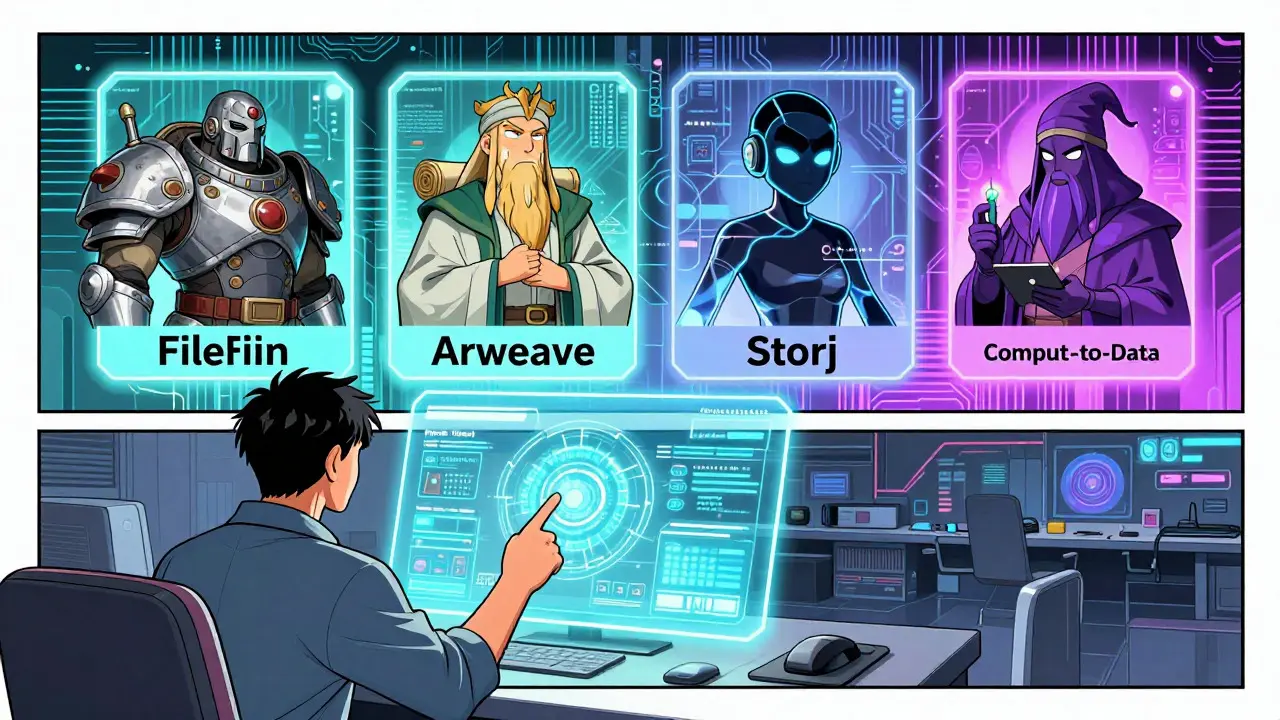
The market isn’t dominated by one player. Instead, we see a diverse ecosystem of specialized networks. Understanding the differences between them is crucial for choosing the right tool for your job.
| Platform | Primary Use Case | Cost Efficiency | Retrieval Speed | Key Feature |
|---|---|---|---|---|
| Filecoin | General-purpose storage, AI data | High (50-70% cheaper than AWS) | Medium (2-5 seconds) | Programmable via FVM |
| Arweave | Permanent archival, NFTs | Moderate (One-time fee) | Fast (Sub-second for cached data) | Endowment model for permanence |
| Storj | Enterprise backup, media | High | Fast (Optimized for streaming) | S3-compatible API |
| Crust Network | Web3 infrastructure, IPFS | Very High | Medium | Compute-to-Data capabilities |
Filecoin remains the heavyweight champion in terms of total capacity, leveraging a proof-of-storage consensus mechanism that rewards miners for keeping data available. Its integration with the InterPlanetary File System (IPFS) makes it a standard for linking content across the web. On the other hand, Arweave focuses on permanence. By paying a one-time endowment fee, users ensure their data is stored forever, making it ideal for historical archives, legal documents, and non-fungible tokens (NFTs) where immutability is paramount.
Storj takes a different approach by prioritizing ease of use. It offers an S3-compatible API, meaning developers can swap out their AWS credentials for Storj credentials with minimal code changes. This lowers the barrier to entry for enterprises hesitant to rewrite their entire backend architecture. Meanwhile, newer entrants like Crust Network are pushing boundaries with "Compute-to-Data" functionality, allowing computation on encrypted data without ever decrypting it-a game-changer for privacy-sensitive industries like healthcare.
Performance vs. Cost: The Real Trade-offs
If blockchain storage is so secure and cheap, why hasn’t everyone switched yet? The answer lies in performance trade-offs. In 2026, speed is still king for many applications. Traditional cloud providers like AWS S3 can handle thousands of requests per second with sub-millisecond latency. Blockchain storage networks, while improving, typically lag behind in raw retrieval speed.
Benchmarking data from 2023-2025 shows that decentralized storage solutions offer a 50-70% cost reduction compared to traditional cloud providers. However, retrieval speeds average 2-5 seconds versus sub-second access in centralized systems. For archiving cold data-documents you rarely need to access-this delay is negligible. But for high-frequency trading platforms or real-time video streaming, it’s a dealbreaker.
Scalability is another hurdle. Current blockchain storage networks handle approximately 1,200 transactions per second across the entire network, whereas AWS S3 scales infinitely within prefixes. However, Layer 2 scaling solutions are bridging this gap. Polygon ID’s zero-knowledge proofs implementation, rolled out in 2024, aims to increase throughput by 15-20x through off-chain processing. As these technologies mature, the performance gap will narrow, making decentralized storage viable for more dynamic workloads.
Security and Immutability: The Ultimate Defense
Let’s talk about security, because this is where blockchain storage shines. In a centralized system, security relies on the provider’s firewalls and internal controls. If an insider leaks data, or if hackers find a zero-day exploit in the provider’s software, millions of users are exposed. In a decentralized network, data is fragmented and encrypted using military-grade AES-256 encryption at rest and TLS 1.3 in transit.
But the real magic is immutability. Once data is written to a blockchain-backed storage contract, it cannot be altered without altering every subsequent block. This requires controlling 51% of the network’s computing power-a feat estimated to cost billions of dollars for major networks like Ethereum-based storage systems. For industries requiring audit trails, such as finance and healthcare, this feature is invaluable.
Consider the Estonian government’s X-Road implementation, which stores 1.4 billion health records across hundreds of nodes with zero breaches since 2016. Or MedRec’s MIT pilot, which managed 1.2 million patient records across 47 hospitals. These aren’t theoretical concepts; they are live, production-grade systems proving that decentralization enhances security.
The Regulatory Hurdle: GDPR and the Right to Be Forgotten
Despite the technical advantages, regulatory compliance remains a significant challenge. The European Union’s General Data Protection Regulation (GDPR) includes the "right to be forgotten," allowing individuals to demand their personal data be erased. Blockchain’s core principle-immutability-directly conflicts with this requirement.
How do you delete data that is designed to never be deleted? The industry is developing creative workarounds. One common solution is "client-side encryption." Instead of deleting the data itself, you delete the encryption key. Without the key, the data becomes unreadable gibberish, effectively rendering it useless. While the bytes remain on the network, the information is gone. Projects like Polygon ID are also exploring zero-knowledge proofs to verify identity without storing personal data on-chain, thus reducing regulatory exposure.
The EU’s 2023 Data Governance Act has created frameworks for decentralized storage compliance, providing some clarity for enterprises. However, legal uncertainty persists, particularly in jurisdictions with strict data sovereignty laws. Companies must carefully assess whether their use case fits within these emerging guidelines before migrating sensitive customer data.

Integration Challenges for Enterprises
Moving from AWS to a decentralized storage network isn’t as simple as changing a URL. It requires a shift in mindset and technical infrastructure. Enterprise integration typically spans 8-12 weeks for experienced DevOps teams. Critical skills include understanding consensus mechanisms, managing cryptographic keys, and handling distributed system complexities.
Wallet management is a frequent pain point. Unlike logging into AWS with a username and password, interacting with blockchain storage often involves managing seed phrases and private keys. A lost key means lost data forever. This has led to the rise of custodial services and multi-signature wallets to mitigate human error. According to user reviews, 68% of negative feedback centers on "seed phrase recovery nightmares," highlighting the need for better user experience design.
However, the ROI can be compelling. Organizations report a 38% reduction in data breach costs within 18 months of adopting decentralized storage. IBM’s Cost of a Data Breach 2023 report underscores this benefit, noting that the $12.7 billion annual cost of breaches can be dramatically reduced through decentralized architectures. For high-value assets, the upfront integration effort pays off quickly.
Future Outlook: AI, RWAs, and Beyond
Looking ahead to 2027 and beyond, two trends will define the next phase of blockchain storage: Artificial Intelligence and Real-World Assets (RWAs). AI models require massive amounts of verified, high-quality data. Traditional data lakes are prone to corruption and bias. Blockchain-stored data, with its provenance tracking, ensures AI training sets are authentic. CrustLab predicts that by 2026, AI models trained on blockchain-stored data will achieve 27% higher accuracy due to verified data provenance.
Simultaneously, the tokenization of real-world assets-from real estate to art-is exploding. JPMorgan’s Onyx division processed $1.2 trillion in tokenized assets in 2023 alone. These digital tokens require secure, immutable storage to maintain their value and ownership history. This convergence is driving institutional adoption, with Gartner predicting mainstream blockchain storage adoption between 2026 and 2028.
Energy efficiency is also improving. Early proof-of-work networks were energy-intensive, but the shift to proof-of-stake and optimized storage algorithms has slashed consumption. Current proof-of-stake networks use 0.0026 kWh per GB stored, compared to 0.4 kWh for traditional cloud storage. This sustainability angle appeals to environmentally conscious enterprises and aligns with global ESG goals.
Is blockchain storage cheaper than AWS?
Yes, for most use cases. Benchmarks show decentralized storage solutions like Filecoin and Storj are 50-70% cheaper than Amazon S3 for long-term archival and general storage. However, for high-frequency, low-latency access, AWS may still be more cost-effective due to superior speed.
Can I use blockchain storage for GDPR-compliant data?
It is possible but complex. Since blockchain data is immutable, you cannot easily delete it. The standard workaround is client-side encryption: you delete the encryption key, rendering the data unreadable. Consult legal experts to ensure your specific implementation meets local regulations.
What happens if a storage node goes offline?
Decentralized networks are resilient. Files are split into redundant fragments across multiple nodes. If one node fails, the network retrieves the data from others. Protocols like Filecoin use collateral stakes to incentivize nodes to stay online, ensuring high availability.
Is blockchain storage ready for enterprise adoption?
Yes, for specific use cases. It is ideal for archival, audit trails, and high-value asset storage. Major companies like IBM and governments like Estonia are already using it. However, it is not yet suitable for real-time, high-throughput applications like live video streaming.
How do I recover my data if I lose my private key?
In pure decentralized storage, losing your private key means permanent loss of access. There is no "forgot password" button. To mitigate this, use multi-signature wallets, hardware wallets, or enterprise-grade custodial solutions that offer key recovery options.
10 Responses
It is absolutely morally bankrupt that we are still trusting these tech giants with our souls, yet here we are pretending blockchain is some utopian fix when it’s just another layer of complexity for the average person to navigate. The article glosses over the sheer arrogance of assuming people will manage their own keys without losing everything in a panic. We are handing over control not to a company, but to an algorithm that doesn’t care if you starve. It’s dramatic, yes, but the reality is that this technology is being pushed by people who think they are smarter than the system they claim to hate. I find it tedious that everyone acts like this is liberation when it feels more like a test of patience and technical literacy that most of us fail miserably at every single day.
The comparison table is quite illuminating, particularly regarding the retrieval speeds versus cost efficiency. While Filecoin offers significant savings, the latency issues for real-time applications remain a substantial hurdle for enterprise adoption. It is fascinating to see how Arweave’s endowment model addresses permanence, which is crucial for legal archives. However, one must consider the energy implications and the actual throughput capabilities when scaling up. The integration of FVM into Filecoin does seem to bridge the gap between static storage and dynamic smart contract execution nicely.
you think this is about security? its about surveillance capitalism evolving into decentralized surveillance. the big players are already buying nodes to control the network. ipfs is just a trojan horse for metadata harvesting. they want your data encrypted so only they can decrypt it with backdoors. proof-of-stake is rigged by whales. stop believing the hype. the eu gdpr workaround is a joke because the keys are stored on centralized servers anyway. its all a lie designed to keep you compliant while they mine your behavioral patterns for ai training sets that will replace your jobs.
I tried Storj last month and lost three days of work because my wallet got desynced 😩 Why do we need crypto wallets for simple file backup?? Just let me use a password like normal humans do 🤦♂️
There is a profound philosophical shift occurring here, moving from ownership as possession to ownership as access via cryptographic proof. It reminds me of the ancient libraries where knowledge was preserved not by owning the scroll, but by ensuring its replication across many hands. The trade-off of speed for immutability is not merely technical; it is ethical. Are we willing to wait seconds longer for truth that cannot be altered by a corporate board or a government decree? This tension defines our digital age. The future belongs to those who value permanence over convenience, even if the journey there is fraught with friction.
This is actually super exciting stuff! Imagine if every small business could have bank-grade security without the bank fees. In my community, we’ve been talking about using Arweave for local historical records so no mayor can ever erase our history again. It’s about empowerment, really. The learning curve is steep, sure, but isn’t that true for any new tool that changes the world? Let’s help each other out instead of complaining about the keys. We’re building something beautiful here.
I’m just watching this unfold from the sidelines with a cup of tea. It’s wild how we went from floppy disks to encrypting fragments across the globe. The idea of ‘permanent’ storage is both comforting and terrifying. What happens when the hardware of the nodes dies out in 50 years? Do we just leave digital ghosts floating in the ether? Anyway, nice read. Makes you think about what we really want to remember.
the concept of client-side encryption is basically digital death right? you delete the key and the data is gone forever which sounds cool until you realize you also deleted your own memories. its intrusive to think about how much power we give to these protocols. they say its immutable but what if the consensus mechanism fails? then its just chaos. we are playing god with bits and bytes and pretending we understand the consequences. its jargon heavy nonsense wrapped in a shiny package of decentralization.
The entire premise is flawed because the ‘decentralized’ networks are controlled by mining pools that are essentially cartels. They manipulate the hash rate to favor themselves. The GDPR workaround is a legal fiction designed to appease regulators while maintaining total opacity. You think you are secure, but the zero-knowledge proofs are likely compromised by state-level actors. Wake up. This is not freedom; it is a new form of feudalism where the lords are anonymous code snippets. The energy savings are negligible compared to the centralization of power.
One must consider the long-term viability of these models under current economic conditions. The reliance on token incentives for node operators introduces volatility that traditional SLAs do not possess. If the token price crashes, does the network collapse? This is a critical question for enterprises considering migration. The technical architecture is sound, but the economic layer remains fragile. Further empirical studies are required before widespread adoption can be recommended for mission-critical infrastructure.