

When you're looking at a new cryptocurrency or blockchain project, how do you know if it's truly valuable-or just hype wrapped in whitepaper? Many investors jump into crypto based on price charts, social media buzz, or FOMO. But if you want to build a lasting portfolio, you need a system. That’s where fundamental analysis frameworks come in. Unlike technical analysis, which tracks price movements, fundamental analysis digs into what a project is actually worth-based on its technology, team, economics, and real-world use.
Why Fundamental Analysis Matters in Crypto
Crypto markets are wild. Prices can swing 30% in a day. But over time, the projects that survive and grow aren’t the ones with the flashiest marketing. They’re the ones with solid foundations. Think Bitcoin: it didn’t explode because of influencers. It grew because it solved a real problem-decentralized digital money-with a secure, predictable, and censorship-resistant design. Fundamental analysis in crypto asks: Does this project have lasting value? Is the token economically sound? Is the team capable? Are users actually using it? These aren’t just nice-to-know questions. They’re survival filters. A 2023 study by the Blockchain Research Institute found that projects using structured fundamental frameworks had 40% higher survival rates after three years compared to those relying solely on price charts.The Three Core Frameworks: Top-Down, Bottom-Up, and Hybrid
There are three main ways to approach fundamental analysis in crypto. Each has strengths, and the best investors use a mix.Top-Down: Start with the Big Picture
Top-down analysis begins outside the project. You look at the macro environment first:- Regulatory climate: Is the country where the project is based crypto-friendly? For example, projects based in Switzerland or Singapore have more legal clarity than those in countries with outright bans.
- Macroeconomic trends: When inflation is high and fiat currencies weaken, demand for Bitcoin and other hard-capped assets tends to rise. In 2022, as the U.S. Federal Reserve raised rates, stablecoins like USDC and USDT saw record adoption as digital hedges.
- Adoption cycles: Is the broader blockchain ecosystem growing? In 2021, Ethereum’s merge was a major catalyst. In 2023, Layer 2 solutions like Arbitrum and Optimism saw massive usage growth as users moved away from congested and expensive mainnets.
Bottom-Up: Dig Into the Project Itself
This is where most crypto investors focus. You go deep on the project: its tech, tokenomics, team, and community.- Technology: Is the blockchain secure? Has it been audited? Are the smart contracts open-source? Projects like Ethereum, Solana, and Polygon have public codebases and regular audits from firms like CertiK or Trail of Bits.
- Tokenomics: How many tokens exist? Is there a cap? Is inflation built in? A token with unlimited minting and no burning mechanism is risky. Compare Bitcoin’s fixed 21 million supply to meme coins with 1 trillion tokens and no utility-those are gambling chips, not investments.
- Usage metrics: Are people actually using this? Look at daily active addresses, transaction volume, and total value locked (TVL) in DeFi protocols. A project with 10,000 daily users and $500M in TVL is more credible than one with 200 users and $2M in TVL.
- Team and advisors: Who’s behind it? Are they anonymous? Have they built successful projects before? Real names, LinkedIn profiles, and past track records matter. Projects with anonymous teams and no verifiable history have a much higher failure rate.
- Competitive edge: What makes this project different? Does it have an “economic moat”? For example, Chainlink dominates oracle services because of its network effect and institutional adoption. No other project has matched its reliability.
Hybrid: Combine Both Approaches
The most effective investors blend top-down and bottom-up. They don’t just look at a project’s tokenomics-they ask: Is this project positioned to benefit from rising institutional adoption? Are regulatory changes coming that could help or hurt it? For example, in 2023, many investors started favoring Layer 2 solutions not just because they were technically superior, but because they saw the macro trend: Ethereum was becoming the settlement layer, and users needed cheaper, faster options. That’s hybrid thinking.Key Metrics That Actually Matter
Forget P/E ratios-they don’t apply to crypto. But there are crypto-specific metrics that work:- Network Value to Transaction (NVT) Ratio: Like P/E, but for crypto. Divide market cap by daily on-chain transaction volume. A high NVT (above 100) can signal overvaluation. A low NVT (under 30) might mean undervaluation.
- Active Address Growth: Are more people using this daily? A steady 10-20% monthly growth is a strong sign. Flat or declining usage is a red flag.
- Developer Activity: Check GitHub commits. Are developers actively fixing bugs and adding features? Or is the last commit from six months ago? Projects with consistent development are more likely to survive.
- Token Distribution: Are tokens concentrated in a few wallets? If 10 wallets hold 50%+ of supply, the project is vulnerable to manipulation.
- Staking Yield vs. Inflation: If staking rewards are 15% but the token supply grows 20% yearly, you’re losing value in real terms.

What Fundamental Analysis Gets Wrong
Even the best frameworks have blind spots. One big mistake is ignoring narrative. In 2021, Dogecoin didn’t have strong fundamentals-but it had a massive community and Elon Musk’s tweets. It surged. In 2023, AI-themed tokens like FET and AGIX exploded not because of revenue, but because of hype around AI + blockchain. Fundamental analysis alone would’ve missed these moves. Another flaw is over-relying on historical data. Crypto evolves fast. A project that was dominant in 2021 might be obsolete in 2024. The frameworks must adapt. Also, many investors forget that crypto isn’t just finance. It’s technology, social movement, and political experiment. You can’t value a project like Ethereum the same way you value a utility company. Its value lies in its network effect, developer ecosystem, and global adoption-not just its balance sheet.Real-World Successes and Failures
In 2020, a crypto investor on Reddit noticed that the DeFi protocol Aave had low token supply, strong developer activity, and growing TVL. He used a bottom-up checklist: audit reports, no major hacks, team with experience at top firms. He bought at $0.50. By 2023, it hit $120. His analysis was clean, patient, and data-driven. On the flip side, in 2022, a fund invested heavily in TerraUSD (UST) because it had a 20% APY and was pegged to the dollar. They ignored the macro risk: UST relied on an algorithmic mechanism, not reserves. When Bitcoin dropped 40%, the peg broke. The entire system collapsed. They didn’t use top-down analysis. They didn’t ask: What happens if the broader market crashes?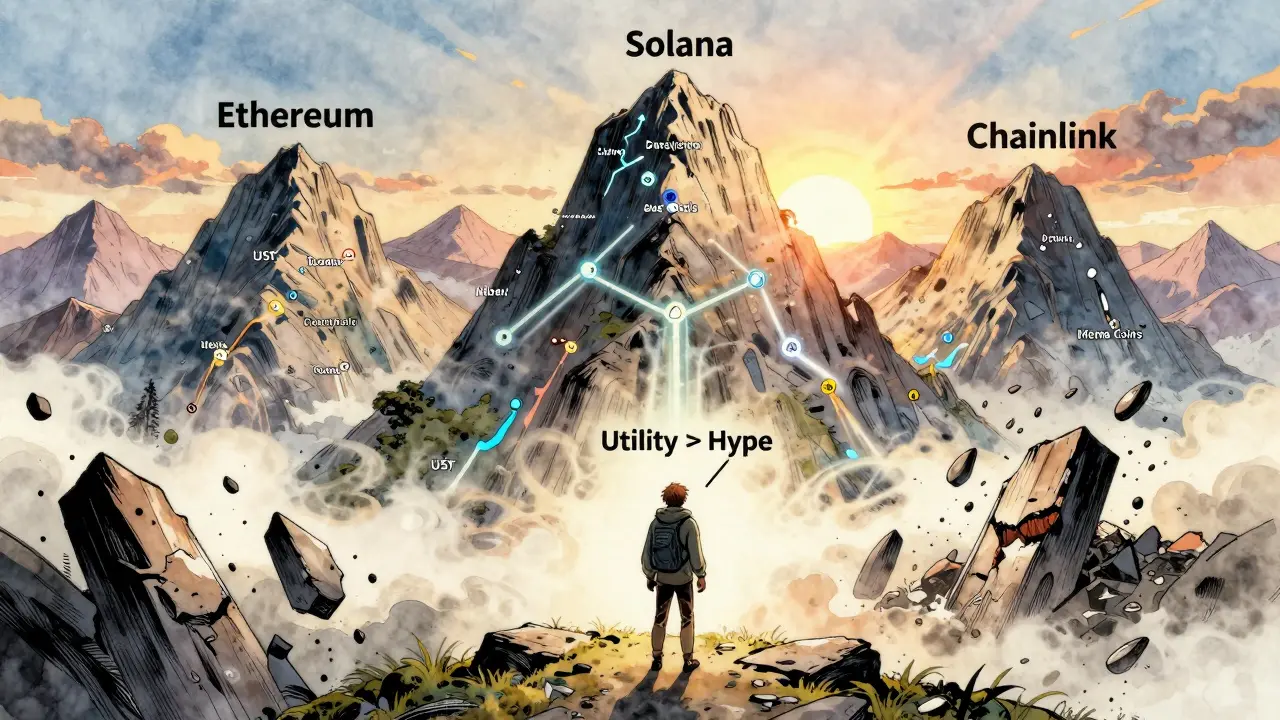
How to Start Using Fundamental Analysis Today
You don’t need a finance degree. Here’s how to begin:- Pick one project: Start small. Pick a well-known one like Ethereum, Solana, or Chainlink.
- Read the whitepaper: Skip the fluff. Focus on the problem it solves and how it solves it.
- Check GitHub: Look at commit frequency and contributor count.
- Use Dune Analytics: Search for the project’s dashboard. See daily users, transaction volume, and token movement.
- Compare metrics: Is its NVT ratio lower than similar projects? Is its developer activity higher?
- Ask: Would I still buy this if the price dropped 70% tomorrow? If yes, it’s probably solid.
Tools That Help
You don’t have to do all the legwork manually:- Dune Analytics: Free dashboards for on-chain metrics.
- Token Terminal: Compares crypto projects like public companies-revenue, P/E equivalents, etc.
- Messari: Reports on tokenomics, governance, and regulatory status.
- DefiLlama: Tracks TVL and protocol usage across chains.
The Future of Fundamental Analysis in Crypto
The field is evolving. In 2023, the CFA Institute added crypto valuation to its curriculum. BlackRock and Fidelity now include blockchain assets in their institutional models. AI tools are being trained to read smart contracts and detect hidden risks in code. But the core won’t change: value comes from utility, scarcity, and trust. Not from charts, memes, or promises. The most successful crypto investors aren’t the ones who predicted the next moonshot. They’re the ones who stuck to a framework, stayed patient, and avoided the noise. If you want to build real wealth in crypto, stop chasing pumps. Start building your own framework. Use data. Ask hard questions. Be patient. The market rewards those who understand what’s real.What’s the difference between fundamental and technical analysis in crypto?
Fundamental analysis looks at what a project is worth based on its technology, team, tokenomics, and real usage. Technical analysis looks at price charts and trading volume to predict short-term price movements. Fundamental analysis is for long-term investors. Technical analysis is for traders. Most successful crypto investors use both-but only fundamental analysis can tell you if a project will survive five years from now.
Can you use fundamental analysis on meme coins like Dogecoin or Shiba Inu?
You can, but it’s not very useful. Meme coins have no underlying utility, no revenue, and no clear roadmap. Their value comes entirely from speculation and social trends. Fundamental analysis will tell you they’re overvalued-which is true-but it won’t predict when they’ll spike next. If you’re trading meme coins, treat them like gambling chips, not investments. Use fundamental analysis only if you’re trying to avoid them, not chase them.
How long does it take to learn fundamental analysis for crypto?
You can learn the basics in 2-3 weeks by studying one project deeply. But becoming proficient-able to spot red flags, compare metrics across chains, and build your own checklist-takes 6-12 months of consistent practice. Most people fail because they try to analyze 10 projects at once. Start with one. Master it. Then move to the next.
Is fundamental analysis still relevant with AI and algorithmic trading?
Yes-more than ever. AI tools like JPMorgan’s LOXM can scan 10-K filings in seconds, but they still need humans to define what’s important. AI can’t yet judge whether a team is trustworthy or if a token’s distribution is fair. These are judgment calls. AI helps you work faster, but it doesn’t replace your critical thinking. The best investors use AI as a tool, not a crutch.
What’s the biggest mistake beginners make with fundamental analysis?
They confuse activity with value. A project with 100,000 daily transactions might look impressive-but if those are all spam transactions or bot trades, it’s meaningless. The key is to look at *quality* of activity: Are real users sending real value? Are developers building? Is the token being held, not just traded? Always dig deeper than surface numbers.
16 Responses
This whole 'fundamental analysis' thing is just a scam to make you ignore the real truth: the Fed's printing money like crazy, and crypto is the only real hedge. They don't want you to know this. They're scared you'll figure out the system is rigged.
LMAO you think NVT ratios matter? I've seen projects with 500% TVL growth and zero devs just because someone tweeted 'to the moon'. This is all just accounting theater for people who still think Wall Street is smart.
Actually, you're missing the point. The real metric is developer retention rate - not just commits, but how many stay active past 6 months. Most projects have a burst of activity then vanish. Look at the 12-month commit graph, not the 30-day spike.
If you're using Dune Analytics, you're already behind. Use Arkham instead. They track whale wallets and exchange inflows in real time. Most of these 'metrics' are outdated by the time you read them.
Top-down analysis is useless if you don't account for geopolitical black swans - like when China banned mining overnight and BTC dropped 40% in 72 hours. You can't model that with macro trends. It's chaos theory, not finance.
Bro, start with one project. Don't try to analyze 10 coins at once. I did this with SOL last year - read the whitepaper, checked GitHub, watched TVL for 3 weeks. Didn't buy until I saw consistent daily active addresses. Now I'm up 8x. Patience beats hype.
I love how this post mentions AI tools but doesn't talk about how they're already being used to detect rug pulls. Tools like DeFiLlama now have AI flags for token concentration spikes. It's not magic - it's just better data aggregation.
Let me tell you something - I’ve seen projects with perfect tokenomics collapse because the team ghosted after the airdrop. Metrics don’t care about character. You need to dig into Discord mods, Telegram admins, Reddit flair - the real culture. That’s where the truth hides.
You say 'don't chase pumps' but then you list Dune Analytics and Token Terminal like they're gospel. Newsflash: every single one of those dashboards is built by the same people who profit from your trading. You're not analyzing - you're consuming curated narratives disguised as data.
I love how this post is so thoughtful! Honestly, it's so refreshing to see someone break down crypto without the hype! I've been using the hybrid approach for 8 months now, and it's changed my life - I finally feel like I'm investing, not gambling! Keep it up, you're doing amazing!! :D
You think Switzerland is crypto-friendly? Please. They’re just hiding behind banking secrecy while quietly banning DeFi. The real crypto hubs are in Dubai and El Salvador - places that don’t pretend to be 'regulated' but actually let innovation happen. This is elite bias disguised as analysis.
The assertion that fundamental analysis can be applied to blockchain projects with the same rigor as public equities is fundamentally flawed. The absence of GAAP-compliant financials, coupled with the non-linear network effects inherent in decentralized systems, renders traditional valuation frameworks epistemologically inadequate.
I replied to you earlier - and you’re right, culture matters. I checked a project’s Discord last week. The mods were deleting any criticism. That’s a red flag bigger than any TVL number. If they’re afraid of questions, they’re hiding something.
NVT is garbage. It assumes all transactions are equal. But 70% of ETH transactions are wash trades between DeFi protocols. You need to filter for unique senders, not total volume. Messari’s new 'Adjusted NVT' does this - it’s the only metric worth tracking now.
You missed the biggest point: 90% of these 'fundamental' frameworks were created by ex-traders who got rich and now sell courses. The real edge? Buy when the team is quiet, and sell when they’re on Twitter every day. That’s the opposite of what they teach you.
I just started learning this last month. I picked Polygon. Read the docs, checked GitHub, looked at Dune. Found out 80% of its TVL is from one bridge. I didn’t buy. Learned more from not investing than from 10 other 'analysts'.