
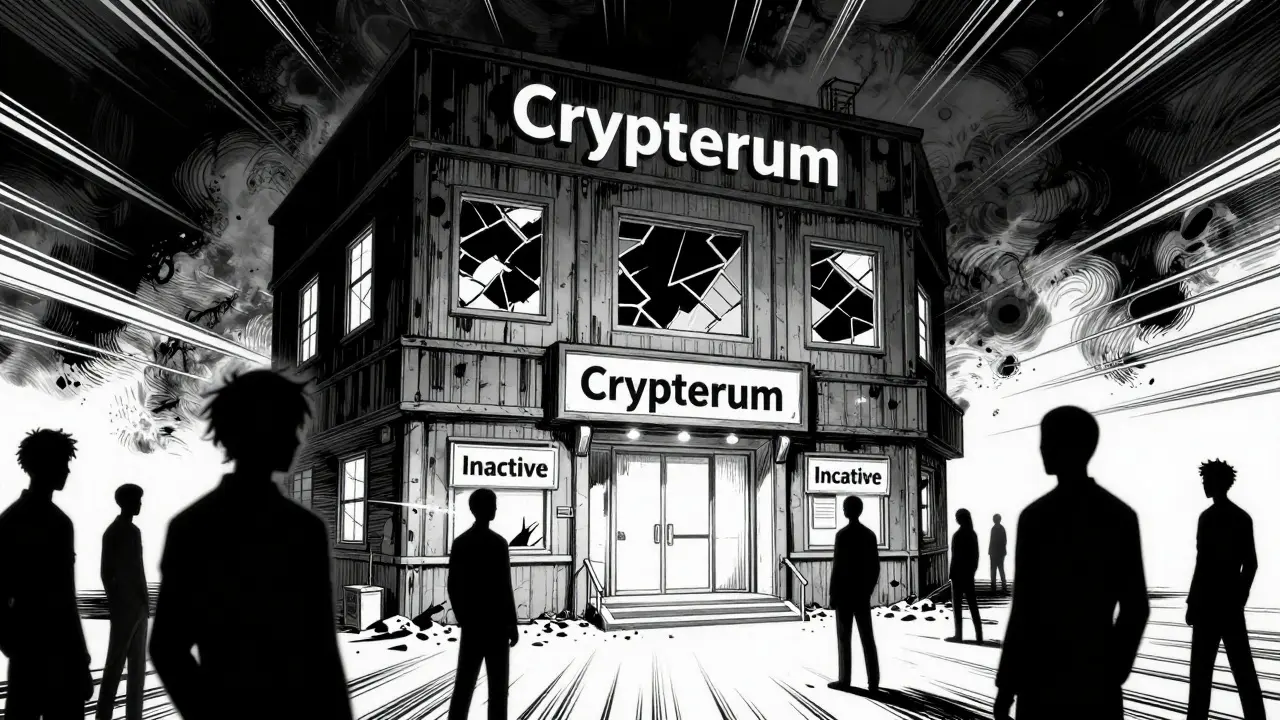
Imagine finding a cryptocurrency exchange with fees that look too good to be true. You sign up, deposit your funds, and then... silence. The website loads slowly, support doesn't reply, and suddenly you realize the platform isn't just quiet-it’s gone. This is exactly what happened to Crypterum, a Cyprus-based crypto exchange that once promised competitive trading costs but has since been flagged as inactive.
If you are looking at Crypterum today in 2026, you need to know one thing immediately: **do not deposit money here**. While the platform had some attractive features during its operational window, its current status poses significant risks to your capital. In this review, we will break down why Crypterum failed, analyze its former fee structure, and help you find safe, active alternatives that actually work.
The Current Status: Why Crypterum Is No Longer an Option
Let’s get the bad news out of the way first. According to industry watchdogs like Cryptowisser, Crypterum was officially flagged as inactive in their 2025 assessment. By 2026, there is no evidence suggesting any change in this status. When an exchange is marked as inactive, it means they are no longer processing transactions, updating their software, or maintaining customer support channels.
Why does this matter? Because in the world of cryptocurrency, liquidity and security are everything. An inactive exchange cannot guarantee that your assets are secure or even still exist on their ledgers. Without active operations, you have no recourse if something goes wrong. There are no Reddit threads discussing recent trades, no Trustpilot reviews from last month, and certainly no community engagement. The absence of user feedback is a massive red flag. Active exchanges generate constant chatter-complaints about bugs, praise for new features, or questions about withdrawals. Silence usually means the lights are off.
Crypterum was operated by Agreados LTD, registered in Cyprus. While Cyprus offers a regulatory framework for financial services, registration alone does not protect users when a company ceases operations. Many smaller exchanges struggle to survive due to high compliance costs, intense competition, and market volatility. Crypterum appears to be another casualty of this consolidation trend.
What Made Crypterum Attractive? A Look at Past Fees
Before it shut down, Crypterum did have one major selling point: low fees. If you were an active trader back then, the cost structure looked appealing compared to many larger platforms. They used a standard maker-taker model, which rewards you for adding liquidity to the market (maker) and charges slightly more for taking it away (taker).
| Exchange | Taker Fee | Maker Fee | Status (2026) |
|---|---|---|---|
| Crypterum | 0.20% | 0.10% | Inactive |
| Coinbase | 0.4% - 3.99% | 0% - 0.6% | Active |
| Kraken | 0.16% - 0.4% | 0% - 0.16% | Active |
| Binance US | 0.1% - 0.6% | 0% - 0.1% | Active |
As you can see, Crypterum’s taker fee of 0.20% was below the global average of roughly 0.217%. Their Bitcoin withdrawal fee was also quite low at 0.0003 BTC, compared to the industry average of around 0.000643 BTC. For a serious trader, saving fractions of a percent on every trade adds up over time. However, these savings mean nothing if you can’t access your funds.
It is important to remember that low fees often come with trade-offs. Smaller exchanges may cut corners on security audits, insurance funds, or customer support staff to keep costs down. In Crypterum’s case, those cuts apparently proved fatal to the business.
Safety and Security Concerns
When evaluating any crypto exchange, security should be your top priority. Unfortunately, detailed information about Crypterum’s security protocols is scarce because the platform is no longer operational. During its active years, it likely required standard KYC (Know Your Customer) verification, which is typical for regulated entities in Cyprus. But without ongoing maintenance, even basic security measures like two-factor authentication (2FA) enforcement or cold storage management become questionable.
Consider this: if an exchange stops updating its software, it becomes vulnerable to known exploits. Hackers constantly scan for inactive or poorly maintained platforms because they represent easy targets. Furthermore, without active customer support, you have nowhere to go if you suspect unauthorized activity on your account. The lack of transparency regarding their security infrastructure makes Crypterum a dangerous choice for anyone holding digital assets.
Compare this to major players like Kraken or Coinbase, which publish regular proof-of-reserves reports and undergo third-party security audits. These companies invest millions in cybersecurity because they understand that trust is their most valuable asset. Crypterum, being a smaller player, simply didn't have the resources-or perhaps the incentive-to maintain such rigorous standards.
Why Small Exchanges Fail: Lessons from Crypterum
Crypterum’s demise is not unique. The cryptocurrency exchange landscape is brutal for small operators. Here are the main reasons why platforms like Crypterum often fail:
- Regulatory Pressure: Compliance costs are skyrocketing globally. Exchanges must navigate complex laws in multiple jurisdictions, requiring expensive legal teams and technical infrastructure.
- Competition from Giants: Platforms like Binance, Coinbase, and Kraken offer deep liquidity, hundreds of trading pairs, and robust ecosystems. Users naturally gravitate toward where the volume is.
- Lack of Diversification: Many small exchanges rely solely on spot trading fees. They don't offer futures, staking, lending, or NFT marketplaces, limiting their revenue streams.
- Trust Deficit: After high-profile collapses (like FTX), users are more cautious than ever. They prefer established brands with proven track records over unknown entities promising low fees.
Crypterum couldn't compete on scale, so it tried to compete on price. But price wars are unsustainable without economies of scale. Eventually, the operational costs outweighed the transaction fees, leading to shutdown.
Safe Alternatives to Crypterum in 2026
Since Crypterum is inactive, you need a reliable alternative. Here are three top-tier exchanges that offer competitive fees, strong security, and full regulatory compliance:
- Kraken: Known for its exceptional security record and wide range of supported cryptocurrencies (over 350). Kraken offers maker fees as low as 0% for high-volume traders and has a reputation for transparent communication during market crises.
- Coinbase Advanced Trade: Ideal for beginners who want simplicity without sacrificing too much on fees. While their standard interface is pricey, their "Advanced Trade" platform brings fees down significantly, competing closely with other major venues.
- Binance US: Offers deep liquidity and a vast array of trading pairs. With maker/taker fees starting at 0%, it’s great for active traders. Note that this is the US-specific entity, ensuring compliance with local regulations.
Each of these platforms provides features that Crypterum lacked: dedicated mobile apps, responsive 24/7 customer support, educational resources, and integration with hardware wallets for enhanced security. More importantly, they are actively trading, meaning your orders will execute and your withdrawals will process.
How to Spot an Inactive or Unsafe Exchange
To avoid ending up like the users of Crypterum, learn to spot warning signs early. Here is a quick checklist before you deposit any funds into a new exchange:
- Check Recent Activity: Look for recent tweets, blog posts, or forum discussions. If the last update was months ago, walk away.
- Verify Regulatory Status: Ensure the exchange is licensed in reputable jurisdictions (e.g., EU MiCA license, US FinCEN registration). Check official government registries, not just the exchange's website.
- Read Independent Reviews: Don't trust testimonials on the exchange's own site. Search for unbiased reviews on sites like Trustpilot, Reddit, and specialized crypto forums.
- Test Withdrawals First: Before moving large sums, make a small deposit and withdraw it immediately. If the process is slow or confusing, consider it a red flag.
- Look for Proof of Reserves: Reputable exchanges regularly publish audited proofs showing they hold user assets in full.
Final Thoughts on Choosing a Crypto Platform
The story of Crypterum serves as a stark reminder: the lowest fee is not always the best deal. In the crypto space, reliability, security, and liquidity are far more valuable than saving a fraction of a percent on trades. An inactive exchange might look cheap on paper, but it costs you everything when you can't access your money.
As you move forward in 2026, prioritize platforms with a long history of stability and transparent operations. Do your homework, check recent user experiences, and never let greed for lower fees blind you to obvious risks. Your capital is hard-earned; protect it by choosing partners who are actively committed to serving you.
Is Crypterum still operating in 2026?
No, Crypterum is considered inactive. Industry reviewers flagged it as non-operational in 2025, and there is no evidence of resumed activity in 2026. Users should avoid depositing funds.
Where is Crypterum based?
Crypterum was operated by Agreados LTD, a company registered in Cyprus. However, its inactive status means this jurisdictional protection is currently irrelevant for users.
What were Crypterum's trading fees?
During its operation, Crypterum charged 0.20% for takers and 0.10% for makers. Bitcoin withdrawal fees were approximately 0.0003 BTC. These rates were competitive but are now moot due to the platform's closure.
Can I recover my funds from Crypterum?
Recovering funds from an inactive exchange is extremely difficult. Since the platform is no longer processing transactions, there is no functional support channel. Legal action would be complex and costly given the cross-border nature of the entity.
What are the best alternatives to Crypterum?
Top alternatives include Kraken, Coinbase Advanced Trade, and Binance US. These platforms offer robust security, regulatory compliance, and active trading environments with competitive fee structures.
11 Responses
Look, I’ve been tracking these Cyprus-registered entities for years and the pattern is always the same. They lure you in with maker fees that undercut the big boys by a fraction of a percent, then vanish when compliance costs get real. It’s not just bad luck; it’s structural failure. You cannot run a secure exchange on thin margins without cutting corners on security audits or liquidity reserves. The fact that Agreados LTD went silent means they likely couldn’t cover their operational overhead during the last market dip. Don’t fall for the 'too good to be true' fee structure again.
You guys are so naive thinking this is just about fees. This is a scam from day one. They knew they couldn’t compete with Binance or Kraken on volume, so they tried to steal users with low fees and no support. Typical predatory behavior. I hope everyone who lost money sues them into oblivion.
Oh my god, reading this gives me such anxiety! 😱 I actually had a small amount on there last year because the interface looked so clean. I was going to move it but kept procrastinating. Now I’m panicking. Is there any way to check if the blockchain shows those coins were moved? Or are we just completely out of luck? This is a nightmare scenario for retail traders who don’t know better.
This is exactly what happens when you allow offshore jurisdictions like Cyprus to regulate financial instruments without strict US oversight. The SEC should have blacklisted them years ago. Instead, we have these rogue operators draining capital from American citizens and hiding behind shell companies. It is a disgrace to our financial sovereignty. We need stricter laws that prevent foreign entities from touching US dollars in crypto trades.
haha typical retail sheep getting rekt 🤡📉 you people cant even read whitepapers properly. crypterum was dead on arrival tbh. the liquidity was fake, the spreads were wide, and the support was bots. i told u all months ago. now u cry here. learn to use cold wallets or stay poor 💀💸
The technical analysis of their downfall is quite simple really. They lacked the institutional backing to survive regulatory scrutiny. Most of you probably dont understand how KYC/AML frameworks work in the EU vs US. Crypterum was trying to bridge that gap without the necessary legal infrastructure. It was inevitable. Only fools trade on platforms without proof of reserves. Wake up.
In the grand scheme of digital currency evolution, failures like Crypterum are merely pruning. They serve as harsh lessons for the collective consciousness of the market. We must reflect on why we trust centralized intermediaries at all. Perhaps the answer lies not in finding safer exchanges, but in embracing decentralized protocols where no single entity can shut down your access. 🧘♂️✨
I think it is important to remain calm and analyze the facts. While the situation is unfortunate, panic does not help recover funds. The article correctly points out that silence is a major red flag. For those looking to move forward, sticking to regulated entities like Coinbase or Kraken is the most prudent path. Let us learn from this and ensure our assets are secure in the future.
i mean its kinda obvious right? if the site loads slow and support doesnt reply its over. why do ppl keep falling for this? just use binance or whatever. not trying to be mean but common sense is rare these days lol. also the table in the post is helpful tho.
I can’t believe I missed this warning earlier! 😫 I was literally looking at their fee schedule yesterday because I needed to move some BTC and thought, 'hey, 0.2% taker fee is nice.' Then I saw the comments section was empty and got a chill. Thank god I didn’t deposit. This is absolutely terrifying. How do they even disappear? Do they just delete the servers? I feel like I need to change all my passwords now just in case.
Let’s be honest, the entire crypto exchange model is a house of cards waiting to collapse. These ‘safe’ alternatives you’re recommending? They’re all just bigger targets. FTX proved that even the giants can fail. Crypterum is just a small fish dying in the same polluted pond. The only safe place is self-custody, and most of you are too lazy to learn how to use a hardware wallet properly. Enjoy your next rug pull.