
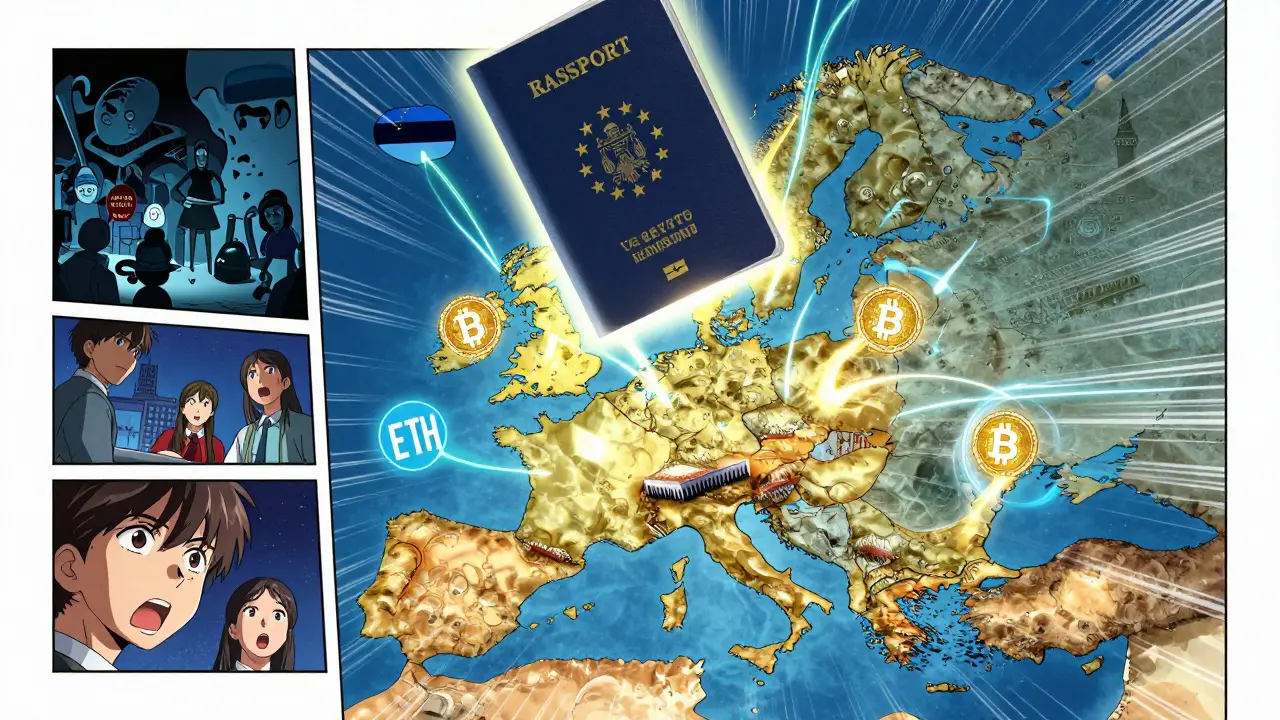
Before MiCA, running a crypto business across Europe was a nightmare. Each country had its own rules. One license in Germany didn’t mean you could operate in France. Many crypto firms either avoided the EU entirely or set up separate legal entities in every country they wanted to serve. That changed on MiCA regulation’s full go-live date: December 30, 2024. Now, a single authorization lets a crypto company serve all 27 EU member states. It’s the first time Europe has unified its crypto rules - and it’s reshaping who can operate here, and how.
How the EU Crypto Passport Works
Under MiCA, a crypto-asset service provider (CASP) gets licensed in one EU country - their home state. Once approved, they can offer services anywhere in the EU without applying again. This is called the EU passport. It’s not a new idea - banks and investment firms have used it for decades. But for crypto, it’s revolutionary.Think of it like a driver’s license. If you get one in Spain, you can drive in Italy, Poland, or Sweden without retesting. Same here. A CASP licensed in Estonia can now offer crypto trading, custody, or staking services to customers in Spain, Romania, or Finland. All under the same compliance framework.
But there’s a catch. The passport isn’t automatic. The CASP must notify its home regulator before expanding. They need to prove they meet MiCA’s rules: keeping client funds safe, reporting suspicious activity, having enough capital, and publishing clear disclosures. If they fail any of these, the passport can be pulled - even if they were approved in their home country.
Who Needs a MiCA License?
MiCA doesn’t just cover big exchanges. It applies to any business offering crypto services to EU users - even if crypto is just a side feature. Here’s who’s affected:- Crypto exchanges - Anyone letting users trade BTC, ETH, or other tokens needs a license.
- Custodial wallet providers - If you hold users’ private keys (like Coinbase or Kraken), you’re a CASP. Even if you call it a “wallet,” if you control the keys, you’re regulated.
- Token issuers - Companies launching new tokens must publish a detailed white paper approved under MiCA standards. No vague promises or marketing fluff allowed.
- Stablecoin issuers - If you issue a euro-backed token, you must hold reserves in liquid assets, guarantee daily redemptions, and undergo regular audits.
- Embedded finance platforms - Even non-crypto companies offering crypto as a feature (like a payment app that lets users buy Bitcoin) must comply.
There’s no loophole. If you’re serving EU customers, you’re under MiCA’s watch. Even if your company is based in the U.S., Canada, or Singapore - if you market to EU users or actively solicit them, you need an EU entity.

Third-Country Providers: The Hard Wall
This is where things get tough for non-EU companies. MiCA doesn’t let foreign crypto firms just operate across borders like a bank might. If you’re based outside the EU and want to serve EU customers, you have two options:- Set up a legal entity inside the EU and get full CASP authorization.
- Wait for EU users to find you on their own - no ads, no websites in local languages, no customer support in EU time zones.
The second option is called reverse solicitation. But ESMA’s guidelines made it nearly useless. If a U.S. exchange runs a TikTok ad in German, or has a .eu domain, or even replies to an EU user’s tweet about trading - that’s considered promotion. That breaks the reverse solicitation rule.
Many big exchanges - including Binance, Coinbase, and Kraken - have already opened EU subsidiaries. Binance Europe is now based in France. Coinbase EU operates out of Ireland. They didn’t do it because they wanted to. They did it because they had to.
What MiCA Demands From CASPs
Getting licensed isn’t just filling out a form. MiCA sets strict rules that mirror traditional finance:- Own funds - You must keep enough capital on hand to cover losses. Minimums vary by service type, but they’re not small.
- Client asset protection - Your customers’ crypto must be kept separate from your company’s funds. No commingling. No using client assets for lending or trading.
- Market abuse monitoring - You must detect and report insider trading or price manipulation. If someone’s pumping a token you list, you’re expected to notice.
- Transparency - All crypto assets you offer must come with a white paper. It can’t say “the future of finance.” It must list risks, team details, tokenomics, and how the asset works.
- Anti-money laundering - You must verify every customer, monitor transactions, and report anything suspicious to national authorities.
There’s also a special category for “significant” CASPs: those serving 15 million or more active users in the EU. These firms report directly to ESMA, not just their home regulator. They face extra stress tests, stricter capital rules, and more frequent audits.

Who Benefits? Who Gets Left Behind?
MiCA is good news for established players. Bigger firms can afford the legal teams, compliance software, and capital reserves. They’re already adapting. But for startups? It’s a hurdle.A small crypto wallet app in Lithuania might have spent $50,000 on development. Now, they need another $300,000 to get licensed, hire AML officers, and build audit trails. Many won’t make it. Some will shut down. Others will pivot to non-EU markets.
On the flip side, consumers win. No more shady platforms disappearing overnight. No more “we’re not regulated” excuses. If you’re using a MiCA-licensed service, your assets are protected by law. You know what you’re buying. You can complain to a real regulator if something goes wrong.
What’s Next? The Road Beyond 2025
MiCA isn’t the end. It’s the beginning. ESMA is still writing technical standards - for stablecoin reserves, stress testing, and how to handle decentralized finance protocols. The regulation doesn’t cover NFTs yet, or DeFi protocols without central operators. Those gaps will be filled.Some EU countries are moving faster than others. Fifteen member states opted for shorter transitional periods, meaning some firms had to comply by early 2025, while others had until mid-year. This patchwork is fading, but it created confusion.
Outside the EU, regulators in the U.S., UK, and Asia are watching closely. MiCA is becoming the global benchmark. If you want to operate internationally, you’ll likely need to meet MiCA-style rules anyway.
For now, the message is clear: if you want to serve EU customers with crypto, you need to play by EU rules. No shortcuts. No loopholes. Just compliance.
Do I need a MiCA license if I’m a U.S.-based crypto exchange?
Yes - if you actively market to EU customers, offer services in local languages, or have a website targeting EU users. MiCA doesn’t care where you’re based. It cares who you serve. If you’re trying to attract EU clients, you must set up an EU legal entity and get licensed. The only exception is reverse solicitation - but that’s nearly impossible to use legally under current ESMA guidelines.
Can I still use non-MiCA wallets like MetaMask in the EU?
Yes. MiCA regulates service providers, not users or non-custodial tools. If you’re using MetaMask, Trust Wallet, or any wallet where you control your own private keys, you’re not breaking any rules. MiCA only applies to companies that hold your keys or offer trading, custody, or exchange services. Personal use is untouched.
What happens if a crypto exchange doesn’t get MiCA licensed?
They can’t legally operate in the EU. National regulators can block their websites, freeze bank accounts, and fine them. Some exchanges have already been forced to shut down their EU services. Others have quietly removed access to EU users - no warning, no explanation. If you’re using an unlicensed platform, your funds aren’t protected under EU law.
Are stablecoins like USDT and USDC affected by MiCA?
Yes - and they’re under the strictest rules. Issuers must hold 1:1 reserves in liquid assets like cash or short-term government bonds. They must guarantee daily redemptions, publish monthly reserve reports, and undergo audits by EU-approved firms. USDC and USDT have both launched EU-based entities to comply. Smaller stablecoins without these safeguards are being phased out.
Does MiCA apply to NFTs?
Not yet. MiCA currently excludes NFTs unless they represent financial rights - like shares in a company or revenue-sharing tokens. A digital art NFT isn’t covered. But if you’re selling an NFT that gives you voting rights or dividends, it’s treated as a crypto-asset and falls under MiCA. Watch for updates - NFTs are likely to be regulated soon.
10 Responses
This is huge! Seriously, I’ve been waiting for this for years. Finally, a clear rulebook for crypto in Europe. No more guessing if your app’s legal in France vs. Germany. It’s like the EU finally grew up and said, ‘We’re not playing house anymore.’
They think this is progress? It’s just another bureaucracy wrapped in blockchain glitter. The real innovators are being crushed under compliance paperwork while bureaucrats get paid to read white papers written by lawyers who’ve never held a private key.
It’s not perfect, but it’s a start. For too long, crypto in Europe felt like a wild west with a few cops who didn’t know the rules. Now there’s at least a map. Yes, it’s expensive for small teams-but safety shouldn’t be optional. If you’re building something real, this is the price of legitimacy.
People forget that MiCA isn’t about controlling crypto-it’s about protecting people. I’ve seen friends lose everything to shady exchanges that vanished overnight. Now, at least, if something goes wrong, you can file a complaint and actually get an answer. That’s not regulation. That’s basic human decency.
so like… if i use metamask im chill but if i use coinbase i gotta jump through 12 hoops? 😅 i mean… fair? kinda? but also… why does it feel like the system’s rigged for the big guys?
Wait, so USDT and USDC are now EU-approved? That’s hilarious. You’re telling me a company that got fined $4.3B for money laundering in the US is now a ‘trusted’ issuer? This isn’t regulation-it’s a corporate handshake with a fancy EU stamp.
i just want to buy dogecoin without getting audited. why does everything have to be so complicated now? i’m not a bank, i’m just a person who likes memes and crypto. why do i care if a wallet has a license? it’s just a wallet… right?
While the regulatory framework is comprehensive, it is important to acknowledge the burden it places on small-scale innovators. The cost of compliance may unintentionally stifle grassroots innovation, which has historically been the engine of cryptocurrency advancement. A balanced approach, with tiered licensing based on user volume, may serve the ecosystem better.
Of course the EU created a regulation that only multinational corporations can afford. The irony is that they claim to support innovation while systematically eliminating anyone without a legal department. This is not progress. This is capture.
Oh wow, look who’s finally caught up. The US has been doing this for years, and now Europe’s playing catch-up with a 500-page PDF and a $300K compliance budget. Congrats, you’ve turned decentralization into a corporate compliance seminar. Next up: mandatory crypto ethics training and a 10% ‘good vibes’ tax.