

Imagine you are a refugee in Jordan. You need food for your family. In the past, you might have waited weeks for a paper voucher that could be stolen or lost. Today, you walk up to a scanner, look into a camera, and instantly access funds at local shops. No cash changes hands. No middlemen take a cut. This isn't science fiction; it is how organizations like the World Food Programme (WFP) are using blockchain technology to change the face of humanitarian aid.
But does this tech actually work? Or is it just another buzzword wrapped around a complex problem? The reality is messy. While blockchain has saved millions in fees and protected vulnerable people from theft, it also brings new headaches like broken scanners and slow internet. Here is what you need to know about moving international aid onto the blockchain.
Why Blockchain for Humanitarian Aid?
The core idea behind using distributed ledger technology for aid is simple: trust without intermediaries. Traditional aid often involves banks, money transfer services, and local administrators. Each step adds cost and risk. According to UN estimates, corruption and inefficiency can divert up to 30% of aid before it reaches the intended recipients. That is money meant for food going into pockets instead of plates.
Blockchain solves this by creating a shared, unchangeable record of transactions. When an organization sends digital tokens to a beneficiary, that transaction is recorded on a network that everyone involved can see but no single person can alter. This creates three main benefits:
- Transparency: Donors can track exactly where their money goes.
- Cost Reduction: By cutting out traditional banking fees, more aid reaches the end user.
- Dignity and Security: Beneficiaries receive direct assistance without needing physical cash that can be stolen or confiscated.
It is not about making refugees use Bitcoin. It is about using the underlying technology to make systems fairer and faster.
The Big Players: WFP Building Blocks and Oxfam
To understand if this works, we have to look at who is actually doing it. Two projects stand out as the gold standards in this space.
WFP Building Blocks is the world's largest implementation of blockchain for humanitarian assistance. Launched in 2017, it started with 100 refugees in Pakistan and has since scaled massively. As of 2023, it had distributed US$ 325 million to one million refugees across Bangladesh and Jordan. The system uses a private Ethereum blockchain. Instead of storing sensitive data on the chain, it uses anonymous identifiers linked to biometric scans (iris recognition via 'EyePay'). This means the blockchain verifies the transaction, but the refugee's identity remains private and secure.
The results in Jordan were striking. The WFP saved US$ 2.4 million in transaction fees alone. More importantly, they reduced payment processing time from weeks to near real-time. For a family facing hunger, waiting two weeks for a bank transfer is unacceptable. Getting instant access to food vouchers is life-changing.
Then there is Oxfam's UnBlocked Cash. This project takes a slightly different approach. It combines e-voucher 'tap-and-pay' cards with smartphones used by vendors. NGOs disburse funds through a single-payment online platform. This allows them to monitor transactions in real-time. Oxfam reported that women beneficiaries felt significantly safer because they didn't have to carry physical cash through potentially dangerous areas to get to market.
How the Technology Actually Works
You don't need to be a coder to understand the flow, but knowing the basics helps explain why it fails sometimes. These systems do not use public cryptocurrencies like Bitcoin or Litecoin. They use private permissioned blockchains. This means only authorized nodes (servers run by trusted partners like the UN, NGOs, and banks) can validate transactions.
- Registration: A refugee's biometric data (usually an iris scan) is registered. This creates a unique digital ID. Crucially, the raw biometric data is not stored on the blockchain itself, which protects privacy.
- Funding: Donors send fiat currency (USD, EUR) to the NGO. The NGO converts this into digital credits on the private blockchain.
- Transaction: The beneficiary goes to a participating vendor. They scan their eye. The vendor's app confirms the balance and deducts the amount.
- Settlement: At the end of the day or week, the vendor receives actual cash or a bank transfer for the total value of goods sold.
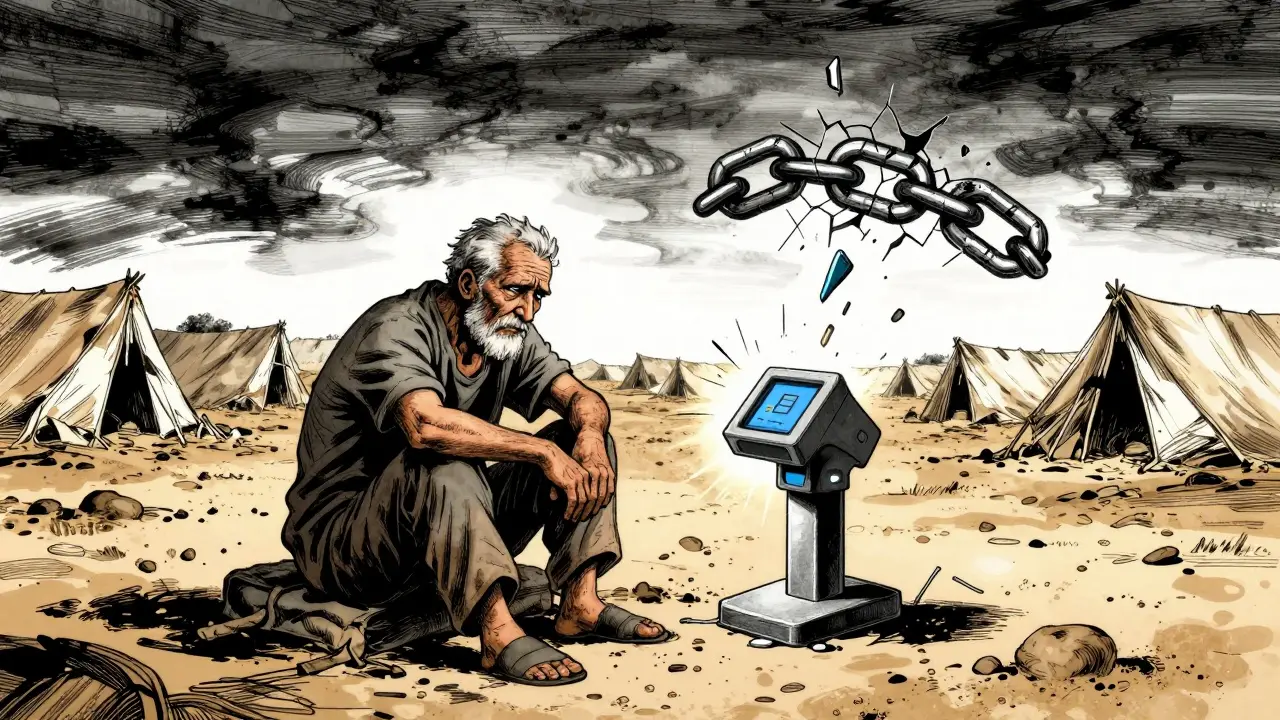
This process relies heavily on connectivity. If the internet goes down, the scanner cannot verify the balance. Unlike a piece of paper, a digital token needs a network to exist.
The Hard Truths: Limitations and Risks
If blockchain were perfect, every NGO would use it. They don't. Why? Because the technology introduces new vulnerabilities that traditional systems don't have.
Infrastructure Dependency is the biggest hurdle. A 2022 analysis by Prism Sustainability Directory found that 68% of refugee camps in developing regions lack the reliable internet and power needed to support these systems. If the server crashes, nobody eats. In remote areas, implementation failure rates are 43% higher than in urban camps.
Biometric Failures are a serious concern. Humanitarian Innovation Exchange forums have documented cases where elderly refugees, suffering from malnutrition, experienced changes in their iris patterns. The scanners couldn't recognize them. For a young person, this might be annoying. For an elderly person dependent on daily rations, it is devastating. There are reports of 47 distinct incidents of such failures in a single forum thread in early 2023.
Scalability Issues persist. Current humanitarian blockchain networks handle about 15-20 transactions per second. Traditional payment processors like Visa handle thousands. While 15 TPS is enough for a small camp, it struggles during mass emergencies when tens of thousands of people need aid simultaneously.
| Feature | Traditional Cash/Vouchers | Blockchain-Based Systems |
|---|---|---|
| Transaction Fees | US$ 1-2 per transaction | Near zero (internal network) |
| Processing Time | Weeks | Near real-time |
| Corruption Risk | High (up to 30% diversion) | Low (98% reduction in diversion) |
| Infrastructure Needs | Low (paper/cash) | High (internet, scanners, servers) |
| User Onboarding | Immediate | Average 72 hours |
| Privacy | Anonymous (cash) | Pseudonymous (biometric-linked) |
What Do the Experts Say?
The debate is far from settled. David Beasley, former Executive Director of the WFP, called Building Blocks a "paradigm shift," highlighting the US$ 2.4 million saved in Jordan as proof of concept. He argues that returning funds to the mission is the ultimate goal of efficiency.
However, Dr. Sarah Smith from Oxford University's Humanitarian Innovation Project offers a cooler perspective. She warns that "blockchain's benefits are often oversold." Her research suggests that in contexts where financial infrastructure already exists, the cost of implementing blockchain often exceeds the savings. It is a solution looking for a problem in some stable environments.
Dr. James Morris, also a former WFP head, raised concerns about "techno-solutionism." This is the danger of believing that technology can fix root causes like poverty or conflict. Blockchain makes the pipe cleaner, but it doesn't fill the well. If the underlying political situation prevents aid from entering a country, no amount of coding will help.
The Future: Interoperability and CBDCs
Where does this go from here? The industry is moving toward standardization. The UN launched the Interagency Blockchain Framework in September 2023. The goal is interoperability-allowing different blockchain systems to talk to each other. Currently, if a refugee moves from a WFP camp to an Oxfam-supported area, their digital wallet might not work. Interoperability aims to fix that.
Another major trend is the rise of Central Bank Digital Currencies (CBDCs). Governments are exploring their own digital currencies. These could eventually replace private blockchain solutions in aid distribution. CBDCs offer similar transparency and speed but come under the control of national governments rather than international NGOs. This raises political questions but might solve the infrastructure fragmentation issue.
By 2030, experts estimate a 68% probability that major UN agencies will use blockchain as standard practice. However, widespread adoption across all humanitarian sectors is less likely (32%) due to persistent infrastructure gaps.
Is blockchain-based aid safe for refugees?
Yes, generally safer than carrying cash. Systems like WFP's Building Blocks use biometric authentication (iris scans) and store only anonymous identifiers on the blockchain, not sensitive personal data. This reduces the risk of theft and exploitation. However, privacy concerns remain regarding the collection of biometric data by large organizations.
How much money does blockchain save in aid distribution?
In the Jordan pilot, WFP saved US$ 2.4 million in transaction fees. Typically, traditional banking systems charge US$ 1-2 per transaction. Blockchain eliminates these intermediary fees, allowing more donor funds to reach the final recipient directly.
Can blockchain aid work without internet?
Currently, no. Most systems require real-time connectivity to verify balances and update ledgers. This is a major limitation in remote refugee camps where internet access is unreliable. Offline capabilities are being developed but are not yet standard.
What happens if the biometric scanner fails?
This is a known risk. Malnutrition or aging can change iris patterns, causing scan failures. In such cases, manual intervention is required, which delays aid. Organizations are working on multi-modal biometrics (combining iris, fingerprint, etc.) to improve reliability.
Is this using Bitcoin or cryptocurrency?
No. These systems use private, permissioned blockchains. They do not involve volatile cryptocurrencies like Bitcoin. The value is pegged to fiat currencies (USD, EUR) and is controlled by the humanitarian organizations and their banking partners.
19 Responses
oh look another tech bro fantasy about saving the world with code while ignoring the actual human suffering on the ground it is absolutely pathetic how these organizations like WFP are playing god with biometric data of vulnerable people who have no choice but to comply this is not aid this is surveillance capitalism dressed up in a humanitarian costume and if you think for one second that storing iris scans on a blockchain makes it secure you are either ignorant or complicit in the violation of basic human rights because let us be clear here the real issue is not transaction fees it is the systemic failure of global governance to address the root causes of displacement and poverty and until we fix that no amount of ethereum nodes will change anything
i just feel so sad reading this because nobody talks about the elderly refugees whose eyes cant be scanned anymore and then they starve while some developer gets a bonus for implementing the system it makes me want to cry every time i see these success stories because behind every saved dollar is a person who was treated like a number instead of a human being and its disgusting how we prioritize efficiency over dignity
Look, I get the hype around distributed ledgers 🚀 but lets keep it real for a sec. The infrastructure gap is massive. You cant deploy high-tech solutions in places where the power grid goes down twice a day. It’s cool theory, sure, but practical implementation is a nightmare. Maybe focus on solar-powered offline-first apps first? 🌞💻
I have been following the developments in humanitarian technology for quite some time now and while there are certainly significant challenges associated with the implementation of blockchain systems in refugee camps particularly regarding internet connectivity and biometric reliability I believe that the potential benefits of increased transparency and reduced transaction costs cannot be overlooked especially when considering the vast amounts of funds that are currently lost to corruption and inefficiency within traditional aid distribution channels which ultimately means less food and resources for those who need them most so perhaps we should view this not as a perfect solution but as an evolving tool that requires careful adaptation and continuous improvement rather than outright dismissal based on current limitations.
techno-solutionism at its finest lol like putting a band-aid on a bullet wound and calling it innovation the fact that they are using private permissioned blockchains means its basically just a fancy database with extra steps why do we need immutable ledgers for charity vouchers its absurd really but hey at least the donors can feel warm and fuzzy about their money going somewhere even if the recipient has to stare into a camera lens to eat
We need to stop pretending this is about helping refugees and start acknowledging it is about control. Who owns the data? Who controls the ledger? If the NGO pulls the plug, does the wallet vanish? This needs strict regulation before rolling out to more camps.
It is kind of wild how we went from paper vouchers to scanning eyeballs in ten years. I guess progress is inevitable even if it feels a bit dystopian sometimes. At least the kids dont have to walk miles to get cash though right?
I really appreciate the detailed breakdown here. It helps to understand both the good and the bad sides of this technology. My heart goes out to anyone who has experienced a scanner failure. That must be incredibly stressful and frustrating for someone already in a difficult situation.
its so scary to think about what happens if the server crashes during a crisis like a natural disaster when everyone needs help at once i hope they have backup plans but honestly it sounds risky relying on something that needs constant internet access
The article ignores the fundamental flaw in assuming that blockchain solves trust issues. It only solves verification. If the input data is corrupted or the biometric registration is biased, the output is garbage. Also, the claim of 98% reduction in diversion is likely cherry-picked from ideal pilot scenarios, not scalable reality. Do your own research before getting excited.
hey guys just wondering if anyone knows if these systems work in countries with heavy internet censorship like iran or syria because i heard they block a lot of tech stuff so maybe the scanners wont connect to the cloud servers properly
You are missing the bigger picture here! We need to push harder for interoperability between agencies. If WFP and Oxfam cant talk to each other, we are just creating silos of data that hurt the very people we try to help. Step up your game NGOs!
This is exactly why I say we need to hold these corporations accountable. They promise the moon and deliver a glitchy app. I am tired of hearing about 'innovations' that fail the most vulnerable among us. Wake up people! The profits are looking good for the tech providers while the refugees suffer.
I just wanted to add that I saw a documentary recently about this in Jordan and it seemed pretty smooth for the vendors. Not sure how universal that experience is though.
Can someone clarify if the biometric data is encrypted end-to-end? I am concerned about data breaches involving sensitive health and identity information. Transparency is great but security protocols matter too.
so if the internet goes down does that mean the whole system stops working or is there like a cache mode where it stores transactions locally and syncs later cause that would be kinda important to know for remote areas
Oh my goodness this is such a complex topic! On one hand I love that technology can help save money and make things faster but on the other hand I worry so much about the poor old ladies who cant get their eyes scanned. It is just so dramatic and heartbreaking really. We need to be careful please.
The philosophical implication of replacing human discretion with algorithmic certainty in aid distribution is profound. Are we optimizing for efficiency at the cost of empathy? When a machine denies a scan due to malnutrition-induced iris changes, it lacks the contextual understanding that a human worker might possess. This raises questions about the nature of justice in automated systems.
just seems like a lot of hassle for what used to be simple cash handouts but i guess times are changing and we gotta adapt or get left behind i suppose