

If you're searching for a Bitturex crypto exchange review, you've likely noticed something strange: the platform isn't exactly "open for business" anymore. While many people still search for it as a place to trade, the reality is that Bittrex has transitioned from a powerhouse of altcoin trading to a case study in regulatory collapse. If you still have funds sitting in an account, you aren't just looking for a review-you're looking for a way to get your money out before fees eat it alive.
For years, Bittrex was the go-to spot for traders who wanted a massive selection of small-cap coins without the constant fear of a platform hack. But by 2026, the story has changed. Between the shutdown of U.S. operations and the subsequent liquidation of its global arms, the exchange is now in a state of wind-down. Here is the raw truth about what happened and how to handle your assets now.
The Rise and Fall of a Security Giant
Founded in 2014 by former Microsoft security engineers, Bittrex is a cryptocurrency exchange that prioritized military-grade security and regulatory compliance over aggressive growth. For a long time, they were the gold standard for safety. While other exchanges were getting drained by hackers, Bittrex kept 95% of user funds in cold storage. They used multi-signature wallets spread across different geographic locations, which essentially meant they had zero reported security breaches throughout their operational life.
They weren't just about safety, though. Bittrex was an altcoin paradise. At its peak in 2021, it listed over 250 cryptocurrencies, including early access to assets like TRON (TRX) and EOS. This diversity made them a favorite for "gem hunters" who found Coinbase too restrictive. However, this openness came with a price: a rigid approach to regulation that eventually became their undoing.
Comparing Bittrex to the Big Players
To understand why Bittrex failed where others survived, you have to look at the trade-offs they made. They focused on being "the safe choice," but they lacked the liquidity and tools that professional traders crave. While a platform like Bitfinex was processing billions in daily volume and offering high-leverage derivatives, Bittrex stayed focused on simple spot trading and strict compliance.
| Feature | Bittrex | Coinbase | Bitfinex |
|---|---|---|---|
| Altcoin Variety | Very High (250+) | Moderate | High |
| Security Record | Zero Breaches | Strong | Had Historical Hacks |
| Trading Liquidity | Low to Moderate | Very High | Extreme |
| Fiat Options | Limited (USD only) | Broad | Very Broad |
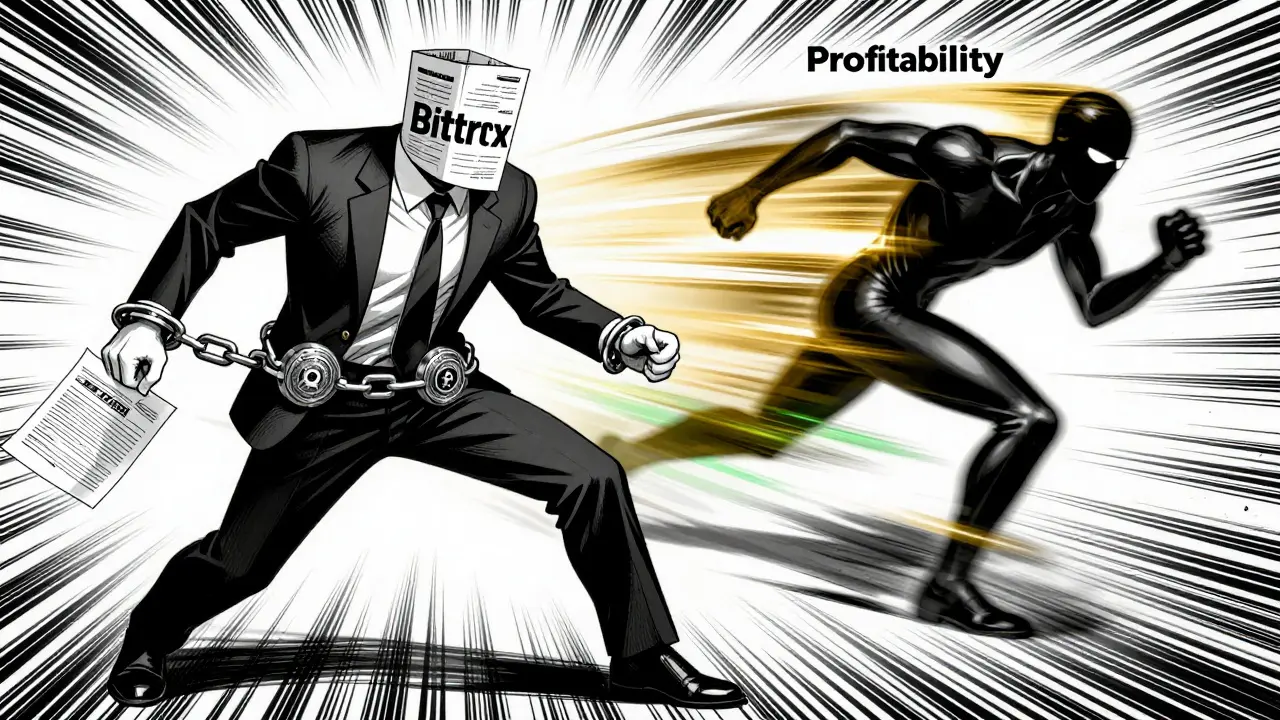
The biggest weakness wasn't the tech-it was the cost of staying legal. Reports indicate that Bittrex spent roughly $47 million annually on regulatory adherence, far outpacing competitors like Coinbase. This bled their profit margins dry, eventually hitting -18% by 2022. They tried to play by the rules, but the rules shifted too fast for them to keep up.
The Shutdown Timeline: What Actually Happened?
The collapse didn't happen overnight, but it felt like it. First, the U.S. arm, Bittrex Incorporated, shut down on April 30, 2023. They cited escalating regulatory pressures that made it impossible to operate. Then, the international side, Bittrex Global, halted trading on December 4, 2023. At that point, the platform entered a "withdrawal-only" mode, which is basically the crypto version of a waiting room.
By early 2025, things got more serious. Both the Liechtenstein and Bermuda entities entered active liquidation. This means professional liquidators, such as ALPS Trust Ltd., took over the recovery process. If you are one of the thousands of users still holding a balance, you are no longer dealing with a trading platform-you are dealing with a liquidation firm.

Urgent: How to Withdraw Your Funds
If you still have assets on the platform, you need to act now. This isn't a drill because the liquidators have introduced a "default fee." Since February 2025, users face a monthly fee of 1% per asset (with a minimum of $50 per asset per month) for delayed withdrawals. If you're holding a small amount of a niche altcoin, these fees could literally wipe out your entire balance in a few months.
Here is the step-by-step process to get your funds out:
- Access the Zendesk Portal: You cannot just log in and click "withdraw" like the old days. You must submit your request via the official Zendesk support portal for Bittrex Global.
- Re-verify your KYC: Even if you were verified years ago, the liquidators require new KYC (Know Your Customer) documents. Be prepared to upload a fresh ID and proof of address.
- Submit a Ticket: Follow the specific instructions for asset recovery. Be precise with your account details to avoid the 72-hour processing delay.
- Monitor Your Wallet: Once approved, your assets will be sent to the external wallet address you provided. Double-check your address-there is no customer support to help you if you send funds to the wrong chain.
For those in Bermuda, things are slower. The Bermuda Monetary Authority is still overseeing the process, and withdrawals there have been more restricted compared to the Liechtenstein entity.
The Legacy of Bittrex: A Lesson in Custody
Is there anything positive to take away from this? Yes. The a-bit-bitter irony is that while the business failed, the security worked. Even during liquidation, the funds stayed safe because of those Microsoft-engineered cold storage systems. In fact, other companies like BitGo have adopted similar multi-sig architectures based on the Bittrex model.
The real lesson here is that "regulatory compliance" doesn't always equal "business survival." You can follow every rule in the book and still go bust if the cost of compliance outweighs your revenue. More importantly, it's a reminder that no matter how "military-grade" an exchange's security is, the biggest risk isn't always a hacker-sometimes it's the company's own balance sheet.
Is Bittrex still operating?
No. Both Bittrex Inc. (U.S.) and Bittrex Global have ceased trading operations. The platform is currently in a liquidation phase, meaning it only exists to facilitate the return of user funds to their rightful owners.
How do I get my money out of Bittrex Global?
You must contact the appointed liquidators (such as ALPS Trust Ltd.) via the official Bittrex Global Zendesk support portal. You will be required to re-submit KYC documentation before your withdrawal request can be processed.
What are the Bittrex liquidation fees?
As of February 2025, a monthly default fee of 1% per asset is charged to accounts that have not withdrawn their funds. There is a minimum charge of $50 per asset per month, which can significantly deplete small balances.
Was Bittrex hacked?
No, Bittrex is widely praised for its security record. It maintained a 95% cold storage ratio and had no major reported security breaches during its operational history.
Can I still trade altcoins on Bittrex?
No, all trading pairs were disabled when the platform transitioned to withdrawal-only mode in late 2023. You cannot buy, sell, or trade any assets on the platform.
11 Responses
The narrative here is far too clean. You're telling us the funds are safe because of some Microsoft-engineered vault, yet the company is bleeding out through regulatory costs? Please. It is blindingly obvious that the regulatory pressure was a smokescreen for a coordinated exit by the insiders. If you look at the timing of the U.S. shutdown and the subsequent global collapse, it aligns perfectly with a larger systemic purge of mid-tier exchanges. The "default fee" of $50 is the real punchline; it's a calculated mechanism to shave off the dust of thousands of small accounts to pad the liquidators' pockets while the big fish swim away. This isn't just a business failure, it's a masterclass in institutional theft masked as compliance. Wake up and realize that once a firm enters "withdrawal-only" mode, you are no longer a customer, you are a creditor in a game where the house owns the dice. The precision of this collapse suggests a script written long before 2023. Only a fool believes a company with zero breaches just happens to go bankrupt due to the cost of following the law.
total scam obviously... follow the money and u see where it goes. these liquidators are just another layer of the pyramid scheme to keep ur funds hostage until they rot
It really makes you think about the nature of trust in the digital age. We trust the code, then we trust the company, but we forget that companies are just groups of people subject to the same flaws as anyone else. There is a certain tragedy in the fact that they prioritized security so heavily, only to be defeated by the very rules designed to keep the system stable. It's like building an impenetrable fortress and then realizing you can't afford the taxes on the land it sits on. I suppose it's a lesson in balance, though it's a harsh one for those still trying to claw back their assets.
who actually cares about the security record when the money is gone anyway lol
GET YOUR MONEY OUT NOW! Stop reading these long-winded analyses and just go to the Zendesk portal before they find another reason to charge you a fee! MOVE IT!
For those who are feeling overwhelmed by the process, please remember to maintain a detailed log of all your interactions with the ALPS Trust Ltd. portal. It is highly advisable to take screenshots of every submitted ticket and save the confirmation emails in a dedicated folder. Should there be any discrepancies in the asset recovery, having a chronological record of your requests will be indispensable for any further legal recourse.
I totally agree with the need for records!! Its so easy to lose track of those tickets when you're stressed out about your money!! I once lost a support ticket for another platform and it took forever to fix... just a little tip to stay organized everyone!!
imagine still having funds on an exchange in 2026 what a joke... some people just love the thrill of losing money to a corporate void
Omg this is just heartbreaking! To see such a giant fall like this is truly a drama for the ages! But our spirit is stronger than any exchange!
It is a poignant reminder that self-custody is the only way to ensure true ownership. 🛡️
Absolute shambles.