
Imagine a single machine performing one sextillion calculations every second. That is not science fiction; it is the reality of the Bitcoin network, which surpassed the 1 Zetahash (1 ZH) mark in April 2025. As we move through 2026, the question isn't just whether the network will grow, but how fast and at what cost. Future hash rate projections are no longer simple guesses based on past trends. They are complex economic models involving energy prices, hardware efficiency, and global regulations.
If you are looking to invest in mining hardware or understand the security of your Bitcoin holdings, you need to look beyond the headline numbers. The race to secure the blockchain is becoming an industrial-scale competition where only the most efficient players survive. This guide breaks down the real data behind these projections, helping you separate hype from hard facts.
The Current State of Network Security
To predict where the hash rate is going, we first need to understand where it stands today. By early 2025, the network’s 7-day moving average (7DMA) hit 929 Exahashes per second (EH/s). More importantly, the 1-day moving average briefly crossed 1,000 EH/s, marking the entry into the Zetahash era. This milestone signifies that the Bitcoin network is now more computationally powerful than all supercomputers combined.
This growth isn't accidental. It is driven by the relentless pursuit of profit. When Bitcoin’s price rises, miners buy more hardware. When hardware becomes more efficient, miners can operate profitably at lower prices. This feedback loop has pushed the network difficulty up by 8.66% over a 90-day period in mid-2025 alone. For context, the network was sitting at just 14 EH/s in 2018. Today, it is nearly 60 times larger. Understanding this baseline is crucial because any projection for 2030 must account for this massive scale.
Three Scenarios for 2030 Growth
Experts do not agree on a single number for the future. Instead, they use compound annual growth rates (CAGR) to model different outcomes. Here are the three primary scenarios emerging from industry analysis in 2025 and 2026:
- Conservative Scenario (35% CAGR): This model assumes significant regulatory headwinds and energy constraints. Under this assumption, the hash rate would reach approximately 2,543 EH/s by 2030. This scenario accounts for potential crackdowns in major mining hubs like Texas or Kazakhstan.
- Base Case Scenario (45% CAGR): This represents steady industrial growth without major black swan events. It projects the hash rate to hit around 4,128 EH/s by 2030. This aligns with current trends of institutional adoption and gradual hardware upgrades.
- High-Growth Scenario (52.5% CAGR): Based on historical data since 2018, analysts like those at GoMining project a much faster trajectory. If this trend holds, the network could reach 6,891 EH/s by 2030. This assumes continuous innovation in ASIC design and favorable market conditions.
Which scenario plays out depends largely on two factors: the price of Bitcoin and the cost of electricity. If Bitcoin reaches the $1.16 million mark projected by some analysts by 2030, even older hardware remains profitable, fueling further hash rate growth. However, if regulations increase operational costs by 150%, as warned by some risk models, growth could stall.
The Hardware Efficiency Arms Race
You cannot talk about hash rate projections without discussing the machines driving them. The era of mining with GPUs is long gone. Today, the network is dominated by Application-Specific Integrated Circuits (ASICs). These specialized chips are designed for one task: calculating SHA-256 hashes.
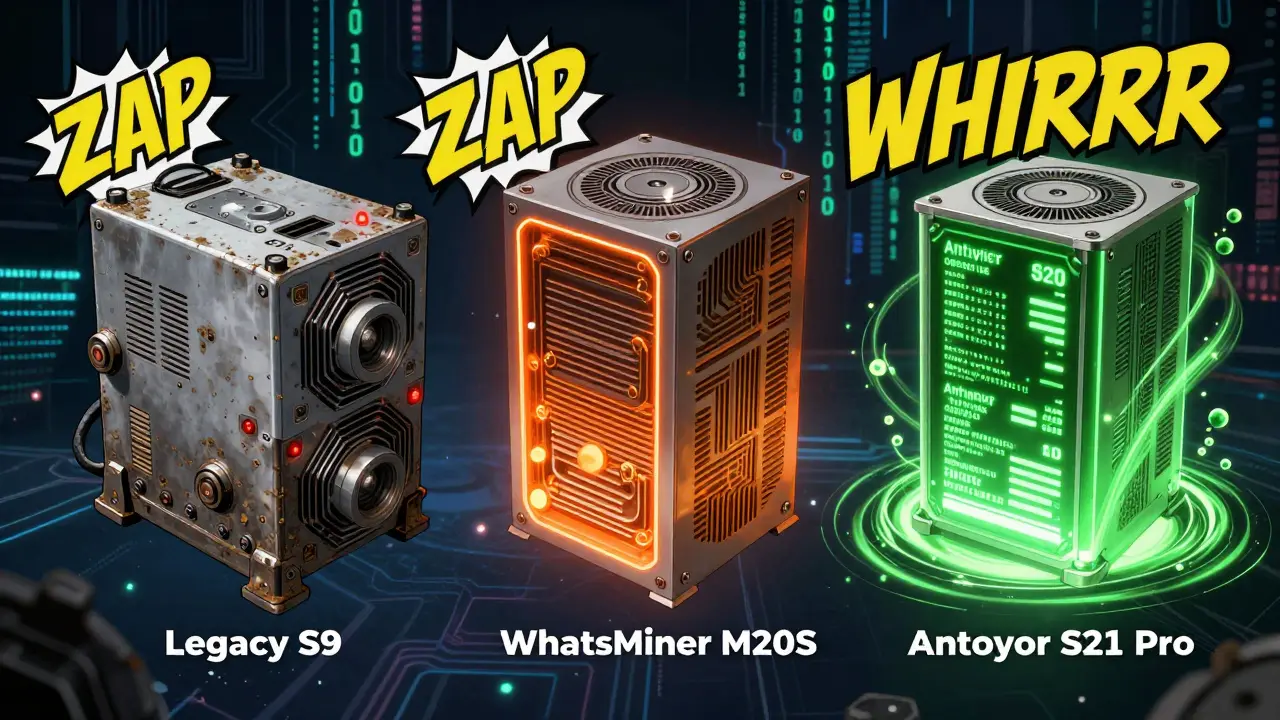
Modern ASICs, such as the WhatsMiner M20S, deliver 68 Terahashes per second (TH/s) while consuming between 2,000 and 20,000 watts. The key metric here is efficiency-how many terahashes you get per watt. As the network difficulty rises, inefficient machines become money losers. A miner using older hardware might break even when Bitcoin is at $100,000, but if the price drops to $50,000, they are shut down. This dynamic forces constant upgrading, which pushes the total network hash rate higher.
| Hardware Model | Hash Rate | Power Consumption | Efficiency (J/TH) |
|---|---|---|---|
| WhatsMiner M20S | 68 TH/s | 3,400 W | 50 J/TH |
| Antminer S21 Pro | 200 TH/s | 3,500 W | 17.5 J/TH |
| Legacy S9 | 14 TH/s | 1,375 W | 98 J/TH |
Note the dramatic difference in efficiency. The Antminer S21 Pro uses less than half the energy per terahash compared to the legacy S9. This efficiency gap means that as new machines come online, the old ones are retired, leading to a net increase in total network power despite similar energy usage.
Energy Costs: The Real Profit Killer
Electricity is the lifeblood of mining, accounting for 40-60% of operational expenses. Your location determines your survival. In regions like Kazakhstan or parts of Texas, miners can access electricity for around $0.045 per kWh. On the U.S. East Coast, rates exceed $0.12 per kWh. At these higher rates, mining is often unprofitable unless Bitcoin’s price skyrockets.
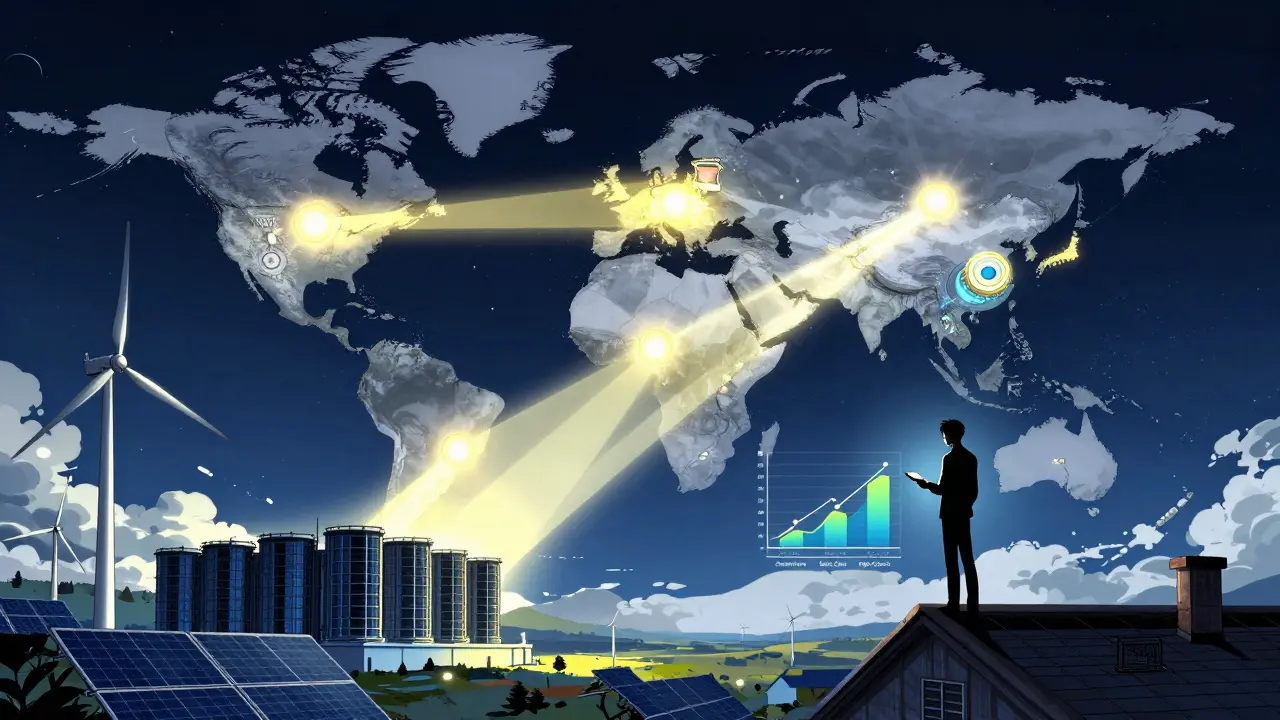
This geographic disparity drives "hash rate migration." When regulations tighten or prices rise in one region, miners physically move their equipment to cheaper areas. We saw this after China’s 2021 ban, which caused a temporary dip in hash rate before operations relocated to North America and Central Asia. Future projections must account for this mobility. If a major hub faces political instability, the hash rate doesn’t disappear; it moves.
Sustainability is also changing the game. By Q3 2025, 56.1% of global mining used sustainable energy sources. Companies like HIVE Digital Technologies are converting data centers into high-performance computing facilities that support both AI and Bitcoin mining. This dual-use strategy helps stabilize revenue streams and reduces reliance on volatile crypto markets.
Regulatory Risks and Market Dynamics
No projection is complete without considering the rulebook. Governments worldwide are still figuring out how to regulate cryptocurrency mining. Some countries view it as a strategic asset for grid stability, while others see it as an environmental threat. A sudden ban in a top-10 mining country could drop the global hash rate by 10-15% overnight.
However, the network has shown remarkable resilience. After the Chinese ban, the hash rate recovered within 12 months. Today, the industry is more mature. Institutional players like BitMine Immersion Technologies hold billions in crypto assets and have the legal resources to navigate complex regulations. This institutionalization suggests that future shocks may be less severe than in the past.
Additionally, the convergence of Bitcoin mining with artificial intelligence infrastructure offers a hedge against regulatory risk. By providing compute services for AI training alongside block validation, mining companies can diversify their income. This trend, highlighted by HIVE’s expansion in Sweden, indicates that the future of mining is not just about hashing-it’s about integrated data center economics.
What This Means for Investors and Miners
If you are considering entering the mining space, the message is clear: efficiency is everything. You cannot compete with hobbyist setups anymore. Professional operations require access to cheap power, cutting-edge ASICs, and robust cooling systems. The margin for error is slim. A small increase in difficulty or a spike in energy costs can wipe out profits.
For investors, rising hash rate is a bullish signal for network security. It means it becomes exponentially more expensive to attack the blockchain. While high hash rates make individual mining rewards harder to earn, they strengthen the trustlessness of the system. This security premium supports long-term value retention for Bitcoin holders.
Keep an eye on the next halving event in 2028. Halvings cut block rewards in half, forcing miners to either improve efficiency or exit the market. Historically, this leads to short-term hash rate dips followed by strong recoveries as prices adjust. Models that ignore this cyclical nature tend to fail.
What is the predicted Bitcoin hash rate for 2030?
Predictions vary widely. Conservative estimates suggest 2,543 EH/s, base cases point to 4,128 EH/s, and aggressive models project up to 6,891 EH/s by 2030. These figures depend on hardware efficiency gains, Bitcoin price appreciation, and regulatory environments.
How does the Bitcoin halving affect hash rate projections?
Halvings reduce block rewards by 50%, making mining less profitable. This typically causes less efficient miners to shut down, leading to a temporary drop in hash rate. Over time, as Bitcoin prices adjust and new efficient hardware enters the market, the hash rate usually recovers and grows.
Is it still profitable to mine Bitcoin in 2026?
Profitability depends entirely on your electricity cost and hardware efficiency. With network difficulty rising, only miners with access to sub-$0.05/kWh power and modern ASICs like the Antminer S21 Pro can remain consistently profitable. Hobbyist mining is generally no longer viable.
What role does renewable energy play in future hash rate growth?
Renewable energy is critical for long-term sustainability. Over 56% of global mining now uses sustainable sources. Access to stranded renewable energy (like excess hydro or solar) allows miners to operate at lower costs and avoid regulatory backlash, supporting stable hash rate growth.
Will quantum computing threaten Bitcoin's hash rate?
Not in the near term. Current estimates suggest Bitcoin's SHA-256 algorithm remains resistant to quantum attacks until at least 2040. Therefore, quantum computing is not a factor in hash rate projections through 2030.
21 Responses
the existential dread of watching machines think faster than humans is palpable here. we are building a digital cathedral on a foundation of silicon and sweat, yet the soul of it remains elusive to me. why do we chase these numbers? is it security or just vanity?
I mean, look at the table. The S9 is basically e-waste now. It’s kind of wild how fast this tech moves. My uncle tried mining with his gaming PC in 2017 and he just lost money on electricity for two years before giving up.
hey everyone! i think its really cool that the network is getting stronger. does anyone know if there are any good tutorials for setting up cooling systems for home rigs? i want to try but im worried about my electric bill spiking too high lol
you guys are all missing the point. the 'base case' is a lie fed by institutional investors who want you to buy their overpriced ASICs. look at the energy costs. $0.045/kWh is only available if you have political connections or live in a war zone. the rest of us are being squeezed out by monopolies like BitMine. stop dreaming about $1.16m BTC and face reality
Haha, nice analysis Kenneth! But seriously, if you can't afford the power, maybe don't mine? It's not a conspiracy, it's basic economics. Also, India has some great solar potential for this, we should be leading the charge instead of complaining :)
solar? please. the intermittency makes it useless for consistent hash rate contribution unless you have battery storage that costs more than the miners themselves. you are ignoring the grid stability issues. typical naive optimism
i feel like the article ignores the human cost. all those people in kazakhstan dealing with blackouts while rich americans mine bitcoin. it feels wrong. the network grows but our empathy shrinks. what is the point of secure transactions if the world burns?
While I understand the concern regarding energy distribution, it is important to note that many mining operations are actually stabilizing local grids by acting as flexible load consumers, which allows renewable sources to be integrated more effectively without causing frequency fluctuations that could otherwise lead to broader infrastructure failures in regions that are already struggling with outdated electrical infrastructure.
grid stabilization is just a buzzword used to justify industrial pollution. the government wants you to believe that burning fossil fuels for digital coins is 'green'. they are lying to you. the hash rate will crash when the regulations hit because they know the system is unsustainable. prepare for the collapse. the elites are moving their assets off-chain into gold and real estate while you hold bags of volatile code.
Filbert, your paranoia is showing again. The data shows resilience, not collapse. Institutional adoption is a fact, not a theory. If you want to participate in the future of finance, educate yourself on the actual economic models rather than spreading fear based on outdated narratives from 2018.
Let's talk about the J/TH metrics. The Antminer S21 Pro at 17.5 J/TH is a beast compared to the M20S. For anyone looking at ROI, you need to calculate the breakeven point based on current difficulty adjustments. If you are running legacy hardware, you are literally throwing money into the void. Upgrade or die.
The efficiency gap is indeed significant. One must consider that the transition from GPU to ASIC mining was inevitable due to the specialized nature of SHA-256 hashing. The current landscape demands capital-intensive infrastructure which naturally leads to centralization concerns however the network has historically proven resilient to such structural shifts.
Amit is right about the hardware. In India, we are seeing a lot of interest in small-scale mining farms using waste heat recovery. It's a collaborative approach where miners provide heat for nearby greenhouses. Win-win situation.
I am curious about the regulatory aspect mentioned in the post. How exactly do companies navigate the legal complexities when moving equipment between countries? It seems like a logistical nightmare to physically relocate thousands of ASICs overnight.
it's simple jessica. they bribe the officials or they move to countries that hate america anyway. china banned it so they went to russia and iran. now they are coming back to texas because trump loves crypto. it's all politics. american miners should stick to american soil and pay american taxes :)
this whole thread is exhausting. everyone pretending to understand complex macroeconomics when they probably cant even balance their checkbook. the projections are just guesses. nobody knows what happens in 2030. stop wasting time.
Andrea, negativity doesn't help anyone. We are here to discuss the technology and its implications. Whether you choose to engage or not is your choice, but dismissing the entire community's effort to understand these trends is counterproductive.
Sarcasm aside, the dual-use strategy for AI and Bitcoin mining is fascinating. Imagine a data center that trains LLMs during the day and mines blocks at night. That's the kind of innovation that keeps the lights on. Who's ready for the AI-mining hybrid era?
India must develop its own sovereign blockchain infrastructure. Relying on foreign mining hubs is a strategic vulnerability. Our engineers are capable of designing efficient chips locally. We should not be dependent on Chinese ASIC manufacturers for our national digital security.
It is imperative to recognize that the centralization of hash rate among a few large entities poses a significant threat to the decentralized ethos of the network. One must question whether the security provided by these industrial complexes is genuine or merely an illusion maintained by regulatory capture and coordinated market manipulation.
The philosophical implication of a machine performing one sextillion calculations per second is profound. It suggests a form of digital consciousness emerging from pure logic. Yet, we treat it as a mere tool for speculation. Perhaps we are underestimating the entity we have created.