
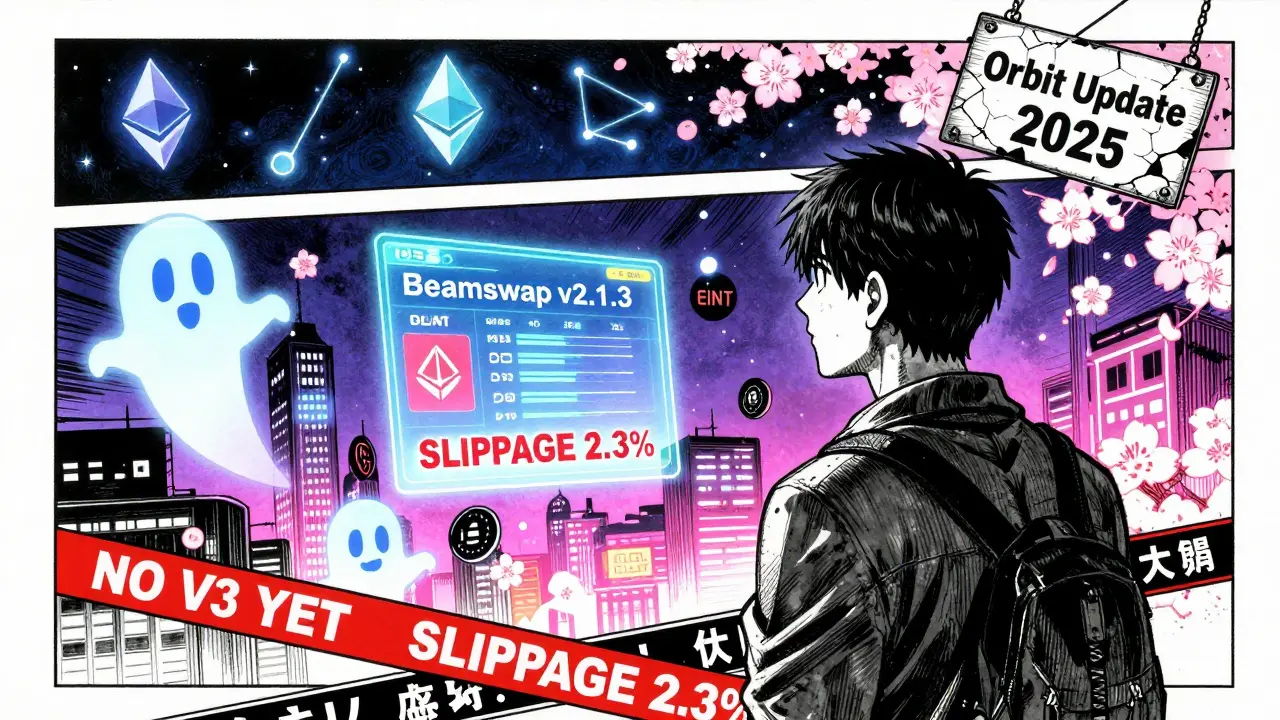
There’s a lot of noise around Beamswap. Some call it the best-kept secret on Moonbeam. Others say it’s stuck in 2021. If you’re looking at Beamswap v3, you’re already confused - because Beamswap doesn’t have a v3. Not yet. Not even close. This isn’t marketing spin. It’s a fact buried in their docs and GitHub commits. The platform is still running on what’s essentially a heavily modified Uniswap V2 setup. If you’re expecting concentrated liquidity, TWAP oracles, or advanced order types like v3 offers, you’ll be disappointed. But if you’re a Moonbeam user looking for a fast, cheap way to swap tokens without bridges, Beamswap might still be your best bet.
What Beamswap Actually Is (Not What You Think)
Beamswap isn’t a centralized exchange like Binance or Coinbase. It’s a decentralized exchange (DEX) built directly on the Moonbeam network - a Polkadot parachain that speaks Ethereum’s language. That means if you’ve used MetaMask on Ethereum, you can plug it into Beamswap with zero extra steps. No new wallet. No complicated setup. Just connect, approve, and swap.
Its native token, GLINT, isn’t just a coin. It’s the glue holding the system together. Use GLINT to pay for trades? You get a 0.05% discount on fees. Stake it? You earn a slice of the 10% fee pool that goes to the treasury. Vote on upgrades? You need GLINT. It’s not a flashy token, but it’s functional. As of March 2025, GLINT’s price hovers around $0.00006, with a market cap under $12 million. It’s not going to make you rich, but it’s not dead either.
The Real Performance Numbers
Let’s cut through the hype. Beamswap processes between $1.2 million and $3.8 million in trades every day. That’s not nothing - but it’s also not Uniswap. For comparison, Uniswap V3 on Ethereum does over $3 billion daily. PancakeSwap on BSC? Over $18 million. Beamswap sits at #87 among DEXs globally. It’s not a top player. But here’s the twist: on Moonbeam, it owns 58.7% of all DEX trading volume. That’s dominance in a niche. If you’re trading GLMR, WETH, or USDC on Moonbeam, you’re likely using Beamswap.
Transaction speed? Around 12 seconds. Gas fees? Between $0.0008 and $0.002 per swap. That’s 92% cheaper than Ethereum-based DEXs. For users tired of paying $5 just to swap $200 worth of tokens, this is a game-changer. The platform handles 47-63 transactions per second at peak. It’s not blazing, but it’s smooth under normal load. During high volatility, like Bitcoin’s 18% plunge on March 14, 2025, over 12% of trades above $5,000 failed. That’s a red flag. If you’re moving big money, Beamswap isn’t yet reliable.
Why It Feels Like Uniswap V2 (And Why That Matters)
Beamswap uses the classic x*y=k constant product formula. That’s the same math Uniswap used before v3. No concentrated liquidity. No price ranges. No limit orders. Every token pair has one pool, and liquidity is spread thin across the entire price curve. The result? High slippage on large trades.
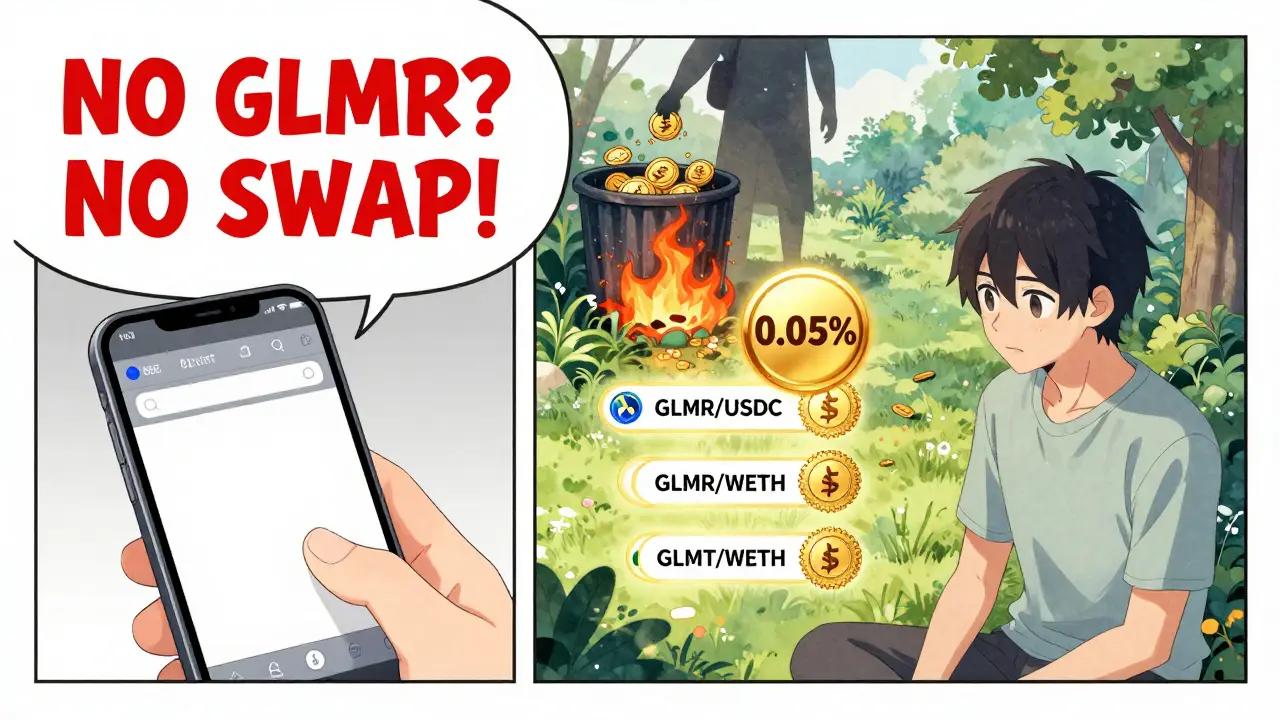
Try swapping $10,000 worth of GLMR for WETH? You’ll likely see 2.3% slippage. On Uniswap V3? Around 0.8%. That’s a massive difference. Beamswap’s liquidity pools are deep for stablecoins - GLMR/USDC and GLMR/WETH make up over half of all liquidity. But for anything else? Thin. You’ll often see 10-15% slippage on small-cap tokens. And with over 1,200 token pairs listed, many are dead. 237 scam tokens were listed and removed between Q3 2023 and Q2 2024. No vetting. No gatekeeping. Just permissionless chaos.
What You Can and Can’t Do
You can:
- Swap tokens with MetaMask, Ledger, Trezor, or Polkadot.js
- Add liquidity to pools and earn 90% of the 0.3% swap fee
- Use GLINT to reduce fees and participate in governance
- Swap directly between Polkadot, Ethereum, and Moonbeam assets without bridges
You can’t:
- Set price ranges for your liquidity (no concentrated liquidity)
- Place limit orders
- Use real-time price feeds - Beamswap relies on 15-minute TWAPs
- Trade with advanced tools like stop-loss or trailing orders
- Use a mobile app - it’s a responsive website only
The cross-chain feature is Beamswap’s hidden gem. If you hold DOT and want GLMR, you don’t need to bridge through a third party. Beamswap handles it in one click. That’s rare on DEXs. But it’s only useful if you’re already in the Moonbeam ecosystem. If you’re coming from Ethereum or Solana, you’ll need to bridge first - and that adds time and risk.
The User Experience: Smooth, But Fragile
First-time users spend 17-22 minutes on their first swap. Why so long? Because setup isn’t automatic. You need to manually add the Moonbeam network (chain ID 1284) to your wallet. Many beginners skip this and get stuck with “wrong network” errors. Then there’s gas. You need GLMR to pay fees - not ETH, not USDC. If you have $100 in USDC but zero GLMR, you can’t swap. It’s a trap.
Interface-wise, it’s clean. No clutter. No ads. Just a simple swap screen, pool tab, and stats. But the documentation? 87 pages long. It’s thorough, but overwhelming. Uniswap’s docs score 91/100. Beamswap’s? 82/100. You’ll find answers, but not quickly.
Support is worse. Telegram response time averages 11.3 hours. Discord is quiet. Reddit is your best bet - the r/Moonbeam community has 12,400 members, and many have solved issues there. If you’re stuck, don’t wait for customer service. Search Reddit or ask in the Beamswap Telegram group.
Security and Audits - A Mixed Bag
Beamswap’s smart contracts were audited by CertiK, OpenZeppelin, and Quantstamp. All critical bugs were fixed. That’s good. But audits don’t protect you from bad tokens. The platform doesn’t screen new listings. A scammer can deploy a token, add it to Beamswap, and vanish. You’re on your own. That’s why 237 scam tokens were removed. The platform doesn’t stop them - it just cleans up after.
Another issue: MEV (miner extractable value). Beamswap used to be vulnerable to sandwich attacks. Now, with Flashbots’ SUAVE integration, those attacks dropped 74%. That’s a win. But it’s still not immune. If you’re swapping large amounts, assume someone will front-run you.

Who Should Use Beamswap? Who Should Avoid It?
Use Beamswap if:
- You’re active on Moonbeam or Polkadot
- You want cheap, fast swaps without bridges
- You’re comfortable with DIY DeFi and can handle slippage
- You’re staking GLINT and want fee discounts
Avoid Beamswap if:
- You’re trading large amounts of volatile assets
- You need limit orders or advanced trading tools
- You expect 24/7 customer support
- You’re new to crypto and want hand-holding
Beamswap is not for beginners. It’s not for big traders. It’s for Moonbeam natives who want a no-frills, low-cost way to move assets within their ecosystem. If that’s you, it’s solid. If not, look elsewhere.
What’s Coming? The Roadmap That Might Save It
Beamswap’s team announced the “Orbit Update” on March 18, 2025. If they deliver, it could change everything:
- Hybrid AMM-CLOB (Q3 2025): Combines automated market making with a traditional order book. This could fix slippage and enable limit orders.
- Native Limit Orders (Q4 2025): Finally, you’ll be able to set price targets and wait.
- Polkadot Asset Hub Integration: Direct swaps between parachains without Moonbeam as a middleman.
If these features ship on time, Beamswap could leapfrog competitors like StellaSwap. If they don’t? It’ll keep drifting. The team has been slow to innovate. Only 3 major upgrades since 2022. Uniswap had 11. That’s the real risk - stagnation.
Final Verdict
Beamswap isn’t v3. It’s v2.1.3 - a reliable, cheap, and fast DEX for Moonbeam users. It’s not the most advanced. It’s not the safest. But if you’re already in the ecosystem, it’s the best tool for daily swaps. The lack of concentrated liquidity is a dealbreaker for serious traders. The poor support and scam token problem are serious flaws. But for the average Moonbeam user? It works. And in DeFi, sometimes “works” is better than “perfect.”
Don’t expect miracles. Don’t invest based on hype. Just use it for what it is: a fast, low-fee swap engine for Moonbeam’s native assets. And if v3 ever arrives? Then revisit.
Is Beamswap v3 real?
No, Beamswap v3 does not exist. The platform is currently on version 2.1.3, which is based on Uniswap V2 architecture. Any mention of "Beamswap v3" is either misinformation or speculation about future updates. The team has announced plans for a hybrid AMM-CLOB upgrade ("Orbit Update") in late 2025, but this is not v3.
Can I use MetaMask with Beamswap?
Yes. Beamswap is fully compatible with MetaMask, as it runs on the Moonbeam network, which is EVM-compatible. You just need to manually add the Moonbeam network (chain ID 1284) to your MetaMask wallet before connecting. Once added, you can connect and swap tokens just like on Ethereum.
What are the fees on Beamswap?
Beamswap charges a standard 0.3% swap fee. 90% of that goes to liquidity providers, and 10% goes to the treasury. If you stake GLINT, you get a 0.05% discount on this fee. Gas fees are paid in GLMR and average $0.0008-$0.002 per transaction - far cheaper than Ethereum-based DEXs.
Is Beamswap safe?
The smart contracts have been audited by CertiK, OpenZeppelin, and Quantstamp, and critical vulnerabilities were patched. However, Beamswap does not vet new tokens - anyone can list a token. Over 237 scam tokens have been removed since 2023. You’re responsible for checking token legitimacy. Also, slippage can be high on large trades, and there’s no customer support for failed transactions.
Why is my swap failing?
Common causes: 1) You don’t have enough GLMR to pay gas fees - you need at least 0.005 GLMR. 2) Slippage tolerance is too low - raise it to 0.8-1.2%. 3) You’re trading during high volatility - trades over $5,000 often fail when markets are wild. 4) You’re using the wrong network in your wallet - make sure you’re on Moonbeam, not Ethereum or BSC.
Does Beamswap have a mobile app?
No. Beamswap only offers a responsive web interface. It works on mobile browsers but has no dedicated iOS or Android app. Load times on 4G are around 2.1 seconds, which is decent, but you’ll need to rely on your wallet’s mobile app (like MetaMask) to connect.
Can I stake GLINT on Beamswap?
Yes. GLINT can be staked directly on the platform to earn a share of the 10% treasury fee. Staking also gives you a 0.05% discount on swap fees. There’s no lock-up period, and you can unstake anytime. However, staking GLINT won’t earn you yield from liquidity pools - that’s separate and requires adding liquidity to a pool.
Is Beamswap available in the US?
No. Beamswap’s Terms of Service block users from 28 jurisdictions, including the United States, China, and India. This is due to regulatory uncertainty around DeFi and token classification. Attempting to access the platform from these regions may result in account restrictions or loss of funds.
How does Beamswap compare to Uniswap?
Beamswap is much cheaper and faster than Uniswap on Ethereum - gas fees are 92% lower and settlement is 4.3x faster. But Uniswap V3 offers concentrated liquidity, limit orders, and better capital efficiency. Beamswap has no equivalent features. If you’re on Ethereum, Uniswap is better. If you’re on Moonbeam, Beamswap is your only viable option.
What’s the future of Beamswap?
Beamswap’s future depends on its "Orbit Update" - a hybrid AMM-CLOB upgrade planned for late 2025. If delivered, it could bring limit orders, reduced slippage, and better capital efficiency. If delayed or canceled, Beamswap risks becoming obsolete as competitors like StellaSwap adopt modern DEX features. The platform’s current lack of innovation is its biggest weakness.
12 Responses
Let me just say this: anyone who calls Beamswap 'v3' is either lying or has never read the GitHub commits. The platform is still running on Uniswap V2 code with a fresh coat of paint. And yet, people are acting like this is the future of DeFi? Please. I’ve seen more innovation in a single weekend of Ethereum Layer-2 experiments than Beamswap has delivered in three years. This isn’t progress-it’s a time capsule from 2021, labeled 'innovative' by people who don’t know what concentrated liquidity means. The fact that they’re still using 15-minute TWAPs? That’s not a feature. That’s a bug. And the 237 scam tokens? That’s not 'permissionless innovation.' That’s negligence dressed up as decentralization.
Beamswap v3? More like Beamswap... v2.1.3. Still waiting for the 'Orbit Update' like it’s the second coming. Meanwhile, I’m over here trying to swap $50 of GLMR and my transaction fails because I forgot to add the chain ID. Again. Because of course I did. The UI is clean. The docs are 87 pages. The support? Telegram replies in 11 hours. I’m not mad. I’m just... disappointed. Like when you buy a 'luxury' phone and it has a 2017 processor. Same energy.
Okay but honestly? I love Beamswap. 🥹 I know it’s not perfect. I know the slippage is wild on small caps. I know I need GLMR to pay gas and not USDC. But for Moonbeam natives? It’s the only game in town. And the cross-chain swaps? Pure magic. No bridges. No waiting. Just click and go. I’ve swapped DOT to GLMR in 20 seconds. That’s not hype-that’s real utility. The team’s slow? Maybe. But they’re still here. And they’re listening. The Orbit Update could be huge. Let’s not throw the baby out with the bathwater. 💪✨
so like… beamswap v3? lol. its not even v3. its v2.1.3. and the devs are still using the same old x*y=k formula? like… why? why not just upgrade? also i tried to swap 10k glmr and lost 2.3% to slippage. that’s like paying $230 to move $10k. i could’ve just used a bridge and paid $10. wtf. and why is there 1200 tokens? half of them are scams. i lost $800 on one. no one cares. no one moderates. just… why?
People keep saying 'it works for Moonbeam natives' like that’s an excuse. It’s not. It’s a cop-out. If you’re building a DEX and you don’t have limit orders, concentrated liquidity, or real-time oracles by 2025, you’re not innovating-you’re lagging. And the fact that you need to manually add the network? That’s not 'user empowerment.' That’s poor UX. And then you wonder why adoption is stuck? Because you’re treating users like devs. Stop pretending this is a product. It’s a beta. A very, very old beta.
Can we just talk about how terrifying it is that Beamswap allows ANYONE to list a token? ANYONE. No vetting. No KYC. No red flags. I had a friend who got rug-pulled on a token called 'MoonBeamAI'-it had a whitepaper written by ChatGPT, a logo from Canva, and a Telegram group with 14 members. They lost $14,000. And the platform? Did nothing. Just sat there. Like a passive-aggressive landlord who says 'I’m sorry you’re having issues' while the ceiling collapses. And now they’re talking about 'Orbit Update'? Ha. Like they’re going to fix the foundation after the whole house has burned down. I’m not angry. I’m just… numb. This is what happens when you confuse 'permissionless' with 'lawless.'
The operational efficiency of Beamswap, while marginally acceptable within the Moonbeam ecosystem, is fundamentally undermined by its lack of technological sophistication. The absence of concentrated liquidity mechanisms renders it obsolete in the context of contemporary DeFi standards. Furthermore, the governance structure, predicated upon GLINT staking, lacks scalability and transparency. One must question the sustainability of a platform that relies on 0.05% fee discounts as a primary incentive. The user experience, though visually minimal, is functionally inadequate. The absence of a mobile application is not merely an inconvenience-it is a strategic failure.
Beamswap doesn’t have v3. It never will. The team is too slow. Too lazy. Too afraid to innovate. They’re just riding the Moonbeam wave until someone else builds something better. And guess what? StellaSwap is already there. They’ve got limit orders. They’ve got better liquidity. They’ve got actual updates. Beamswap? Still stuck on Uniswap V2. And they call themselves a DEX? Please. This isn’t DeFi. It’s DeFi fanfiction.
US users are blocked? Of course. Because Beamswap knows the SEC is coming. They’re not trying to help you. They’re trying to stay off the radar. This isn’t innovation. It’s evasion. And now they’re pretending 'Orbit Update' is gonna save them? Nah. The team’s been silent since 2023. No roadmap. No updates. No transparency. Just vibes. And vibes don’t pay gas fees.
I’ve used Beamswap for over a year now. I’ve had trades fail. I’ve lost a few bucks to scams. I’ve cursed at the 'add network' step. But I keep coming back. Why? Because when you’re deep in the Moonbeam ecosystem, there’s literally nothing else that works as smoothly. The fees are dirt cheap. The speed is fine for daily swaps. And the cross-chain feature? Still the only one that doesn’t make you jump through ten hoops. Yeah, it’s flawed. But it’s *my* flawed. And I’ve seen better DEXs die. Maybe Beamswap just needs time. Or maybe it’s time to move on. I’m still deciding.
Look-I get it. Beamswap isn’t perfect. But let’s not pretend it’s dead. It’s just… evolving slowly. And honestly? That’s okay. Not every project needs to be Uniswap. You don’t need limit orders to swap GLMR for USDC on a daily basis. You need cheap, fast, reliable. Beamswap delivers that. The scam tokens? Yeah, that’s bad. But the team removes them. That’s more than most chains do. And the Orbit Update? If they ship even half of it? They’ll be the quiet hero of Moonbeam. Don’t write it off. Give them space to grow. The crypto world doesn’t need more hype. It needs more builders who actually ship. Even if they’re slow.
Beamswap is functional for Moonbeam users. It is not a revolutionary product. It is not a superior one. It is simply adequate. The absence of advanced features is not a flaw-it is a design choice. One must consider the ecosystem context. For users who require only basic swaps within Moonbeam, Beamswap serves its purpose. The governance model with GLINT is logical. The fee structure is transparent. The lack of mobile app is regrettable but not critical. The platform does not claim to be a comprehensive trading suite. It is a utility. And as a utility, it performs adequately.